Drug Pricing Analytics Market Size, Share & Industry Analysis, By Product (Software Platforms, Data & Intelligence Databases, Analytics Modules, APIs & Data Feeds, and Services), By Application (Launch Pricing, Access & Reimbursement, Gross-to-Net Analytics, Payer Contracting, Compliance Analytics, and Others), By Deployment, By Type (Descriptive Analytics, Diagnostic Analytics, Predictive Analytics, Prescriptive Analytics, and AI-enabled Analytics), By End User (Pharmaceutical Companies, Biotechnology Companies, Payers & PBMs, and Others), and Regional Forecast, 2026-2034
 Download Free Sample
Drug Pricing Analytics Market Size and Future Outlook
 Listen to Audio Version
The global drug pricing analytics market size was valued at USD 1.12 billion in 2025. The market is projected to grow from USD 1.26 billion in 2026 to USD 3.19 billion by 2034, exhibiting a CAGR of 12.30% during the forecast period. North America dominated the drug pricing analytics market with a market share of 42.86% in 2025.
The market comprises pricing intelligence platforms, market access databases, reimbursement analytics tools, payer insight solutions, and AI-enabled pricing strategy software. The demand for these solutions is increasing as pharmaceutical companies face stricter pricing scrutiny, country-level reimbursement differences, growing payer control, and rising pressure to justify drug value through clinical and economic evidence. As drug launches become more expensive and access decisions become more data-driven, companies are using pricing analytics to evaluate reference pricing, tender outcomes, rebate exposure, launch sequencing, and competitor price movements. These developments have made pharmaceutical and biotechnology companies improve pricing decisions, reduce commercial risk, and support better reimbursement outcomes across the product lifecycle.
- For instance, in January 2025, Lyfegen collaborated with EVERSANA to combine Lyfegen’s drug market access, pricing, and rebate management capabilities with EVERSANA’s commercialization and market access expertise. The partnership focused on using AI-driven insights to improve drug pricing and access decisions.
Furthermore, major players, such as IQVIA Inc., EVERSANA, Clarivate Plc., and GlobalData Plc., are actively participating in strategic collaborations and acquisitions to expand their offerings, facilitate interchangeability, enhance market access, and strengthen their market presence.
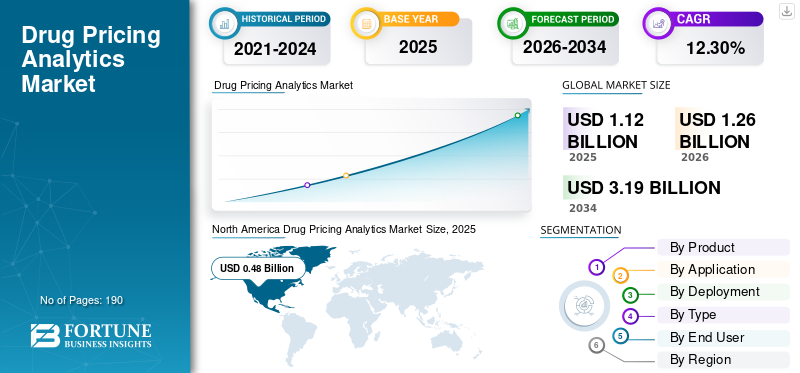
Download Free sample to learn more about this report.
Drug Pricing Analytics Market Key Takeaways
 Global Market Size & Forecast
- 2025 Market Size: USD 1.12 billion
- 2026 Market Size: USD 1.26 billion
- 2034 Forecast Market Size: USD 3.19 billion
- CAGR: 12.30% from 2026–2034
 Market Share
- North America dominated the drug pricing analytics market with a market share of 42.86% in 2025.
- The prescriptive analytics segment is projected to grow at a CAGR of 15.14% during the forecast period.
- The biotechnology companies segment is projected to grow at a CAGR of 14.02% over the estimated period.
 Key Regional Highlights
North America
The region reached USD 0.48 billion in 2025 after recording USD 0.43 billion in 2024, driven by high prescription drug spending, increasing pricing transparency initiatives, and broader adoption of pricing analytics solutions.
Europe
The market is projected to reach USD 0.34 billion in 2026, supported by strong reimbursement frameworks, health technology assessments, and widespread reference pricing practices across countries.
Asia Pacific
The region is estimated to attain USD 0.26 billion in 2026, fueled by expanding healthcare digitization, growing pharmaceutical investments, and rising adoption of pricing analytics for market access and reimbursement planning.
U.S.
The U.S. market is estimated at around USD 0.49 billion in 2026, accounting for roughly 38.99% of the global market.
Japan
In 2026, the Japanese market is estimated at USD 0.06 billion, accounting for approximately 4.83% of the global market.
Read More

DRUG PRICING ANALYTICS MARKET TRENDS
Growing Shift toward AI-Enabled Drug Pricing Intelligence is a Prominent Market Trend
A prominent trend observed in the market is the shift toward AI-enabled pricing intelligence. As pharmaceutical companies face increasing pressure to manage launch prices, payer negotiations, country-level reimbursement differences, and global reference pricing rules, there is a driving demand for these solutions. As a result, companies are integrating AI into pricing and market access platforms to identify patient pricing patterns, forecast payer responses, compare reimbursement outcomes, and reduce delays in decision making process. The trend is expected to strengthen market growth as pharma and biotech companies increasingly depend on advanced analytics to improve price governance, optimize revenue, and support patient access.
- For instance, in May 2026, QuantHealth launched its predictive competitive intelligence solution, an unprecedented capability designed to help life sciences organizations optimize for clinical trial
MARKET DYNAMICS
MARKET DRIVERS
Download Free sample to learn more about this report.
Rising Pressure on Pharmaceutical Companies to Improve Pricing Transparency Drives Market Growth
The global drug pricing analytics market is growing as pharmaceutical companies face increasing pressure to explain, compare, and justify drug prices across different countries, payer groups, and healthcare systems. As governments, insurers, and healthcare providers continue to question high drug costs, pharma companies need stronger analytics tools to track list prices, net prices, rebates, discounts, and the impact of reference pricing. This is driving greater demand for pricing intelligence platforms that convert complex pricing data into clear insights for market access, compliance, and negotiation teams. These factors are supporting more evidence-based pricing decisions across the product lifecycle.
- For instance, in October 2025, IntegriChain launched its AI-powered State Price Transparency Reporting (SPTR) system to help life sciences companies manage evolving state-level price transparency reporting requirements. The system supports compliance with expanding pricing transparency mandates, showing how regulatory pressure is directly increasing global drug pricing analytics market demand.
MARKET RESTRAINTS
High Cost of Advanced Analytics Platforms Limits Adoption among Smaller Pharma Companies
A key factor limiting the global drug pricing analytics market growth is the high cost associated with these platforms. Pharmaceutical companies need stronger tools to manage price transparency, payer negotiations, reimbursement planning, and global launch pricing with expanding demand. However, the high cost of advanced analytics platforms limits adoption by small and mid-sized pharma companies, biotech firms, and regional market access teams. As a result, companies with limited budgets may delay adoption or continue using manual pricing models, which reduces the overall penetration of advanced drug pricing analytics solutions.
- For instance, in October 2024, S&P Global Ratings reported that large pharmaceutical companies’ significant investments in AI could create long term competitive advantages over smaller rivals. This highlights that the cost and investment intensity of AI-enabled analytics can act as a barrier for smaller pharma companies, limiting their ability to adopt advanced pricing and commercial intelligence platforms at the same pace as larger players.
MARKET OPPORTUNITIES
Expansion of AI-Driven Market Access Platforms Creates New Growth Opportunities
The global drug pricing analytics market is creating significant growth opportunities as pharmaceutical companies move from basic price tracking to advanced market-access decision-making. Pricing teams now need faster ways to compare country-level drug prices, assess payer expectations, evaluate HTA outcomes, and understand how access decisions can affect launch success. This is increasing demand for AI-enabled pricing platforms that combine pricing data, reimbursement intelligence, payer evidence, and competitive benchmarks in a single system. As a result, vendors that offer predictive analytics, automated price modeling, and real-time access insights are expected to gain stronger adoption, especially among pharma and biotech companies planning global product launches.
- For instance, in September 2025, Access Infinity launched an AI-powered price and health technology assessment feature for its Nuro market access insights platform. The feature was designed to reduce drug pricing and HTA outcome analysis to minutes, generating actionable insights for users and showing how AI-based pricing and market access tools are opening new opportunities.
MARKET CHALLENGES
Lack of Standardized and Transparent Global Drug Pricing Data Creates Accuracy Challenges
The lack of standardized, transparent global drug pricing data remains a major challenge for the market. Drug prices often differ between list prices and actual net prices because of confidential rebates, managed entry agreements, tender discounts, and country-specific reimbursement rules. This makes it difficult for analytics platforms to provide fully comparable pricing insights across markets. As a result, users may face uncertainty when forecasting launch prices, assessing the impact of reference pricing, or comparing real product value across regions, which can slow the wider adoption of advanced pricing analytics solutions.
- For instance, in May 2024, PharmacoEconomics published an article titled ‘Market Transparency in Medicine Pricing: Pathways to Fair Pricing’, which highlighted that medicine price transparency is still limited because public prices often do not reflect actual transaction prices, and confidential discounts can reduce the comparability of pricing information across countries.
Segmentation Analysis
By Product
Integrated Software Platforms Dominate Due to End-to-End Pricing and Market Access Decision Support
Based on product, the market is categorized into software platforms, data & intelligence databases, analytics modules, APIs & data feeds, and services.
Software platforms dominated as pharmaceutical companies increasingly demand a single integrated system to manage pricing intelligence, market access data, reimbursement tracking, competitor benchmarking, and launch pricing decisions. Key operating companies are increasingly preferring platforms that bring multiple datasets and workflows into one environment. This helps pricing and market access teams compare country-level prices, evaluate HTA outcomes, track access agreements, and support faster commercial decisions, driving the segment’s dominance. Key companies are increasingly engaging in strategic collaborations, underscoring the segment's growth potential as they expand their offerings.
- For instance, in March 2022, EVERSANA launched NAVLIN by EVERSANA, a global price and market access software platform that combines data, software, and insights into one integrated ecosystem. The platform includes price and access data, research insights, reference pricing, launch sequencing, predictive pricing models, tender discovery, competitive intelligence, and gross-to-net analytics.
The APIs & data feeds segment is expected to grow at a CAGR of 14.91% over the forecast period.
To know how our report can help streamline your business, Speak to Analyst
By Application
Access & Reimbursement Leads as Payer Acceptance Becomes Central to Drug Commercial Success
Based on application, the market is segmented into launch pricing, access & reimbursement, gross-to-net analytics, payer contracting, compliance analytics, and others.
In 2025, access and reimbursement accounted for the largest drug pricing analytics market share. Drug pricing decisions are closely linked with payer acceptance, HTA outcomes, formulary access, and reimbursement approval. Pharmaceutical companies cannot depend only on list-price analysis because a product’s success depends on whether payers accept its clinical and economic value. This is increasing demand for analytics tools that support price prediction, HTA assessment, payer evidence planning, and reimbursement pathway analysis. Highlighting its importance, many key market players are actively participating in strategic collaborations to unlock the growth potential.
- For instance, in April 2025, Policy Reporter partnered with Mercalis and AccessSync to integrate payer policy intelligence with access realization solutions. The collaboration aims at helping life sciences manufacturers manage market access complexity and improve the ability of innovative products to reach more patients.
The payer contracting segment is projected to grow at a CAGR of 13.60% during the forecast period.
By Deployment
Cloud-Based/SaaS Deployment Dominates Due to Scalability, Real-Time Updates, and Lower IT Burden
Based on deployment, the market is segmented into cloud-based/SaaS, on-premise, and hybrid.
The cloud-based/SaaS accounted for the largest share of the market. Pricing teams of pharmaceutical and biotechnology companies need faster access to updated pricing data, payer insights, reimbursement changes, and market access intelligence across multiple regions. Cloud-based platforms are easier to scale, quicker to update, and better suited to global teams than traditional on-premises systems. They also reduce the need for heavy internal IT infrastructure and allow users to access analytics through subscription-based models. New product launches and increasing preference for cloud deployment further drive segmental growth.
- For instance, in November 2023, Pharmspective launched AccessAI, a web-enabled, subscription-based market access AI portal for biopharmaceutical The platform uses curated references and AI technology to provide on-demand research into reimbursement, payer, access, coverage, and policy questions.
The hybrid segment is projected to grow at a CAGR of 9.88% during the forecast period.
By Type
Descriptive Analytics Leads as Historical Pricing Data Remains the Foundation for Market Access Decisions
Based on type, the market is segmented into descriptive analytics, diagnostic analytics, predictive analytics, prescriptive analytics, and AI-enabled analytics.
Descriptive analytics dominates as most pricing and market access teams need a clear overview of the market before moving into predictive or prescriptive models. Companies use descriptive analytics to track historical drug prices, reimbursement decisions, formulary changes, payer coverage, access restrictions, and competitor pricing movements. This type of analysis is widely adopted because it supports basic pricing dashboards, country comparisons, trend monitoring, and internal reporting. As a result, descriptive analytics remains the foundation of drug pricing analytics, as advanced AI and predictive tools depend on accurate, structured historical pricing data.
- For instance, in June 2025, CustomerInsights.AI launched ciATHENA, an agentic AI platform for life sciences commercial analytics. The platform helps pharma teams ask questions about trend breaks, market access favorability, formulary access scoring, and commercial performance, showing how structured analytics is being used to convert complex market data into timely insights.
The prescriptive analytics segment is projected to grow at a CAGR of 15.14% during the forecast period.
By End User
Pharmaceutical Companies are Leading End Users Due to Strong Need for Launch Pricing, Reimbursement, and Lifecycle Price Management
Based on end user, the market is segmented into pharmaceutical companies, biotechnology companies, payers & PBMs, and others.
In 2025, pharmaceutical companies dominated the market as they are the primary users of pricing analytics across launch planning, access strategy, lifecycle management, payer negotiation, and revenue optimization. These companies face strong pressure to justify drug value, manage country-level price differences, comply with pricing rules, and protect product profitability. Since pricing decisions directly affect market access, reimbursement approval, and commercial success, pharma companies invest more heavily in pricing intelligence platforms than other end users. These factors encourage them to invest in innovative product launches and investment initiatives.
- For instance, in January 2026, Oracle launched its Oracle Life Sciences AI Data Platform, designed for pharmaceutical, medical device, research, and life sciences organizations. The platform unified customer data, third-party sources, and real-world data to generate insights for commercialization and other life sciences workflows, supporting the growing use of advanced analytics by pharma companies.
The biotechnology companies segment is projected to grow at a CAGR of 14.02% over the estimated period.
Drug Pricing Analytics Market Regional Outlook
By geography, the market is categorized into Europe, North America, Asia Pacific, Latin America, and the Middle East & Africa.
North America
North America Drug Pricing Analytics Market Size, 2025 (USD Billion)
To get more information on the regional analysis of this market, Download Free sample
North America held the dominant share in 2024 with USD 0.43 billion and also maintained its leading position in 2025 with a valuation of USD 0.48 billion. The region’s growth is attributed to high prescription drug spending, strong payer negotiations, and increasing pressure for drug price transparency. Pharmaceutical companies are actively using pricing analytics to better manage rebates, payer contracts, and launch pricing.
U.S. Drug Pricing Analytics Market
Given North America's substantial contribution and the U.S.’ dominance in the region, the U.S. market is estimated at around USD 0.49 billion in 2026, accounting for roughly 38.99% of the global market.
Europe
Europe is projected to depict a growth rate of 11.10% over the coming years, the second-highest among all regions, and reach USD 0.34 billion in 2026. The region is witnessing growth driven by strict reimbursement systems, robust HTA frameworks, and widespread use of reference pricing across countries. Pharmaceutical companies need analytics tools to compare country-level prices and manage access strategies under government-led pricing controls. This creates steady demand for pricing and market access intelligence platforms.
U.K Drug Pricing Analytics Market
The U.K. market is estimated at USD 0.06 billion in 2026, accounting for roughly 4.77% of the global market.
Germany Drug Pricing Analytics Market
Germany is projected to reach approximately USD 0.08 billion in 2026, equivalent to around 5.99% of the global market.
Asia Pacific
Asia Pacific is estimated to reach USD 0.26 billion in 2026 and secure third position in the market. Key companies in the region are using pricing analytics to support market entry, tender planning, reimbursement submissions, and country-specific launch strategies. Rapid healthcare digitization also supports the adoption of cloud-based pricing tools.
Japan Drug Pricing Analytics Market
In 2026, the Japanese market is estimated at 0.06 billion, accounting for approximately 4.83% of the global market.
China Drug Pricing Analytics Market
China's market is projected to be among the largest worldwide, with 2026 revenues estimated at around USD 0.07 billion, accounting for approximately 5.65% of global sales.
India Drug Pricing Analytics Market
India will account for USD 0.03 billion in 2026, accounting for roughly 2.53% of global revenue.
Latin America and the Middle East & Africa
The market of Latin America is estimated to reach USD 0.08 billion. Latin America is growing due to rising concerns about the affordability of medicine, expanding public healthcare coverage, and the growing need for structured pricing decisions. The growing demand for specialty drugs also underscores the need for better pricing intelligence. In the Middle East & Africa, the GCC is set to reach USD 0.03 billion in 2026.
South Africa Drug Pricing Analytics Market
South Africa is projected to reach approximately USD 0.01 billion in 2026, accounting for roughly 0.69% of global revenue.
COMPETITIVE LANDSCAPE
Key Industry Players
Strategic Collaboration among Key Companies to Propel Market Progress
The global drug pricing analytics market is moderately consolidated, with competition led by companies offering pricing intelligence platforms, market access databases, and reimbursement analytics tools. Major players such as IQVIA Inc., EVERSANA, Clarivate Plc, GlobalData Plc, Wolters Kluwer, Merative, First Databank, Inc., Model N, Inc., IntegriChain, and MMIT are strengthening their market position. Some of their strategies include broad pricing databases, AI-enabled analytics, payer intelligence, reimbursement tracking, and cloud-based decision-support platforms.
- For instance, in January 2025, Lyfegen collaborated with EVERSANA to announce the combination of NAVLIN, EVERSANA's product, with Lyfegen’s Public Drug Agreement Library. The partnership focuses on using AI-driven insights to improve drug pricing and Access decisions, helping pricing and market access teams address rising drug costs and complex reimbursement models.
Other notable participants include Access Infinity, Lyfegen HealthTech AG, Global Pricing Innovations, Trinity Life Sciences, Certara, Veeva Systems, and Oracle Life Sciences. The market remains strongly technology-driven, with larger vendors holding near-term advantages through broad data coverage and established pharma relationships. At the same time, specialized players compete by offering faster, more focused tools for pricing, access, reimbursement, and commercial strategy decisions.
LIST OF KEY DRUG PRICING ANALYTICS COMPANIES PROFILED:
- IQVIA Inc. (U.S.)
- EVERSANA (U.S.)
- Clarivate Plc (U.K.)
- GlobalData Plc (U.K.)
- Model N, Inc. (U.S.)
- Wolters Kluwer (Netherlands)
- Merative (U.S.)
- First Databank, Inc. (U.S.)
- IntegriChain (U.S.)
- MMIT (U.S.)
KEY INDUSTRY DEVELOPMENTS
- May 2026: NIQ launched Price & Promo Optimizer, an AI‑enabled Revenue Growth Management (RGM) platform built to help brands test pricing decisions before reaching market.
- March 2026: Prescient Healthcare Group acquired the pricing and market access consultancy Dolon, strengthening its ability to support global biopharma companies navigating increasingly complex and interconnected clinical, commercial, and market-access environments.
- February 2026: Pfizer Inc. launched the TrumpRx program, making innovative medicines more affordable and accessible to millions of Americans. The program provided patients with a wide range of more than 30 medicines at a significant discount off list prices.
- October 2025: IntegriChain launched its AI-powered State Price Transparency Reporting (SPTR) system. As state-level price transparency mandates continue to expand and evolve, IntegriChain is meeting the moment with a comprehensive, market-leading solution built on deep regulatory expertise, advanced automation, and real-time analytics.
- September 2025: Access Infinity launched its AI-powered price and HTA (Health Technology Assessment) predictions feature on Nuro, the company’s market access insights platform. The innovative capabilities represent a major evolution for Early Market Access teams, reducing the time required to analyze complex drug pricing and HTA outcomes from months to minutes.
- August 2025: IQVIA partnered with Veeva Systems. Under the terms of the long-term agreement, customers can use Veeva and IQVIA's software, data, technology, and service offerings together in a simple, efficient way.
REPORT COVERAGE
The report provides a detailed global drug pricing analytics market analysis across the pharmaceutical value chain. The report covers key market segments by product, application, deployment, analytics type, end user, and region to understand where demand is strongest and how adoption is changing across global markets. It also evaluates major factors supporting market growth, including increased drug pricing scrutiny, the rising need for launch pricing strategy, the growing complexity of reimbursement systems, and the broader use of AI-enabled analytics in pharma commercial decisions. Additionally, the report examines competitive positioning, recent product developments, partnerships, collaborations, and technological advancements by key players in the market.
Request for Customization to gain extensive market insights.
Report Scope & Segmentation
| ATTRIBUTE | DETAILS |
| Study Period | 2021-2034 |
| Base Year | 2025 |
| Estimated Year | 2026 |
| Forecast Period | 2026-2034 |
| Historical Period | 2021-2024 |
| Growth Rate | CAGR of 12.30% from 2026 to 2034 |
| Unit | Value (USD Billion) |
| By Product |
|
| By Application |
|
| By Deployment |
|
| By Type |
|
| By End User |
|
| By Region |
|
Frequently Asked Questions
According to Fortune Business Insights, the global market value stood at USD 1.12 billion in 2025 and is projected to reach USD 3.19 billion by 2034.
In 2025, North America’s market value stood at USD 0.48 billion.
The market is expected to grow at a CAGR of 12.30% over the forecast period of 2026-2034.
The software platforms segment is expected to lead the market.
Rising pressure on pharmaceutical companies to improve pricing transparency is a key factor driving market growth.
IQVIA Inc., EVERSANA, and Clarivate Plc. are some of the top players.
In 2025, North America dominated the market in terms of share.



- 2021-2034
- 2025
- 2021-2024
- 190
Get 30-60 hrs Free Customization
Expand Regional and Country Coverage, Segments Analysis, Company Profiles, Competitive Benchmarking, and End-user Insights.













.webp)






Related Reports
-
US +1 833 909 2966 ( Toll Free )
-
Get In Touch With Us