E-Methanol Market Size, Share & Industry Analysis, By Source (Industrial Captured CO₂, Biogenic CO₂, and Direct Air Capture (DAC) CO₂), By Application (Marine Fuel, Chemical Feedstock, Sustainable Aviation Fuel (SAF), Road Transport Fuel, and Others), and Regional Forecast, 2026-2034
 Download Free Sample
E-Methanol Market Size and Future Outlook
 Listen to Audio Version
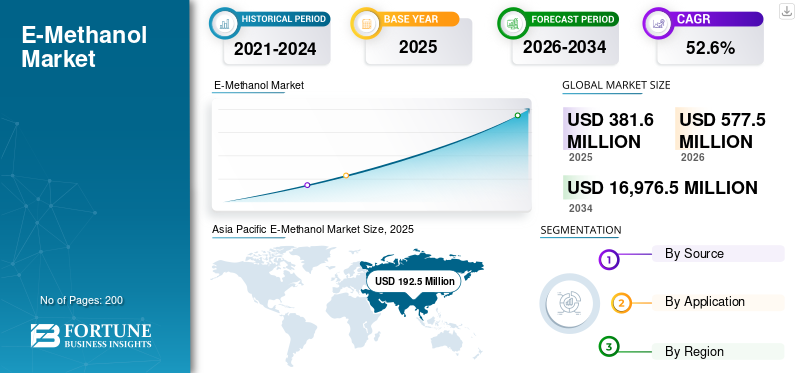
The global E-methanol market size was valued at USD 381.6 million in 2025. The market is projected to grow from USD 577.5 million in 2026 to USD 16,976.5 million by 2034, exhibiting a CAGR of 52.6% during the forecast period. Asia Pacific dominated the E-methanol market with a market share of 50.44% in 2025.
E-methanol is a type of green methanol produced through the synthesis of renewable hydrogen and captured carbon dioxide, offering a sustainable alternative to conventional fossil-based methanol. The production process typically uses green hydrogen generated through renewable electricity and biogenic, industrial, or direct-air-captured CO₂ as the carbon source. E-methanol can be used as a feedstock in the chemical industry, a fuel-blending component, and an intermediate for producing e-fuels. Maritime operators, fuel suppliers, chemical producers, and e-fuel developers are increasingly investing in E-methanol as a scalable solution to reduce lifecycle carbon emissions. Therefore, the rising focus on shipping decarbonization, renewable fuel mandates, and low-carbon chemical production is driving the global market.
The global market is shaped by a developing group of clean fuel producers, energy companies, shipping firms, and technology providers with capabilities in green hydrogen production, carbon capture, methanol synthesis, and renewable fuel distribution. Major players include European Energy, Carbon Recycling International, C2X, Methanex, and Liquid Wind. Continuous investments in green hydrogen electrolyzers, CO₂ utilization platforms, renewable methanol plants, marine fuel supply chains, and long-term offtake partnerships are about to shape the competitive landscape.
Download Free sample to learn more about this report.
E-Methanol Market Takeaways
 Global Market Size & Forecast
- 2025 Market Size: USD 381.6 million
- 2026 Market Size: USD 577.5 million
- 2034 Forecast Market Size: USD 16,976.5 million
- CAGR: 52.6% (2026–2034)
 Market Share
- Asia Pacific dominated the E-methanol market with a market share of 50.44% in 2025.
- Industrial captured CO₂ accounted for the largest share of the global market in 2025.
- Marine fuel accounted for the largest global E-methanol market share in 2025.
 Key Regional Highlights
Asia Pacific
Asia Pacific dominated the global market in 2025, with a value of USD 192.5 million, and is expected to maintain its leadership through the forecast period, expanding at a CAGR of 53.5% during 2026–2034.
Europe
Europe reached USD 154.8 million in 2025, expanding at a CAGR of 47.8% through 2034. The region represents one of the most policy-driven markets, supported by renewable fuel mandates, shipping emission regulations, and strong investment in power-to-X projects.
North America
North America reached USD 23.0 million in 2025, growing at a CAGR of 61.6% through 2034.
U.S.
The U.S. market is estimated to be valued at USD 27.9 million in 2026, accounting for roughly 4.8% of global revenues.
Japan
The Japan market is estimated to reach USD 13.3 million in 2026, accounting for nearly 2.3% of global demand.
Read More

E-METHANOL MARKET TRENDS
Momentum Toward Green Fuels and Expansion of Carbon Capture Technologies to Accelerate Product Adoption
Rising momentum toward green fuels and the rapid expansion of carbon capture technologies are accelerating the adoption of E-methanol across clean energy and chemical applications. E-methanol is gaining attention as it can be produced by combining renewable hydrogen with captured carbon dioxide, making it a practical route for converting CO₂ emissions into usable low-carbon fuel and feedstock. Growing investments in carbon capture, utilization, and storage projects are improving the availability of sustainable carbon sources, while renewable hydrogen development fuels production. This trend is particularly relevant for marine fuel, chemicals, and e-fuel applications, where companies are seeking alternatives that can reduce lifecycle emissions without requiring major changes to existing methanol-handling infrastructure.
- The European Union is driving massive investments in e-methanol through the European Innovation Fund and the Horizon Europe program to decarbonize the shipping and chemical sectors. For instance, the Triskelion project in Spain secured a USD 57 million grant to build a facility that will utilize breakthrough Solid Oxide Electrolysis Cell (SOEC) technology.
MARKET DYNAMICS
MARKET DRIVERS
Download Free sample to learn more about this report.
Growing Decarbonization Initiatives across Industrial and Transportation Sectors to Drive Market Growth
Growing decarbonization initiatives across the industrial and transportation sectors are set to drive E-methanol market growth. Industries such as chemicals, shipping, refining, and energy are under increasing pressure to reduce carbon emissions and shift toward low-carbon fuels and feedstocks. E-methanol offers a strong value proposition as it can support emission reduction while remaining compatible with established methanol storage, blending, and distribution systems. In transportation, its adoption is gaining traction in marine fuel applications, where shipowners and fuel suppliers are evaluating methanol-based routes to meet tightening emission targets. Similarly, chemical producers are exploring E-methanol to lower the carbon footprint of downstream products. Hence, increasing corporate climate commitments and policy-led decarbonization targets are supporting market expansion.
MARKET RESTRAINTS
High Production Costs Associated with Renewable Hydrogen and Regulatory Uncertainties Regarding Green Fuel Certification is Limiting Market Growth
High production costs associated with renewable hydrogen and regulatory uncertainties around green fuel certification are limiting the growth of the market. Renewable hydrogen remains one of the most expensive inputs in E-methanol production, as electrolyzer prices, renewable power availability, plant utilization rates, and infrastructure requirements influence costs. In addition, sourcing certified sustainable carbon dioxide can add to project development costs and complexity. The market also faces uncertainty regarding fuel classification, carbon accounting methods, lifecycle emission thresholds, and certification rules across regions. These factors make long-term pricing, offtake agreements, and project financing more challenging. As a result, E-methanol adoption is progressing steadily but remains cost-sensitive compared with conventional methanol and other fuel alternatives.
- The International Maritime Organization (IMO) is adopting e-methanol and other sustainable e-fuels by establishing legally binding lifecycle Greenhouse Gas (GHG) standards. Further, incorporating methanol-specific safety protocols into international law and implementing market-based penalty and incentive systems to drive industry-wide decarbonization.
MARKET OPPORTUNITIES
Increasing Demand for Low-Carbon Fuel Alternatives across Marine and Aviation Industries to Create Lucrative Opportunities in the Market
The increasing demand for low-carbon fuel alternatives across the marine and aviation industries is expected to create lucrative opportunities for the market. The shipping industry is emerging as one of the strongest demand centers, as methanol-powered vessels, fuel supply partnerships, and port bunkering infrastructure continue to develop. E-methanol can help marine operators reduce emissions while using a liquid fuel that is comparatively easier to store and handle than several alternative fuels. In aviation, E-methanol can serve as an intermediate for producing synthetic fuels and sustainable aviation fuel through downstream conversion routes. As airlines, shipping companies, fuel producers, and governments strengthen their low-carbon fuel strategies, E-methanol suppliers are expected to benefit from rising demand for scalable renewable fuel solutions.
Segmentation Analysis
By Source
Industrial Captured CO₂ Dominates the Market Owing to Strong Availability from Large-scale Emission Sources
Based on the source, the market is segmented into industrial captured CO₂, biogenic CO₂, and Direct Air Capture (DAC) CO₂.
Industrial captured CO₂ accounted for the largest share of the global market in 2025. The segment’s dominance is supported by the comparatively higher availability of CO₂ from cement, steel, refining, power, and chemical facilities, where carbon capture integration is gradually expanding. For E-methanol producers, industrial CO₂ offers a near-term, scalable carbon source, as several commercial methanol projects require a consistent feedstock supply to support plant economics. Its established collection potential, lower sourcing complexity compared to DAC, and alignment with carbon utilization strategies continue to support its leading position in the market.
Biogenic CO₂ is expected to grow strongly at a CAGR of 50.4% during 2026–2034, supported by rising interest in renewable carbon feedstocks for E-methanol production. The growing demand is increasingly linked with bioenergy plants, biomass processing, ethanol facilities, and waste-to-energy operations. Biogenic CO₂ is attractive as it can help improve the lifecycle emission profile of E-methanol, particularly for marine fuel, chemical feedstock, and e-fuel applications. As certification requirements become stricter, producers are likely to prioritize biogenic carbon sources to strengthen compliance with low-carbon fuel standards.
By Application
To know how our report can help streamline your business, Speak to Analyst
Marine Fuel Dominates the Market Owing to Rising Methanol-fueled Vessel Adoption and Shipping Decarbonization
Based on application, the market is segmented into marine fuel, chemical feedstock, Sustainable Aviation Fuel (SAF), road transport fuel, and others.
Marine fuel accounted for the largest global e-methanol market share in 2025. The segment’s leadership is supported by growing orders for methanol-powered vessels, port bunkering development, and shipping companies’ efforts to reduce greenhouse gas emissions. E-methanol is gaining preference in marine applications as it is liquid at ambient conditions, easier to store than several alternative fuels, and compatible with emerging methanol dual-fuel engine platforms. As global shipping operators move toward cleaner fuel strategies, marine fuel is expected to remain the anchor demand segment for E-methanol.
Chemical feedstock is projected to grow at a CAGR of 46.1% during 2026–2034, supported by the rising need to reduce embedded carbon footprints across methanol-derived chemicals. It is gaining relevance in formaldehyde, acetic acid, methyl tert-butyl ether, olefins, and other downstream chemical routes. E-methanol allows chemical producers to decarbonize existing value chains without making major changes to methanol-based production infrastructure. As brand owners, manufacturers, and regulators increase pressure for lower-carbon materials, demand for renewable methanol as a chemical feedstock is expected to grow steadily.
Sustainable Aviation Fuel (SAF) applications are expected to expand at a CAGR of 57.7% during 2026–2034, making it one of the fastest-growing demand areas in the market. E-methanol serves as an intermediate in the production of synthetic aviation fuel via downstream conversion technologies. Airlines and fuel producers are exploring scalable low-carbon pathways to meet aviation decarbonization targets, especially as conventional bio-based SAF feedstocks face availability constraints. Hence, rising investment in power-to-liquid fuels is expected to strengthen E-methanol demand in aviation.
E-Methanol Market Regional Outlook
By region, the market is segmented into North America, Europe, Asia Pacific, and the Rest of the World.
Asia Pacific
Asia Pacific E-Methanol Market Size, 2025 (USD Million)
To get more information on the regional analysis of this market, Download Free sample
Asia Pacific dominated the global market in 2025, with a value of USD 192.5 million, and is expected to maintain its leadership through the forecast period, expanding at a CAGR of 53.5% during 2026-2034. The region’s dominance is mainly supported by China’s strong project pipeline, rising interest in low-carbon marine fuels, and growing investments in renewable hydrogen and CO₂ utilization pathways. Demand is also supported by the region’s large chemical manufacturing base, where E-methanol can be used as a lower-carbon feedstock for methanol derivatives. In addition, emerging clean fuel policies, port decarbonization initiatives, and the availability of renewable energy resources are expected to strengthen regional adoption across marine fuel, chemical feedstock, and e-fuel applications.
China E-Methanol Market
China is estimated to reach USD 255.5 million in 2026, representing around 44.2% of the global market. The country’s strong position is supported by large-scale e-methanol investments. China’s existing infrastructure for methanol production and distribution ecosystem also provides a strong platform for scaling adoption across marine fuel, road transport fuel, and chemical feedstock applications.
To know how our report can help streamline your business, Speak to Analyst
Japan E-Methanol Market
The Japan market is estimated to reach USD 13.3 million in 2026, accounting for nearly 2.3% of global demand. The market is supported by the country’s focus on imported clean fuels, shipping decarbonization, and low-carbon energy diversification. Japan’s strong maritime industry, fuel trading networks, and corporate decarbonization commitments are expected to support the gradual adoption of E-methanol, particularly in marine and synthetic fuel applications.
North America
North America reached USD 23.0 million in 2025, growing at a CAGR of 61.6% through 2034. Although the region currently has a smaller base than Asia Pacific and Europe, it is expected to witness rapid growth driven by expanding low-carbon fuel initiatives, clean hydrogen investments, and the development of carbon capture projects. Demand is likely to be driven by marine fuel supply chains, chemical-sector decarbonization, and emerging e-fuel projects across the U.S. and Canada.
U.S. E-Methanol Market
The U.S. market is estimated to be valued at USD 27.9 million in 2026, accounting for roughly 4.8% of global revenues. Market growth is being supported by the country’s expanding carbon capture ecosystem, renewable hydrogen investments, and increasing demand for low-carbon fuels across industrial and transportation sectors. The U.S. also offers strong potential for E-methanol production due to its large industrial CO₂ sources and growing support for clean fuel policies.
Europe
Europe reached USD 154.8 million in 2025, expanding at a CAGR of 47.8% through 2034. The region represents one of the most policy-driven markets, supported by renewable fuel mandates, shipping emission regulations, and strong investment in power-to-X projects. Countries such as Denmark and Germany are emerging as key contributors due to their renewable energy resources, green hydrogen strategies, and early commercial E-methanol project development. Demand is increasingly linked to marine fuel, chemical feedstock decarbonization, and sustainable aviation fuel pathways.
Germany E-Methanol Market
Germany is estimated to account for USD 48.0 million in 2026, representing approximately 8.3% of the global market. The demand is supported by the country’s strong chemical manufacturing base, industrial decarbonization targets, and rising interest in renewable methanol as a low-carbon feedstock. Germany’s focus on green hydrogen imports, carbon utilization, and synthetic fuel production is expected to strengthen the role of E-methanol across chemical and transport-related applications.
Denmark E-Methanol Market
Denmark is set to record USD 75.5 million in 2026, contributing around 13.1% of global revenues. The country is emerging as a major European E-methanol hub due to its strong offshore wind potential, power-to-X project pipeline, and early involvement in renewable methanol production. Denmark’s focus on green shipping corridors and renewable fuel exports is expected to support steady E-methanol demand and supply development during the forecast period.
Rest of the World
The Rest of the World region reached USD 11.3 million in 2025, expanding at the fastest regional CAGR of 64.4% through 2034. This segment includes emerging opportunities across the Middle East, Latin America, and other developing clean fuel markets. The growth is supported by rising interest in renewable fuel exports, green hydrogen development, and early-stage investments in low-carbon maritime fuels. While the current market size remains limited, improving project economics and international fuel partnerships are expected to support future expansion.
COMPETITIVE LANDSCAPE
Key Industry Players
Strategic Project Development and Feedstock Integration Strengthen Competitive Positioning in the Market
The global E-methanol market is at an early commercial stage, with competition shaped by project execution capability, access to low-cost renewable power, green hydrogen integration, sustainable CO₂ sourcing, and long-term offtake partnerships. The market includes renewable fuel developers, methanol producers, shipping-linked fuel suppliers, energy companies, and technology providers working across power-to-X value chains. Companies such as European Energy, Carbon Recycling International, C2X, Methanex, and Liquid Wind are strengthening their positions through commercial-scale project development, technology licensing, strategic investments, and supply agreements with marine fuel and industrial customers. Since production costs remain high, players with integrated renewable energy access, strong financing support, and secured demand from shipping, chemicals, and e-fuel buyers are expected to gain a competitive advantage. Over the forecast period, competition is likely to intensify as more projects move from pilot and demonstration phases toward commercial operation.
LIST OF KEY E-METHANOL COMPANIES PROFILED
- European Energy (Denmark)
- Carbon Recycling International (Iceland)
- C2X (Denmark)
- Methanex (Canada)
- Liquid Wind (Sweden)
- HIF Global (U.S.)
- HY2GEN (Germany)
- Proman (Switzerland)
- WasteFuel (U.S.)
- Johnson Matthey (U.K.)
KEY INDUSTRY DEVELOPMENTS
- March 2026: HIF Global submitted the Prior Environmental Authorization application for its Paysandú e-fuels project in Uruguay. The project involves an investment of approximately USD 5.3 billion. It is designed to produce up to 876 kilotons of e-methanol per year, strengthening Latin America’s position in the emerging commercial-scale e-fuels market.
- February 2026: HIF Global and German eFuel One GmbH signed a Heads of Agreement for the long-term offtake of 100 kilotons per year of e-methanol. The agreement is expected to support sustainable mobility and strengthen demand visibility for HIF’s planned e-methanol production portfolio.
- November 2025: The Ministry of Transport, Communications, and Information Technology of Oman signed an MoU with a consortium comprising HIF EMEA GmbH, Acciona Nordex Green Hydrogen, and Al Meera Investments to explore an e-methanol project at Dhofar Governorate Port. The project is intended to support the development of clean marine fuels and strengthen Oman’s green hydrogen
- October 2025: Topsoe was selected to provide its Solid Oxide Electrolyzer Cell technology for Forestal del Atlántico’s Triskelion e-methanol project in Galicia, Spain. The project will use 55 MW of green power to produce hydrogen for e-methanol production, supporting low-carbon chemical and fuel applications.
- May 2025: European Energy officially inaugurated the Kassø e-methanol facility in Aabenraa, Denmark. The facility is one of the world’s first large-scale commercial e-methanol plants. It is positioned to supply renewable methanol to shipping, chemical, and industrial customers, supporting the commercialization of power-to-X fuel pathways.
REPORT COVERAGE
The global E-methanol market analysis provides an in-depth study of market size & forecast across all market segments included in the report. It includes details on the market dynamics and market trends expected to drive the market in the forecast period. It offers information on technological advancements, new product launches, key industry developments, and partnerships, mergers & acquisitions. The market research report also encompasses a detailed competitive landscape, including market share and profiles of key operating players.
Request for Customization to gain extensive market insights.
Report Scope & Segmentation
| ATTRIBUTE | DETAILS |
| Study Period | 2021-2034 |
| Base Year | 2025 |
| Estimated Year | 2026 |
| Forecast Period | 2026-2034 |
| Historical Period | 2021-2024 |
| Growth Rate | CAGR of 52.6% from 2026-2034 |
| Unit | Value (USD Million) and Volume (Kilotons) |
| Segmentation | By Source, Application, and Region |
| By Source |
|
| By Application |
|
| By Region |
|
Frequently Asked Questions
Fortune Business Insights says that the global market size was valued at USD 381.6 million in 2025 and is projected to reach USD 16,976.5 million by 2034.
In 2025, the market value stood at USD 192.5 million.
Recording a CAGR of 52.6%, the market is slated to exhibit steady growth during the forecast period.
The marine fuel application segment led in 2025.
Growing decarbonization initiatives across the industrial and transportation sectors are set to drive the market growth.
European Energy, Carbon Recycling International, C2X, Methanex, and Liquid Wind are some of the prominent players in the market.
Asia Pacific held the highest market share in 2025.
Momentum toward green fuels and the expansion of carbon capture technologies are set to accelerate product adoption.



- 2021-2034
- 2025
- 2021-2024
- 200
Get 30-60 hrs Free Customization
Expand Regional and Country Coverage, Segments Analysis, Company Profiles, Competitive Benchmarking, and End-user Insights.


















Related Reports
-
US +1 833 909 2966 ( Toll Free )
-
Get In Touch With Us