Fermented Food Market Size, Share & Industry Analysis, By Type (Fermented Dairy Products {Cheese, Yogurt, Buttermilk, and Kefir}, Fermented Beverages {Kombucha, Beer, Wine, and Others}, Fermented Bakery Products, Fermented Vegetables, and Others), By Microorganisms (Bacteria, Yeasts, Molds, and Mixed Cultures), By Distribution Channel (Supermarkets/Hypermarkets, Convenience Stores, Specialty Stores, & Online Retail), By Functional Benefits (Probiotic and Gut Health, Nutritional Enhancement, & Extended Shelf Life/Preservation), and Regional Forecast, 2026-2034
 Download Free Sample
(Offer valid till 15th Oct 2026)

KEY MARKET INSIGHTS
 Listen to Audio Version
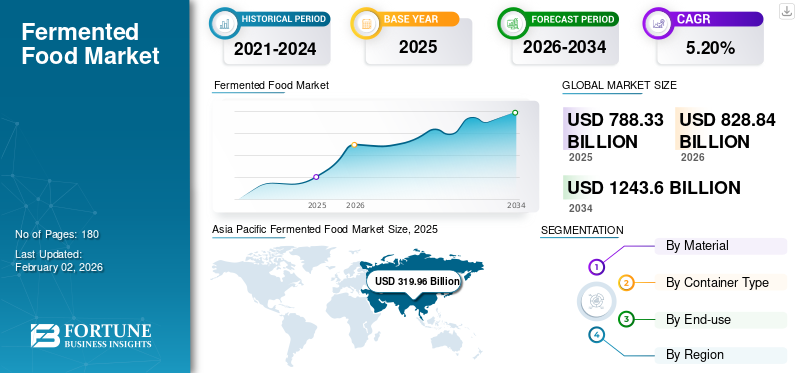
The global fermented food market size was valued at USD 788.33 billion in 2025 and is projected to grow from USD 828.84 billion in 2026 to USD 1,243.60 billion by 2034, exhibiting a CAGR of 5.20% during the forecast period. Asia Pacific dominated the fermented food market with a market share of 40.59% in 2025.
Fermented foods are a type of functional product that have undergone fermentation (bacteria, molds, and yeasts) and controlled microbial growth. This process strengthens the product’s nutritional value, texture, and flavor. Some of the popular fermented items include kimchi, sauerkraut, pickles, and tempeh. In terms of health advantages, these products break down anti-nutrients, which boost nutrient bioavailability. Moreover, it minimizes toxic components found in food and reduces the risk of food waste. Additionally, it helps in mood regulation, digestive challenges, and inflammation. Apart from human health benefits, the traditional fermentation process extends the shelf life of packaged food items and augments the palatability.
The rising consumer demand for allergen-conscious diets and surging health & wellness trends propel market potential. Some of the well-known key market players include Fermented Food Holdings, Maple Hill Creamery, and Brew Dr. Kombucha.
Download Free sample to learn more about this report.
Fermented Food Market Key Takeaways
 Global Market Size & Forecast
- 2025 Market Size: USD 788.33 billion
- 2026 Market Size: USD 828.84 billion
- 2034 Forecast Market Size: USD 1,243.60 billion
- CAGR: 5.20% from 2026–2034
 Market Share
- Asia Pacific dominated the fermented food market with a 40.59% share in 2025.
- Fermented beverages will account for 36.98% of the global market in 2026.
- The yeasts segment is projected to grow at a CAGR of 4.77% during the forecast period.
 Key Regional Highlights
Asia Pacific
Asia Pacific led the market with USD 319.96 billion in 2025 and is projected to reach USD 339.68 billion in 2026.
Europe
Europe accounted for USD 188.74 billion in 2025 and is expected to reach USD 199.32 billion in 2026.
North America
North America generated USD 132.95 billion in 2025 and is projected to reach USD 138.38 billion in 2026.
U.S
The market is projected to reach USD 94.77 billion by 2026.
Japan
The market is projected to reach USD 41.52 billion by 2026.
Read More

MARKET DYNAMICS
MARKET DRIVERS
Increasing Demand for Natural/Clean-Label Products Boosts Market Potential
The rising demand for clean-label/natural products is a pivotal driver augmenting the market growth. In today’s modern era, most global consumers are seeking items with minimally processed and natural components that offer various health benefits. This demand aligns well with fermented products, as they are rich in functional ingredients and are less processed. Particularly, fermented items are rich in beneficial compounds that strengthen immunity and gut health, making them captivating to health-centric consumers. Moreover, the surging trend of veganism has escalated the demand for fermented processed foods such as kefir and kombucha, creating growth opportunities for the market. Additionally, the rising animal welfare and growing incidences of chronic health ailments fuel the consumption of fermented products. By seeing such benefits, the manufacturers in the market are focusing on introducing novel fermented items that appeal to consumers.
MARKET RESTRAINTS
Surging Incidences of Health Ailments and Limited Consumer Acceptance Hamper Market Growth
One of the crucial hurdles in the global market is the rising prevalence of chronic health ailments. Traditionally fermented products are known to be rich in salt, which poses a threat to human health, such as brain stroke, hypertension, and heart attack. Moreover, high salt diets are associated with stomach cancer and can interact with various components, resulting in the formation of carcinogenic compounds. Although salt is essential for the proper texture and flavor of fermented items and is necessary for microbial inhibition, its excessive consumption aggravates health disorders. Thus, this factor impedes the global fermented food market growth.
Another obstacle in the industry is limited consumer acceptance of fermented products. Globally, most consumers face difficulties in accepting fermented items, who may have concerns about their texture and taste. As a result, such instances hinder the market’s momentum.
MARKET OPPORTUNITIES
Adopting Advanced Fermentation Technologies Creates Growth Chances
The utilization of modern fermentation techniques unlocks growth opportunities in the global market. Advanced tools such as high-throughput sequencing and genome editing are being highly used by manufacturers for understanding microbiomes, leading to more efficient and targeted processes. AI and machine learning are other digital techniques utilized to predict microbial interactions and strengthen the overall consistency and quality of fermented items. Moreover, using modern bioreactors provides control over oxygen and temperature, while minimizing energy consumption and improving efficiency. Additionally, companies can utilize emerging technologies such as pulsed electric fields, ultrasound, and Ohmic heating to enhance product quality and strengthen fermentation processes.
FERMENTED FOOD MARKET TRENDS
Growing Inclination Toward Functional Foods is the Current Trend
The global industry is experiencing a growing and remarkable trend toward functional food products. In today’s health-conscious era, most individuals are inclined toward plant-centric and natural products, which help in minimizing lifestyle disorders. To curb the incidences, the majority of the population is incorporating fermented foods into their daily diet. Kombucha, yogurt, kefir, and sauerkraut are most commonly consumed items as they are rich in bioactive compounds and probiotics. Moreover, these food products align with the growing clean-label phenomenon, which is a key trend in the functional food sector. Additionally, fermented items enhance nutrient absorption, boost digestive and gut health, and aid in weight management.
Download Free sample to learn more about this report.
Segmentation Analysis
By Type
Fermented Beverages Dominated Market Owing to Their Advantages
Depending on type, the market is segmented into fermented dairy products, fermented beverages, fermented bakery products, fermented vegetables, and others.
The fermented beverages segment dominated the global market share of 36.98% in 2026. In comparison to other products, fermented drinks offer a vast range of advantages, including improved nutritional value and enhanced digestibility. Moreover, these beverages are known to lower cholesterol and blood pressure, and have the potential to reduce the risk of diabetes. Additionally, a few studies suggest that these products are useful in weight management. As a result, the aforementioned factors fuel the segment’s growth.
The fermented dairy segment secured second position in the global market.
By Microorganisms
Bacteria Led the Market Due to Its Versatility
On the basis of microorganisms, the market is distributed into bacteria, yeasts, molds, and mixed cultures.
Out of all, the bacteria segment led the market share of 68.32% in 2026. Bacteria, when utilized in food products, enhance consumers’ health by producing beneficial bacteria. These microorganisms boost nutrient absorption and create antimicrobial components that aid in inhibiting food spoilage. Moreover, they can synthesize vitamin C and vitamin B12, which are usually lost during processing methods. Additionally, bacterial fermentation produces sour and tangy flavors, whereas molds/yeasts develop stronger flavors, sometimes off-notes.
The yeasts segment is expected to flourish at a high CAGR of 4.77% during the study period.
By Distribution Channel
Supermarkets/Hypermarkets Led Market Due to Their Easy Accessibility
Based on distribution channel, the market is segmented into supermarkets/hypermarkets, convenience stores, specialty stores, online retail, and others.
The supermarkets/hypermarkets led the global market share with 65.54% in 2026. Supermarkets are gaining popularity and are recognized as large self-service outlets providing an array of fermented items of various international/local brands. To captivate a large consumer base, these channels also offer discount benefits, particularly for bulk purchasing. Moreover, the easy affordability of fermented items and numerous payment options further bolster the segment’s potential.
The online retail segment is anticipated to grow at a high CAGR of 6.57% during the study period.
To know how our report can help streamline your business, Speak to Analyst
By Functional Benefits
Probiotic & Gut Health Led Market Owing to Presence of Beneficial Microbes in Fermented Food
On the basis of functional benefits, the market is distributed into probiotic & gut health, nutritional enhancement, extended shelf life/preservation, and others.
The probiotic & gut health segment is anticipated to hold a dominant market share of 46.64% in 2026. Globally, most individuals consume fermented items for gut health as they deliver bioactive compounds that help in enhanced digestion and gut microbiome. Moreover, the live microbes present in fermented products can easily interact with immune cells and aid in regulating immune response. Thus, consuming fermented beverages and food products can promote well-being beyond regular nutrition.
The nutritional enhancement segment is projected to grow at a CAGR of 5.15% during the forecast period.
Fermented Food Market Regional Outlook
On the basis of regions, the market is segmented into North America, Europe, Asia Pacific, South America, and the Middle East & Africa.
Asia Pacific
Asia Pacific Fermented Food Market Size, 2025 (USD Billion) To get more information on the regional analysis of this market, Download Free sample
The market in Asia Pacific reached USD 319.96 billion in 2025, representing 40.59% of total market revenue, and is projected to reach USD 339.68 billion in 2026. It held the largest fermented food market share in 2024. In this region, the majority of the population is aware of enhanced immunity and gut health and how a balanced diet plays a substantial role in limiting non-communicable diseases. This awareness augments the demand for functional food that provides advantages beyond traditional nutrition. Moreover, the surging consumer preferences for clean-label ingredients and plant-based substitutes are escalating the sales of fermented items.
Additionally, in comparison to other regions, the Asia Pacific has a high aging population, which requires probiotics to counteract a weakened immune system and age-related gut microbiota issues. Additionally, the technological advancements in the fermentation process and improved disposable income further propel the region’s momentum. The Japan market is projected to reach USD 41.52 billion by 2026, the China market is projected to reach USD 125.15 billion by 2026, and the India market is projected to reach USD 98.55 billion by 2026.
Europe
Other regions, such as Europe and North America, are expected to observe considerable growth in the future. During the forecast period, Europe is predicted to record a growth rate of 5.63%, which is the second highest among all the regions. This growth is driven by increasing inclination toward plant-sourced ingredients and the growing trend of functional probiotics. The UK market is projected to reach USD 35.33 billion by 2026, and the Germany market is projected to reach USD 52.17 billion by 2026. In 2025, Europe held 23.94% of the global market, reaching a valuation of USD 188.74 billion, and is projected to grow to USD 199.32 billion in 2026.
North America
North America ranked third in the global industry in 2024. The expanding food and beverage industry and improved awareness of health & wellness fuel the growing potential. The U.S. market is projected to reach USD 94.77 billion by 2026. The North America market was valued at USD 132.95 billion in 2025, capturing 16.86% of global revenue, and is estimated to reach USD 138.38 billion in 2026.
South America and Middle East & Africa
South America and the Middle East & Africa are predicted to witness a moderate growth over the forecast period. Countries such as South Africa and the UAE are experiencing the e-commerce market expansion and increasing incidences of allergies, which strengthen the market growth. In 2025, the Middle East & Africa market stood at USD 50.97 billion, representing 6.47% of global demand, and is projected to grow to USD 52.17 billion in 2026.
Latin America
Latin America maintained a strong presence in the global market, reaching USD 95.7 billion in 2025, accounting for 12.14% share, and is expected to reach USD 99.3 billion in 2026.
COMPETITIVE LANDSCAPE
Key Industry Players
Prominent Players are Focusing on Product Innovation to Enhance Their Market Presence
Key players in the market include Brew Dr. Kombucha, Fermented Food Holdings, Maple Hill Creamery, and others. All the companies in the global market are aiming at new product launches that entice consumers’ attention. Moreover, the firms should focus on entering into collaborations/partnerships that boost the market growth.
List of Key Fermented Food Companies Profiled
- Fermented Food Holdings (U.S.)
- The Compleat Food Group Limited (U.K.)
- Salud (India)
- Sbooch (India)
- Flanagan Farm (U.S.)
- Ms Organics (Thailand)
- Lifeway Foods (U.S.)
- GT’s Living Foods (U.S.)
- Brew Dr. Kombucha (U.S.)
- Maple Hill Creamery (U.S.)
KEY INDUSTRY DEVELOPMENTS
- March 2025: Fermented Food Holdings, a functional foods manufacturer in the U.S., released the news of expanding its Wildbrine and Bubbies Fine Foods brands. Via these brands, the firm introduced Wildbrine pickled red onions, mild white kimchi, and others, for American consumers.
- February 2025: Vadasz, the U.K.-based kimchi and chilled pickles firm, added a new live cultured and naturally fermented Kimchi shot, sourced from 100% plant-sourced ingredients. This kimchi improves gut health and is available in an on-the-go format.
- January 2025: MUJI, a brand of the Japanese retailer Ryohin Keikaku, launched lime fermented chocolate items, using Indonesia-based cacao. This chocolate is available at selected MUJI stores and online through its website in Japan.
- August 2024: Flanagan Farm, an American fermented food enterprise, expanded its product portfolio by releasing new sauerkraut flavors. All the products launched are non-GMO, gluten-free, and kosher, and are available at retailers across the U.S.
- February 2024: Salud, an Indian lifestyle brand, revealed Salud Viking, a ready-to-drink mead-based beverage, produced by utilizing hops and fermented honey. This drink can be purchased by consumers across Goa and Kerala.
REPORT COVERAGE
The market report includes quantitative and qualitative insights into the market. It also offers a detailed global fermented food market analysis of sizing and growth rate for all possible market segments. Various key insights presented in the market research report are an overview of related markets, competitive landscape, recent industry developments such as mergers & acquisitions, the regulatory scenario in critical countries, and global fermented food market trends.
Request for Customization to gain extensive market insights.
Report Scope & Segmentation
|
ATTRIBUTE |
DETAILS |
|
Study Period |
2021-2034 |
|
Base Year |
2025 |
|
Estimated Year |
2026 |
|
Forecast Period |
2026-2034 |
|
Historical Period |
2021-2024 |
|
Unit |
Value (USD Billion) |
|
Growth Rate |
CAGR of 5.20% from 2026 to 2034 |
|
Segmentation |
By Type · Fermented Dairy Products o Cheese o Yogurt o Buttermilk o Kefir · Fermented Beverages o Kombucha o Beer o Wine o Others · Fermented Bakery Products o Sourdough Bread o Idli/Dosa Batter o Others · Fermented Vegetables o Kimchi o Sauerkraut o Pickles o Fermented Soy · Others |
|
By Microorganisms · Bacteria · Yeasts · Molds · Mixed Cultures |
|
|
By Distribution Channel · Supermarkets/Hypermarkets · Convenience Stores · Specialty Stores · Online Retail · Others |
|
|
By Functional Benefits · Probiotic & Gut Health · Nutritional Enhancement · Extended Shelf Life/Preservation · Others |
|
|
By Region · North America (By Type, Microorganisms, Distribution Channel, Functional Benefits, and Country) o U.S. (Distribution Channel) o Canada (Distribution Channel) o Mexico (Distribution Channel) · Europe (By Type, Microorganisms, Distribution Channel, Functional Benefits, and Country) o Germany (Distribution Channel) o France (Distribution Channel) o Italy (Distribution Channel) o Spain (Distribution Channel) o U.K. (Distribution Channel) o Rest of Europe (Distribution Channel) · Asia Pacific (By Type, Microorganisms, Distribution Channel, Functional Benefits, and Country) o China (Distribution Channel) o India (Distribution Channel) o Japan (Distribution Channel) o Australia (Distribution Channel) o Rest of Asia Pacific (Distribution Channel) · South America (By Type, Microorganisms, Distribution Channel, Functional Benefits, and Country) o Brazil (Distribution Channel) o Argentina (Distribution Channel) o Rest of South America (Distribution Channel) · Middle East & Africa (By Type, Microorganisms, Distribution Channel, Functional Benefits, and Country) o UAE (Distribution Channel) o South Africa (Distribution Channel) o Rest of the Middle East & Africa (Distribution Channel) |
Frequently Asked Questions
Fortune Business Insights says that the global market size was valued at USD 788.33 billion in 2025.
The market is expected to grow at a CAGR of 5.20% during the forecast period (2026-2034).
By microorganisms, the bacteria segment led the market.
Increasing demand for natural/clean-label products boosts market potential.
Fermented Food Holdings, Maple Hill Creamery, and Brew Dr. Kombucha are a few of the top players in the market.
Asia Pacific dominated the fermented food market with a market share of 40.59% in 2025.
Adopting advanced fermentation technologies creates growth chances.



- 2021-2034
- 2025
- 2021-2024
- 180
-
(Offer valid till 15th Oct 2026)
Get 30-60 hrs Free Customization
Expand Regional and Country Coverage, Segments Analysis, Company Profiles, Competitive Benchmarking, and End-user Insights.




















Related Reports
-
US +1 833 909 2966 ( Toll Free )
-
Get In Touch With Us