Aircraft Lighting Market Size, Share & Industry Analysis, By Aircraft Type (Fixed Wing and Rotary Wing), By Lighting Type (Interior Lights and Exterior Lights), By Point of Sale (OEM and Aftermarket), and Regional Forecast, 2026-2034
 Download Free Sample

(Offer valid till 31st Oct 2026)

Aircraft Lighting Market Size and Future Outlook
 Listen to Audio Version
The global aircraft lighting market size was valued at USD 2.75 billion in 2025. The market is projected to grow from USD 3.00 billion in 2026 to USD 5.95 billion by 2034, exhibiting a CAGR of 8.95% during the forecast period.
The global market includes interior and exterior lighting systems, such as cabin lights, reading lights, ceiling and sidewall illumination, cockpit lighting, emergency and exit-path lighting, navigation lights, anti-collision lights, landing lights, taxi lights, wing inspection lights, and related lighting control units. These systems are installed across commercial aircraft, business jets, regional aircraft, military aircraft, helicopters, and other aviation platforms to support passenger comfort, crew visibility, flight safety, aircraft identification, and operational requirements.
Key companies in the market include Collins Aerospace, Honeywell International, Safran, Astronics Corporation, Diehl Aviation, Oxley Group, STG Aerospace, and Luminator Aerospace, among others. Competition and market share are increasingly influenced by lighting efficiency, weight reduction, reliability, certification capability, customization, system integration, product lifecycle support, and compatibility with next-generation aircraft electrical architectures.
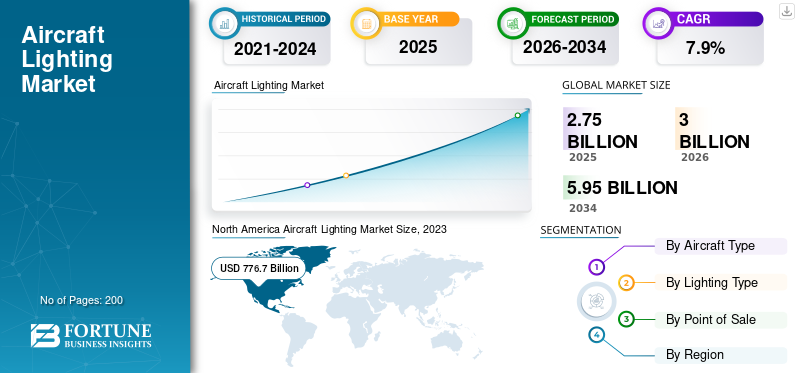
Download Free sample to learn more about this report.
AIRCRAFT LIGHTING MARKET TRENDS
Growing Demand for Aesthetic, Lightweight, and Customized Lighting Emerged as a Defining Market Trend
Weight reduction represents another important consideration in aircraft-lighting design. Every reduction in cabin-system weight contributes to overall aircraft weight management, which remains an important consideration for fuel efficiency, payload capability, and operating economics. LED systems can provide weight advantages over conventional tube-lighting architectures, particularly where compact fixtures and simplified installation arrangements reduce the amount of associated hardware.
The requirement for lighter equipment is encouraging suppliers to address lighting as part of broader cabin-weight optimization rather than as an isolated component. Integration of lighting into sidewalls, ceilings, monuments, and decorative surfaces can reduce the need for separate fixtures while providing greater flexibility in cabin design. This approach is particularly relevant for next-generation commercial aircraft and premium cabin programs where weight, available space, and interior aesthetics must be considered simultaneously.
Airlines are incorporating indirect illumination, concealed light sources, decorative lighting, and programmable color combinations into cabin interiors to distinguish business-class, first-class, and premium-economy cabins. Such requirements are encouraging lighting suppliers to develop systems with greater design flexibility and improved integration with seats, monuments, sidewalls, ceilings, galleys, and lavatories.
- In March 2025, Diehl Aviation presented its Future Cabin Concept with lightweight materials, bionic design principles, digital decorative surfaces, and concealed LED elements intended to combine aesthetic and functional integration within the aircraft interior.
MARKET DYNAMICS
MARKET DRIVERS
Download Free sample to learn more about this report.
Increasing Adoption of Energy-Efficient LED Aircraft Lighting Systems to Drive Market Growth
The transition toward energy-efficient LED technology remains a major structural driver for the aircraft lighting market growth. Airlines, aircraft manufacturers, business-jet operators, and military users are progressively replacing fluorescent, incandescent, halogen, and xenon lighting with LED-based systems across cabin and exterior applications.
The technology shift is also expanding beyond basic white illumination. Moreover, modern RGBW and digitally controlled LED systems allow airlines to develop programmable lighting scenarios for boarding, meal service, rest periods, and arrival while maintaining relatively low electrical loads. Lighting has consequently become more closely integrated with cabin-management systems and broader passenger-experience strategies. Astronics' current Nuancia architecture, for example, provides addressable RGBW lighting capable of producing millions of colors and integrating with multiple aircraft communication and control technologies.
Energy efficiency is particularly important for retrofit applications because operators can modernize older aircraft without undertaking major changes to the underlying electrical architecture. Replacement systems designed around existing wiring, mounting locations, and power supplies can reduce installation complexity while allowing airlines to remove maintenance-intensive legacy equipment.
- In September 2025, PWI received FAA Parts Manufacturer Approval (PMA) approval for its LED cabin-lighting system covering additional Beechjet/Hawker 400A and 400XP aircraft. The system replaces aging fluorescent lights and high-voltage power supplies with LED equipment using the aircraft's existing 28-volt wiring, while PWI specifies a service life of approximately 100,000 hours for the LED system.
Increasing Aircraft Refurbishment and Cabin Modernization is Propelling Market Growth
Aircraft refurbishment is becoming an increasingly important source of lighting-system expenditure as airlines retain serviceable aircraft for longer periods while upgrading the passenger environment. Rather than waiting for complete fleet replacement, operators are using scheduled heavy-maintenance visits and cabin-modification programs to modernize interiors, improve product consistency, and align older aircraft with recently delivered fleets. Lighting frequently forms part of these programs alongside seats, overhead systems, monuments, in-flight entertainment, connectivity, and cabin-management equipment.
Cabin refurbishment also allows airlines to standardize passenger products across fleets acquired at different times or from different operators. This is particularly relevant where airlines acquire used aircraft, extend leases, or retain older wide-body and narrow-body fleets because of new-aircraft delivery constraints. By coordinating lighting upgrades with scheduled maintenance, operators can reduce additional downtime and spread modernization expenditure across the remaining economic life of the aircraft.
- In May 2025, HAECO Xiamen completed a comprehensive Airbus A330 cabin-configuration overhaul for T'way Air as part of the airline's program to standardize its newly acquired A330 fleet. The project illustrates how cabin reconfiguration of existing aircraft becoming an established route for bringing acquired fleets toward common interior standards.
Market Drivers - Impact & CAGR Contribution (2026–2034)
| Rank | Market Drivers | Expected Impact on Market Growth | Estimated Gross Market Growth Contribution (USD Billion) | Impact: 2026-2028 | Impact: 2029-2031 | Impact: 2032-2034 |
|---|---|---|---|---|---|---|
| 1 | Increasing commercial aircraft deliveries and global fleet expansion | High | 0.86 | High | High | High |
| 2 | Growing adoption of LED, mood lighting and advanced cabin-lighting systems | High | 0.74 | High | High | High |
| 3 | Rising retrofit and replacement of legacy halogen and fluorescent lighting systems | Medium-High | 0.66 | Medium-High | High | High |
| 4 | Increasing focus on aircraft weight reduction, energy efficiency and lower maintenance requirements | Medium-High | 0.59 | Medium | Medium-High | High |
| 5 | Expansion of aircraft cabin refurbishment, MRO and interior modernization programs | Medium | 0.52 | Medium | Medium-High | High |
| Total Gross Growth Contribution | 3.37 | |||||
Source: Fortune Business Insights
Download Free sample For In-Depth Market Restraints & Risk Analysis
MARKET RESTRAINTS
Existing Aircraft Backlog and Delayed Deliveries to Hamper Market Growth
Aircraft production constraints and extended delivery schedules continue to restrain near-term growth in the market, particularly within the OEM channel. Lighting-system volumes are directly linked to aircraft production rates, final assembly schedules, and delivery activity. Delays involving engines, aerostructures, avionics, or other critical aircraft components can therefore postpone the installation and shipment of cabin, cockpit, emergency, and exterior lighting systems, even when underlying aircraft orders remain strong.
The impact is more pronounced across high-volume commercial aircraft programs, where lighting suppliers align production capacity with expected aircraft build rates. Any divergence between planned and actual output can affect supplier scheduling, inventory planning, working-capital requirements, and revenue realization.
Certification timelines represent an additional constraint for lighting suppliers associated with new aircraft variants. Lighting systems may be qualified and incorporated into production planning, but commercial volumes remain dependent on the certification and delivery schedule of the aircraft platform. Delays at the aircraft-program level can therefore shift expected lighting-system revenue into later periods and limits the growth of the market during the forecast period.
Market Restraints - Impact & Negative CAGR Contribution (2026–2034)
| Rank | Market Restraints | Expected Impact on Market Growth | Estimated Reduction in Market Size (USD Billion) | Impact: 2026-2028 | Impact: 2029-2031 | Impact: 2032-2034 |
|---|---|---|---|---|---|---|
| 1 | High certification, qualification and aircraft-integration costs for lighting system | High | 0.17 | High | Medium-High | Medium |
| 2 | Long aircraft development cycles and dependence on OEM production and retrofit schedules | Medium-High | 0.14 | High | Medium-High | Medium |
| 3 | Supply-chain constraints, electronic-component availability and pricing pressure | Medium | 0.11 | Medium-High | Medium | Medium-Low |
| Total Market Reduction | 0.42 | |||||
Source: Fortune Business Insights
Download Free sample For In-Depth Market Restraints & Risk Analysis
MARKET OPPORTUNITIES
Increasing Adoption of NVIS-Compatible and Infrared Aircraft Lighting to Present Significant Opportunities
The growing requirement for night, low-visibility, and mission-critical aircraft operations is creating opportunities for specialized aircraft lighting systems, particularly across military, law-enforcement, emergency-response, search-and-rescue, and special-mission aviation.
These applications require lighting systems that can operate effectively with night-vision goggles and other electro-optical equipment without interfering with pilot visibility or cockpit instrumentation. As a result, NVIS-compatible cockpit lighting, infrared formation lights, covert exterior lighting, and dual-mode visible/infrared search and landing lights are gaining greater relevance within the market.
Military aviation represents an important application area for these technologies. Aircraft operating during night missions require cockpit and cabin illumination that remains compatible with night-vision imaging systems while maintaining sufficient visibility for pilots and crew. Astronics offers a range of NVIS-compatible lighting solutions covering cockpit components, internal lighting, navigation lights, infrared covert formation lighting, and anti-collision systems for fixed-wing aircraft and helicopters.
MARKET CHALLENGES
Thermal Management, Lighting Consistency, and Harsh Operating Conditions Challenges Market Growth
Aircraft lighting systems must maintain consistent brightness, color quality & reliability across significant variations in temperature, vibration, electrical loads & operating conditions. High-intensity LED assemblies and associated electronic drivers generate heat within confined installation spaces, making effective thermal management important for maintaining light output, component life & system reliability. The challenge becomes more complex across exterior, cockpit & cabin applications, where lighting equipment must simultaneously meet requirements for low weight, limited power consumption, electromagnetic compatibility, visibility & long operating life.
Segmentation Analysis
By Aircraft Type
Large Installed Fleet and High Aircraft Production Volumes to Support Fixed Wing Segment’s Dominance
Based on aircraft type, the market is divided into fixed wing and rotary wing. The fixed wing segment is further classified into commercial aircraft, military aircraft, regional jets, and business jets and general aviation. The rotary-wing segment is further divided into commercial helicopter and military helicopter.
The fixed wing segment dominated the market in 2025, due to substantially larger installed base and annual production volume of commercial aircraft, regional jets, business jets & military fixed-wing platforms. Rising commercial aircraft production, airline fleet expansion and continued cabin modernization are further supporting demand for both line-fit and replacement lighting systems.
- In January 2026, Airbus reported that it delivered 793 commercial aircraft to 91 customers during 2025, compared with 766 aircraft in 2024. The company also ended 2025 with a record backlog of 8,754 commercial aircraft, supporting a sustained pipeline of aircraft requiring OEM-installed interior & exterior lighting systems.
The rotary wing segment is anticipated to grow with a steady CAGR of 6.33% over the forecast period.
To know how our report can help streamline your business, Speak to Analyst
By Lighting Type
Cabin Modernization & Passenger-Experience Upgrades to Support Interior Lights Segment’s Dominance
Based on lighting type, the market is divided into interior lights and exterior lights. The interior lights segment further include signage lights, ceiling & wall lights, floor path lighting, reading lights, and lavatory lights. The exterior lights segment is further divided into emergency lights, navigation lights, and others.
The interior lights segment dominated the market in 2025, owing to accelerating airline expenditure on cabin refurbishment, passenger-experience differentiation, and premium-cabin upgrades. Airlines are increasingly replacing conventional cabin illumination with programmable LED and RGBW systems that support mood lighting, branding, different flight phases and passenger comfort while reducing power consumption and maintenance requirements.
- In April 2025, Astronics showcased an expanded Nuancia aircraft cabin-lighting portfolio, including RGBW strip lighting, side-emitting lighting and the ELEA LED reading-light family. The Nuancia architecture allows airlines to adjust cabin colors, brightness curves and lighting scenarios while supporting integration with aircraft cabin-control systems.
The exterior lights segment is anticipated to rise with a steady CAGR of 8.18% over the forecast period.
By Point of Sale
Aging Fleet and LED Retrofit Requirements to Drive Aftermarket Segment’s Growth
Based on point of sale, the market is divided into OEM and aftermarket.
The aftermarket segment dominated the aircraft lighting market share in 2025, driven by the combination of aging aircraft fleet & maintenance requirements and accelerating conversion of legacy lighting systems to LED technology. Airlines are increasingly using cabin refurbishment and aircraft lease-transition events to upgrade ambient lighting, reading lights, signage and emergency illumination which drives growth.
The OEM segment is anticipated to rise with the fastest CAGR of 8.65% over the forecast period.
Aircraft Lighting Market Regional Outlook
By region, the market is segmented into North America, Europe, Asia Pacific, the Middle East, and Rest of the World.
North America
North America Aircraft Lighting Market Size, 2025 (USD Billion)
To get more information on the regional analysis of this market, Download Free sample
North America dominated the market in 2025, with a valuation of USD 0.94 billion, and is projected to growing grow to USD 1.01 billion by 2026. The region’s leadership is supported by its large installed base of commercial, business aviation, and military aircraft, high aircraft utilization, strong aftermarket activity, and continued fleet modernization. North America also benefits from the presence of major aircraft OEMs, lighting-system manufacturers, MRO providers & cabin-interior specialists, supporting both line-fit and retrofit demand for interior, exterior, emergency & cockpit lighting systems.
- Boeing estimates that North America had more than 8,000 commercial aircraft at the end of 2024, representing nearly 30% of the global fleet. Demand is further supported by cabin refurbishment, LED retrofit programs and replacement of legacy halogen, incandescent & xenon lighting with lower-maintenance LED systems.
U.S. Aircraft Lighting Market
Based on North America’s strong contribution and the U.S. dominance within the region, the U.S. market can be approximated at around USD 0.66 billion in 2025. The country represents a major market within North America due to its large commercial aircraft fleet, substantial aircraft production base, extensive business and general aviation activity, and continuous airline cabin-modernization programs. Demand spans cabin and cockpit illumination, reading and passenger-service lighting, emergency lighting, navigation and anti-collision lights, landing and taxi lights, and increasingly sophisticated LED mood-lighting systems.
Europe
European demand is supported by a substantial installed fleet of commercial aircraft, established cabin-interior and lighting suppliers, and continuing airline fleet-modernization programs. Regional demand is increasingly moving toward full-LED architectures, programmable ambient illumination, human-centric lighting, lightweight fixtures, and digitally controlled cabin-lighting systems.
U.K. Aircraft Lighting Market
The U.K. market size in 2025 was estimated at around USD 0.19 billion, representing roughly 6.8% of global revenues.
Italy Aircraft Lighting Market
The Italy market value reached approximately USD 0.08 billion in 2025, equivalent to around 2.8% of global sales.
Asia Pacific
Asia Pacific is expected to register the fastest growth in the market. Regional growth is being driven by rapid expansion of commercial aviation fleets, increasing aircraft deliveries, development of regional MRO capacity and rising airline investment in cabin upgrades & passenger-experience improvements. Increasing procurement of business aircraft, helicopters & military platforms is also broadening demand for aircraft lighting systems.
Japan Aircraft Lighting Market
The Japan market size in 2025 was estimated at around USD 0.09 billion, accounting for roughly 3.4% of global revenues.
China Aircraft Lighting Market
China’s market is projected to be one of the largest worldwide, with 2025 revenues estimated at around USD 0.28 billion representing roughly 10.0% of global sales.
India Aircraft Lighting Market
The Indian market size in 2025 was estimated at around USD 0.15 billion, accounting for roughly 5.4% of global revenues.
Middle East
The Middle Eastern market demand is supported by rapid fleet expansion, high concentrations of widebody aircraft, premium-cabin investment, and extensive aircraft refurbishment programs among major Gulf carriers. Airlines in the region place considerable emphasis on cabin ambience and passenger differentiation, supporting adoption of programmable LED mood lighting, accent lighting, seat-integrated illumination, premium-suite lighting, and advanced lighting-control systems across new and retrofitted aircraft.
UAE Aircraft Lighting Market
UAE market in 2025 is estimated at around USD 0.09 billion, accounting for roughly 3.3% of global revenues.
Rest of the World
Rest of the World demand, excluding the Middle East, is increasingly supported by commercial fleet expansion and aircraft modernization. Growth in the Rest of the World is supported by fleet expansion across the Latin America and Africa, along with rising aircraft deliveries to regional and low-cost carriers. Increasing cabin refurbishment, premium-service upgrades, and replacement of legacy halogen and fluorescent lighting with LED systems are strengthening aftermarket demand. Expansion of business aviation, defense aviation, and MRO capabilities is also supporting adoption of advanced interior, exterior, and emergency lighting systems across the region.
Latin America Aircraft Lighting Market
The Latin America market in 2025 is estimated at around USD 0.11 billion, accounting for roughly 3.9% of global revenues.
COMPETITIVE LANDSCAPE
LED Innovation, Smart Cabin Integration, and Retrofit Capabilities to Shape Competitive Positioning
The global aircraft lighting market is characterized by competition among aerospace lighting manufacturers, cabin-interior system suppliers, avionics companies, and specialized LED technology providers. Competitive positioning is primarily determined by lightweight design, energy efficiency, reliability, LED lifespan, color consistency, certification capability, lighting-control integration, customization, maintenance requirements, and availability of both line-fit and retrofit solutions.
Leading participants are increasingly differentiated by the breadth and integration of their lighting portfolios. Diehl Aviation offers cabin-lighting solutions including integrated LED illumination, human-centric lighting, dynamic lighting scenarios, emergency lighting, and connected cabin-system integration. Astronics Corporation competes across cabin, cockpit, emergency, and exterior lighting and provides certified line-fit and retrofit products across major aircraft platforms.
LIST OF KEY AIRCRAFT LIGHTING COMPANIES PROFILED
- Astronics Corporation (U.S.)
- Aveo Engineering Group s.r.o (Czech Republic)
- Bruce Aerospace (U.S.)
- Thales Group (France)
- Collins Aerospace (U.S.)
- Diehl Stiftung & Co. KG (Germany)
- Honeywell International Inc. (U.S.)
- Luminator Technology Group (U.S.)
- Oxley Group (U.K.)
- Safran (France)
- Soderberg Manufacturing Company (U.S.)
- STG Aerospace Limited (U.K.)
KEY INDUSTRY DEVELOPMENTS
- November 2025: Collins Aerospace opened a 26-acre manufacturing facility in Bengaluru, India, with aircraft-lighting systems included among the products manufactured at the site. The expansion increases regional production capacity across multiple aerospace product categories.
- November 2025: Diehl Aviation secured an agreement supporting the next phase of Emirates' Airbus A380 retrofit program through 2030. The program is supported by Diehl's new EASA Part 21G-approved Dubai facility for local cabin-component manufacturing, rework & delivery.
- October 2025: Astronics acquired Bühler Motor Aviation, expanding its aircraft seat-actuation portfolio with actuators, electronics, control panels, pneumatic systems, and lighting capabilities. Astronics stated that the acquired business would complement its existing PGA aircraft-interior activities.
- June 2025: Bruce Aerospace published its current T5/T8 LED retrofit configuration, supporting direct replacement of fluorescent aircraft lighting with LED lamps while retaining existing lamp sockets and minimizing installation changes.
- April 2025: Riyadh Air selected Safran's customized Unity business-class suite for its Boeing 787-9 fleet. The configuration incorporates an advanced ambient-lighting system with scenario-based settings controllable by passengers & crew.
- November 2023: EASA approved an Aveo modification covering the replacement or installation of retractable searchlights on Airbus Helicopters AS350/EC130, EC120 and EC135-family rotorcraft. The approval incorporated additional Aveo lighting part numbers.
REPORT COVERAGE
The global aircraft lighting market analysis provides an in-depth study of market size & forecast across all the market segments covered in the report. It includes details on the market dynamics, and market trends, and regional factors expected to influence market growth in the forecast period. The market report includes porter’s five forces analysis which illustrates the potency of buyers suppliers in the market. The report also examines technological advancements, new product launches, key trends, major aviation sector developments, and details on partnerships, mergers & acquisitions. The market analysis also encompasses a detailed competitive landscape with information on the market share and profiles of key players.
Request for Customization to gain extensive market insights.
Report Scope & Segmentation
| ATTRIBUTE | DETAILS |
| Study Period | 2021-2034 |
| Base Year | 2025 |
| Estimated Year | 2026 |
| Forecast Period | 2026-2034 |
| Historical Period | 2021-2024 |
| Growth Rate | CAGR of 8.95% from 2026-2034 |
| Unit | Value (USD Billion) |
| Segmentation | By Aircraft Type, By Lighting Type, By Point of Sale, and Region |
| By Aircraft Type |
|
| By Lighting Type |
|
| By Point of Sale |
|
| By Region |
|
Frequently Asked Questions
According to Fortune Business Insights, the global market value stood at USD 2.75 billion in 2025 and market is projected to reach USD 5.95 billion by 2034.
In 2025, the market value reached USD 0.94 billion.
The market is expected to exhibit a CAGR of 8.95% during the forecast period.
By aircraft type, the fixed wing segment is expected to lead the market.
Increasing adoption of energy-efficient LED aircraft lighting systems is driving market expansion.
Astronics Corporation, Aveo Engineering Group s.r.o , Bruce Aerospace, Thales Group and among others are some of the major players in the global market.
North America dominated the market in 2025.



- 2021-2034
- 2025
- 2021-2024
- 220
-
(Offer valid till 31st Oct 2026)
Get 30-60 hrs Free Customization
Expand Regional and Country Coverage, Segments Analysis, Company Profiles, Competitive Benchmarking, and End-user Insights.




















-
US +1 833 909 2966 ( Toll Free )
-
Get In Touch With Us