Flexible Foam Packaging Market Size, Share & Industry Analysis, By Material (Expanded Polystyrene (EPS), Polyurethane (PU), Polyolefin (PO), and Others), By Application (Automotive, Electrical & Electronics, Building & Construction, Medical, Food & Beverages, Military & Defense, and Others), and Regional Forecast, 2026-2034
 Download Free Sample
(Offer valid till 31st Oct 2026)

KEY MARKET INSIGHTS
 Listen to Audio Version
The global flexible foam packaging market size was valued at USD 2.97 billion in 2025. The market is projected to grow from USD 3.14 billion in 2026 to USD 5.22 billion by 2034, exhibiting a CAGR of 6.57% during the forecast period.
Flexible foam packaging involves utilizing soft, elastic foam materials to safeguard items during transportation and storage. This packaging type is defined by its capacity to adapt to the shape of the object being safeguarded and to absorb shocks, thus averting harm from collisions, falls, and other pressures. Market growth is driven by the increasing demand for lightweight and protective packaging solutions across various sectors such as electronics, e-commerce, healthcare, and food & beverage. Flexible foams such as polyurethane and polyethylene are widely utilized, providing cushioning and shock-absorbing properties. The growing automotive and electronics sectors and the manufacturing of electrical and electronic products are significantly contributing to the growth of the global market.
- The China State Council Information Office states that, in 2024, a total of 1.67 billion mobile phones were manufactured, representing a year-on-year growth of 7.8% for key products. Of these, approximately 1.25 billion were smartphones, an increase of 8.2% compared to the previous year.
Sealed Air and Smurfit Kappa are the leading manufacturers, accounting for the largest global market share.
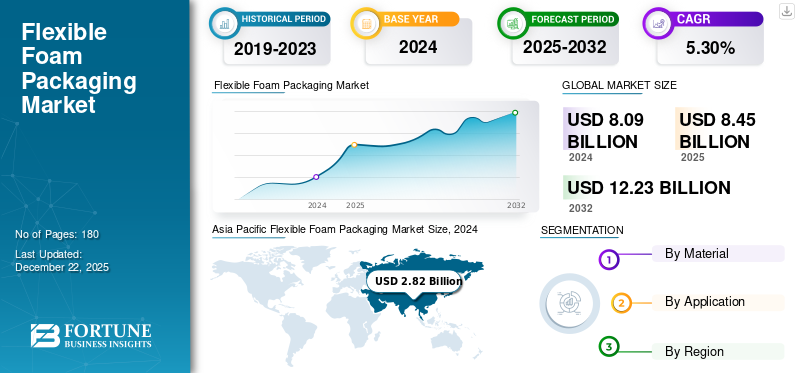
Download Free sample to learn more about this report.
Flexible Foam Packaging Market KEY TAKEAWAYS
 Market Size & Forecast
- 2025 Market Size: USD 2.97 billion
- 2026 Market Size: USD 3.14 billion
- 2034 Forecast Market Size: USD 5.22 billion
- CAGR: 6.57% from 2026–2034
 Market Share
- Asia Pacific dominated the flexible foam packaging market in 2025.
- The polyurethane (PU) segment accounted for the largest market share.
- The automotive segment emerged as the dominant application segment.
 Key Regional Highlights
Asia Pacific
Holds the largest market share, driven by booming e-commerce and strong demand from the automotive and electronics industries.
North America
Growth is supported by rising demand for sustainable packaging and expanding e-commerce activities.
Europe
Growth is driven by strict sustainability regulations and increasing adoption of recyclable foam packaging.
U.S.
Expected to witness steady growth, supported by strong demand for flexible and sustainable packaging.
Japan
Expected to witness steady growth, driven by increasing demand for advanced packaging solutions.
Read More

MARKET DYNAMICS
MARKET DRIVERS
Rapidly Growing Online Shopping Trends Drive Market Growth
Flexible foam packaging has become an essential solution in contemporary packaging due to its protective qualities, lightweight characteristics, and adaptability across various sectors. A major factor contributing to its growth is the swift rise of e-commerce. As consumer demand for online shopping grows, there is also a rising necessity for efficient protective packaging to ensure product safety during shipping. Flexible foam, known for its cushioning and shock-absorbing properties, reduces product damage and returns, making it perfect for shipping electronics, appliances, and other delicate items. Moreover, the increasing need for consumer electronics and delicate devices has strengthened the adoption of foam packaging due to its ability to adapt to different forms and offer customized protection.
- According to a recent study by the United Nations Conference on Trade and Development, in the 43 developed and developing economies analyzed, sales from business e-commerce surpassed the total value of exported goods and services. It is estimated that exports ordered digitally amounted to approximately USD 2.5 trillion in 2021 (between USD 1.6 and USD 4.9 trillion).
MARKET RESTRAINTS
Rising Environmental Concerns and Regulatory Compliance to Hamper Market Expansion
A significant challenge is the environmental impact of traditional flexible foam materials, particularly those produced from petroleum-derived polymers such as polyurethane (PU) and polyethylene (PE). These foams are frequently non-biodegradable, hard to recycle, and add to long-lasting plastic pollution. In response, governments globally are implementing tougher packaging laws designed to minimize plastic waste and encourage recycling. Compliance with these evolving standards requires companies to invest in research and development, adopt innovative raw materials, and conduct testing to confirm that their foam packaging complies with environmental and safety criteria.
- In April 2024, the European Commission established rules regarding plastic packaging, primarily aiming to decrease waste and encourage a circular economy by 2030. These rules, particularly the Packaging and Packaging Waste Directive (PPWD), currently being succeeded by the Packaging and Packaging Waste Regulation (PPWR), are designed to minimize the consumption of virgin materials, enhance the incorporation of recycled content in packaging, and ensure that the recycling of all packaging within the EU market is economically feasible.
MARKET OPPORTUNITIES
Advancements in Manufacturing Technologies to Offer Potential Growth Opportunities
Advancements in manufacturing technologies, including CNC cutting, digital design, and 3D printing, facilitate the accurate and efficient creation of tailored foam inserts, improving user experience and minimizing waste. Additionally, integrating AI in quality control and production processes boosts operational efficiency. The development of battery-free smart packaging with embedded sensors creates growth opportunities. Emerging markets, especially in the Asia Pacific and Latin America, present untapped opportunities due to increasing industrialization, rising disposable incomes, and the growth of the middle class that demands improved product packaging. These factors foster a conducive environment for ongoing expansion and market growth in the flexible foam packaging industry.
- According to a recent study by the European Patent Office, Europe and the U.S. are at the forefront of the worldwide competition for advancements in 3D printing technology. The U.S. occupies the leading position, accounting for 39.8% of all IPFs associated with additive manufacturing from 2001 to 2020. Europe (comprising 39 EPO member countries) closely trails with a 32.9% portion.
FLEXIBLE FOAM PACKAGING MARKET TRENDS
Digital Printing & Sustainability Demands Boom as a Market Trend
Digital printing technologies have evolved significantly in recent years, providing enhanced print quality, quicker turnaround times, and economical customization compared to conventional methods like offset lithography printing. Companies use digital printing for smaller print runs, versioning, and tailored packaging to boost consumer interaction. The circular economy fosters innovations that enhance products' sustainability in flexible materials. Henceforth, the growing sustainability demand and implementation of digital printing are booming as a market trend.
Download Free sample to learn more about this report.
Segmentation Analysis
By Material
Significant Benefits Offered Boosted the Polyurethane Segment Growth
Based on material, the market is segmented into expanded polystyrene (EPS), polyurethane (PU), polyolefin (PO), and others.
The polyurethane segment accounted for the largest share of the market in 2024 due to its exceptional flexibility, ease of fabrication and cutting, and extensive applications across various end-use industries. It protects items from scratches, breaks, dents, and damage while in transit. The increasing adoption of this material in the automotive and electronic sectors, owing to its insulating and antistatic characteristics, is supporting the expansion of this segment.
Expanded polystyrene will continue holding a considerable market share due to its desirable thermal insulation qualities and ability to be shaped into any form or size. The segment's expansion is additionally fueled by its affordable and lightweight characteristics.
By Application
Automotive Segment Dominated the Market due to Properties of Protective Packaging
Based on application, the market is divided into automotive, electrical & electronics, building & construction, medical, food & beverages, military & defense, and others.
Automotive emerged as the dominant segment of the market in 2024. The automotive industry demonstrates a significant demand for protective packaging that provides sound insulation, shock absorption, vibration dampening, and structural support. The packaging foams can meet all these needs, making the automotive sector the primary end-user.
The electrical & electronics segment is expected to grow steadily during the forecast period. Foam packaging provides numerous advantages for electrical and electronic items, such as reliable protection against impacts, vibrations, and electrostatic discharge (ESD). It's also economical, lightweight, and can be tailored to accommodate particular product forms.
Flexible Foam Packaging Market Regional Outlook
By geography, the market is categorized into North America, Europe, Asia Pacific, and the Rest of the World.
Asia Pacific
Asia Pacific Flexible Foam Packaging Market Size, 2024 (USD Billion)
To get more information on the regional analysis of this market, Download Free sample
The Asia Pacific region dominates the global flexible foam packaging market share. The rise in online shopping stimulates the need for protective, lightweight, and compact packaging. Fragile and highly valuable items require cushioning packaging to avoid damage during transportation. There is an increasing focus on reusable and recyclable foam systems, especially within industrial and B2B supply chains. The region's rapidly growing automotive, electronics, and B2B sectors are contributing significantly to the flexible foam packaging market growth.
- According to the China State Council Information Office, China's electronic information manufacturing industry experienced strong growth in 2024, with value added by key enterprises rising by 11.8% compared to the previous year.
North America
North America is the second-largest market for flexible foam packaging. Sustainable development offers the most promising growth opportunity in the region, as manufacturers prioritize eco-friendly packaging alternatives. Moreover, the rapidly growing flexible packaging sector is also cushioning the market expansion. The flexible foam packaging market in the U.S. is seeing notable expansion, fueled by a rising need for sustainable options, the growth of e-commerce, and innovations in packaging technology.
- According to the Flexible Packaging Association, flexible packaging ranks as the second largest segment in the U.S. packaging industry. The largest market for flexible packaging is food (both retail and institutional), representing roughly 50% of deliveries. Additional sectors for flexible packaging consist of pet food – 2%; personal care – 5%; beverages – 6%; other non-food items – 9%; industrial uses – 7%; consumer goods – 2%; and medical and pharmaceutical – 16%.
Europe
Europe is a significant market for flexible foam packaging, with environmental sustainability as a significant market driver. Growing consumer and regulator demand for eco-friendly materials has accelerated the advancement of biodegradable, recyclable, and bio-based foam options, opening up fresh paths for innovation. In support of these trends, the EU likewise enforces regulations to encourage sustainable and circular economy practices, including those for Expanded Polystyrene (EPS) and various foam materials.
- For instance, in December 2024, the European Union implemented the Packaging and Packaging Waste Regulation (PPWR - Regulation (EU) 2025/40) to promote a circular and competitive economy for packaging and associated waste.
Rest of the World
The market in the rest of the world region is expected to witness considerable growth in the near future. With stricter environmental regulations and growing consumer awareness of plastic waste, manufacturers are putting money into eco-friendly foam materials that uphold the same performance criteria in countries such as Saudi Arabia and South Africa. This shift supports the growth of the flexible foam packages market in the region. The market is set for strong growth driven by sustainability and technology innovation. Environmental regulations and recycling challenges are prompting the need for adaptive strategies. Firms investing in bio-based materials, smart packaging, and AI-enhanced production will gain a competitive advantage.
COMPETITIVE LANDSCAPE
Key Industry Players
Key Companies Focus on the Introduction of New Products to Maintain their Dominating Position
The global flexible foam packaging market is consolidated, with key companies such as Sealed Air, Smurfit Kappa, UFP Technologies, Inc., Sonoco Products Company, Jamestown Container Companies, and JSP accounting for a significant market share.
Sealed Air Corporation, currently operating as SEE, is an international packaging firm offering solutions in food safety, product safeguarding, and automation. They provide a broad selection of products, such as Cryovac food packaging, Bubble Wrap padding, and automation solutions like Autobag. SEE's main office is located in Charlotte, North Carolina, and it functions in more than 120 countries.
Smurfit Kappa is a worldwide leader in sustainable, paper-based packaging, functioning in 36 nations with more than 47,000 staff members. They create, manufacture, and provide various paper products, such as corrugated boxes, solidboard, and folding cartons. Their dedication to sustainability is firmly established in their business framework, emphasizing eco-friendly practices.
Additionally, UFP Technologies, Inc. and Sonoco Products Company are among the other prominent players in the market. These companies have strengthened their market positions through significant investments in research & development, leading to the creation of innovative product packaging solutions.
- In September 2024, Sonoco Products Company, a worldwide leader in sustainable, high-value packaging, revealed that it had begun assessing strategic options for its Thermoformed & Flexible Packaging (“TFP”) division, which is part of the Company’s Consumer Packaging segment. This strategic review aims to speed up Sonoco's portfolio simplification strategy, enhance pro forma leverage, and further boost shareholder value.
LIST OF KEY FLEXIBLE FOAM PACKAGING COMPANIES PROFILED
- Sealed Air (U.S.)
- Smurfit Kappa (Ireland)
- UFP Technologies, Inc. (U.S.)
- Sonoco Products Company (U.S.)
- Jamestown Container Companies (U.S.)
- JSP (Japan)
- Zotefoams plc (U.K.)
- The Supreme Industries Ltd (India)
- Carpenter Co. (U.S.)
- Atlas Molded Products (U.S.)
- Atlas Foam Products (U.S.)
- Storopack (Germany)
- Conner Industries Inc. (U.S.)
- Wisconsin Foam Products (U.S.)
- Epack India (India)
KEY INDUSTRY DEVELOPMENTS
- February 2024: Pregis introduced an advancement in foam technology utilizing certified circular polyethylene resins. In partnership with ExxonMobil, a pioneer in advanced recycling technology, Pregis provides protective foam packaging to assist customers in achieving their plastics circularity objectives.
- January 2024: In its ongoing efforts to create packaging materials that align with its customers' sustainability objectives, global packaging solutions provider SEE unveiled the first biobased, industrial compostable tray for protein packaging, which has been effectively tested to satisfy the requirements of current food processing equipment. Created to provide equivalent performance and stability to EPS foam trays, SEE’s lightweight tray has been subjected to thorough testing throughout the food value chain.
- February 2023: Cruz Foam, located in Santa Cruz, California, launched a new line of protective packaging items designed for shipping delicate and temperature-sensitive products. The firm asserts that its proprietary compostable foam outperforms conventional plastic-based alternatives and exceeds existing industry benchmarks for sustainability.
- November 2022: Storopack introduced the FOAMplus protective packaging solution. Storopack’s FOAMplus foam packaging offers a premium protective packaging option that conforms to the product's shape and safeguards items during transit from harm caused by impact, shock, and vibration.
- December 2022: EFP announced the acquisition of NatureKool, Incorporated, a company located in North Carolina that is the world's first shipper insulated with natural fibers. This acquisition marks the next step in EFP’s initiative to offer a comprehensive range of high-quality, consistent cold chain packaging solutions in the U.S. market.
REPORT COVERAGE
Request for Customization to gain extensive market insights.
Report Scope & Segmentation
|
ATTRIBUTE |
DETAILS |
|
Study Period |
2021–2034 |
|
Base Year |
2025 |
|
Estimated Year |
2026 |
|
Forecast Period |
2026-2034 |
|
Historical Period |
2021–2024 |
|
Growth Rate |
CAGR of 6.57% from 2026-2034 |
|
Unit |
Value (USD Billion) |
|
Segmentation |
By Material
|
|
By Application
|
|
|
By Region
|
Frequently Asked Questions
Fortune Business Insights says that the global market value stood at USD 2.97 billion in 2025 and is projected to reach USD 5.22 billion by 2034.
In 2025, the market value stood at USD 2.82 billion.
The market is expected to grow at a CAGR of 6.57% during the forecast period.
By application, the automotive segment led the market.
The key factor driving the market is the rapidly growing online shopping trends.
Sealed Air, Smurfit Kappa, UFP Technologies, Inc., Sonoco Products Company, Jamestown Container Companies, and JSP are the top players in the market.
Asia Pacific dominates the market.
Increased demand from the automotive sector is one of the factors that is expected to favor product adoption.



- 2021-2034
- 2025
- 2021-2024
- 180
-
(Offer valid till 31st Oct 2026)
Get 30-60 hrs Free Customization
Expand Regional and Country Coverage, Segments Analysis, Company Profiles, Competitive Benchmarking, and End-user Insights.








Related Reports
-
US +1 833 909 2966 ( Toll Free )
-
Get In Touch With Us