Food Starch Market Size, Share & Industry Analysis, By Product Type (Native Food Starch {Corn Starch, Wheat Starch, Rice Starch, and Others}, Modified Food Starch {Chemically Modified Starch, Physically Modified Starch, and Enzymatically Modified Starch}, and Specialty Food Starch {Pregelatinized Starch, Resistant Starch, and Others}), By Form (Dry and Liquid), and By Application (Bakery & Confectionery, Snacks & Convenience Foods, Soups, Sauces & Gravies, Dairy & Frozen Desserts, and Others), and Regional Forecast, 2026-2034
 Download Free Sample
(Offer valid till 15th Oct 2026)

Food Starch Market Size & Future Outlook
 Listen to Audio Version
The global food starch market size was valued at USD 23.74 billion in 2025. The market is projected to grow from USD 25.01 billion in 2026 to USD 38.68 billion by 2034, exhibiting a CAGR of 5.60% during the forecast period. Asia Pacific dominated the food starch market with a market share of 45.07% in 2025.
Food starch is a carbohydrate-based component extracted from cassava, potato, pea, wheat, and corn. This ingredient comprises amylopectin polymers and amylose and is utilized as a texturizer, stabilizer, and binder in a vast range of processed beverage and food products. A few of the common types of starch include native starch, specialty starch, and modified starch. With respect to sensory attributes, this food starch offers a neutral odor and taste and is white/off-white in appearance. Moreover, it contributes to gel formation, creaminess, and crispiness, especially in snacks.
The market includes key companies such as Ingredion Incorporated, Cargill Incorporated, and AGRANA Beteiligungs AG. New product launches are a pivotal strategy adopted by market players to improve their position.
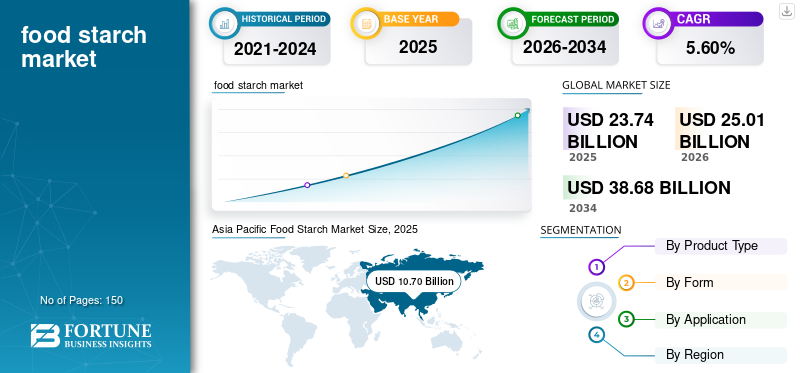
Download Free sample to learn more about this report.
FOOD STARCH MARKET KEY TAKEAWAYS
 Global Market Size & Forecast
- 2025 Market Size: USD 23.74 billion
- 2026 Market Size: USD 25.01 billion
- 2034 Forecast Market Size: USD 38.68 billion
- CAGR: 5.60% from 2026–2034
 Market Share
- Asia Pacific dominated the food starch market with a 45.07% share in 2025.
- Native food starch dominated the market due to lower processing complexity.
- Dry food starch led the market due to longer shelf life and minimal moisture.
 Key Regional Highlights
Asia Pacific
Asia Pacific dominated with a USD 10.70 billion market size in 2025, representing 45.07% of global revenue.
Europe
Europe ranked second with a USD 5.79 billion market size in 2025 and is projected to grow at a 5.15% rate.
North America
North America ranked third with a USD 4.56 billion market size in 2025, supported by demand for functional ingredients.
U.S.
The U.S. food starch market reached USD 3.70 billion in 2025, accounting for approximately 15.57% of global sales.
Japan
Japan’s food starch market reached USD 1.25 billion in 2025, representing approximately 5.28% of global revenue.
Read More

FOOD STARCH MARKET TRENDS
Increasing Use of Food Starch in Infant Nutrition Fuels the Ongoing Market Trend
The global market is witnessing a remarkable and growing trend in food starch for the infant nutrition sector. In specialized pediatric nutrition products, infant cereals, and follow-on formulas, refined starches, especially rice starch, are valued for their low allergenicity and high digestibility. Their mild nature makes them ideal for minimizing digestive discomfort and gastrointestinal tolerance. Moreover, clean-label positioning is another key aspect in this segment, which increases the use of physically modified or native food starches rather than chemically modified derivatives. In addition, these starches also enhance the texture and stability of infant purees. By seeing such advantages, the manufacturers in the operating space are aiming to introduce new products for infants.
MARKET DYNAMICS
MARKET DRIVERS
Download Free sample to learn more about this report.
Expansion of Frozen Food and Ready Meals Boosts the Usage of Food Starch
The expansion of the ready meals and frozen food sector is a pivotal driver strengthening the usage of starch. These finished products undergo various processing steps such as rapid freezing, cooking, and reheating, all of which pose stress on the product’s stability and structure. Food starch plays a substantial role in maintaining product stability, viscosity, and textures throughout these steps. In the frozen foods category, the incorporation of starch primarily contributes to freeze-thaw stability, helping gravies and sauces retain their smoothness. Moreover, it maintains the texture and mouthfeel of ready and frozen meals even after reheating or microwaving. Additionally, it avoids water release during thawing in chilled/frozen foods, which is one of the key hurdles. Thus, such advantages improve its acceptability across foodservice and household purposes.
MARKET RESTRAINTS
Fluctuations in Raw Materials and Competition from Alternative Ingredients Hamper the Market
One of the key challenges in the global market is variations in raw material components. Globally, the production of food starch is highly dependent on agrarian commodities such as rice, corn, peas, and potatoes. Variations in crop yields, majorly owing to trade restrictions, climatic variability, and geopolitical disruptions, substantially increase food starch manufacturing costs. Increasing input costs such as transportation, fertilizers, and energy further fuel price volatility. Since food producers mostly operate on tight margins and under fixed contracts, a sudden spike in starch costs cannot be fully transferred to consumers, leading to delayed purchasing and margin compression.
Intense competition from alternative components is another difficulty in the industry. The food starch products face tough competition from alginates, xanthan gum, and carrageenan. In various food applications, especially plant-centric beverages, dairy, and sauces, these components offer stability and viscosity at minimal levels. As a result, such factors impede the global food starch market growth.
MARKET OPPORTUNITY
Technological Advancements in the Starch Sector Reveal Several Growth Opportunities
The usage of advanced technologies in the starch industry unlocks growth opportunities in the global market. To minimize lump formation and improve dispersibility, food manufacturers in the starch sector are using instantization and cold-water swelling technologies. These modern techniques allow food starch to hydrate quickly in cold systems. Wet milling technologies are another method gaining traction, enhancing starch yield while minimizing energy and water consumption. Moreover, producers are adopting precision enzymatic technologies that can easily modify the starch structure, thereby strengthening properties such as gel clarity and freeze thaw stability. In addition, starch producers are also using hydrothermal processing and drum drying to strengthen starch functionality.
Segmentation Analysis
By Product Type
Native Food Starch Segment Dominated the Market Owing to Lower Processing Complexity
Based on the product type, the market is distributed into native food starch, modified food starch, and specialty food starch. The native food starch is further segmented into corn starch, wheat starch, rice starch, and others. The modified food starch is further segmented into chemically modified starch, physically modified starch, and enzymatically modified starch. The specialty food starch is further segmented into pregelatinized starch, resistant starch, and others.
The native food starch segment led the global market in 2025. Compared with specialty and modified starches, native starch is economical because it requires minimal processing and fewer additional treatment steps. This component faces limited regulatory challenges than modified starches, which improves its utilization rate. Moreover, owing to its lower processing complexity, native starch can be easily integrated into regular food formulations. Additionally, it eliminates the risk of chemical residues, which further enhances growth. Thus, the aforementioned factors propel the market’s potential.
Specialty food starches are projected to grow at a high CAGR of 7.32% over the forecast period.
By Form
Dry Segment Led the Market Due to Longer Shelf Life and Minimal Moisture
Based on the form, the market is bifurcated into dry and liquid.
In 2025, the dry category led the global industry. Dry starch has a substantially longer shelf life than liquid starch, as it contains minimal moisture, reducing the risk of spoilage. Compared to other forms of starch, dry food starch is safer and easier to transport, especially over long distances. Moreover, it requires basic packaging materials, such as bulk containers and paper bags, without specialized handling systems. Additionally, dry starch has high formulation flexibility and can be easily incorporated into bakery and premix formulations. As a result, the aforementioned factors boost the segment’s momentum.
The liquid segment is projected to grow at a high CAGR of 9.80% over the forecast period.
By Application
To know how our report can help streamline your business, Speak to Analyst
Bakery & Confectionery Leads the Market Owing to High Usage of Food Starch in Baked Goods
Based on application, the market is segmented into bakery & confectionery, snacks & convenience foods, soups, sauces & gravies, dairy & frozen desserts, and others.
Bakery & confectionery dominated the global food starch market share in 2025. In the bakery sector, food starch plays a key role in batter and dough systems. During the process of baking, starch gelatinizes with proteins and gluten to create the crumb structure. This ingredient is also known to improve mouthfeel and elasticity in pastries and cakes. Moreover, in the confectionery industry (fondants, jellies, and gummies), it controls chewiness and gel strength. Additionally, it offers neutral color and taste in the confectionery and bakery sector, further boosting its usage. Thus, these factors drive market growth.
The snacks & convenience foods segment is projected to grow at a high CAGR of 8.42% over the forecast period.
Food Starch Market Regional Outlook
By region, the market is categorized into Europe, North America, Asia Pacific, South America, and the Middle East & Africa.
Asia Pacific
Asia Pacific Food Starch Market Size, 2025 (USD Billion)
To get more information on the regional analysis of this market, Download Free sample
Asia Pacific dominated the market, reaching a valuation of USD 10.70 billion in 2025. The rising consumer preference for ready to eat food products and increased demand for clean label starch are key factors boosting the region’s growth. In the region, India and China were valued at USD 2.12 billion and USD 5.05 billion, respectively, in 2025.
India Food Starch Market
The Indian market in 2025 reached USD 2.12 billion, accounting for roughly 8.92% of global market revenues. The rising demand for corn starch products and the surging inclination toward baked goods are driving the market.
China Food Starch Market
China's market is one of the largest globally, with revenues of USD 5.05 billion in 2025, representing roughly 21.27% of global sales.
Japan Food Starch Market
Japan’s market in 2025 reached USD 1.25 billion, accounting for approximately 5.28% of the global revenues.
Europe
Europe reached USD 5.79 billion in 2025 and is expected to grow at 5.15% over the forecast period, securing second place. The high use of starch derivatives in soups and gravies, along with new product launches, propels the region’s potential.
Germany Food Starch Market
The Germany market in 2025 was valued at USD 1.28 billion, representing roughly 5.39% of the global market revenues.
U.K. Food Starch Market
The U.K. market reached at USD 0.95 billion in 2025, equivalent to around 4% of the global market sales.
North America
The North American market reached a valuation of USD 4.56 billion in 2025 and ranked third position. The market in North America is expected to grow over the forecast period due to advancements in technology and increasing demand for functional ingredients. Moreover, the growing health & wellness trends and surging preference for plant-based alternatives are driving regional growth.
U.S. Food Starch Market:
Based on North America’s strong contribution and the U.S. dominance within the region, the U.S. market accounted for USD 3.70 billion in 2025, with a roughly 15.57% of global sales.
South America and the Middle East & Africa
The South America and Middle East & Africa regions are expected to witness moderate growth in the market during the forecast period. The South America market reached a valuation of USD 1.48 billion in 2025. The growing private label players and strong e-commerce network are expected to drive the regional growth. The Middle East and Africa market accounted for a valuation of USD 1.21 billion in 2025.
South Africa Food Starch Market
The South African market reached around USD 0.54 billion in 2025, representing roughly 2.29% of global revenues.
COMPETITIVE LANDSCAPE
Key Industry Players
Launching New Products Help the Key Companies to Improve Their Market Position
The market is fragmented, with intense competition among the key players. In this market, the key companies are primarily adopting new product launches as the main strategy. Moreover, the firms are focusing on expanding their production base by opening new plants, thereby adding value to their growth. Through this approach, the players operating in the market can cater to rising consumer demands and enhance their brand image.
LIST OF KEY FOOD STARCH COMPANIES PROFILED
- Roquette Frères (France)
- Ingredion Incorporated (U.S.)
- Emsland Group (Germany)
- Archer-Daniels-Midland Company (U.S.)
- Cargill, Incorporated (U.S.)
- AGRANA Beteiligungs-AG (Austria)
- Tereos S.A. (France)
- Avebe (Netherlands)
- Tate & Lyle PLC (U.K.)
- BENEO (Germany)
KEY INDUSTRY DEVELOPMENTS
- October 2025: Roquette Frères, a French plant-based ingredients firm, unveiled its new soluble pea starch, “AMYSTA L 123,” for the food processing industry. Owing to its enhanced product uniformity, it is suitable for condiment mixes, ready-to-mix drinks, and dried soup.
- October 2025: Al Ghurair Foods, a subsidiary of the Al Ghurair Group, a company based in the UAE, announced the completion of its first corn starch plant at Khalifa Economic Zones Abu Dhabi (Kezad).
- August 2024: Roquette Frères, a vegan raw ingredients producer in France, expanded its texturizing solutions range by adding four new tapioca-based starches.
- February 2024: Ingredion Incorporated, an American specialty ingredients producer, introduced NOVATION Indulge 2940, a functional native corn starch that can be used in desserts and dairy alternative products.
- March 2022: Ingredion Incorporated, an ingredient solutions manufacturer in the U.S., launched its Novation Lumina 8600 and 8300 clean-label rice starches in Europe, the Middle East & Africa. This product is designed to enhance the flavor and color of the end product.
REPORT COVERAGE
The global food starch market provides an in-depth study of the market size & forecast by all the market segments included in the report. The market forecast analysis contains details on the market dynamics and trends, which are expected to drive the market during the forecast period. The global market analysis offers information on the technological advancements, new product launches, key industry developments, and details on partnerships, mergers & acquisitions. The food starch industry market forecast also encompasses a detailed competitive landscape with information on the market segmentation, market share, and profiles of key operating players.
Request for Customization to gain extensive market insights.
Report Scope & Segmentation
| ATTRIBUTE | DETAILS |
| Study Period | 2021-2034 |
| Base Year | 2025 |
| Estimated Year | 2026 |
| Forecast Period | 2026-2034 |
| Historical Period | 2021-2024 |
| Growth Rate | CAGR of 5.60% from 2026-2034 |
| Unit | Value (USD Billion) |
| Segmentation | By Product Type, Form, Application, Region |
| By Product Type |
|
| By Form |
|
| By Application |
|
| By Region |
North America (By Product Type, Form, Application, and Country)
Europe (By Product Type, Form, Application, and Country)
Asia Pacific (By Product Type, Form, Application, and Country)
South America (By Product Type, Form, Application, and Country)
Middle East and Africa (By Product Type, Form, Application, and Country)
|
Frequently Asked Questions
Fortune Business Insights says that the global market value stood at USD 23.74 billion in 2025 and is projected to reach USD 38.68 billion by 2034.
In 2026, the market value stood at USD 11.40 billion.
The market is expected to exhibit a CAGR of 5.60% during the forecast period.
By form, the dry segment led the global market in 2025.
Expansion of frozen food and ready meals boosts the use of food starch.
Ingredion Incorporated, Cargill, Incorporated, and AGRANA Beteiligungs AG are among the key players in the food starch market.
Asia Pacific held the largest market share in 2025.
Increasing use of food starch in infant nutrition is an ongoing trend.



- 2021-2034
- 2025
- 2021-2024
- 150
-
(Offer valid till 15th Oct 2026)
Get 30-60 hrs Free Customization
Expand Regional and Country Coverage, Segments Analysis, Company Profiles, Competitive Benchmarking, and End-user Insights.




















Related Reports
-
US +1 833 909 2966 ( Toll Free )
-
Get In Touch With Us