Food Thickening Agents Market Size, Share & Industry Analysis, By Type (Starch-based Thickening Agents {Corn starch, Potato starch and Others}, Hydrocolloid-based Thickening Agents {Xanthan gum, Guar gum, Gelatin and Others}, Protein-based Thickening Agents {Egg-based thickeners, Collagen-derived systems and Others} and Others), By Source (Plant-based, Animal-based, Microbial/Fermentation-based and Synthetic/Semi-Synthetic), By Form (Dry and Liquid), By Application (Bakery & Confectionery, Dairy & Frozen Desserts, Meat, Poultry & Seafood Products, & Others), and Regional Forecast, 2026-2034
 Download Free Sample
(Offer valid till 31st Oct 2026)

Food Thickening Agents Market Size and Future Outlook
 Listen to Audio Version
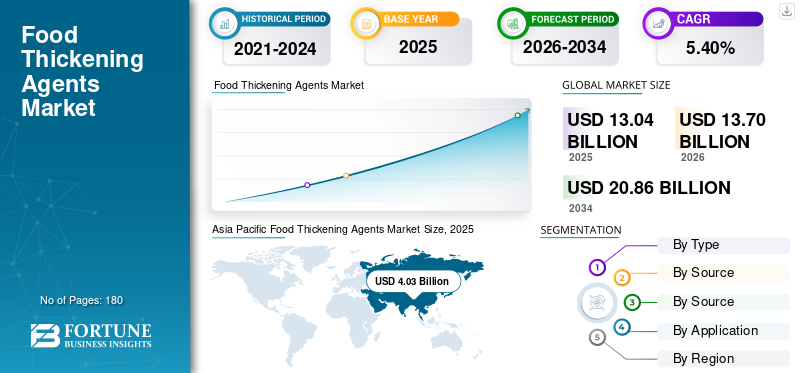
The food thickening agents market size was valued at USD 13.04 billion in 2025. The market is projected to grow from USD 13.70 billion in 2026 to USD 20.86 billion by 2034, exhibiting a CAGR of 5.40% during the forecast period. Asia Pacific dominated the food thickening agents market with a market share of 30.9% in 2025.
Food thickening agents are substances added to foods and beverages to increase viscosity, improve texture, stability, and mouthfeel. Common examples include starches, gums (xanthan, guar), pectin, gelatin, and cellulose derivatives. They are widely used in sauces, soups, dairy, bakery, and processed foods.
The market is growing rapidly due to rising demand for convenience and processed foods, clean-label and plant-based ingredients, and improved food formulations. Additionally, expansion in the foodservice industry, increasing health awareness, and technological advancements in food processing are also driving adoption globally, especially in emerging markets.
Companies such as Ingredion Incorporated, Tate & Lyle PLC, and Cargill Incorporated, are some of the players in the market. New product launch is the key strategy which is boosting product sales and supporting the market growth.
Download Free sample to learn more about this report.
Food Thickening Agents Market Key Takeaways
 Market Size & Forecast
- 2025 Market Size: USD 13.04 billion
- 2026 Market Size: USD 13.70 billion
- 2034 Forecast Market Size: USD 20.86 billion
- CAGR: 5.40% from 2026–2034
 Market Share
- Asia Pacific dominated the food thickening agents market with a 30.9% share in 2025.
- The Starch-Based Thickening Agents segment held the largest market share in 2025.
- The Processed Foods & Convenience Foods segment accounted for the largest market share in 2025.
 Key Regional Highlights
North America
North America market valued at USD 3.54 billion in 2025.
Asia Pacific
Asia Pacific market valued at USD 4.03 billion in 2025.
Europe
Europe market valued at USD 3.90 billion in 2025.
U.S.
Market valued at USD 2.94 billion in 2025.
Japan
Market valued at USD 0.63 billion in 2025.
Read More

FOOD THICKENING AGENTS MARKET TRENDS
Shift Toward Natural, Multifunctional Ingredients Drives Product Innovation
A major market trend positively influencing the market is the move toward natural, less processed ingredients, which is increasing demand for hydrocolloids derived from plants and seaweed. Manufacturers are currently seeking ingredients that can thicken, stabilize, and emulsify simultaneously. There is also growing interest in cold-soluble and instant thickeners which is leading toward research and development initiatives and product innovation. Sustainability and traceability in sourcing raw materials are also significant throughout the supply chain.
MARKET DYNAMICS
MARKET DRIVERS
Download Free sample to learn more about this report.
Rising Processed Food Consumption Accelerates Demand for Texture-Enhancing Ingredients
The market for food thickening agents is growing mainly due to people want processed and convenience foods that require good texture, stability, and a longer shelf-life. With rising urbanization, and growing adoption of west style dietary changes, and the growth in ready-to-eat meals there is a growing use of thickening agents. There is also increasing interest in clean-label, plant-based ingredients, which has increased the use of natural thickeners such as pectin and guar gum. Growth in the foodservice industry and new product innovations are also driving market expansion and is one of the key driver influencing the food thickening agents market growth.
MARKET RESTRAINTS
Raw Material Price Volatility and Regulatory Pressures Limit Market Expansion
Market growth is limited by changing prices for raw materials, especially agricultural inputs such as corn, cassava, and seaweed. Supply chain problems and reliance on weather conditions also affect availability. Strict food safety rules and labeling requirements raises compliance costs. Consumers may be hesitant to adopt these products due to concerns about synthetic additives and possible digestive problems associated with some gums.
MARKET OPPORTUNITIES
Growing Preference for Clean-Label and Plant-Based Products Creates New Growth Avenues
Developing clean-label, organic, and non-GMO thickening agents can help meet changing consumer preferences and offer a strong business opportunity. As more plant-based and vegan foods become popular, there is a growing demand for plant based thickeners alternatives to gelatin and synthetic thickeners. Rising consumer demand for clean label products is driving manufacturers to increasingly adopt natural, plant-based thickening agents, thereby accelerating innovation and reshaping the product demand.
Segmentation Analysis
By Type
Abundant Raw Material Availability and Low Cost Drive Dominance of Starch-Based Thickening Agents
The market is segmented by type into starch-based thickening agents, hydrocolloid-based thickening agents, protein-based thickening agents and others.
The starch-based thickening agents segment held the largest food thickening agents market share in 2025. They are widely available, affordable, and can be used in different types of food. Starches come from common sources such as corn, potatoes, and tapioca. Such raw materials cost much less than most hydrocolloids, and hence they are often chosen for large-scale food production. Starches are widely used as they give products including sauces, soups, bakery fillings, and ready meals the right thickness, texture, and bulk. Consumers are familiar with starches, and those which are naturally sourced, fit well with clean-label trends.
The hydrocolloid-based thickening agents holds the second-largest market share, and is expected to grow at a CAGR of 5.44% during the forecast period. Hydrocolloid-based thickening agents are popular as they offer strong stability, aid emulsification, and perform well even when pH, temperature, or freeze-thaw conditions change. Ingredients such as xanthan gum, guar gum, and carrageenan are key to premium and specialized products, such as dairy alternatives and glutenfree foods. However, these ingredients cost more and have a narrower range of use, hence are less common than starch-based options.
By Source
Rising Demand for Vegan and Clean-Label Foods Increases Adoption of Plant-Based Ingredients
Based on source, the market is segmented into plant-based, animal-based, microbial/fermentation-based and synthetic/semi-synthetic.
Plant-based sources segment accounted for the largest market share in 2025. They are widely available, cost-effective, and match changing consumer preferences. Crops such as corn, potato, cassava, and guar are grown across many regions, helping in stabilizing supply chain. Due to this, manufacturers choose plant-based thickening agents for large-scale food production. Also, growing number of consumers demand vegan, vegetarian, and clean-label products, which has led to greater use of plant-based ingredients and made them even more popular. Rising demand for gluten free products is driving increased adoption of alternative thickening agents,
Animal-based sources make up the second-largest share of the market is expected to grow at a CAGR of 5.20% during the forecast period Animal-based ingredients are used in some foods as they offer benefits, especially in products that require gelling or texture, such as gelatin in candy and dairy products. However, the raw materials are limited, the costs are higher, and more people are concerned about animal welfare, dietary needs, and religious beliefs.
By Form
Longer Shelf Life and Higher Storage Stability Increase Preference for Dry Thickening Agents
The market is segmented, by form into dry and liquid.
The dry form led the global market in 2025 as they are more stable, last longer, and are easier to store and transport. Powdered and granulated dry thickening agents are less likely to spoil and do not require preservatives, helping lower handling costs. Hence, manufacturers choose dry forms for large-scale production and worldwide shipping. Dry formats also make it easier to adjust doses and mix into different food products, especially processed and packaged foods, which adds to their popularity. Increasing focus on products projected to enhance texture and stability is driving the adoption of advanced thickening agents, thereby strengthening growth in the global market.
Liquid is another major segment that has a CAGR of 5.69% during the forecast period. Users often choose liquid form as it is convenient for applications that require quick dispersion and easy mixing, especially in foodservice and industrial processing. However, the liquid form is not as common as the dry forms as it does not last as long, is more expensive to transport, and requires special storage conditions.
By Application
To know how our report can help streamline your business, Speak to Analyst
Rising Demand for Ready-to-Eat Meals Increases Use of Thickening Agents in Processed and Convenience Foods
The market is segmented, by application into bakery & confectionery, dairy & frozen desserts, meat, poultry & seafood products, processed foods & convenience foods, beverages and others.
The processed and convenience foods segment led the global market in 2025. The segment holds the largest market share as ready-to-eat and packaged products need better texture, stability, and longer shelf life. These foods use thickening agents to maintain their consistency during processing, storage, and reheating. As a result, more thickening agents are used in products such as soups, sauces, ready meals, and instant mixes.
Bakery & confectionery segment accounted for the second largest market share in 2025 and are expected to register a CAGR of 5.92% during the forecast period. Bakery and confectionery use thickening agents mainly to improve texture, help retain moisture, and strengthen the structure of products such as cakes, fillings, and gels.
Food Thickening Agents Market Regional Outlook
By geography, the market is categorized into Europe, North America, Asia Pacific, South America, and Middle East & Africa.
Asia Pacific
Asia Pacific Food Thickening Agents Market Size, 2025 (USD Billion)
To get more information on the regional analysis of this market, Download Free sample
The Asia Pacific market was valued at USD 4.03 billion in 2025 and is the leading region globally. Asia Pacific is growing rapidly due to industrialization, urbanization and growth in the food processing industry. Consumers are demanding more convenience food as well as traditional dishes that need thickening agents, which is raising demand. China, India, and Japan are significant markets as they have large populations and evolving dietary habits. There are plenty of raw materials, such as cassava and guar, in the region, which help boost production.
India Food Thickening Agents Market
The India market in 2025 was valued around USD 0.54 billion, accounting for roughly 4.40% of global market revenues.
China Food Thickening Agents Market
China’s market in 2025 was valued around USD 1.39 billion, representing roughly 10.67% of market share. China’s market is growing quickly as the food industry continues to expand and people consume processed and convenience foods. China produces a lot of starch-based thickeners as it has ample raw materials, such as corn and cassava. The growth of foodservice and e-commerce is also increasing demand.
Japan Food Thickening Agents Market
The Japan market in 2025 reached a valuation of around USD 0.63 billion, accounting for roughly 4.82% of global market revenues.
North America
The market in North America reached a valuation of USD 3.54 billion in 2025. North America is a well-established market, due to customers demanding processed and convenience foods. The region’s many top food manufacturers and advanced processing technologies help maintain steady demand for thickening agents. Trends such as clean-label products and growing interest in plant-based foods are also accelerating the adoption of natural thickeners. The U.S. leads the region due to its large packaged food industry, and ongoing innovation in functional ingredients is driving market growth.
U.S. Food Thickening Agents Market
In 2025, the U.S. market reached USD 2.94 billion. The U.S. leads the North American market due to its large and advanced food processing industry. Customer’s strong preference for convenience foods, ready-to-eat meals, and bakery products has led to greater use of thickening agents. As more consumers look for clean-label products and natural ingredients, the move toward plant-based thickeners is growing. New food formulations and the strong role of major food manufacturing companies are helping the market grow.
Europe
The European market reached a valuation of USD 3.90 billion in 2025. Europe is experiencing steady growth, thanks to strict food regulations and a strong demand for clean-label and organic ingredients. Many consumers now choose natural hydrocolloids and starches, especially for bakery and dairy products. Germany, France, and the U.K. are leading as they have strong, established food industries. Trends such as sustainability and traceability are shaping how ingredients are sourced and produced. At the same time, changes in processed food recipes are keeping demand steady.
Germany Food Thickening Agents Market
The market in Germany in 2025 reached around USD 0.78 billion, representing roughly 5.95% of global market revenues. Germany stands out in Europe due to its strong food manufacturing industry and a high demand for quality, natural ingredients. Strict regulations help maintain high product quality. At the same time, new food technology and reformulation efforts are keeping the market growing steadily.
U.K. Food Thickening Agents Market
The U.K. market reached approximately USD 0.54 billion in 2025, equivalent to around 4.12% of global market sales. The need for improved texture in processed and convenience foods is driving increased utilization of advanced thickening agents, thereby enhancing product quality and boosting demand in the market.
South America and Middle East & Africa
Over the forecast period, South America is expected to experience significant growth in this market. The South America market in 2025 recorded USD 0.99 billion. South America is experiencing steady growth, driven by expanding food processing industries and rising urbanization. Brazil and Argentina play a major role, as more people in these countries are buying packaged and convenience foods. The region’s strong agricultural sector provides the raw materials for starch-based thickeners. Middle East & Africa region reached a valuation of USD 0.58 billion in 2025. The market in the Middle East & Africa is seeing steady growth as more people demand for processed foods rises, and the retail sector expands. Countries such as the UAE and Saudi Arabia are leading as people have more disposable income, and lifestyles are changing. In Africa, growth is helped by the slow industrialization of the food sector. However, relying on imports and having limited local processing facilities can hold back progress. Expanding applications across processed foods and increasing industrial utilization are driving efforts to accurately source the market, reflecting its growing economic significance.
UAE Food Thickening Agents Market
UAE market is set to grow at a CAGR of 4.09% during the forecast period. The UAE market continues to grow, driven by its strong dependence on imported processed foods and a fast-growing foodservice industry. The country serves as a regional hub for food trade, which helps the market grow. Rising demand for halal-certified and clean-label ingredients is shaping product choices. Continued investment in food manufacturing is also boosting growth opportunities.
COMPETITIVE LANDSCAPE
Key Industry Players
Intensifying Competition and Innovation in Clean-Label Solutions Drive Strategic Expansion Among Key Market Players
The food thickening agents market includes both global ingredient manufacturers and regional companies. These businesses compete based on how their products work, their prices, and their ability to innovate. Major companies such as Cargill Incorporated, ADM, Ingredion, Tate & Lyle, and Kerry Group lead the market. They offer a wide range of products, have strong distribution networks, and invest in research and development. These companies are working on clean-label, plant-based, and multifunctional ingredients to meet changing consumer preferences. Mergers, acquisitions, and partnerships are common strategies for companies looking to grow their reach and improve their technology. Companies are also investing more in sustainable sourcing and traceability to build stronger brands. Innovation in hydrocolloids and modified starches, along with customized solutions for specific applications, remains a key competitive differentiator in this market.
LIST OF FOOD THICKENING AGENTS COMPANIES PROFILED IN REPORT
- Ingredion Incorporated (U.S.)
- Tate & Lyle PLC (U.K.)
- Cargill Incorporated (U.S.)
- Kerry Group plc (Ireland)
- International Flavors & Fragrances (IFF) (U.S.)
- dsm-firmenich (Switzerland)
- Ashland Inc. (U.S.)
- ADM (U.S.)
- Jungbunzlauer Suisse AG (Switzerland)
- CP Kelco (U.S.)
KEY INDUSTRY DEVELOPMENTS
- January 2026: Emsland Group has introduced a plant-based functional starch designed to help vegan and vegetarian confectionery makers. The ingredient Emjel LC 15 enables the creation of gelatin-free jellies and gums with smoother, more elastic textures.
- January 2026: Ingredion Incorporated, a top global supplier of specialty ingredients for the food and beverage industry, has launched NOVATION Indulge 2940 starch. The company has expanded its line of clean-label texturizers by introducing a non-GMO functional native corn starch.
- May 2025: AGRANA, a global Austrian company that makes specialty starch ingredients, is adding a new line of clean-label starches, AGENAPURE, to its product range. These high-performance starches are made from raw materials grown in Europe and designed to meet the evolving needs of the food manufacturing industry.
- August 2024: Roquette, a company known for plant-based functional ingredients, has added four new tapioca-based starches to its range of texturising solutions. The new CLEARAM range, including CLEARAM TR 2010, TR 2510, TR 3010, and TR 4010, is designed to improve the thickness and texture of foods such as sauces and dairy desserts.
- August 2024: Roquette, a global leader in plant-based ingredients and pharmaceutical excipients, added four new tapioca-based cook-up starches to its texturizing solutions. The new grades are CLEARAM TR 2010, CLEARAM TR 2510, CLEARAM TR 3010, and CLEARAM TR 4010. These new starches were created to help food manufacturers achieve the right texture and to work well with other plant-based ingredients in the product line.
REPORT COVERAGE
The global food thickening agents market research provides an in-depth study of market size & forecast by all the market segments included in the report. The market analysis includes details on the market dynamics and market trends expected to drive the market during the forecast period. It offers information on the technological advancements, new product launches, key industry developments, and details on partnerships, mergers & acquisitions. The food thickening agents forecast also encompasses detailed competitive landscape with information on the market segmentation, market share and profiles of key operating players.
Request for Customization to gain extensive market insights.
Report Scope & Segmentation
| ATTRIBUTE | DETAILS |
| Study Period | 2021-2034 |
| Base Year | 2025 |
| Estimated Year | 2026 |
| Forecast Period | 2026-2034 |
| Historical Period | 2021-2024 |
| Growth Rate | CAGR of 5.40% from 2026-2034 |
| Unit | Value (USD Billion) |
| Segmentation | By Type, By Source, By Form, By Application, and Region |
| By Type |
|
| By Source |
|
| By Form |
|
| By Application |
|
| By Region |
|
Frequently Asked Questions
Fortune Business Insights says that the global market value stood at USD 13.04 billion in 2025 and is projected to reach USD 20.86 billion by 2034.
In 2025, the Asia Pacifics market value stood at USD 4.03 billion.
The market is expected to exhibit a CAGR of 5.40% during the forecast period of 2026-2034.
By application, processed foods & convenience foods segment led the global market.
Rising processed food consumption accelerates demand for texture-enhancing ingredients.
Ingredion Incorporated, Tate & Lyle PLC, and Cargill Incorporated are a few of the players in the market.
Asia Pacific held the largest market share in 2025.
Shift toward natural, multifunctional ingredients drives product innovation is a major market trend.



- 2021-2034
- 2025
- 2021-2024
- 180
-
(Offer valid till 31st Oct 2026)
Get 30-60 hrs Free Customization
Expand Regional and Country Coverage, Segments Analysis, Company Profiles, Competitive Benchmarking, and End-user Insights.


















Related Reports
-
US +1 833 909 2966 ( Toll Free )
-
Get In Touch With Us