Functional Mushroom Ingredients Market Size, Share & Industry Analysis, By Species Composition (Lion's Mane, Reishi, Cordyceps, Chaga, and Turkey Tail), By Ingredient Processing Architecture (Non-Extracted Biomass, Extracted Concentrates, and Purified Fractions), By Form (Dry Powder, Liquid Extracts, and Oil-Based Ingredients), By Nature (Conventional and Organic), By Application (Functional Foods [Nutrition Bars and Bakery Products], Functional Beverages [Mushroom Coffee and Tea], Dietary Supplements & Nutraceuticals, and Medical & Clinical Nutrition), and Regional Forecast, 2026-2034
 Download Free Sample
(Offer valid till 15th Oct 2026)

Functional Mushroom Ingredients Market Size and Future Outlook
 Listen to Audio Version
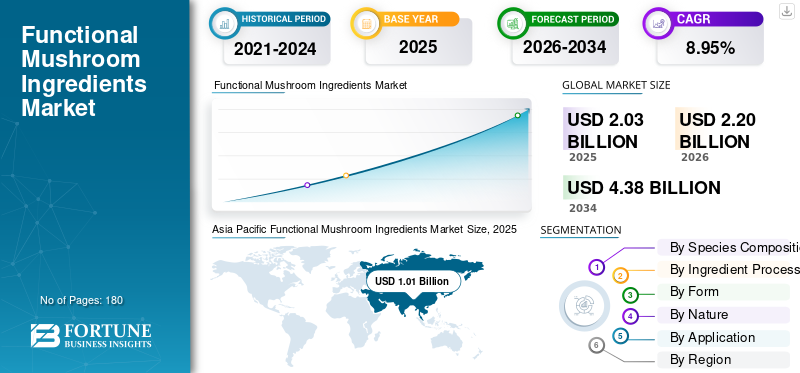
The functional mushroom ingredients market size was valued at USD 2.03 billion in 2025 and is projected to grow from USD 2.20 billion in 2026 to USD 4.38 billion by 2034, exhibiting a CAGR of 8.95% during the forecast period. Asia Pacific dominated the functional mushroom ingredients market with a market share of 49.75% in 2025.
Functional mushroom ingredients are bioactive materials derived from edible and medicinal mushrooms. They are added to supplements, foods, drinks, sports nutrition, personal care, plant-based nutrition, and other health products to provide potential health benefits. They are sold as powders, extracts, liquid concentrates, and other forms, depending on their usage. The market has moved from traditional herbal products toward ingredients that are scientifically standardized. Currently, the focus is on consistent quality, traceable sourcing, reliable extraction methods, and measurable levels of active compounds. Consumers look for clear specifications, better solubility, lower doses, and improved performance in their products which supports the market growth.
Companies such as M2 Ingredients, Nammex, and Sempera Organics, Inc. are some of the key players in the market. New product launch is the key strategy boosting market expansion.
Download Free sample to learn more about this report.
Functional Mushroom Ingredients Market Key Takeaways
 Global Market Size & Forecast
- 2025 Market Size: USD 2.03 billion
- 2026 Market Size: USD 2.20 billion
- 2034 Forecast Market Size: USD 4.38 billion
- CAGR: 8.95% from 2026–2034
 Market Share
- Asia Pacific dominated the functional mushroom ingredients market with a 49.75% share in 2025.
- Cordyceps held the second-largest market share and is projected to grow at a 9.01% CAGR.
- Non-extracted biomass ingredients held the second-largest share and are projected to grow at an 8.80% CAGR.
 Key Regional Highlights
Asia Pacific
Asia Pacific led the global market with a valuation of USD 1.01 billion in 2025.
North America
North America reached a valuation of USD 0.68 billion in 2025.
Europe
Europe recorded a market valuation of USD 0.26 billion in 2025.
U.S.
The U.S.market reached USD 0.59 billion in 2025.
Japan
The market reached approximately USD 0.19 billion in 2025, accounting for 9.36% of global revenues.
Read More

FUNCTIONAL MUSHROOM INGREDIENTS MARKET TRENDS
Growing Consumer Preference for Higher-Quality Organic Ingredients is a Significant Market Trend
The market for functional mushroom ingredients is moving toward higher-quality, science-backed, and easily traceable ingredient options. Manufacturers are going beyond traditional whole-mushroom powders by creating standardized extracts. Advances in mycelium cultivation are improving the scalability and consistency of functional mushroom ingredient production. Consumers are also looking for organic certification, non-GMO sources, mushrooms grown in sustainable ways, clear supply chains, and independent quality checks. Hence companies grow mushrooms locally, build connected supply chains, and use new extraction techniques which make products more reliable and reduce the need for imported materials.
MARKET DYNAMICS
MARKET DRIVERS
Download Free sample to learn more about this report.
Growing Consumer Preference for Natural Cognitive Health and Adaptogenic Ingredients Drives Functional Mushroom Ingredient Demand
The increasing consumer focus on cognitive wellness, stress management, healthy aging, and natural energy is one of the primary drivers of functional mushroom ingredients market growth. Consumers are increasingly seeking botanical and fungi-based ingredients that provide perceived functional benefits beyond basic nutrition, leading to growing adoption of mushrooms such as reishi, lion's mane, cordyceps, chaga, and others in dietary supplements, functional foods, and beverages. The sale of functional mushroom products is expanding through dietary supplements, gummies, mushroom coffees, wellness beverages, and powdered formulations. More people are focusing on preventive healthcare and choosing clean-label nutrition. This is leading manufacturers to add standardized mushroom extracts to their premium products. Ongoing research into bioactive compounds such as beta-glucans, polysaccharides, terpenoids, and erinacines is boosting industry confidence and helping bring these products to market.
|
Rank |
Market Drivers |
Overall Impact Rank |
CAGR Contribution (2026-2034) |
Impact 2026-2028 |
Impact 2029-2031 |
Impact 2032-2034 |
|
1 |
Increasing demand for natural cognitive, immune, stress-management, and energy-support ingredients |
High |
+3.15% |
High |
High |
High |
|
2 |
Expansion of functional mushroom ingredients across supplements, foods, beverages, cosmetics, and pet nutrition |
High |
+2.55% |
Medium |
High |
High |
|
3 |
Advancements in mushroom cultivation, extraction, fermentation, and ingredient standardization |
High-Medium |
+2.05% |
Medium |
High |
High |
|
4 |
Expansion of e-commerce, direct-to-consumer channels, retail distribution, and new product launches |
Medium |
+1.75% |
High |
High |
Medium |
|
5 |
Growing preference for organic, clean-label, fruiting-body, and traceable mushroom ingredients |
Medium |
+1.40% |
Medium |
High |
High |
|
6 |
Others |
Low |
+0.65% |
Low |
Low |
Low |
|
Total Positive Growth Contribution |
+11.55% |
MARKET RESTRAINTS
Regulatory Uncertainty and Limited Harmonization of Health Claims Restricts Market Expansion
Regulatory authorities do not have standardized method to classify mushroom species, fruiting bodies, mycelial biomass, extraction methods, or finished products. This leads to higher compliance costs for ingredient makers and brands for nutraceutical formulations. Companies also have to deal with different rules for safety checks, contaminant testing, species identification, labeling, and marketing claims allowed before they can sell products internationally. In addition, many benefits that manufacturers promote need more clinical evidence to support approved health claims. These regulatory complexities increase product development timelines, restrict international market access, and create barriers for smaller ingredient suppliers seeking global expansion.
|
Rank |
Market Restraints |
Overall Impact Rank |
Negative CAGR Contribution (2026-2034) |
Impact 2026-2028 |
Impact 2029-2031 |
Impact 2032-2034 |
|
1 |
Regulatory uncertainty, inconsistent classification, and restrictions on claims and applications |
High |
-1.05% |
High |
High |
Medium |
|
2 |
Ingredient-quality inconsistency, identity concerns, and insufficient standardization |
High - Medium |
-0.70% |
High |
Medium |
Medium |
|
3 |
High production, extraction, testing, certification, and import costs |
Medium |
-0.55% |
High |
Medium |
Medium |
|
4 |
Others |
Low |
-0.30% |
Low |
Low |
Low |
|
Total Negative Growth Impact |
-2.60% |
MARKET OPPORTUNITIES
Standardized Extract Technologies and Functional Beverage Innovation Creates Significant Growth Opportunities
As more companies look for highly standardized functional ingredients, manufacturers who focus on advanced mushroom extraction technologies have new growth opportunities. Supplement and beverage companies currently demand concentrated extracts that have verified beta-glucan content, dissolve easily, taste better, and offer consistent quality from batch to batch. Therefore, companies are investing in hot-water extraction, dual extraction, fermentation, microencapsulation, spray drying, and other advanced processing methods to make ingredients work better in different products. Similarly, functional beverages are emerging as one of the fastest-growing application areas, with mushroom ingredients being incorporated into coffees, teas, energy drinks, protein drinks, wellness shots, hydration products, and ready-to-drink options. As more consumers choose convenient wellness drinks instead of traditional supplements, manufacturers who can provide mushroom ingredients that work well in beverages and have better stability and taste are likely to see strong long-term growth.
Segmentation Analysis
By Species Composition
Cognitive Wellness Positioning and Broad Product Integration Support Lion’s Mane Segment Dominance
The market is segmented, by species composition, into lion’s mane, reishi, cordyceps, chaga, turkey tail, shiitake, maitake, tremella/snow mushroom, agaricus blazei, poria, other single-species ingredients, and multi-species mushroom blends.
Lion’s mane segment held the largest functional mushroom ingredients market share in 2025 due to its strong commercial recognition in products for cognitive wellness, focus, memory, mood, and healthy aging. This mushroom fits well with the growing demand for natural nootropic ingredients that people can add to their daily wellness routines instead of using traditional stimulants. Manufacturers are adding lion’s mane to capsules, gummies, powdered drink mixes, mushroom coffees, protein blends, functional shots, and ready-to-drink beverages. This gives lion’s mane a wider range of uses than many other functional mushrooms.
Cordyceps holds the second-largest market share, and is expected to grow at a CAGR of 9.01% during the forecast period. This is due to its established association with energy, stamina, endurance, vitality, respiratory support, and exercise performance. Its long history of use in Asian traditional medicine provides strong consumer familiarity, particularly in China and other Asia Pacific markets. Commercial cultivation of Cordyceps militaris and fermentation-based production has also improved ingredient availability and reduced dependence on scarce wild-harvested sources.
Other products such as turkey tail extract, agaricus blazei, poria, other single-species ingredients and multi-species mushroom blends are slowly growing in popularity.
By Ingredient Processing Architecture
Standardization, Higher Potency and Formulation Efficiency Drive Extracted Ingredient Concentrates Segment Leadership
Based on ingredient processing architecture, the market is segmented into non-extracted biomass ingredients, extracted ingredient concentrates, and purified fractions and isolates.
Extracted ingredient concentrates segment accounted for the largest market share in 2025. Suppliers use hot-water, alcohol, and dual-extraction methods to concentrate beta-glucans, polysaccharides, triterpenes, and other compounds from mushrooms. These processes also reduce the amount of inactive material. Extracts offer technical benefits for capsules, tablets, gummies, sachets, and drinks. Smaller amounts can achieve the right ingredient levels without changing texture, taste, or serving size.
Non-extracted biomass ingredients hold second-largest share of the market and is expected to grow at a CAGR of 8.80% during the forecast period. Non-extracted biomass ingredients include milled fruiting bodies, mycelial biomass, fermented substrates, and whole-mushroom powders. These ingredients appeal to brands emphasizing minimally processed, whole-food, organic, or traditional formulations.
By Form
Stability, Versatility and Cost-Efficient Distribution Led to Dry Powder Segment’s Leadership
The market, by form, is segmented into dry powder, dry granules and agglomerates, liquid extracts and concentrates, oil-based ingredients, and semi-solid ingredients.
The dry powder segment led the global market in 2025 as it provides superior shelf stability, lower transportation costs, easy storage, and broad compatibility with both supplement and food applications. Mushroom ingredients such as functional fungi are available as whole-biomass powders, spray-dried extracts, freeze-dried concentrates, or standardized soluble powders. This gives manufacturers options to choose the right potency and processing for their needs.
Oil-based ingredients segment is another major segment expected to grow with a CAGR of 9.15% during the forecast period. They offer easy dosing, mix quickly into drinks, and fit well with premium herbal and wellness products. Examples include alcohol-based tinctures, glycerin extracts, water-based concentrates, dual-extracted liquids, and mushroom solutions made for drinks. This format is now common in functional shots, ready-to-drink beverages, coffee concentrates, droppers, syrups, and wellness tonics.
To know how our report can help streamline your business, Speak to Analyst
By Application
Established Consumer Adoption and Higher Ingredient Dosage Drive Dietary Supplements and Nutraceuticals Segment’s Dominance
The market is segmented, by application into functional foods, functional beverages, dietary supplements and nutraceuticals, medical and clinical nutrition, topical cosmetics and personal care, pet nutrition, and other applications.
Dietary supplements and nutraceuticals segment accounted for the largest market share in 2025. Functional mushroom ingredients are usually taken as capsules, tablets, gummies, powders, tinctures, or as part of wellness blends. These formats allow for higher ingredient doses and make it easier to highlight specific benefits, such as supporting cognition, energy, immunity, stress management, sleep, and healthy aging. Supplements also let brands mix lion’s mane, cordyceps, reishi, chaga, phenolic compounds and other mushrooms with adaptogens, vitamins, minerals, amino acids, and plant-based ingredients.
Functional beverages segment held the second largest share in market in 2025. It is expected to register a CAGR of 9.13% during the forecast period. Functional beverages are one of the most dynamic growth areas within the market. Mushroom ingredients are increasingly incorporated into coffee alternatives, instant coffee blends, energy drinks, ready-to-drink teas, cacao beverages, protein drinks, wellness shots, and hydration products. Lion’s mane is used in drinks that aim to boost focus and mental clarity, while cordyceps is chosen for products that support natural energy and performance.
By Nature
Wider Raw Material Availability and Cost-Efficient Processing Augments Conventional Ingredients Segment Dominance
The market is segmented, by nature, into conventional and organic.
Conventional segment accounted for the largest market share in 2025. They are easier to source, cost less to grow, and work well for large-scale extraction and formulation. With conventional production, growers and processors can fine-tune substrate choices, control the environment, improve yields, and streamline harvesting and processing. This enables suppliers to provide lion’s mane, cordyceps, reishi, chaga, and other functional mushroom ingredients at prices that are commercially viable for mass-market supplements, powdered beverage blends, capsules, gummies, and ready-to-drink products.
Organic segment held second largest market share in 2025 and is expected to register a CAGR of 9.08% during the forecast period. Organic certification strengthens product positioning among health-conscious consumers who associate certified cultivation with reduced use of synthetic pesticides, fertilizers, and other agricultural inputs. The segment is particularly relevant to premium lion’s mane powders, cordyceps supplements, mushroom coffee blends, food and beverage, adaptogenic drink mixes, and practitioner-oriented wellness products.
Functional Mushroom Ingredients Market Regional Outlook
By geography, the market is categorized into Europe, North America, Asia Pacific, South America, and Middle East & Africa.
Asia Pacific
Asia Pacific Functional Mushroom Ingredients Market Size, 2025 (USD Billion)
To get more information on the regional analysis of this market, Download Free sample
The Asia Pacific market was valued at USD 1.01 billion in 2025 and is the largest market globally. Asia Pacific constitutes the principal cultivation, processing, and historical-consumption base for functional mushrooms and is expected to remain one of the fastest-growing regional markets. China provides a large amount of mushroom biomass and extracts. Similarly, Japan, South Korea, Australia, and India play a role through traditional medicine, dietary supplements, nutraceutical production, and developing new functional foods. This region has strong expertise in mushroom cultivation, well-developed extraction facilities, lower processing costs, and a long history of using mushrooms in traditional health practices.
India Functional Mushroom Ingredients Market
The India market in 2025 was valued around USD 0.06 billion, accounting for roughly 2.96% of global market revenues.
China Functional Mushroom Ingredients Market
China’s market in 2025 was valued at around USD 0.42 billion, representing roughly 20.64% of global market share. China is a significant global production and processing center for functional mushroom ingredients. The country benefits from extensive mushroom cultivation, fermentation expertise, hot-water extraction infrastructure, and long-established use of cordyceps and other medicinal fungi. Chinese manufacturers supply fruiting-body powders, mycelial biomass, standardized polysaccharide extracts, and concentrated dry ingredients to domestic and international supplement companies.
Japan Functional Mushroom Ingredients Market
The Japan market in 2025 reached a valuation of around USD 0.19 billion, accounting for roughly 9.36% of global market revenues. Mushroom polysaccharides, particularly beta-glucans, are driving ingredient innovation as suppliers develop standardized extracts targeting immune health, functional nutrition, and premium nutraceutical applications.
North America
The market in North America reached a valuation of USD 0.68 billion in 2025. The region has an established dietary supplement industry, quick uptake of adaptogenic products, strong direct-to-consumer sales, and successful commercialization of mushroom-based coffees, energy drinks, powders, gummies, and capsules. Lion’s mane is now a key anti-inflammatory ingredient in products aimed at improving cognitive performance, focus, mood, and daily mental wellness.
U.S. Functional Mushroom Ingredients Market
In 2025, the U.S. market reached USD 0.59 billion. The U.S. leads the world in demand for functional mushroom ingredients. This is mainly due to people using a lot of dietary supplements, functional drinks are growing quickly, online shopping is common, and there is strong interest in cognitive health and natural energy. Lion’s mane is the most popular species, found in capsules, mushroom coffees, nootropic powders, energy drinks, gummies, and wellness blends.
Europe
The European market reached a valuation of USD 0.26 billion in 2025. Europe is a fast-growing market, driven by more people choosing natural cognitive-support ingredients, adaptogenic drinks, plant-based wellness products, and high-quality dietary supplements. Germany and the U.K. are most developed markets, while the Nordic countries, France, the Netherlands, Italy, and Spain are growing through more specialist nutrition and natural-product channels. Functional mushroom ingredients are gaining attention as natural immunomodulators, with manufacturers incorporating mushroom-derived bioactive into supplements and wellness products positioned around immune system support.
Germany Functional Mushroom Ingredients Market
The market in Germany, in 2025, reached around USD 0.05 billion, representing roughly 2.46% of global market revenues. Germany is one of Europe’s principal markets due to its developed dietary supplement sector, rising demand for natural products, and established pharmacy and organic retail channels.
U.K. Functional Mushroom Ingredients Market
The U.K. market reached approximately USD 0.05 billion in 2025, equivalent to around 2.46% of global market sales. Encapsulated mushroom extracts are gaining adoption among supplement manufacturers as they improve ingredient stability, enable incorporation into capsules, gummies, and advanced delivery systems.
South America and Middle East & Africa
The South America market in 2025 recorded USD 0.048 billion of market revenue. South America is an emerging market, led by Brazil and followed by Argentina, Chile, and Colombia. Growth is supported by increasing consumer interest in gut health products, natural supplements, sports nutrition, mental wellness products, and functional beverages. Most product demand comes from higher-income city residents, as well as specialist health stores, online shops, fitness outlets, and pharmacies.
Middle East & Africa region reached a valuation of USD 0.041 billion in 2025. The market is still relatively small, however growing steadily. This growth is driven by more premium supplement imports, rise of e-commerce, more people joining gyms and sports nutrition programs, and a greater interest in natural wellness ingredients. The United Arab Emirates, Saudi Arabia, Israel, and South Africa are the significant markets in the region. They have stronger retail networks, higher purchasing power, and easier access to imported nutraceutical products.
UAE Functional Mushroom Ingredients Market
UAE market is set to grow at a CAGR of 6.79% during the forecast period. It is the key market in Middle East & Africa region. This is due to presence of premium supplement stores, strong online shopping options, and a large expatriate community. Imported lion’s mane and cordyceps products are now easier to find in pharmacies, sports nutrition shops, health food stores, and online. As more premium wellness stores and international supplement brands open, the market is expected to keep growing.
COMPETITIVE LANDSCAPE
Key Industry Players
Vertical Integration, Extraction Expertise and Ingredient Traceability Intensify Market Competition
The global market for functional mushroom ingredients is a fragmented with multiple small & medium and large sized companies operating in it. Manufacturers are producing hot-water extracts, dual extracts, fermented ingredients, spray-dried concentrates, and ingredients that dissolve easily in drinks. More companies are forming partnerships with growers, extractors, distributors, and finished-product makers to speed up development and reach in more international markets. Companies support product adoption through investment in extraction equipment, buying brands, and building distribution partnerships.
LIST OF KEY FUNCTIONAL MUSHROOM INGREDIENT COMPANIES
- M2 Ingredients (U.S.)
- Nammex (Canada)
- Sempera Organics, Inc. (U.S.)
- Fungi Perfecti, LLC (U.S.)
- Aloha Medicinals (U.S.)
- Monterey Mushrooms, LLC/Monterey Nutra (U.S.)
- Mushroom Wisdom, Inc. (U.S.)
- Mycotrition GmbH (Germany)
- Hawlik Gesundheitsprodukte GmbH (Germany)
- Hifas da Terra (Spain)
KEY INDUSTRY DEVELOPMENTS
- November 2025: Volunteer Botanicals introduced Rapidose Liquid Mushrooms, a microemulsion-based ingredient range covering lion’s mane, cordyceps, and reishi. The company positioned the liquid ingredients as more easily dispersed and less labor-intensive for beverage formulators than conventional mushroom powders.
- October 2025: M2 Ingredients launched a new extract portfolio comprising LionXtract, CordyExtract, ReiExtract, and Myco-Six, a six-mushroom blend. The products were developed to provide improved flavor, solubility, and format flexibility across supplements, foods, and beverages.
- May 2025: M2 Ingredients introduced its first range of functional mushroom extracts grown and processed in the U.S. The launch expanded the company beyond whole-mushroom powders into domestically cultivated and extracted ingredients.
- April 2025: KÄÄPÄ Biotech announced that its NordRelease extraction process and resulting mushroom extract powders had received a favorable European regulatory assessment. The company stated that the development supported commercialization of its standardized extracts in the European market.
- February 2025: M2 Ingredients announced that its new 155,000-square-foot organic functional mushroom cultivation facility in Vista, California, had become fully operational. The company indicated that the facility would increase production capacity and support demand for organic mushroom ingredients.
REPORT COVERAGE
The functional mushroom ingredients market report provides an in-depth study of market size & forecast by all the market segments included in the report. The analysis includes details on the dynamics and trends expected to drive the market during the forecast period. It offers information on the technological advancements, supply chain, new product launches, key industry developments, and details on partnerships, and mergers & acquisitions. The market forecast also encompasses detailed competitive landscape with information on the segmentation, share and research of profiles of key operating players.
Request for Customization to gain extensive market insights.
Report Scope & Segmentation
| ATTRIBUTE | DETAILS |
| Study Period | 2021-2034 |
| Base Year | 2025 |
| Estimated Year | 2026 |
| Forecast Period | 2026-2034 |
| Historical Period | 2021-2024 |
| Growth Rate | CAGR of 8.95% from 2026-2034 |
| Unit | Value (USD Billion) |
| Segmentation | By Species Composition, By Ingredient Processing Architecture, By Form, By Nature, By Application, and Region |
| By Species Composition |
|
| By Ingredient Processing Architecture |
|
| By Form |
|
| By Nature |
|
| By Application |
|
| By Region |
|
Frequently Asked Questions
Fortune Business Insights says that the global market value stood at USD 2.03 billion in 2025 and is projected to reach USD 4.38 billion by 2034.
In 2025, Asia Pacific’s market value stood at USD 1.01 billion.
The market is expected to grow at a CAGR of 8.95% during the forecast period.
By species composition, lion’s mane segment was leading the market.
Growing consumer preference for natural cognitive health and adaptogenic ingredients drives market growth.
M2 Ingredients, Nammex, and Sempera Organics, Inc. are a few top players in the market.
Asia Pacific held the largest market share in 2025.
Growing consumer preference for higher-quality organic ingredients is significant market trend.



- 2021-2034
- 2025
- 2021-2024
- 180
-
(Offer valid till 15th Oct 2026)
Get 30-60 hrs Free Customization
Expand Regional and Country Coverage, Segments Analysis, Company Profiles, Competitive Benchmarking, and End-user Insights.


















Related Reports
-
US +1 833 909 2966 ( Toll Free )
-
Get In Touch With Us