Green Hydrogen Mobility Market Size, Share & Industry Analysis, By Vehicle Type (Hatchback & Sedan, SUV, Light Commercial Vehicles (LCVs), and Heavy Commercial Vehicles (HCVs)), By Technology (Proton Exchange Membrane Fuel Cells (PEMFC), Solid Oxide Fuel Cells (SOFC), Alkaline Fuel Cells, and Hydrogen Internal Combustion Engines (H2-ICE)), By Hydrogen Production Method (Solar-Powered Hydrogen Production, Wind-Powered Hydrogen Production, and Others), By Storage & Distribution (Compressed Hydrogen, Liquid Hydrogen, and Others), and Regional Forecast, 2026-2034
 Download Free Sample
(Offer valid till 30th Sep 2026)

Green Hydrogen Mobility Market Size and Future Outlook
 Listen to Audio Version
The global green hydrogen mobility market size was valued at USD 1.22 billion in 2025. The market is projected to grow from USD 1.49 billion in 2026 to USD 7.38 billion by 2034, exhibiting a CAGR of 22.1% during the forecast period. Asia Pacific dominated the green hydrogen mobility market with a market share of 58.2% in 2025.
The market focuses on using green hydrogen produced through renewable energy powered electrolysis as a clean fuel for transportation. It includes hydrogen-powered vehicles, refueling infrastructure, fuel cell technologies, and related services across automotive, rail, marine, and aviation sectors. The market aims to reduce carbon emissions, support sustainable mobility, and accelerate the transition toward zero-emission transportation systems through government policies, investments, and technological advancements.
Key drivers of the market include rising demand for zero-emission transportation, stringent environmental regulations, government incentives for clean energy adoption, advancements in fuel cell technology, expanding hydrogen fuel infrastructure, and increasing investments in renewable energy projects. Growing focus on reducing carbon footprints further accelerates market growth globally.
Major players in the market include Toyota Motor Corporation, Hyundai Motor Company, Honda Motor Co., Ltd., BMW Group, Ballard Power Systems Inc., Plug Power Inc., Air Liquide, Linde plc, and Nel ASA, competing through fuel cell innovation, hydrogen production expansion, strategic partnerships, infrastructure development, and advanced zero-emission mobility solutions.
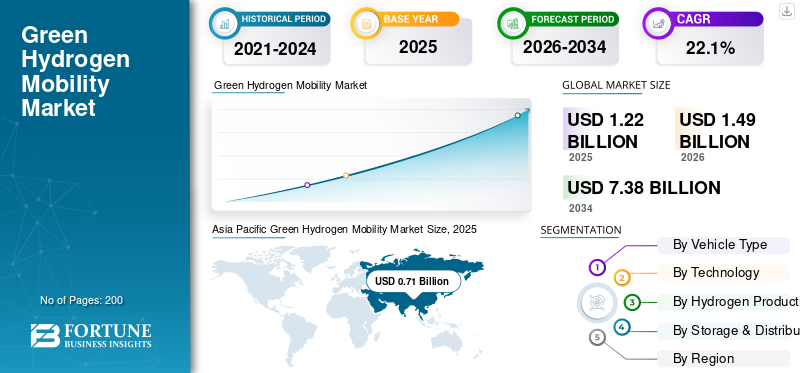
Download Free sample to learn more about this report.
Green Hydrogen Mobility Market Key Takeaways
 Global Market Size & Forecast
- 2025 Market Size: USD 1.22 billion
- 2026 Market Size: USD 1.49 billion
- 2034 Forecast Market Size: USD 7.38 billion
- CAGR: 22.1% from 2026–2034
 Market Share
- Asia Pacific dominated the green hydrogen mobility market with a 58.2% share in 2025.
- The hatchback & sedan segment is projected to grow at a CAGR of 20.9% during the forecast period.
- The Solid Oxide Fuel Cells (SOFC) segment is projected to grow at a CAGR of 25.2% during the forecast period.
 Key Regional Highlights
North America
North America represents the third-largest market, supported by increasing investments in hydrogen hubs, clean transportation projects, and renewable energy integration.
Asia Pacific
Asia Pacific dominated the market, driven by strong government support and expanding hydrogen mobility initiatives.
Europe
Europe accounted for the second-largest market share and is projected to grow at a CAGR of 21.5% during the forecast period.
U.S.
The market is estimated to reach USD 0.18 billion in 2026.
Japan
The market is estimated to reach USD 0.06 billion in 2026.
Read More

GREEN HYDROGEN MOBILITY MARKET TRENDS
Development of Integrated Hydrogen Mobility Ecosystems to Shape Industry Trends
A major trend influencing the global market is the development of integrated hydrogen ecosystems combining renewable energy generation, hydrogen production, storage, distribution, and mobility applications. Industry participants are increasingly focusing on creating end-to-end hydrogen value chains to ensure reliable fuel supply and operational efficiency. Collaborative projects involving automotive manufacturers, utility providers, and governments are supporting the establishment of hydrogen corridors and smart transportation networks.
Another notable trend is the growing adoption of hydrogen-powered commercial vehicles, particularly buses and heavy duty trucks, in urban public transportation systems. Technological innovations in fuel cell durability, lightweight storage tanks, and high-capacity electrolyzers are improving vehicle performance and reducing operational costs. Furthermore, companies are investing in digital monitoring and energy management systems to optimize hydrogen consumption and infrastructure utilization, reflecting the market’s transition toward scalable and interconnected clean mobility solutions.
MARKET DYNAMICS
MARKET DRIVERS
Download Free sample to learn more about this report.
Rising Government Decarbonization Policies and Incentives to Accelerate Green Hydrogen Mobility Adoption
Governments globally are introducing stringent carbon reduction targets and clean transportation policies, significantly driving the global green hydrogen mobility market growth. Subsidies, tax incentives, and funding programs for hydrogen fuel cell electric vehicles and refueling infrastructure are encouraging public and private sector investments. Countries across Europe, Asia Pacific, and North America are integrating hydrogen into national energy transition strategies to reduce dependence on fossil fuels and achieve net-zero emission goals. In addition, mandates supporting zero-emission buses, trucks, and rail systems are accelerating commercial adoption.
Public transportation operators and logistics companies are increasingly investing in hydrogen-powered fleets to comply with evolving environmental regulations. Growing international collaborations and large-scale hydrogen corridor projects are also strengthening the ecosystem, creating favorable conditions for long-term market expansion and technological commercialization.
MARKET RESTRAINTS
High Production and Infrastructure Costs to Limit Large-Scale Market Penetration
Despite strong growth potential, the market faces substantial financial barriers due to the high cost of hydrogen production, storage, and distribution infrastructure. Producing green hydrogen through renewable-powered electrolysis remains significantly more expensive than conventional fossil fuel-based hydrogen and battery-electric alternatives. Additionally, establishing hydrogen refueling stations requires considerable capital investment, specialized equipment, and safety compliance measures.
Limited infrastructure availability in developing regions further restricts widespread adoption of hydrogen-powered vehicles. Automakers and fleet operators often hesitate to transition owing to high vehicle acquisition costs and uncertain returns on investment. Furthermore, fluctuations in renewable energy prices and supply chain constraints for electrolyzers and fuel cell components increase operational complexity. These cost-related challenges may slow commercialization and delay the transition toward mass adoption of hydrogen mobility solutions globally.
MARKET OPPORTUNITIES
Expansion of Heavy-Duty and Long-Range Transportation to Create Growth Opportunities
The increasing demand for clean heavy-duty transportation presents significant opportunities for the market. Hydrogen fuel cell technology is particularly suitable for long-haul trucks, buses, marine vessels, and rail applications that require fast refueling and extended driving range beyond battery-electric capabilities. Logistics companies and freight operators are actively exploring hydrogen-powered fleets to meet sustainability targets while maintaining operational efficiency.
Ports, airports, and industrial transportation hubs are also investing in hydrogen-based mobility ecosystems to reduce emissions from high-energy transport activities. Emerging economies are expected to witness growing opportunities as governments prioritize hydrogen infrastructure development and renewable energy integration. In addition, advancements in electrolyzer efficiency and declining renewable energy costs could improve commercial viability over time. Strategic partnerships among automakers, energy companies, and infrastructure providers are further opening new revenue streams across the global mobility value chain.
MARKET CHALLENGES
Limited Renewable Energy Availability and Supply Chain Complexity to Challenge Market Growth
One of the major challenges facing the market is ensuring a consistent and large-scale supply of renewable energy required for sustainable hydrogen production. Green hydrogen production depends heavily on renewable energy sources such as solar and wind power, which may face intermittency and regional availability constraints. In several countries, inadequate renewable capacity and grid limitations hinder the ability to scale hydrogen production economically. Additionally, the market faces supply chain complexities related to critical materials used in electrolyzers, fuel cells, and hydrogen storage systems. Dependence on rare metals and specialized manufacturing processes may create procurement bottlenecks and price volatility. Transportation and storage of hydrogen also present technical and safety challenges due to its highly flammable nature. These infrastructure and supply chain limitations could affect operational reliability and slow the pace of global market expansion.
Segmentation Analysis
By Vehicle Type
Expanding Consumer Preference for Larger Passenger Vehicles to Strengthen SUV Segment Dominance
Based on vehicle type, the market is categorized into hatchback & sedan, SUV, light commercial vehicles (LCVs), and heavy commercial vehicles (HCVs).
The SUV segment dominates the green hydrogen mobility market owing to rising consumer preference for larger, high-performance passenger vehicles with extended driving range capabilities. Hydrogen fuel cell technology aligns well with SUVs due to higher energy requirements and faster refueling advantages compared to battery electric alternatives. Automakers are increasingly introducing hydrogen powered SUV models to meet growing demand for premium zero emission mobility. Strong adoption across developed markets and supportive hydrogen infrastructure initiatives further reinforce segmental dominance globally.
The hatchback & sedan segment is projected to grow at a CAGR of 20.9% during the forecast period. Increasing urban adoption of compact zero-emission vehicles, improving hydrogen refueling accessibility, and rising government incentives for clean passenger mobility are supporting segment growth, particularly in densely populated metropolitan regions focused on sustainable transportation solutions.
By Technology
High Efficiency and Rapid Refueling Capabilities to Accelerate Proton Exchange Membrane Fuel Cells (PEMFC) Segment Dominance
Based on technology, the market is categorized into proton exchange membrane fuel cells (PEMFC), solid oxide fuel cells (SOFC), alkaline fuel cells, and hydrogen internal combustion engines (H2-ICE).
The Proton Exchange Membrane Fuel Cells (PEMFC) segment dominates the market due to its high efficiency, compact design, and suitability for automotive applications requiring fast startup and rapid refueling. PEMFC technology is widely adopted in passenger vehicles, buses, and commercial fleets as it delivers longer driving ranges with lower emissions. Leading automotive manufacturers are heavily investing in PEMFC-powered mobility solutions to strengthen zero-emission transportation portfolios. Continuous advancements in membrane durability, fuel efficiency, and infrastructure development further support the segment’s strong global market position.
The Solid Oxide Fuel Cells (SOFC) segment is projected to grow at a CAGR of 25.2% during the forecast period. Increasing interest in high-efficiency energy conversion systems, expanding research investments, and rising adoption in heavy-duty transportation and auxiliary power applications are driving demand for SOFC technology across emerging hydrogen mobility ecosystems globally.
To know how our report can help streamline your business, Speak to Analyst
By Hydrogen Production Method
Abundant Solar Energy Integration and Declining Renewable Costs to Strengthen Solar-Powered Hydrogen Production
Based on hydrogen production method, the market is categorized into solar-powered hydrogen production, wind-powered hydrogen production, and others.
The solar-powered hydrogen production segment dominates the market owing to the widespread availability of solar energy and declining photovoltaic installation costs globally. Solar-powered electrolysis enables sustainable and low-emission hydrogen generation, supporting national clean energy and transportation goals. Countries with high solar potential are investing heavily in integrated solar-hydrogen projects to ensure long-term fuel supply for mobility applications. In addition, advancements in solar panel efficiency and large-scale renewable infrastructure development are improving production economics, reinforcing the segment’s leading market position across major hydrogen-producing regions.
The wind-powered hydrogen production segment is anticipated to grow at a CAGR of 21.2% during the forecast period. Rising offshore and onshore wind energy investments, increasing focus on renewable hydrogen diversification, and growing adoption of large-scale electrolyzer projects are accelerating demand for wind-based hydrogen production across global mobility and industrial sectors.
By Storage & Distribution
Established Refueling Infrastructure and Cost Efficiency to Propel Compressed Hydrogen Segment Dominance
Based on storage & distribution, the market is categorized into compressed hydrogen, liquid hydrogen, and others.
The compressed hydrogen segment dominates the market due to its established storage infrastructure, lower handling complexity, and broad compatibility with existing hydrogen fuel cell vehicles. Compressed hydrogen systems are widely adopted across passenger and commercial mobility applications as they offer safer transportation, easier distribution, and comparatively lower operational costs than cryogenic alternatives. Automakers and fueling station operators continue investing in high-pressure storage technologies to improve efficiency and driving range. In addition, expanding hydrogen refueling networks and standardization of compressed storage systems are reinforcing the segment’s dominant position across developed and emerging hydrogen mobility markets.
The liquid hydrogen segment is projected to grow at a CAGR of 23.7% during the forecast period. Increasing demand for long-range heavy-duty transportation, advancements in cryogenic storage technologies, and rising investments in large-scale hydrogen logistics and export infrastructure are accelerating adoption of liquid hydrogen distribution systems globally.
Green Hydrogen Mobility Market Regional Outlook
By geography, the market is categorized into Europe, North America, Asia Pacific, Latin America, and the Middle East & Africa.
Asia Pacific
Asia Pacific Green Hydrogen Mobility Market Size, 2025 (USD Billion)
To get more information on the regional analysis of this market, Download Free sample
Asia Pacific dominates the green hydrogen mobility market due to strong government support, large-scale hydrogen infrastructure investments, and rapid adoption of fuel cell vehicles across China, Japan, and South Korea. Regional governments are implementing national hydrogen roadmaps and providing subsidies for hydrogen-powered transportation and renewable hydrogen production. Major automotive manufacturers are actively commercializing hydrogen fuel cell vehicles and expanding refueling networks. In addition, increasing industrial decarbonization initiatives, rising renewable energy capacity, and strategic public-private collaborations are accelerating market growth across the region, reinforcing Asia Pacific’s leadership in the global industry.
China Green Hydrogen Mobility Market
The Chinese market is estimated to be valued at around USD 0.38 billion in 2026, supported by large-scale renewable hydrogen projects, rapid industrial decarbonization initiatives, expanding hydrogen transportation networks, and substantial government funding for clean energy technologies.
Japan Green Hydrogen Mobility Market
The Japanese market is estimated at around USD 0.06 billion in 2026, driven by strong government hydrogen strategies, expanding fuel cell vehicle adoption, rising investments in hydrogen infrastructure, and increasing collaboration between automotive and energy companies.
Europe
Europe accounted for the second largest green hydrogen mobility market share and is projected to grow at a CAGR of 21.5% during the forecast period. The region’s growth is driven by stringent carbon neutrality targets, aggressive renewable energy deployment, and strong policy support for hydrogen mobility infrastructure. Germany, France, and the Netherlands are investing heavily in green hydrogen production and cross-border hydrogen transportation corridors. Automotive and energy companies are forming strategic partnerships to accelerate fuel cell vehicle deployment and refueling station expansion. In addition, European Union funding initiatives and decarbonization regulations are supporting widespread adoption of hydrogen-powered commercial and public transportation systems.
U.K. Green Hydrogen Mobility Market
The U.K. market is estimated at around USD 0.05 billion in 2026, supported by national hydrogen roadmaps, increasing offshore wind-powered hydrogen production, investments in low-carbon transportation infrastructure, and growing demand for sustainable industrial fuel alternatives.
Germany Green Hydrogen Mobility Market
The German market is estimated at around USD 0.10 billion in 2026, driven by aggressive carbon neutrality targets, strong renewable energy integration, expanding hydrogen mobility projects, and strategic partnerships supporting industrial and transportation decarbonization initiative.
North America
North America represents the third-largest market for green hydrogen mobility, supported by increasing investments in hydrogen hubs, clean transportation projects, and renewable energy integration. The U.S. and Canada are focusing on expanding hydrogen production capacity and developing hydrogen fuel cell infrastructure for heavy-duty transportation applications. Government incentives, tax credits, and private sector funding are accelerating the commercialization of hydrogen-powered trucks, buses, and industrial mobility solutions. In addition, collaborations among automotive manufacturers, energy providers, and technology firms are driving innovation in fuel cell systems and hydrogen distribution networks. Rising demand for zero-emission transportation continues to strengthen regional market growth.
U.S. Green Hydrogen Mobility Market
The U.S. market is estimated at around USD 0.18 billion in 2026, fueled by federal clean energy incentives, increasing investments in hydrogen production hubs, growing fuel cell mobility adoption, and rising private sector participation in infrastructure development.
Middle East & Africa
The Middle East & Africa region is emerging as a promising market for green hydrogen mobility due to abundant renewable energy resources and increasing investments in large-scale hydrogen production projects. Saudi Arabia and the United Arab Emirates are focusing on developing green hydrogen export hubs supported by solar and wind energy infrastructure. Governments are also exploring hydrogen-powered transportation solutions to diversify energy economies and reduce dependence on fossil fuels. In addition, strategic partnerships with international energy and automotive companies are accelerating hydrogen infrastructure development. Growing interest in sustainable mobility and industrial decarbonization is expected to support future market expansion.
UAE Green Hydrogen Mobility Market
The UAE market is estimated at around USD 0.01 billion in 2026, driven by rising investments in renewable-powered hydrogen production, government sustainability initiatives, expanding clean transportation projects, and strategic partnerships supporting hydrogen export and mobility development.
Latin America
Latin America is witnessing gradual growth in the market driven by rising renewable energy investments and government initiatives promoting clean transportation solutions. Chile and Brazil are investing in green hydrogen production projects leveraging strong solar and wind energy potential. Increasing international collaboration and funding support are encouraging the development of hydrogen infrastructure and pilot mobility projects. Automotive and energy companies are also exploring hydrogen-powered transportation applications to support regional decarbonization goals. Furthermore, growing awareness regarding sustainable fuel alternatives and expanding renewable electricity generation are expected to create long-term opportunities for hydrogen mobility adoption across the region.
Mexico Green Hydrogen Mobility Market
The Mexico market is estimated at around USD 0.02 billion in 2026, supported by increasing renewable energy adoption, growing interest in sustainable transportation fuels, infrastructure modernization initiatives, and international collaborations promoting clean hydrogen mobility solutions.
COMPETITIVE LANDSCAPE
Key Industry Players
Strategic Partnerships and Technological Advancements Strengthen Market Competition
The global green hydrogen mobility market is highly competitive, with major automotive manufacturers, energy companies, and hydrogen technology providers actively investing in fuel cell innovation and infrastructure expansion. Leading players are focusing on strategic collaborations, joint ventures, and long-term supply agreements to strengthen their market presence and accelerate commercialization. Companies are increasingly investing in research and development to improve fuel cell efficiency, hydrogen storage systems, and vehicle performance. In addition, partnerships between governments and private firms are supporting the development of hydrogen refueling networks and integrated mobility ecosystems. Market participants are also expanding geographically to capitalize on emerging hydrogen economies and supportive regulatory frameworks.
Competition in the market is further intensifying as companies prioritize large-scale hydrogen production and vertically integrated supply chains to gain cost advantages and ensure fuel availability. Automotive manufacturers are launching new hydrogen-powered passenger and commercial vehicles to diversify their zero-emission portfolios and address evolving consumer demand. Meanwhile, industrial gas companies and renewable energy developers are investing heavily in green hydrogen generation projects powered by solar and wind energy. Technological advancements, infrastructure scalability, and operational efficiency remain key differentiating factors among competitors. Additionally, companies are pursuing mergers, acquisitions, and technology licensing agreements to enhance production capabilities and strengthen their positions in the rapidly evolving industry.
LIST OF KEY GREEN HYDROGEN MOBILITY COMPANIES PROFILED IN REPORT
- Toyota Motor Corporation (Japan)
- Hyundai Motor Company (South Korea)
- Honda Motor Co., Ltd. (Japan)
- BMW Group (Germany)
- Daimler Truck AG (Germany)
- Ballard Power Systems Inc. (Canada)
- Plug Power Inc. (U.S.)
- Cummins Inc. (U.S.)
- Air Liquide (France)
- Linde plc (U.K.)
- Nel ASA (Norway)
- ITM Power plc (U.K.)
- Nikola Corporation (U.S.)
- Siemens Energy AG (Germany)
- Shell plc (U.K.)
KEY INDUSTRY DEVELOPMENTS
- May 2026: Toyota Motor signed an agreement with Hyroad Energy to deploy 40 hydrogen fuel cell Class 8 trucks in Southern California, supporting zero-emission freight and hydrogen infrastructure expansion.
- April 2026: BMW introduced its Hydrogen Flat Storage system for the upcoming iX5 Hydrogen, storing at least seven kilograms of hydrogen and refueling in under five minutes to support fuel cell SUV commercialization.
- December 2025: Toyota announced the 2026 Mirai, highlighting advanced hydrogen fuel cell technology, strong driving performance, and continued commitment to consumer hydrogen mobility despite slow infrastructure development.
- November 2025: Hyundai reported that its all-new NEXO delivers 190 kW output and projected 826 km WLTP range from a five-minute charge, strengthening its hydrogen SUV leadership.
- September 2025: BMW confirmed the iX5 Hydrogen would move from pilot fleet testing toward series production, with the next X5 offering hydrogen fuel cell technology from 2028.
- February 2025: Toyota developed its third-generation fuel cell system to accelerate commercial adoption, targeting improved durability, efficiency, and cost competitiveness for trucks and broader hydrogen mobility applications
- February 2025: Air Liquide announced two major European electrolyzer projects with TotalEnergies, including a 200 MW ELYgator project supplying industrial and heavy-duty mobility hydrogen needs.
REPORT COVERAGE
The global green hydrogen mobility market analysis provides an in-depth study of market size & forecast by all the market segments included in the report. It includes details on the market dynamics and market trends expected to drive the market during the forecast period. It offers information on the technological advancements, new product launches, key industry developments, and details on partnerships, mergers & acquisitions. The report also encompasses a detailed competitive landscape, including market share and profiles of key operating players.
Request for Customization to gain extensive market insights.
Report Scope & Segmentation
| ATTRIBUTE | DETAILS |
| Study Period | 2021-2034 |
| Base Year | 2025 |
| Estimated Year | 2026 |
| Forecast Period | 2026-2034 |
| Historical Period | 2021-2024 |
| Growth Rate | CAGR of 22.1% from 2026-2034 |
| Unit | Value (USD Billion) |
| Segmentation | By Hydrogen Production Method, By Technology, By Storage & Distribution, By Vehicle Type, and By Region |
| By Vehicle Type |
|
| By Technology |
|
| By Hydrogen Production Method |
|
| By Storage & Distribution |
|
| By Region |
|
Frequently Asked Questions
Fortune Business Insights says that the global market value stood at USD 1.22 billion in 2025 and is projected to reach USD 7.38 billion by 2034.
In 2025, Asia Pacifics market value stood at USD 0.71 billion.
The market is expected to exhibit a CAGR of 22.1% during the forecast period of 2026-2034
The SUV segment led the market by vehicle type.
Rising government decarbonization policies and incentives to accelerate green hydrogen mobility adoption.
Asia Pacific held the largest market share in 2025.



- 2021-2034
- 2025
- 2021-2024
- 200
-
(Offer valid till 30th Sep 2026)
Get 30-60 hrs Free Customization
Expand Regional and Country Coverage, Segments Analysis, Company Profiles, Competitive Benchmarking, and End-user Insights.




















Related Reports
-
US +1 833 909 2966 ( Toll Free )
-
Get In Touch With Us