Ice Cream Premix And Stabilizers Market Size, Share & Industry Analysis, By Product Type (Ice Cream & Frozen Dessert Premixes and Stabilizers & Functional Systems), By Ingredient System (Dairy-Based, Plant-Based, and Water/Fruit-Based Systems), By Form (Powder/Dry Mix, Liquid, and Paste/Semi-Solid), By Functional Ingredient Type (Hydrocolloid-Based and Emulsifier-Based Systems), By Application (Scoopable/Packaged Desserts, Frozen Novelties, and Soft-Serve), By End User (Industrial Manufacturers, Foodservice Operators, and Retail/Consumer-Facing Brands), and Regional Forecast, 2026-2034
 Download Free Sample
(Offer valid till 31st Oct 2026)

Ice Cream Premix And Stabilizers Market Size and Future Outlook
 Listen to Audio Version
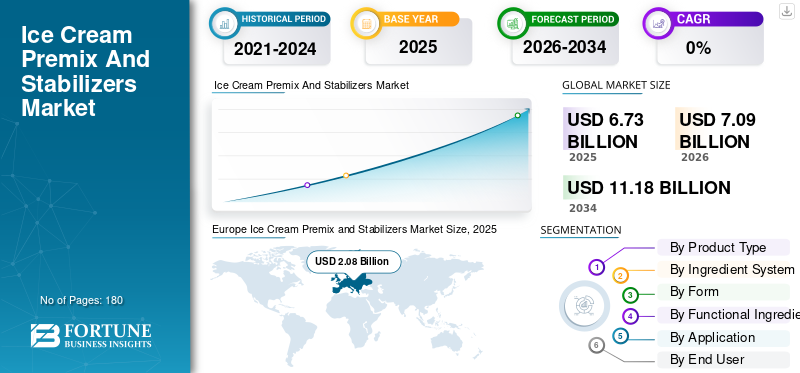
The global ice cream premix and stabilizers market size was valued at USD 6.73 billion in 2025. The market is projected to grow from USD 7.09 billion in 2026 to USD 11.18 billion by 2034, exhibiting a CAGR of 5.9% during the forecast period. Europe dominated the global market with a market share of 30.91% in 2025.
The global market for ice cream premixes and stabilizers includes both dry and liquid ingredient systems which are used by dairy processors, ice cream makers, foodservice businesses, and soft-serve shops to keep texture, sweetness, fat content, aeration, thickness, melt resistance, and stability consistent in ice cream products. Premixes include milk solids, sweeteners, emulsifiers, flavors, stabilizers, and other useful ingredients whereas stabilizer systems often include hydrocolloids such as guar gum, locust bean gum, carrageenan, CMC, pectin, and xanthan gum. The market is expanding as manufacturers prefer consistent product quality in industrial production, foodservice, delivery, and premium frozen desserts while controlling costs and improving processing efficiency.
Companies such as Cargill, Incorporated, Kerry Group plc, Tate & Lyle plc / CP Kelco and International Flavors & Fragrances Inc. (IFF) are some of the key players in the ice cream premix and stabilizers market. New product launch is the key strategy which is boosting market expansion and supporting the market growth.
Download Free sample to learn more about this report.
Ice Cream Premix And Stabilizers Market Key Takeaways
 Global Market Size & Forecast
- 2025 Market Size: USD 6.73 billion
- 2026 Market Size: USD 7.09 billion
- 2034 Forecast Market Size: USD 11.18 billion
- CAGR: 5.9% from 2026-2034
 Market Share
- Europe dominated the ice cream premix and stabilizers market with a 30.91% share in 2025.
- Stabilizers and functional systems held the second-largest share and are projected to grow at a 4.66% CAGR.
- Water / fruit-based systems held the second-largest share and are projected to grow at a 6.35% CAGR.
 Key Regional Highlights
North America
North America reached USD 1.79 billion in 2025, supported by strong demand for innovative ice cream formulations.
Asia Pacific
Asia Pacific was valued at USD 2.04 billion in 2025 and is expected to remain a key growth region for ice cream premix and stabilizer products.
Europe
Europe reached USD 2.08 billion in 2025, maintaining its leading position in the global market.
U.S.
The U.S. led North America with strong demand for ice cream products and advanced premix formulations.
Japan
Growing consumer interest in diverse and premium frozen desserts is supporting demand for ice cream premixes and stabilizers.
Read More

ICE CREAM PREMIX AND STABILIZERS MARKET TRENDS
Clean-Label Stabilizers and Application-Specific Premixes Reshape Frozen Dessert Formulation
The ice cream manufacturers are focusing on systems made for specific uses, such as premium ice cream, gelato, soft serve, frozen yogurt, plant-based desserts, and low-sugar options. Manufacturers opt for ice cream stabilizers that help create a creamy texture, slow down melting, resist heat shock, and fit clean-label food additives standard. Manufacturing customized solutions also impact the market growth as industrial producers need high-performance systems for long distribution chains. Artisanal producers also seek natural texture improvement with minimal ingredients. Such customized solution provide formulation flexibility to the artisan ice cream manufacturers. Rising consumer preference for indulgent and premium frozen desserts is driving demand for premium ice cream ingredients that enhance mouthfeel, flavor release, and overall product quality.
MARKET DYNAMICS
MARKET DRIVERS
Download Free sample to learn more about this report.
Expansion of Industrial Ice Cream and Frozen Novelty Production Accelerates Demand for Ice Cream Premix & Stabilizer Systems
The expansion of industrial ice cream and frozen novelty production is significantly driving demand for ice cream premixes and stabilizer systems. Large-scale manufacturers are increasing production of impulse ice creams, family packs, ice cream bars, cones, sandwiches, molded novelties, frozen yogurt, and other frozen desserts to meet rising global consumption. As production increases, manufacturers rely on standardized ingredient systems to keep texture, viscosity, overrun, melt resistance, and freeze-thaw stability consistent on fast processing lines. Premixes simplify formulation by combining several ingredients into ready-to-use systems. Moreover, the growing commercialization of premium, reduced-sugar, high-protein, and plant-based frozen novelties has further increased the need for customized stabilizer and functional ingredient blends. Consequently, the continued expansion of industrial frozen dessert manufacturing is strengthening long-term demand for advanced premix and stabilizer solutions that improve production efficiency, product consistency, and supply chain reliability and supporting the ice cream premix and stabilizers market growth.
|
Rank |
Market Driver |
Overall Impact Rank |
CAGR Contribution (2026-2034) |
Impact 2026-2028 |
Impact 2029–2031 |
Impact 2032–2034 |
|
1 |
Expansion of industrial ice cream and frozen novelty production |
High |
1.75% |
High |
High |
Medium |
|
2 |
Growth of foodservice, QSR, soft-serve, cafés, kiosks, and dessert chains |
High |
1.45% |
High |
High |
High |
|
3 |
Rising demand for plant-based, dairy-free, lactose-free, and hybrid frozen desserts |
Medium-High |
1.25% |
Medium |
High |
High |
|
4 |
Clean-label, reduced-sugar, high-protein, and premium texture reformulation |
Medium-High |
1.15% |
Medium |
Medium |
High |
|
5 |
Emerging-market adoption of dry premixes and local frozen dessert manufacturing |
Medium |
1.10% |
Medium |
Medium |
High |
|
6 |
Others ( e-commerce sales of premixes, halal/kosher-certified systems, seasonal product innovation, premium gelato) |
Low |
0.90% |
Low |
Medium |
Medium |
|
Total Positive Driver Contribution |
+7.60% |
MARKET RESTRAINTS
Volatility in Dairy, Sugar, Hydrocolloid, and Emulsifier Raw Material Prices Increases Formulation Costs and Procurement Uncertainty
Volatility in the prices of dairy solids, sugar, cocoa, hydrocolloids, and emulsifiers for ice cream is a major restraint for the market as these ingredients account for a significant portion of formulation costs. Changes in milk powder and dairy prices, shifts in global sugar markets, cocoa price jumps, and inconsistent supplies of hydrocolloids such as guar gum, locust bean gum, carrageenan, and pectin can impact the production costs. Frequent changes in raw material costs also make it harder to plan long-term contracts, manage inventory, and adjust product formulas. Consequently, sustained raw material price volatility places pressure on profit margins, increases pricing uncertainty for industrial buyers, and slows investment in new frozen dessert formulations.
|
Rank |
Market Restraint |
Impact on Growth Restraint |
Negative CAGR Impact, 2026–2034 |
Impact 2026–2028 |
Impact 2029–2031 |
Impact 2032–2034 |
|
1 |
Volatility in dairy solids, sugar, cocoa, hydrocolloids, emulsifiers, and protein raw material prices |
High |
-0.65% |
High |
High |
Medium |
|
2 |
Clean-label pressure and consumer scrutiny of gums, emulsifiers, additives, and ultra-processed ingredients |
Medium-High |
-0.45% |
Medium |
High |
High |
|
3 |
Regulatory complexity across additives, labeling, allergen claims, dairy/non-dairy standards, and certifications |
Medium |
-0.35% |
Medium |
Medium |
High |
|
4 |
Others |
Low |
-0.25% |
Low |
Low |
Medium |
|
|
Total Negative Restraint Impact |
|
-1.70% |
|
|
|
MARKET OPPORTUNITIES
Plant-Based, High-Protein, and Delivery-Focused Frozen Desserts Create New Formulation Opportunities
Ice cream manufacturers are expanding into plant-based, high-protein, reduced-sugar, low-fat, and delivery-suitable frozen desserts. These formats often require more advanced stabilizer systems as removing dairy fat, sugar, or milk solids can weaken texture, body, sweetness perception, and freeze-thaw performance. Plant-based ice creams composed of oat, almond, soy, coconut, or pea protein use stabilizers to control iciness, prevent separation, and improve melting. High-protein and functional frozen dessert ingredients also need stabilizer systems to manage thickness, reduce chalkiness, and handle protein performance. This creates opportunity for custom blend manufacturer to expand their market presence.
Segmentation Analysis
By Product Type
Production Standardization and Ready-to-Use Formulation Benefits Drives the Leadership of Ice Cream & Frozen Dessert Premixes
The market is segmented by product type into ice cream and frozen dessert premixes and stabilizers and functional systems.
The ice cream and frozen dessert premixes segment held the largest ice cream premix and stabilizers market share in 2025. They help manufacturers and foodservice operators simplify production while maintaining consistent taste, texture, solids balance, sweetness, viscosity, and freezing performance. These premixes are widely used in industrial ice cream, soft serve, gelato, frozen yogurt, milk-based frozen desserts, and foodservice dispensing systems. They reduce formulation errors, shorten preparation time, and improve batch-to-batch consistency across multiple outlets or production lines.
The stabilizers and functional systems segment held the second-largest market share and is expected to grow at a CAGR of 4.66% during the forecast period. Food stabilizing agents are becoming increasingly important as manufacturers seek to improve melt resistance, control ice crystal formation, and maintain product quality throughout frozen storage and distribution.
By Ingredient System
Balanced Dairy Functionality and Consumer Familiarity Drives the Leadership of Dairy-Based Systems
Based on ingredient system, the market is segmented into dairy-based systems, plant-based systems, water / fruit-based systems, hybrid systems, and specialty / other systems.
The dairy-based systems segment accounted for the largest market share in 2025. They form the essential base needed to make high-quality ice cream and frozen desserts. Milk solids, whey proteins, cream powders, skim milk powder, and other dairy processing additives help to create creamy body and smooth texture. They also improve melting and stability, while maintaining the creaminess of ice cream.
Water / fruit-based systems make up the second-largest share of the market and is expected to grow at a CAGR of 6.35% during the forecast period. They are commonly found in sorbets, water ice, fruit bars, frozen drinks, and plant-based frozen desserts. These products use fruit purees, juices, sugars, stabilizers, and hydrocolloid blends to create a smooth texture, control ice crystals, and ensure stable melting, even without milk fat or dairy proteins.
By Form
Long Shelf Life and Simplified Global Distribution Drives the Leadership of Powder/Dry Mix Form
The market is segmented by form into powder / dry mix, liquid, paste / semi-solid, and others.
The powder / dry mix segment led the global market in 2025. It is easier to store and transport, and lasts longer than liquid products. It also helps lower logistics costs. They make inventory easier to manage, reduce the need for cold storage, and help with accurate batching during production. Powder systems let manufacturers mix dairy solids, sweeteners, stabilizers, emulsifiers, flavors, and other ingredients into one standard formula that is easy to ship worldwide.
Liquid is another major segment that is estimated to register a CAGR of 5.53% during the forecast period. They reduce ingredient handling and eliminate multi stage ice cream preparation. They are particularly suited for industrial processors with continuous manufacturing lines and foodservice operators seeking rapid product preparation. Liquid systems provide consistent dispersion of functional ingredients and reduce dust generation during mixing, improving operational efficiency.
By Functional Ingredient Type
Superior Ice Crystal Control and Texture Stability Drives the Leadership of Hydrocolloid-Based Systems
The market is segmented by functional ingredient type into hydrocolloid-based systems, emulsifier-based systems, fiber and starch-based systems, protein-based functional systems, and
blended multi-functional systems.
The hydrocolloid-based systems segment accounted for the largest market share in 2025. They are the primary ingredients responsible for controlling ice crystal growth, viscosity, water binding, melt resistance, and overall texture stability in frozen desserts. Ingredients such as guar gum, locust bean gum, carrageenan, xanthan gum, pectin, and cellulose gums help manufacturers to produce smooth, creamy products while maintaining stability throughout frozen storage and distribution.
The emulsifier-based systems segment led with the second-largest share in the market in 2025 and is expected to register a CAGR of 5.95% during the forecast period. Emulsifier-based systems help mix fats better, add air, keep the texture stable, and make products creamier during freezing. Common emulsifiers such as mono- and di-glycerides, polysorbates, and lecithin help keep fat evenly mixed, make the texture smoother, and improve how well the product whips and holds its shape.
By Application
High Global Consumption of Dairy Ice Cream Drives the Leadership of Scoopable / Packaged Frozen Desserts
The market is segmented by application into scoopable / packaged frozen desserts, frozen novelties, soft-serve / dispensed frozen desserts, gelato and artisanal desserts, water ice / sorbet / slush applications, and others.
The scoopable / packaged frozen desserts segment led the global market in 2025. It held the largest market share as it is the leading frozen dessert segment worldwide across retail, foodservice, and hospitality. Manufacturers use premixes and stabilizers to maintain creaminess, control overrun, ensure consistent texture, and extend shelf life during large-scale production. Manufacturers also offer the widest variety of flavors, premium options, and products for impulse buys.
The frozen novelties segment is another major segment that is estimated to grow at a CAGR of 6.14% during the forecast period. Ice cream bars, cones, sandwiches, sticks, molded desserts, and coated frozen treats are becoming more popular in both retail stores and impulse-buy locations. These treats need special premixes and stabilizers to keep their shape during molding, coating, packaging, and long periods in the freezer. Manufacturers use specific ingredient blends to improve how these products bite, help coatings stick, and make them less likely to get damaged by temperature changes.
To know how our report can help streamline your business, Speak to Analyst
By End User
High-Volume Production and Standardized Quality Requirements Drives the Leadership of Industrial Frozen Dessert Manufacturers
The market is segmented by end user into industrial frozen dessert manufacturers, foodservice operators, artisanal and independent producers, retail / consumer-facing premix brands, and others.
The industrial frozen dessert manufacturers segment led the global market in 2025. These manufacturers purchase premixes and stabilizer systems in bulk to support continuous, large-scale production of packaged ice cream, frozen desserts, novelties, soft serve bases, and private-label products. These manufacturers require highly standardized formulations that ensure consistent viscosity, and shelf-life stability across millions of production units. They also rely on technical ingredient suppliers for formulation optimization, processing support, and product innovation.
The foodservice operators segment is another major segment that is growing with a CAGR of 5.28% during the forecast period. These help make frozen desserts easier to prepare and keep quality consistent at different locations. Premix systems make recipes less complicated, save time during preparation, and help serve desserts more consistently.
Ice Cream Premix and Stabilizers Market Regional Outlook
By region, the market is categorized into Europe, North America, Asia Pacific, South America, and the Middle East & Africa.
Europe
Europe Ice Cream Premix and Stabilizers Market Size, 2025 (USD Billion)
To get more information on the regional analysis of this market, Download Free sample
The European market reached a valuation of USD 2.08 billion in 2025 and is the leading region globally. Europe represents a technologically advanced market driven by premium ice cream, gelato, frozen desserts, and strong clean-label ingredient preferences. Italy, Germany, France, the U.K., Spain, and Netherlands are major demand centers due to well-established dairy industries and artisanal as well as industrial ice cream production. The rise of premium gelato, plant-based frozen desserts, and functional ice cream is driving demand for specialized premix systems that offer both good taste and efficient production.
Germany Ice Cream Premix and Stabilizers Market
The market in Germany in 2025 reached around USD 0.40 billion, representing roughly 5.94% of global market revenues. Germany’s ice cream market is influenced by advanced dairy processing, high retail ice cream sales, and a growing demand for clean-label products. There is growing demand for stabilizer blends that work with plant-based, reduced-sugar, and premium recipes in the country.
U.K. Ice Cream Premix and Stabilizers Market
The U.K. market demand reached approximately USD 0.19 billion in 2025, equivalent to around 2.81% of global market sales. Growing demand for smooth, creamy, and consistent frozen desserts is increasing the adoption of food texture enhancers in advanced ice cream premix and stabilizer formulations.
Asia Pacific
The Asia Pacific market was valued at USD 2.04 billion in 2025. It is the fastest-growing regional market, supported by rising disposable incomes, expanding cold-chain infrastructure, rapid urbanization, and increasing consumption of packaged and premium frozen desserts. China, India, Japan, South Korea, Australia, and Southeast Asia are driving regional demand through both industrial dairy processors and expanding foodservice chains. Manufacturers increasingly rely on premixes and stabilizers to maintain product consistency across varying climatic conditions and long distribution networks. Dessert mix solutions are gaining popularity among industrial manufacturers and foodservice operators in the region.
India Ice Cream Premix and Stabilizers Market
The India market in 2025 was valued around USD 0.39 billion, accounting for roughly 5.74% of the global market revenues.
China Ice Cream Premix and Stabilizers Market
China’s market in 2025 was valued around USD 0.69 billion, representing roughly 10.32% of the global market share. China’s market is expanding through packaged ice cream, novelty products, frozen desserts, soft serve, and café-style dessert formats. Industrial manufacturers use premixes and stabilizers to maintain consistent quality across large production volumes and long cold-chain distribution.
Japan Ice Cream Premix and Stabilizers Market
The Japan market in 2025 reached a valuation of around USD 0.26 billion, accounting for roughly 3.82% of global market revenues.
North America
The market in North America reached a valuation of USD 1.79 billion in 2025. The region has a well-established market for ice cream premix and stabilizers due to high ice cream consumption, strong dairy processing systems, and ongoing product innovation. Strong presence of soft-serve outlets and foodservice operators in North America are also driving demand as they prefer standardized formulations that help reduce production differences and make operations more efficient.
U.S. Ice Cream Premix and Stabilizers Market
In 2025, the U.S. market reached USD 1.40 billion and it is the leading country in North America. Growth in the U.S. market is driven by large-scale ice cream makers, private-label brands, soft-serve chains, and new premium frozen desserts. There is also increasing demand for high-protein, reduced-sugar, lactose-free, and plant-based ice cream which use stabilizers to make up for changes in fat, sugar, and dairy content further driving the growth.
South America and Middle East & Africa
South America’s market is expanding steadily through growing consumption of packaged ice cream, artisanal gelato, and foodservice desserts. Manufacturers focus on stabilizer systems that improve texture, melting resistance, and storage stability while maintaining cost competitiveness. The South America market in 2025 recorded USD 0.57 billion. The Middle East & Africa region reached a valuation of USD 0.24 billion in 2025. The Middle East & Africa market is developing through increasing consumption of premium ice cream, expansion of modern retail, tourism, and growth in café and foodservice sectors. The UAE, Saudi Arabia, and South Africa are the principal markets, supported by rising demand for premium frozen desserts and year-round consumption driven by warm climatic conditions.
UAE Ice Cream Premix and Stabilizers Market
UAE market is set to grow at a CAGR of 4.52% during the forecast period. The UAE market is premium-oriented and strongly influenced by hot climate, tourism, modern retail, cafés, hotels, and foodservice dessert consumption. Ice cream manufacturers and foodservice operators rely on stabilizers to maintain melt resistance, creamy texture, and product integrity during distribution and serving.
COMPETITIVE LANDSCAPE
Key Industry Players
Texture Standardization and Cost-Efficient Frozen Dessert Production Intensify Competition Among Premix and Stabilizer Suppliers
The global market for ice cream premixes and stabilizers is competitive with key players, including Cargill, Incorporated, Kerry Group plc, Tate & Lyle plc / CP Kelco, and International Flavors & Fragrances Inc. (IFF), operating in the industry. Dairy ingredient companies, hydrocolloid suppliers, emulsifier producers, flavor houses, premix formulators, and specialty food ingredient manufacturers all compete for market share. Major ingredient suppliers compete by offering integrated systems that blend stabilizers, emulsifiers, milk solids, sweeteners, and flavors for products such as industrial ice cream, soft serve, gelato, and other frozen desserts. Regional premix manufacturers focus on local taste preferences, affordable formulations, and mixes that are ready for foodservice use.
LIST OF KEY ICE CREAM PREMIX AND STABILIZERS COMPANIES PROFILED
- Cargill, Incorporated (U.S.)
- Kerry Group plc (Ireland)
- Tate & Lyle plc / CP Kelco (U.S.)
- International Flavors & Fragrances Inc. (IFF) (U.S.)
- Ingredion Incorporated (U.S.)
- Palsgaard A/S (Italy)
- PreGel S.p.A. (Italy)
- MEC3 (Italy)
- Aromitalia Group (Italy)
- Fabbri 1905 S.p.A. (Italy)
KEY INDUSTRY DEVELOPMENTS
- May 2026: Tate & Lyle PLC, a global leader in ingredient solutions, announced the expansion of its collaboration with BioHarvest Sciences Inc. to include multiple plant-based sweetener molecules in their joint sweetener development program.
- April 2026: Kerry announced the opening of an expanded biotechnology manufacturing facility in Carrigaline, Co. Cork, Ireland, significantly increasing its capacity to produce lactase enzymes at industrial scale.
- February 2024: Ingredion Incorporated, a leading global provider of specialty ingredient solutions, launched NOVATION Indulge 2940 starch and expanded its line of clean label texturizers. The product provides a unique texture for gelling and co-texturizing for popular dairy and alternative dairy product innovation.
- April 2023: IFF introduced a new innovation in the market named the Cremodan Greenpro 101 which is designed for ice cream manufacturers to reduce ice cream manufacturing ingredients cost.
- September 2022: Kerry launched Sherex Supreme, a newly developed, innovative texture system which replicates the functionality of Locust Bean Gum (LBG) in hard-pack ice cream.
REPORT COVERAGE
The global ice cream premix and stabilizers market report provides an in-depth study of market size & forecast by all the market segments included in the report. The market analysis includes details on the market dynamics and market trends expected to drive the market during the forecast period. It offers information on the technological advancements, supply chain, new product launches, key industry developments, and details on partnerships, mergers & acquisitions. The market forecast also encompasses detailed competitive landscape with information on the market segmentation, market share and market research of profiles of key operating players.
Request for Customization to gain extensive market insights.
Report Scope & Segmentation
| ATTRIBUTE | DETAILS |
| Study Period | 2021-2034 |
| Base Year | 2025 |
| Estimated Year | 2026 |
| Forecast Period | 2026-2034 |
| Historical Period | 2021-2024 |
| Growth Rate | CAGR of 5.9% from 2026-2034 |
| Unit | Value (USD Billion) |
| Segmentation | By Product Type, By Ingredient System, By Form, By Functional Ingredient Type, By Application, By End User, and Region |
| By Product Type |
|
| By Ingredient System |
|
| By Form |
|
| By Functional Ingredient Type |
|
| By Application |
|
| By End User |
|
| By Region |
|
Frequently Asked Questions
Fortune Business Insights says that the global market value stood at USD 6.73 billion in 2025 and is projected to reach USD 11.18 billion by 2034.
In 2025, the market value stood at USD 2.08 billion.
The market is expected to exhibit a CAGR of 5.9% during the forecast period.
By application, the scoopable / packaged frozen desserts segment led the global market in 2025.
Expansion of industrial ice cream and frozen novelty production accelerates demand for ice cream premix & stabilizer systems.
Cargill, Incorporated, Kerry Group plc, Tate & Lyle plc / CP Kelco, and International Flavors & Fragrances Inc. (IFF) are a few players operating in the market.
Europe held the largest market share in 2025.
Clean-Label stabilizers and application-specific premixes reshaping frozen dessert formulation, are the major market trends.



- 2021-2034
- 2025
- 2021-2024
- 180
-
(Offer valid till 31st Oct 2026)
Get 30-60 hrs Free Customization
Expand Regional and Country Coverage, Segments Analysis, Company Profiles, Competitive Benchmarking, and End-user Insights.




















Related Reports
-
US +1 833 909 2966 ( Toll Free )
-
Get In Touch With Us