Hydrogen Fueling Station Market Size, Share & Industry Analysis, By Type (Small Station (Less than 1 t/d of H2) {Low Pressure (350 bar) and High Pressure (700 bar)}, Medium Station (1-4 t/d of H2) {Low Pressure (350 bar) and High Pressure (700 bar)}, and Large Station (More than 4 t/d of H2) {Low Pressure (350 bar) and High Pressure (700 bar)}), By Production (Onsite and Offsite), By Configuration (Mobile and Fixed), Regional Forecast, 2026-2034
 Download Free Sample
 Hydrogen Fueling Station Market Size
 Listen to Audio Version
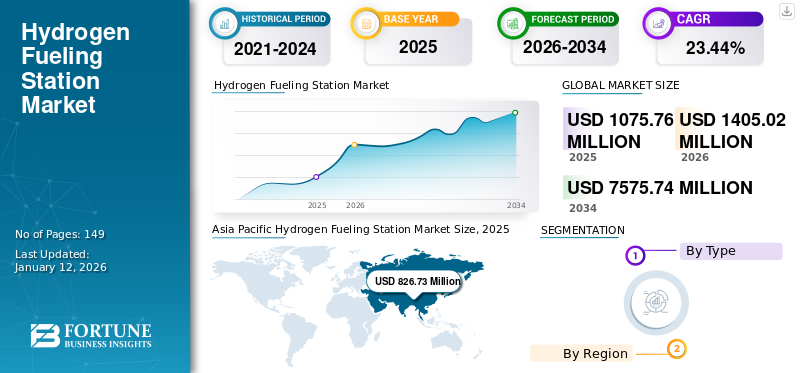
The hydrogen fueling station market size was valued at USD 975.68 million in 2025. The market is projected to grow from USD 1,192.67 million in 2026 to USD 6,592.68 million by 2034, exhibiting a CAGR of 23.83% during the forecast period. Asia Pacific dominated the hydrogen fueling station market with a market share of 55.40% in 2025.
The market is gaining momentum as countries expand clean mobility infrastructure to support fuel cell electric vehicles, heavy-duty trucks, buses, logistics fleets, rail, and other zero-emission transport applications. Hydrogen fueling stations enable fast refueling, longer driving range, and higher payload suitability compared to battery-only solutions in select commercial and long-distance transport use cases. These stations include hydrogen storage, compression, cooling, dispensing, safety, and control systems and may be supplied through on-site hydrogen production or delivered hydrogen.
The market is driven by the rising deployment of hydrogen-powered commercial mobility, especially buses, trucks, and fleet vehicles. Heavy-duty transport requires long range, short refueling time, and high vehicle uptime, making hydrogen attractive for logistics, public transit, ports, and industrial transportation. Governments are supporting this shift through subsidies, hydrogen corridor development, zero-emission vehicle targets, and infrastructure funding programs.
- For instance, in May 2025, Air Liquide inaugurated a new high-capacity hydrogen refueling station in Normandy, France, designed to support heavy-duty fuel cell trucks operating along key European freight corridors. The station is supplied with renewable and low-carbon hydrogen and forms part of the European Union's broader hydrogen mobility initiative. This development highlights the increasing investment in commercial hydrogen refueling infrastructure, accelerating the adoption of zero-emission heavy-duty transport
Some of the leading companies operating in the industry include Air Liquide, Air Products and Chemicals, Inc., China Petroleum and Chemical Corporation (Sinopec), and others. Air Liquide is one of the world's leading developers and operators of hydrogen fueling stations, providing end-to-end solutions including hydrogen production, compression, storage, dispensing, and station operation. The company has deployed hydrogen refueling infrastructure across Europe, North America, and Asia, supporting fuel cell passenger vehicles, buses, trucks, and commercial fleets while advancing the global hydrogen mobility ecosystem.
Download Free sample to learn more about this report.
HYDROGEN FUELING STATION MARKET TRENDS
Expansion of Heavy-Duty Hydrogen Refueling Corridors and High-Capacity Fueling Infrastructure are Emerging Market Trends
A prominent trend shaping the market is the development of dedicated hydrogen refueling corridors for heavy-duty transportation. Rather than focusing primarily on passenger vehicles, governments and industry participants are prioritizing stations capable of serving fuel cell trucks, transit buses, municipal fleets, port vehicles, and long-haul logistics operations. This trend is driving the deployment of high-capacity stations equipped with 350-bar and 700-bar dispensing systems, larger hydrogen storage capacities, and advanced pre-cooling technologies to enable rapid refueling and minimize vehicle downtime.
In addition, the integration of on-site green hydrogen production using electrolyzers powered by renewable electricity reduces dependence on transported hydrogen while improving supply security and lowering lifecycle emissions. Energy companies are also collaborating with industrial gas suppliers, truck manufacturers, logistics operators, and public transport authorities to establish strategically located hydrogen hubs along with freight corridors, ports, and industrial clusters.
MARKET DYNAMICS
MARKET DRIVERS
Download Free sample to learn more about this report.
Government Support and National Hydrogen Infrastructure Programs are Driving Market Growth
Government policies and large-scale hydrogen infrastructure programs are the primary drivers of hydrogen fueling station market growth. Many countries have adopted national hydrogen strategies that prioritize the establishment of refueling networks to support the commercialization of fuel cell vehicles, particularly in the heavy-duty transport segment. Financial incentives, capital grants, tax benefits, low-interest financing, and public-private partnership models are reducing the high upfront investment required for hydrogen station development.
In addition, governments are introducing zero-emission transport regulations, clean fleet procurement policies, and hydrogen government initiatives that encourage the installation of refueling stations along major highways, logistics hubs, ports, and urban transit routes. Automotive manufacturers, industrial gas companies, utilities, and energy retailers are collaborating to expand hydrogen infrastructure in line with growing fuel cell vehicle deployment. These factors are anticipated to drive the market growth during the forecasted period.
|
Rank |
Market Driver |
Relative Impact on Market Growth |
Estimated Growth Contribution (USD Million) |
2026-2028 |
2029-2031 |
2032-2034 |
|
1 |
Government Funding, Subsidies & National Hydrogen Strategies |
High |
2,200.00 |
High |
High |
Medium |
|
2 |
Rising Deployment of Hydrogen Fuel Cell Commercial Vehicles (Trucks, Buses & Fleets) |
High |
1,600.00 |
Medium |
High |
High |
|
3 |
Expansion of Green Hydrogen Production & Electrolyzer Capacity |
High |
1,200.00 |
Medium |
High |
High |
|
4 |
Increasing Investments in Public and Private Hydrogen Refueling Infrastructure |
Medium |
900.00 |
High |
Medium |
Medium |
|
5 |
Growth in Heavy-Duty Transport Decarbonization & Zero-Emission Mobility Policies |
Medium |
700.00 |
Medium |
Medium |
High |
|
6 |
Others (Technology improvements, digital station management, partnerships, standardization, etc.) |
Low |
400.00 |
Low |
Medium |
Medium |
|
Total |
7,000.00 |
MARKET RESTRAINTS
High Capital Investment and Limited Hydrogen Supply Infrastructure to Hamper Market Demand
The market faces a significant restraint due to the high capital investment required for station development and limited availability of supporting hydrogen supply infrastructure. Establishing a hydrogen refueling station involves substantial expenditure on compression systems, high-pressure storage tanks, dispensers, safety equipment, cooling systems, and civil infrastructure, making project economics challenging, particularly during the early stages of market development. In many regions, hydrogen production facilities, dedicated transportation networks, and storage infrastructure remain underdeveloped, resulting in higher hydrogen delivery costs and inconsistent fuel availability.
|
Rank |
Market Restraint |
Impact on Market Growth |
Estimated Market Reduction (USD Million) |
2026-2028 |
2029-2031 |
2032-2034 |
|
1 |
High Capital Cost of Hydrogen Fueling Station Deployment |
High |
700.00 |
High |
High |
Medium |
|
2 |
Limited Hydrogen Supply Infrastructure and Distribution Network |
High |
450.00 |
High |
Medium |
Medium |
|
3 |
Low Availability of Fuel Cell Vehicles in Several Markets |
Medium |
300.00 |
High |
Medium |
Low |
|
4 |
Others (Permitting delays, safety compliance costs, skilled workforce shortages, financing challenges, etc.) |
Low |
149.99 |
Low |
Low |
Low |
|
|
Total Market Reduction |
|
1,599.99 |
|
|
|
MARKET OPPORTUNITIES
Integration of Hydrogen Refueling Stations with Multi-Energy Retail and Industrial Hubs Offers Lucrative Market Opportunities
A major opportunity for the market lies in the integration of hydrogen refueling facilities with multi-energy retail stations, industrial clusters, and renewable energy hubs. Existing fuel retail networks are increasingly being upgraded to offer multiple low-carbon fuels, enabling operators to leverage established land, utility connections, and customer access while reducing infrastructure development costs. Industrial zones, ports, airports, and logistics parks also offers strong opportunities for hydrogen station deployment due to their concentrated demand from captive vehicle fleets and material handling equipment.
Furthermore, coupling hydrogen stations with renewable energy generation and on-site electrolyzers enables localized hydrogen production, reducing transportation sector requirements and improving fuel availability. This integrated approach enhances energy resilience, supports sector coupling between power and transport, and creates additional revenue streams through hydrogen supply to nearby industrial users.
MARKET CHALLENGES
Achieving Commercial Viability Amid Low Station Utilization Challenges Market Development
One of the key challenges faced by the market is achieving commercial viability while station utilization remains relatively low. Many hydrogen refueling stations are commissioned ahead of widespread fuel cell vehicle adoption to establish an initial infrastructure network, resulting in hydrogen dispensing volumes that are often below economically sustainable levels. This imbalance between infrastructure deployment and vehicle demand increases operational costs and delays return on investment for station operators. In addition, maintaining high-pressure equipment, ensuring consistent hydrogen purity, and meeting stringent safety and operational standards require specialized expertise and ongoing maintenance.
Segmentation Analysis
By Type
Small Station (Less than 1 t/d of H2) Segment Dominates as it is Suitable for Early-Stage Hydrogen Mobility Deployment
Based on the type, the market is classified into small station (less than 1 t/d of H2), medium station (1-4 t/d of H2), and large stations (more than 4 t/d of H2).
In 2025, small stations (less than 1 t/d of H2) segment dominated the market, accounting for 89.60% of the market. Small hydrogen fueling stations with a dispensing capacity of less than 1 ton of hydrogen per day are primarily deployed in regions where hydrogen mobility is at an early stage of development. These stations are designed to serve passenger fuel cell vehicles, municipal buses, light commercial fleets, research facilities, and pilot mobility projects with relatively low daily hydrogen demand.
The medium station (1-4 t/d of H2) segment is expected to grow at a CAGR of 26.24% during the forecast period.
To know how our report can help streamline your business, Speak to Analyst
By Production
Offsite Segment Leads Market Owing to Established Supply Chain and Ensures Reliable Fuel
Based on production, the market is classified into onsite and offsite.
In 2025, the offsite segment dominated the global market. It enables a reliable, large-scale hydrogen supply while reducing the complexity and cost of station infrastructure. Hydrogen is produced at centralized facilities using technologies such as steam methane reforming (SMR), electrolysis, or industrial by-product recovery, and is then transported to fueling stations via tube trailers, liquid hydrogen tankers, or pipelines where available.
The onsite segment is expected to grow at the highest CAGR of 25.78% over the forecast period.
By Configuration
Fixed Segment Dominates Market as it is Permanent Infrastructure and Supports Large-Scale Operations
On the basis of the configuration, the market is classified into mobile and fixed.
In 2025, the fixed segment held the largest hydrogen fueling station market share. Fixed stations are strategically located along highways, urban transportation corridors, logistics hubs, ports, and industrial zones where demand for hydrogen fueling stations is expected to remain consistent over the long term. Fixed installations accommodate larger hydrogen storage systems, high-pressure compression equipment, multiple dispensers, and advanced safety systems, enabling faster refueling and higher daily throughput than mobile hydrogen station alternatives. Their robust infrastructure supports a wide range of fuel cell vehicles, including passenger cars, buses, heavy-duty trucks, and commercial fleets.
The mobile segment is expected to grow at a CAGR of 27.54% during the forecast period.
Hydrogen Fueling Station Market Regional Outlook
By geography, the market is categorized into North America, Europe, Asia Pacific, and Rest of the World.
North America
Asia Pacific Hydrogen Fueling Station Market Size, 2025 (USD Million)
To get more information on the regional analysis of this market, Download Free sample
The North America market in 2025 was valued at USD 48.00 million, and also will take a significant share in 2026 with USD 56.75 million. North America market growth is driven by large-scale deployment of hydrogen refueling infrastructure for heavy-duty trucks, transit buses, and commercial fleet operations. The U.S. and Canada are expanding hydrogen corridors linking freight routes, ports, and logistics hubs, supported by federal and state/provincial hydrogen programs.
U.S. Hydrogen Fueling Station Market
Based on North America’s strong contribution, the U.S. market was at USD 36.91 million in 2025, accounting for roughly 3.78% of the global market size.
Europe
Europe's market accounted for the second-highest market share, is projected to record a growth rate of 23.20% in the coming years and reached a valuation of USD 369.08 million in 2025. Europe is expanding its hydrogen fueling station network through cross-border hydrogen corridors and the deployment of refueling infrastructure along the Trans-European Transport Network (TEN-T). Strong regulatory support under the EU's Alternative Fuels Infrastructure Regulation (AFIR), combined with investments in green hydrogen production, is accelerating station deployment for commercial vehicles, public transport, and freight logistics.
Germany Hydrogen Fueling Station Market
The Germany market in 2025 reached USD 186.62 million and is estimated at around USD 223.57 million in 2026, representing roughly 19.13% of the global revenues. Germany is the leading market in Europe, supported by the nationwide H2 MOBILITY Deutschland network, which is expanding high-capacity refueling stations for fuel cell trucks, buses, and commercial fleets. The country is prioritizing hydrogen infrastructure along key freight corridors connecting major industrial regions, ports, and logistics centers to enable long-distance zero-emission transport.
Asia Pacific
Asia Pacific market is estimated to account for the highest market share and reached USD 540.58 million in 2025. Asia Pacific is led by development economies such as Japan, South Korea, and China, where hydrogen fueling stations are being deployed through national hydrogen mobility roadmaps and city-level demonstration clusters. Japan and South Korea focus on passenger FCVs, buses, and commercial fleets, while China is scaling stations around fuel cell trucks, industrial parks, and logistics corridors. Strong involvement from Sinopec, Iwatani, ENEOS, KOGAS, and Hyundai-backed ecosystems supports regional station expansion.
Japan Hydrogen Fueling Station Market
The Japan market accounted for 17.82% of global revenues in 2025. It is advancing hydrogen fueling infrastructure by integrating refueling stations with its automotive manufacturing ecosystem, where companies such as Iwatani, ENEOS, and Toyota are expanding station networks to support commercial deployment of fuel cell vehicles and hydrogen-powered mobility.
China Hydrogen Fueling Station Market
China’s market represented roughly 16.98% of the global market in 2025.
South Korea Hydrogen Fueling Station Market
The South Korea market in 2025 was at USD 148.40 million, accounting for roughly 15.21% of global revenues.
Rest of World
The rest of World is expected to witness moderate growth in this market space in the long term. It was valued at USD 18.02 million in 2025. The market is emerging through pilot hydrogen fueling projects in the Middle East, Latin America, and Africa, mainly linked to green hydrogen hubs, ports, mining fleets, and public transport trials.
COMPETITIVE LANDSCAPE
Key Industry Players
Growing Focus on Partnerships, Business Expansion, and Technological Advancements by Key Players Boosts Market Competition
The hydrogen fueling station market holds a consolidated market structure, constituting prominent players such as Air Liquide, Air Products and Chemicals, Inc., China Petroleum and Chemical Corporation (Sinopec). Companies operating in the market are adopting targeted growth strategies focused on strengthening their product portfolio, technical capability, expanding manufacturing presence, and other areas.
- For instance, in April 2025, Sinopec continued expanding its integrated hydrogen energy network by commissioning additional hydrogen refueling stations in China as part of its nationwide hydrogen mobility strategy. The company combined hydrogen production, refueling, and conventional fuel retail operations to support fuel cell buses and heavy-duty trucks operating in industrial clusters and logistics corridors, further strengthening China's commercial hydrogen transportation ecosystem.
Other key market players in the global market include Iwatani Corporation, Eneos Corporation, and Korea Gas Corporation among others. These companies are expected to prioritize new product launches and collaborations to increase their global market share during the forecast period.
LIST OF KEY HYDROGEN FUELING STATION COMPANIES PROFILED
- Air Liquide (France)
- Air Products and Chemicals, Inc. (U.S.)
- China Petroleum and Chemical Corporation / Sinopec (China)
- FirstElement Fuel Inc. (U.S.)
- H2 Mobility Deutschland GmbH & Co. KG (Germany)
- Iwatani Corporation (Japan)
- ENEOS Corporation (Japan)
- Korea Gas Corporation (South Korea)
- Beijing SinoHytec Co., Ltd. (China)
- Linde Group / Linde plc (Ireland)
- Nel Hydrogen / Nel ASA (Norway)
KEY INDUSTRY DEVELOPMENTS
- April 2026: Iwatani Corporation operated 52 hydrogen fueling stations in Japan and 10 stations in the U.S., reinforcing its position as one of the world's leading hydrogen infrastructure providers. The company continued expanding hydrogen supply capabilities to meet increased demand from passenger fuel cell vehicles and commercial fleets.
- January 2026: FORVIA and Sinopec Capital entered into a strategic partnership to accelerate the development of China's hydrogen mobility ecosystem. The collaboration focuses on advancing hydrogen value chain investments, including hydrogen refueling infrastructure, fuel cell vehicle deployment, and supporting technologies.
- February 2025: Nel ASA secured new orders for hydrogen refueling equipment, including high-capacity electrolyzer-integrated fueling solutions and hydrogen dispensing systems for commercial mobility projects. The company continued supplying modular hydrogen station technologies that enable scalable deployment of refueling infrastructure for buses, trucks, and fleet vehicles while supporting the expansion of green hydrogen mobility.
- January 2025: FirstElement Fuel continued upgrading California's True Zero hydrogen refueling network by increasing station reliability, improving dispensing performance, and expanding hydrogen availability for fuel cell electric vehicles. The company worked closely with hydrogen suppliers and public agencies to improve customer experience while supporting the long-term expansion of California's hydrogen mobility infrastructure.
- May 2024: Air Products announced plans to develop a network of commercial-scale, multi-modal hydrogen refueling stations connecting Northern and Southern California. The stations are designed to fuel up to 200 heavy-duty trucks or 2,000 light-duty vehicles per day, supporting California's transition toward zero-emission transportation while strengthening hydrogen infrastructure for freight and logistics operations.
REPORT COVERAGE
The global hydrogen fueling station market analysis provides an in-depth study of the market size & forecast by all the market segments included in the report. It includes details on the market dynamics and the market trends expected to drive the market in the forecast period. It offers information on the technological advancements, new product launches, key industry developments, and details on partnerships, mergers & acquisitions. The market research report also encompasses a detailed competitive landscape with information on the market share and profiles of key operating players.
Request for Customization to gain extensive market insights.
Report Scope & Segmentation
| ATTRIBUTE | DETAILS |
| Study Period | 2021-2034 |
| Base Year | 2025 |
| Estimated Year | 2026 |
| Forecast Period | 2026-2034 |
| Historical Period | 2021-2024 |
| Growth Rate | CAGR of 23.83% from 2026 to 2034 |
| Unit | Value (USD Million), Volume (Number of Units) |
| Segmentation | By Type, Production, Configuration, and Region |
| By Type |
|
| By Production |
|
| By Configuration |
|
| By Region |
|
Frequently Asked Questions
Fortune Business Insights says that the global market value stood at USD 975.68 million in 2025 and is projected to reach USD 6,592.68 million by 2034.
In 2025, the Asia Pacific market value stood at USD 540.58 million.
The market is expected to exhibit a CAGR of 23.83% during the forecast period of 2026-2034.
The small station (less than 1 t/d of H2) segment led the market by type.
The market is primarily driven by increasing deployment of fuel cell vehicles and the expansion of zero-emission commercial transportation networks.
Air Liquide, Air Products and Chemicals, Inc., China Petroleum and Chemical Corporation (Sinopec) are some of the prominent players in the market.
Asia Pacific dominated the market in 2025.
Growing deployment of fuel cell buses and heavy-duty trucks, expansion of green hydrogen production, and supportive government incentives are expected to accelerate hydrogen fueling station adoption.



- 2021-2034
- 2025
- 2021-2024
- 205
Get 30-60 hrs Free Customization
Expand Regional and Country Coverage, Segments Analysis, Company Profiles, Competitive Benchmarking, and End-user Insights.



















Related Reports
-
US +1 833 909 2966 ( Toll Free )
-
Get In Touch With Us