Incretin-based Drugs Market Size, Share & Industry Analysis, By Drug Class (GLP-1 Receptor Agonists, DPP-4 INHIBITORS/GLIPTINS, and Others), By Indication (Type 2 Diabetes, Obesity/Weight Management, and Others), By Type (Branded and Generic), By Route of Administration (Oral and Parenteral), By Age Group (Adults and Pediatrics), By Distribution Channel (Hospital Pharmacies, Retail Pharmacies & Drug Stores, Online Pharmacies, and Others), and Regional Forecast, 2026-2034
 Download Free Sample
Incretin-based Drugs Market Size and Future Outlook
 Listen to Audio Version
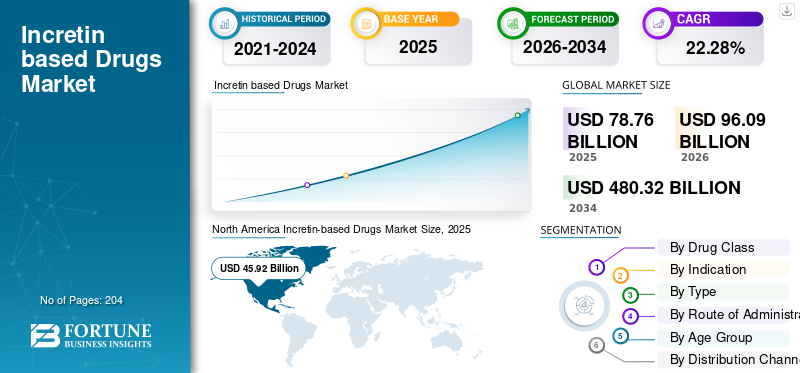
The global incretin-based drugs market size was valued at USD 78.76 billion in 2025 and is projected to grow from USD 96.09 billion in 2026 to USD 480.32 billion by 2034, exhibiting a CAGR of 22.28% during the forecast period. North America dominated the incretin based drugs market with a market share of 58.30% in 2025.
Incretin-based drugs include prescription therapies used to manage type 2 diabetes, obesity/weight management, and related cardiometabolic indications through GLP-1 receptor agonists, DPP-4 INHIBITORS/GLIPTINS, and other incretin-based therapies. The market is growing due to the rising global burden of diabetes and obesity, rapid adoption of GLP-1 and dual-incretin drugs, expanding use in weight management, and increasing prescription penetration in both developed and emerging markets.
Key players in the global market include Novo Nordisk A/S, Eli Lilly and Company, Boehringer Ingelheim International GmbH, and Merck & Co., Inc., among others. Their competitive positioning is supported by strong geographic presence, focus on innovative drug development, and other strategic initiatives.
Download Free sample to learn more about this report.
Incretin based Drugs Market Key Takeaways
 Global Market Size & Forecast
- 2025 Market Size: USD 78.76 billion
- 2026 Market Size: USD 96.09 billion
- 2034 Forecast Market Size: USD 480.32 billion
- CAGR: 22.28% from 2026-2034
 Market Share
- North America dominated the incretin based drugs market with a market share of 58.30% in 2025.
- The GLP-1 receptor agonists segment accounted for the largest global incretin-based drugs market share in 2025.
- The type 2 diabetes segment dominated the global market share in 2025.
 Key Regional Highlights
North America
North America reached USD 36.64 billion in 2024 and led the global market. In 2025, the region continued to hold its leading position, with USD 45.92 billion.
Europe
The European market size is anticipated to grow at 19.96% CAGR during the forecast period.
Asia Pacific
The Asia Pacific market is expected to reach a valuation of USD 16.72 billion in 2026.
U.S.
The U.S. dominated the North American market and can be analytically approximated at around USD 50.99 billion in 2026, accounting for roughly 53.1% of global revenues.
Japan
The Japan market in 2026 is estimated at around USD 4.58 billion, accounting for roughly 4.8% of global revenues.
Read More

INCRETIN-BASED DRUGS MARKET TRENDS
Shift from DPP-4 Inhibitors to GLP-1 and Dual-Incretin Therapies is a Remarkable Market Trend
The market is showing a clear shift from mature DPP-4 INHIBITORS/GLIPTINS toward GLP-1 receptor agonists and dual-incretin therapies as newer agents offer stronger glucose control, clinically meaningful weight loss, and broader cardiometabolic benefits. DPP-4 products remain relevant in oral and cost-sensitive diabetes care, but generic competition, payer price actions, and lower clinical differentiation increasingly pressure their value contribution. Novo Nordisk reported that the estimated global GLP-1 share of total diabetes prescriptions increased to 8.1% in 2025, compared with 6.7% a year earlier, showing rising penetration of GLP-1 therapies. This trend is expected to continue as dual-incretin products such as tirzepatide gain greater use across both diabetes and obesity. These factors are supporting the overall global incretin-based drugs market growth.
- For instance, in February 2026, Eli Lilly reported Q4 2025 revenue growth of 43%, supported by volume growth from Mounjaro and Zepbound, highlighting the rapid market shift toward GLP-1 / dual-incretin therapies.
MARKET DYNAMICS
MARKET DRIVERS
Download Free sample to learn more about this report.
Rising Global Diabetes Burden to Drive Market Expansion
The growing incidence of type 2 diabetes significantly fuels the market, as these treatments are commonly utilized for managing blood sugar levels and are increasingly recognized for their benefits in weight and cardiometabolic health. The IDF estimates that 589 million adults across the globe have diabetes, with projections indicating this figure could rise to 853 million by 2050, and more than 90% of these cases are type 2 diabetes. This forms a broad and growing treatment category for GLP-1 receptor agonists, DPP-4 inhibitors/gliptins, and dual-incretin therapies. Diabetes is a long-term condition that necessitates ongoing treatment, leading to a direct correlation between increased diagnosis rates and consistent prescription demand. The driver holds significant importance in Asia Pacific and emerging markets, as diabetes rates are increasing and GLP-1 utilization is still fairly limited. All these factors cumulatively drive the overall market growth.
- For instance, in September 2025, Eli Lilly announced Phase 3 SURPASS-PEDS results for Mounjaro in children and adolescents aged 10 to under 18 with type 2 diabetes, showing companies are expanding incretin therapy development toward the younger diabetes population as the disease burden broadens.
|
Rank |
Market Driver |
Expected Impact on Market Growth |
Estimated Gross Market Growth Contribution (USD Billion) |
Impact: 2026-2028 |
Impact: 2029-2031 |
Impact: 2032-2034 |
|
1 |
Rapid expansion of obesity/weight management treatment with GLP-1 and dual-incretin drugs |
High |
155 |
High |
High |
Medium |
|
2 |
Rising type 2 diabetes burden and increasing incretin penetration |
High |
115 |
High |
High |
Medium |
|
3 |
Strong uptake of premium GLP-1, dual-incretin, and next-generation incretin products |
High |
95 |
High |
High |
High |
|
4 |
Expansion into broader cardiometabolic indications and label extensions |
Medium |
75 |
Medium |
High |
High |
|
5 |
Improving global access through manufacturing expansion, retail availability, online channels, and emerging-market adoption |
Medium |
50 |
Medium |
Medium |
High |
|
6 |
Others |
Low |
30 |
Low |
Low |
Low |
|
|
Total Gross Growth Contribution |
|
520 |
|
|
|
MARKET RESTRAINTS
High Treatment Cost and Budget Impact to Restrain Market Growth
High treatment cost is a key restraint for the market, as GLP-1 and dual-incretin therapies are chronic-use medicines prescribed to very large diabetes and obesity populations. Even when these drugs deliver strong weight-loss and cardiometabolic benefits, broad reimbursement can create a major budget burden for public and private payers. This can lead to tighter eligibility rules, prior authorization, step therapy, and slower obesity-drug coverage expansion. The restraint is especially relevant for premium products such as Wegovy, Zepbound, Ozempic, and Mounjaro, where demand is high, but payer affordability remains a limiting factor. CBO noted that broader Medicare coverage of anti-obesity medications would increase federal spending as per-user drug costs exceed near-term healthcare savings.
- For example, in October 2024, the U.S. Congressional Budget Office estimated that authorizing Medicare coverage of anti-obesity medications would increase federal spending by about USD 35 billion from 2026 to 2034, highlighting the budget pressure linked to wider GLP-1 access.
|
Rank |
Market Restraint |
Expected Impact on Market Growth |
Estimated Reduction in Market Size (USD Billion) |
Impact: 2026-2028 |
Impact: 2029-2031 |
Impact: 2032-2034 |
|
1 |
High treatment cost and payer budget pressure |
High |
58 |
High |
High |
High |
|
2 |
Pricing pressure, rebates, and generic erosion in mature incretin classes |
High |
36 |
Medium |
High |
High |
|
3 |
Treatment discontinuation, tolerability issues, and safety concerns around misuse / unapproved GLP-1 products |
Medium |
24 |
Medium |
Medium |
Medium |
|
4 |
Others |
Low |
17.77 |
Low |
Low |
Low |
|
|
Total Market Reduction |
|
135.77 |
|
|
|
MARKET OPPORTUNITIES
Expansion of Obesity Reimbursement and Coverage to Create New Growth Opportunity
Broadening reimbursement for obesity medications presents a significant market opportunity since high out-of-pocket expenses have been one of the primary obstacles to the adoption of GLP-1 and dual-incretin therapies in weight management. Expanded coverage for individuals with obesity along with cardiovascular risk, sleep apnea, prediabetes, or other comorbidities can transform a significant untreated group into a reimbursable, ongoing prescription need. This also bolsters the business argument for products such as Wegovy and Zepbound, as the treatment of obesity is more frequently framed as cardiometabolic risk management rather than merely weight reduction. Medicare coverage options for GLP-1s are particularly significant as they can facilitate access for elderly and high-risk groups. All these factors would drive the market growth in the coming years.
- For instance, in July 2026, Medicare launched the GLP-1 Bridge program, offering eligible Medicare and Medicare Advantage beneficiaries access to select GLP-1 weight-loss drugs for USD 50/month, marking a major access expansion for covered obesity treatment.
MARKET CHALLENGES
Scaling Manufacturing and Supply Chain Capacity to Challenge Market Expansion
Increasing manufacturing capacity presents a significant challenge for the market as the demand for GLP-1 and dual-incretin products has surged more rapidly than conventional injectable and peptide production systems. Items such as Mounjaro, Zepbound, Ozempic, and Wegovy necessitate intricate API manufacturing, fill-finish capability, device provision, quality assurance, and cold-chain logistics. Any shortfall in capacity can hinder prescription fulfillment, postpone market launches, and slow the transition of qualified diabetes and obesity patients into treated individuals. This challenge is particularly significant as businesses branch out from diabetes to obesity and other cardiometabolic conditions, elevating volume demands in various regions. All the factors cumulatively affect the market growth.
- For instance, in February 2025, Eli Lilly announced plans to build four new U.S. manufacturing sites and more than double its U.S. manufacturing investment since 2020 to over USD 50 billion, highlighting the scale of capacity expansion required to support rising demand for medicines such as Mounjaro and Zepbound.
Segmentation Analysis
By Drug Class
GLP-1 Receptor Agonists Segment Led Market Due to Its Wider Use in Obesity and Cardiometabolic Care
In terms of drug class, the market is divided into GLP-1 receptor agonists, DPP-4 INHIBITORS/GLIPTINS, and others.
The GLP-1 receptor agonists segment accounted for the largest global incretin-based drugs market share in 2025. The segment’s leadership is due to the strong commercial position of semaglutide, dulaglutide, liraglutide, and other established GLP-1 products across type 2 diabetes and obesity/weight management. The segment captured the highest value share as GLP-1 drugs are used chronically, command premium pricing, and offer dual benefits in glycemic control and weight reduction. Additionally, strong adoption of products helped the segment maintain its leading position over DPP-4 inhibitors, which are more mature and price-sensitive. Furthermore, wider use in obesity and cardiometabolic care further strengthened GLP-1 receptor agonists’ market leadership.
- For instance, in February 2026, Novo Nordisk reported 2025 GLP-1-based type 2 diabetes sales of USD 23.28 billion and obesity care sales of USD 12.59 billion, supported by strong demand for products such as Ozempic, Rybelsus, and Wegovy.
The DPP-4 INHIBITORS/GLIPTINS segment is anticipated to rise with a CAGR of 18.63% over the forecast period.
To know how our report can help streamline your business, Speak to Analyst
By Indication
Large Patient Base and Chronic Treatment Use Led to Dominance of Type 2 Diabetes Segment
On the basis of indication, the market is divided into type 2 diabetes, obesity/weight management, and others.
The type 2 diabetes segment dominated the global market share in 2025. This is due to incretin-based drugs being originally commercialized and widely prescribed for long-term glycemic control in diabetic patients. Additionally, these products are used chronically across a large diagnosed and treated diabetes population. Moreover, broader product availability, established reimbursement, and higher physician familiarity also supported the leading position of the segment. Furthermore, the segment is set to hold a 70.9% share in 2026.
- For instance, in December 2025, the U.S. FDA updated Mounjaro’s label to include use in adults and pediatric patients aged 10 years and older with type 2 diabetes, supporting the continued expansion of incretin therapy within the dominant diabetes indication.
The obesity/weight management segment is anticipated to grow at a CAGR of 32.21% over the forecast period.
By Type
Branded Segment Dominated Due to Increased Premium GLP-1 and Dual-Incretin Product Sales
Based on type, the market is classified into branded and Generic.
The branded segment dominated the global market in 2025, as most high-value incretin-based drugs remained protected originator brands with strong clinical differentiation and premium pricing. The segment captured the highest share due to the strong commercial position of branded GLP-1 and dual-incretin products such as Ozempic, Wegovy, Rybelsus, Mounjaro, Zepbound, and Trulicity. Generic competition was mainly limited to older incretin products, while the major revenue contributors in diabetes and obesity were still branded therapies. Strong physician preference, established brand equity, expanding indications, and recurring chronic use helped branded products maintain their leading position.
- For instance, in August 2025, the U.S. FDA approved an additional indication for Novo Nordisk’s branded Wegovy for the treatment of noncirrhotic MASH in adults with moderate to advanced liver fibrosis, strengthening the commercial lifecycle of a leading branded incretin therapy.
The Generic segment is anticipated to rise with a CAGR of 31.84% over the forecast period.
By Route of Administration
Parenteral Segment Led Market Due to Growing Obesity Treatment Demand
In terms of route of administration, the market is divided into oral and parenteral.
The parenteral segment captured the highest share of the global market in 2025. This can be attributed to the fact that the majority of the incretin-based drugs are available as injectable therapies and used chronically across type 2 diabetes and obesity/weight management. Additionally, strong clinical outcomes in glycemic control and weight reduction, along with growing obesity treatment demand, helped parenteral products maintain their leading position.
- For instance, in November 2023, the U.S. FDA approved Zepbound (tirzepatide) injection for chronic weight management in adults with obesity or overweight with at least one weight-related condition, supporting the continued expansion of high-value injectable incretin therapy.
The oral segment is anticipated to rise with a CAGR of 22.30% over the forecast period.
By Age Group
Adults Segment Led the Market Due to Larger Treatment Pool and Broader Label Use
On the basis of age group, the market is divided into adults and pediatrics.
The adults segment captured the highest share of the global market in 2025, owing to the fact that most incretin-based drugs are primarily prescribed for adult patients with type 2 diabetes, obesity/weight management, and related cardiometabolic risks. The segment captured the highest value share as adult diabetes and obesity populations are significantly larger than pediatric populations, and chronic treatment use is more established in adults. High-value products such as Ozempic, Wegovy, Rybelsus, Mounjaro, Zepbound, Trulicity, and DPP-4 inhibitors are mainly used across adult care settings.
- For instance, in March 2024, the U.S. FDA approved Wegovy to reduce the risk of cardiovascular death, heart attack, and stroke specifically in adults with cardiovascular disease and either obesity or overweight, strengthening the adult-focused use base for incretin therapies.
The pediatrics segment is anticipated to rise with a CAGR of 30.35% over the forecast period.
By Distribution Channel
Retail Pharmacies & Drug Stores Segment Dominated Due to Chronic Outpatient Prescription Refills
In terms of distribution channel, the market is segmented into retail pharmacies & drug stores, hospital pharmacies, online pharmacies, and others.
In 2025, the retail pharmacies & drug stores segment held the dominating market share. The segment’s dominance can be attributed to the fact that incretin-based drugs are mainly chronic outpatient therapies used for type 2 diabetes and obesity/weight management. Retail pharmacies also offer wide geographic reach, cold-chain handling, insurance processing, pharmacist counselling, and repeat refill support, making them the preferred dispensing channel for long-term therapy. Moreover, this segment remains dominant due to its established role in chronic medicine access and patient follow-up. Furthermore, the segment is set to hold a 56.2% share in 2026.
- For instance, in February 2026, Walgreens launched Walgreens Weight Management and stated that the program integrates with Walgreens’ pharmacy services, allowing patients prescribed FDA-approved GLP-1s to send prescriptions to the pharmacy of their choice.
Online pharmacies are projected to witness a CAGR of 34.26% during the forecast period.
Incretin-based Drugs Market Regional Outlook
By geography, the market is divided into North America, Latin America, Asia Pacific, Europe, and the Middle East & Africa.
North America
North America Incretin-based Drugs Market Size, 2025 (USD Billion)
To get more information on the regional analysis of this market, Download Free sample
North America reached USD 36.64 billion in 2024 and led the global market. In 2025, the region continued to hold its leading position, with USD 45.92 billion. North America’s growth is driven by high adoption of premium GLP-1 and dual-incretin brands, strong obesity-drug demand, higher manufacturer-level pricing, and faster uptake of expanded cardiometabolic indications.
U.S. Incretin-based Drugs Market
The U.S. dominated the North American market and can be analytically approximated at around USD 50.99 billion in 2026, accounting for roughly 53.1% of global revenues.
Europe
The European market size is anticipated to grow at 19.96% CAGR during the forecast period. Market growth is driven by the rising type 2 diabetes and obesity prevalence, expanding GLP-1 adoption, and increasing reimbursement acceptance where products demonstrate cardiovascular and weight-management benefits.
U.K. Incretin-based Drugs Market
The U.K. market in 2026 is estimated at around USD 3.49 billion, representing roughly 3.6% of global revenues.
Germany Incretin-based Drugs Market
The Germany market size is projected to reach approximately USD 4.06 billion in 2026, equivalent to around 4.2% of global sales.
Asia Pacific
The Asia Pacific market is expected to reach a valuation of USD 16.72 billion in 2026. Asia Pacific is expected to be the fastest-growing region due to its large diabetes population, rising obesity burden, improving diagnosis rates, and increasing access to GLP-1 and dual-incretin therapies in China, Japan, India, South Korea, Australia, and Southeast Asia. The region also has strong historical use of oral DPP-4 inhibitors, creating a large patient base that is transitioning toward higher-value GLP-1 and next-generation incretin products.
Japan Incretin-based Drugs Market
The Japan market in 2026 is estimated at around USD 4.58 billion, accounting for roughly 4.8% of global revenues.
China Incretin-based Drugs Market
China’s market is projected to reach revenues of around USD 4.73 billion in 2026, representing roughly 4.9% of global sales.
India Incretin-based Drugs Market
The India market in 2026 is estimated at around USD 1.89 billion, accounting for roughly 2.0% of global revenues.
Latin America and Middle East & Africa
The Middle East & Africa and Latin America regions are likely to witness moderate growth over the forecast period. The market in Latin America is projected to attain a valuation of USD 2.50 billion in 2026. The regional growth is supported by increasing diabetes and obesity prevalence, expanding private healthcare access, rising awareness of weight-management treatment, and broader availability of branded GLP-1 products in Brazil and Mexico.
In the Middle East & Africa region, the GCC market is projected to reach approximately USD 1.00 billion in 2026, representing about 1.0% of global revenues. The growth is driven by high diabetes and obesity burden in Gulf countries, rising specialist endocrinology and obesity-care services, and increasing access to premium therapies through private hospitals and high-income healthcare systems.
COMPETITIVE LANDSCAPE
Key Industry Players
Focus on Branded Innovative Products and Generic Portfolios by Key Players to Propel Market Competition
The global incretin-based drugs market is highly concentrated at the premium branded end, with companies such as Novo Nordisk A/S, Eli Lilly and Company, Merck & Co., Boehringer Ingelheim, and others holding notable positions. These players compete through branded GLP-1 therapies, dual GIP/GLP-1 products, DPP-4 inhibitor portfolios, fixed-dose combinations, oral incretin development, and generic GLP-1 launches.
- For instance, in December 2024, Novo Holdings completed the acquisition of Catalent, strengthening manufacturing and fill-finish capacity that can support expanded supply of high-demand GLP-1 products.
Other notable players include Sanofi, Novartis AG, Teva Pharmaceutical Industries Ltd., Takeda Pharmaceutical Company Limited, Biocon, and others. These players are focusing on affordability, generic launches, and regional access expansion.
- For instance, in February 2026, Biocon received U.S. FDA approval for liraglutide injection, a generic version of Saxenda, supporting entry of lower-cost GLP-1 options in the weight management segment.
LIST OF KEY INCRETIN-BASED DRUG COMPANIES PROFILED
- Novo Nordisk A/S (Denmark)
- Eli Lilly and Company (U.S.)
- Novartis AG (Switzerland)
- AstraZeneca (U.K.)
- Boehringer Ingelheim International GmbH (Germany)
- Merck & Co., Inc. (U.S.)
- Teva Pharmaceutical Industries Ltd. (Israel)
- Sanofi (France)
- Takeda Pharmaceutical Company Limited (Japan)
- Biocon (India)
KEY INDUSTRY DEVELOPMENTS
- June 2026: Novo Nordisk reported that Wegovy pill prescriptions surpassed 3 million, with approximately one prescription filled every 5 seconds, highlighting strong early uptake of oral GLP-1 therapy for obesity.
- May 2026: Eli Lilly announced positive topline Phase 3 TRIUMPH-1 results for retatrutide, an investigational GIP/GLP-1/glucagon triple receptor agonist, in adults with obesity or overweight and weight-related comorbidities.
- April 2026: Zealand Pharma announced that Boehringer Ingelheim’s survodutide, a glucagon/GLP-1 dual agonist, achieved significant weight loss of 16.6% in the Phase 3 SYNCHRONIZE-1 obesity trial.
- April 2026: Eli Lilly announced the U.S. FDA approval of Foundayo (orforglipron), an oral GLP-1 pill for adults with obesity or overweight with weight-related medical problems, with availability through LillyDirect and U.S. pharmacies.
- December 2025: Novo Nordisk filed for the first U.S. regulatory approval of CagriSema, after REDEFINE studies showed strong weight-loss results in obesity and obesity with type 2 diabetes populations.
REPORT COVERAGE
The global incretin-based drugs market analysis encompasses an extensive examination of the market size and projections for all market segments featured in the report. It provides insights into the market dynamics and trends expected to drive market growth during the forecast period. It offers insights into crucial elements, such as innovations in products, the regulatory landscape, pipeline analysis, and the introduction of new products. Furthermore, it outlines collaborations, mergers & acquisitions, along with significant advancements in the industry within the market. The report also provides a comprehensive competitive landscape with details on market share and profiles of major active participants.
Request for Customization to gain extensive market insights.
Report Scope & Segmentation
| ATTRIBUTE | DETAILS |
| Study Period | 2021-2034 |
| Base Year | 2025 |
| Estimated Year | 2026 |
| Forecast Period | 2026-2034 |
| Historical Period | 2021-2024 |
| Growth Rate | CAGR of 22.28% from 2026 to 2034 |
| Unit | Value (USD Billion) |
| Segmentation | By Drug Class, Indication, Type, Route of Administration, Age Group, Distribution Channel, and Region |
| By Drug Class |
|
| By Indication |
|
| By Type |
|
| By Route of Administration |
|
| By Age Group |
|
| By Distribution Channel |
|
| By Region |
|
Frequently Asked Questions
According to Fortune Business Insights, the global market value stood at USD 78.76 billion in 2025 and is projected to reach USD 480.32 billion by 2034.
In 2025, the North American market value stood at USD 45.92 billion.
The market is expected to exhibit a CAGR of 22.28% during the forecast period of 2026-2034.
By drug class, the GLP-1 receptor agonists segment led the market.
Rising global burden of type 2 diabetes and a growing prevalence of obesity and weight management needs are primary factors driving market expansion.
Novo Nordisk A/S, Eli Lilly and Company, and Merck & Co., Inc. are among the prominent players in the global market.
North America dominated the market in 2025.



- 2021-2034
- 2025
- 2021-2024
- 204
Get 30-60 hrs Free Customization
Expand Regional and Country Coverage, Segments Analysis, Company Profiles, Competitive Benchmarking, and End-user Insights.













.webp)






Related Reports
-
US +1 833 909 2966 ( Toll Free )
-
Get In Touch With Us