India High-Ethanol Blend Fuels (E25-E100) Market Size, Share & Industry Analysis, By Blend Type (E25, E30, E50, E85, and E100), By Feedstock (Sugarcane Juice, Molasses, and Maize/Corn), By Fuel Grade (Automotive Grade, Premium High-Octane, and Racing Grade), By Vehicle Compatibility (Flex-Fuel Passenger Vehicles, Flex-Fuel Two-Wheelers, and Dedicated Ethanol Vehicles), By Distribution Channel (Retail Fuel Stations, Dedicated Ethanol Pumps, and Fleet Fueling Stations), By End User (Individual Consumers, Commercial Fleets, Government Fleets, and Agriculture), and Country Forecast, 2026-2034
 Download Free Sample
India High-Ethanol Blend Fuels (E25-E100) Market Size and Future Outlook
 Listen to Audio Version
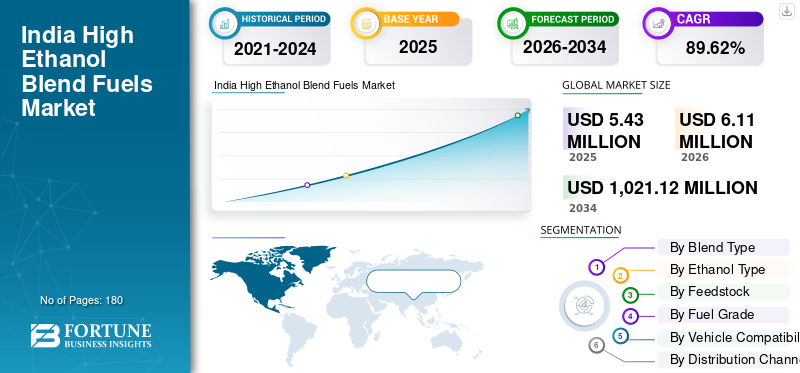
The India high-ethanol blend fuels (E25-E100) market size was valued at USD 5.43 million in 2025. The market is projected to grow from USD 6.11 million in 2026 to USD 1,021.12 million by 2034, exhibiting a CAGR of 89.62% during the forecast period.
India high-ethanol blend fuels (E25-E100) refer to renewable transportation fuels containing 25% to 100% ethanol blended with gasoline, including E25, E30, E50, E85, and E100 formulations. Such fuels are especially designed for use in flex-fuel vehicles (FFVs) and dedicated ethanol-powered engines. These fuels are produced primarily from renewable feedstocks such as sugarcane juice, B-heavy molasses, C-heavy molasses, maize, damaged food grains, and other biomass resources, providing a lower-carbon alternative to conventional petrol. The market encompasses the production, blending, storage, distribution, and retail sale of fuel-grade ethanol through oil marketing companies, dedicated ethanol dispensing stations, fleet fueling facilities, and other authorized distribution channels.
Rising fuel demand, increasing energy security concerns, and ambitious decarbonization objectives are encouraging the adoption of higher ethanol blends beyond the current E20 program. Government initiatives supporting flex-fuel vehicle development, expansion of domestic ethanol production, and investments in blending and dispensing biofuel infrastructure are creating a favorable ecosystem for commercialization of E25 fuel–E100 ethanol fuels. Some of the leading companies operating in the Indian market are Indian Oil Corporation Limited (IOC), Bharat Petroleum Corporation Limited (BPCL), Hindustan Petroleum Corporation Limited (HPCL), and Praj Industries Limited. India's largest oil marketing company, leading the commercialization of high-ethanol fuels through expanded ethanol blending, E100 fuel dispensing infrastructure, and investments in flex-fuel mobility solutions.
Download Free sample to learn more about this report.
INDIA HIGH-ETHANOL BLEND FUELS (E25-E100) MARKET TRENDS
Expansion of Flex-Fuel Vehicle (FFV) Development and Pilot Programs Emerges as a Key Market Trend
Indian automobile manufacturers are increasingly focusing on developing flex-fuel-compatible engines capable of operating on higher ethanol blends such as E85 and E100. Vehicle testing, engine calibration, and component localization are gaining momentum to improve compatibility with high-ethanol fuels. Collaboration between automotive OEMs, fuel suppliers, and technology providers is expected to accelerate commercialization once enabling alternative fuel infrastructure and fuel availability expand across key states. In addition, component suppliers are localizing critical parts, including fuel injectors, seals, hoses, and storage systems designed for ethanol compatibility, helping reduce manufacturing costs and strengthen domestic supply chains.
- In June 2026, the Government of India launched the country's first flex-fuel passenger vehicle in collaboration with Maruti Suzuki. The vehicle is capable of operating on ethanol-petrol blends ranging from E20 to E100, marking the beginning of India's flex-fuel passenger vehicle ecosystem. The government also announced a phased rollout of E85 fuel retail outlets, along with supportive measures such as dedicated dispensing infrastructure, pricing incentives, and consumer awareness programs. These measures are implemented with an aim to accelerate adoption of higher ethanol blends and reduce dependence on imported crude oil.
MARKET DYNAMICS
MARKET DRIVERS
Download Free sample to learn more about this report.
Expansion of Domestic Ethanol Production Capacity and Feedstock Diversification to Drive Market Growth
A key driver supporting the future growth of the market is the rapid expansion of domestic ethanol production capacity combined with the diversification of feedstock sources. India has significantly increased investments in new distilleries, capacity expansions, and multi-feedstock ethanol plants capable of processing sugarcane juice, B-heavy molasses, maize, damaged food grains, and other agricultural feedstocks. This diversified production base reduces dependence on a single raw material, improves year-round ethanol availability, and enhances supply chain resilience against seasonal fluctuations.
Technological advancements in distillation, fermentation, and biomass conversion are also improving production efficiency and reducing costs, making higher ethanol blends more economically viable. In addition, stronger integration between ethanol producers, oil marketing companies, and agricultural stakeholders is facilitating reliable procurement and distribution networks. These factors are anticipated to drive market growth during the forecast period.
- In August 2025, to strengthen India's ethanol supply ecosystem, the Ministry of Petroleum and Natural Gas announced several measures to expand domestic ethanol production capacity and diversify feedstocks. These include promoting multi-feedstock distilleries, expanding maize cultivation around ethanol plants, allocating surplus Food Corporation of India (FCI) rice for ethanol production. Further, supporting cooperative sugar mills in converting to multi-feedstock facilities, and increasing ethanol storage and transportation infrastructure.
|
Rank |
Market Driver |
CAGR Growth Contribution |
2026-2028 |
2029-2031 |
2032-2034 |
|
1 |
Government policies supporting high-ethanol fuels and flex-fuel mobility |
30.50% |
High |
High |
Medium |
|
2 |
Expansion of flex-fuel vehicles and ethanol-compatible automotive technologies |
25.40% |
Medium |
High |
High |
|
3 |
Rapid expansion of domestic ethanol production capacity |
21.30% |
High |
High |
High |
|
4 |
Development of ethanol storage, blending and retail dispensing infrastructure |
17.20% |
Medium |
High |
High |
|
5 |
Increasing focus on crude oil import reduction and transport decarbonization |
13.80% |
Medium |
High |
High |
|
6 |
Others |
5.00% |
Low |
Low |
Low |
|
Total Driver Contribution |
113.20% |
MARKET RESTRAINTS
Limited Flex-Fuel Vehicle Penetration and Fuel Distribution Readiness to Hamper Market Demand
A major restraint for the market is the limited availability of Flex-Fuel Vehicles (FFVs) and the absence of a nationwide distribution network for high-ethanol fuels. Since conventional gasoline vehicles are not designed to operate on E25–E100 blends without engine and fuel system modifications, the addressable consumer base remains relatively small. In addition, dedicated storage tanks, dispensing equipment, transportation infrastructure, and fuel quality management systems for higher ethanol blends are still at an early stage of development.
|
Rank |
Market Restraint |
CAGR Decline Contribution |
2026-2028 |
2029-2031 |
2032-2034 |
|
1 |
Limited availability and higher initial cost of flex-fuel vehicles |
-8.70% |
High |
Medium |
Low |
|
2 |
Inadequate high-ethanol storage, transportation and dispensing infrastructure |
-6.90% |
High |
Medium |
Low |
|
3 |
Feedstock availability, price volatility and competition with food and industrial uses |
-5.48% |
Medium |
High |
High |
|
4 |
Others |
-2.50% |
Low |
Low |
Low |
|
Total Restraint Impact |
|
-23.58% |
|
|
|
MARKET OPPORTUNITIES
Development of Dedicated High-Ethanol Mobility Ecosystems are Creating a New Growth Avenue
The emergence of dedicated high-ethanol sustainable mobility solutions presents a significant opportunity for the India high-ethanol blend fuels (E25-E100) market growth. As India advances toward cleaner transportation, there is considerable potential to establish integrated ecosystems where compatible vehicles, fueling infrastructure, maintenance services, and fuel supply networks are developed simultaneously. State transport undertakings, corporate mobility providers, logistics operators, agricultural machinery fleets, and public utility vehicles offer ideal environments for the phased introduction of higher ethanol blends through centralized fueling models. This approach enables controlled deployment, simplifies fuel logistics, and facilitates performance monitoring before broader retail adoption.
- In June 2026, the Ministry of Road Transport and Highways (MoRTH) approved regulations permitting the use of E100 fuel in compatible vehicles, establishing the regulatory framework for high-ethanol mobility in India. The approval enables automobile manufacturers to introduce E100-compatible flex-fuel vehicles while providing regulatory certainty for investments in dedicated fueling infrastructure, vehicle development, and fuel distribution.
MARKET CHALLENGES
Seasonal Feedstock Availability and Competing Demand for Agricultural Resources to Limit Market Growth
Commercial deployment of higher ethanol blends will require substantially larger volumes of fuel ethanol, increasing demand for sugarcane, maize, damaged food grains, and other biomass feedstocks. However, the availability of these raw materials is influenced by seasonal crop cycles, weather variability, water availability, and fluctuations in agricultural output. At the same time, these feedstocks are also required for food processing, animal feed, industrial applications, and conventional ethanol blending programs, creating competition for limited resources. Variations in crop yields and feedstock prices can affect ethanol production costs and reduce the economic attractiveness of higher ethanol blends.
Segmentation Analysis
By Blend Type
E85 Segment Dominated Due to Balance Between High Ethanol Content and Operational Practicality
Based on blend type, the market is classified into E25, E30, E50, E85, E100, and others.
In 2025, the E85 segment dominated the market, accounting for a 55.12% share. E85 is compatible with flex-fuel vehicle technology already proven in global markets, enabling easier adaptation by Indian automobile manufacturers. Compared to E100, E85 offers improved cold-start performance due to its gasoline content while still delivering significant reductions in fossil fuel consumption and greenhouse gas emissions. It also requires relatively lower modifications to fuel distribution infrastructure during the initial commercialization phase.
The E100 segment is expected to grow at a CAGR of 89.91% over the forecast period.
To know how our report can help streamline your business, Speak to Analyst
By Ethanol Type
Anhydrous Ethanol Segment Led Due to its Superior Fuel Blending Compatibility
Based on ethanol type, the market is classified into anhydrous ethanol, hydrous ethanol, and others.
In 2025, the anhydrous ethanol segment led the Indian market, accounting for a share of 82.13%. Anhydrous ethanol is known for its superior compatibility with gasoline blending and its ability to meet stringent fuel quality requirements. With a very low water content, it ensures stable fuel mixtures, minimizes the risk of phase separation, and maintains consistent combustion performance across different operating conditions. This makes it the preferred choice for producing high-ethanol fuel blends used in flex-fuel vehicles.
The hydrous ethanol segment is expected to grow at the highest CAGR of 92.08% over the forecast period.
By Feedstock
B-Heavy Molasses Segment Led Due to its Established Feedstock Supply Base
On the basis of feedstock, the market is classified into sugarcane juice, B-heavy molasses, C-heavy molasses, maize (corn), damaged food grains, rice, and others.
In 2025, the B-heavy molasses segment dominated the India market, accounting for a 35.23% share. Compared with C-heavy molasses, B-heavy molasses contain a higher fermentable sugar content, resulting in greater ethanol recovery and improved production efficiency. India has witnessed substantial investments by sugar mills in modifying distilleries to process B-heavy molasses, supported by favorable government policies encouraging diversion toward fuel ethanol production.
The maize (corn) segment is expected to grow at a CAGR of 95.28% over the forecast period.
By Fuel Grade
Automotive Grade Ethanol Segment Led as it Meets Transportation Fuel Quality Standards
On the basis of fuel grade, the market is classified into automotive grade ethanol, premium high-octane ethanol blends, racing & performance grade, and others.
In 2025, the automotive grade ethanol segment dominated the India high-ethanol blend fuels (E25-E100) market share, accounting for 87.17%. This ethanol grade is specifically produced to meet the stringent quality, purity, and performance requirements of transportation fuels. It complies with fuel-grade specifications necessary for blending with gasoline, ensuring consistent combustion, engine durability, and emission performance in flex-fuel and ethanol-compatible vehicles.
The premium high-octane ethanol blends segment is expected to grow at a CAGR of 95.28% over the forecast period.
By Vehicle Compatibility
Flex-Fuel Passenger Vehicles (FFVs) Segment Led Owing to its Broadest Vehicle Adoption Potential
On the basis of vehicle compatibility, the market is classified into Flex-Fuel Passenger Vehicles (FFVs), flex-fuel two-wheelers, flex-fuel three-wheelers, flex-fuel light commercial vehicles, flex-fuel heavy commercial vehicles, dedicated ethanol vehicles (E100), and others.
In 2025, the Flex-Fuel Passenger Vehicles (FFVs) segment dominated the India market, accounting for a 58.02% share. Passenger vehicles account for a significant share of India's petrol consumption, making them the primary target for the adoption of E25–E100 blends. Automobile manufacturers are prioritizing the development of FFV passenger cars due to strong consumer demand, expanding model availability, and supportive government initiatives promoting clean fuel technologies.
The flex-fuel two-wheelers segment is expected to grow at a CAGR of 92.80% over the forecast period.
By Distribution Channel
Retail Fuel Stations Segment Led Due to its Extensive Nationwide Retail Network
On the basis of distribution channel, the market is classified into retail fuel stations, dedicated ethanol pumps, fleet fueling stations, bulk supply, and others.
In 2025, the retail fuel stations segment dominated the India market, accounting for a 59.56% share. This segment is operated primarily by Oil Marketing Companies such as IndianOil, Bharat Petroleum, and Hindustan Petroleum. These stations offer widespread geographic coverage across urban, semi-urban, and rural areas, enabling efficient fuel availability to a broad customer base. Leveraging existing retail infrastructure allows high-ethanol fuels to be introduced with comparatively lower investment than establishing entirely new ethanol fueling networks.
The dedicated ethanol pumps segment is expected to grow at a CAGR of 92.17% over the forecast period.
By End User
Individual Consumers Segment Led Due to its Large Consumer Vehicle Base
On the basis of end user, the market is classified into individual consumers, commercial fleets, government fleets, agriculture, industrial users, and others.
In 2025, the individual consumers segment led the India market and accounted for a market share of 49.54%. As high-ethanol fuels become commercially available, private vehicle owners will benefit from easy access through the existing network of retail fuel stations, enabling widespread fuel adoption without relying on centralized fleet infrastructure. Growing demand for cleaner mobility solutions, coupled with increasing consumer acceptance of alternative fuels, is expected to further support this segment’s dominance.
The commercial fleets segment is expected to grow at a CAGR of 92.39% over the forecast period.
COMPETITIVE LANDSCAPE
Key Industry Players
Partnerships, Business Expansion, and Technological Advancements to Enhance Market Share of Key Players
In 2025, Indian Oil Corporation Limited (IOC), Bharat Petroleum Corporation Limited (BPCL), and Hindustan Petroleum Corporation Limited (HPCL) held the majority of the Indian market share. This share is attributed to the targeted growth strategies focused on strengthening their product portfolio, technical capability, expanding manufacturing presence, and other areas.
- In March 2025, BPCL strengthened its ethanol procurement and blending operations by expanding long-term sourcing agreements with domestic ethanol producers and upgrading fuel terminals to handle higher ethanol blends. The company continued investing in blending infrastructure and logistics to support India's transition toward E20 and future commercialization of higher ethanol blends, including E85 and E100.
Other major players in the Indian high-ethanol blend fuels (E25-E100) industry include Praj Industries Limited, Dalmia Bharat Sugar & Industries Limited, Shree Renuka Sugars Limited, and EID Parry (India) Limited. These companies are expected to prioritize new product launches and collaborations to increase their India market share during the forecast period.
LIST OF KEY INDIA HIGH-ETHANOL BLEND FUELS (E25-E100) COMPANIES PROFILED
- Indian Oil Corporation Limited (IOC) (India)
- Bharat Petroleum Corporation Limited (BPCL) (India)
- Hindustan Petroleum Corporation Limited (HPCL) (India)
- Praj Industries Limited (India)
- Triveni Engineering & Industries Ltd. (India)
- Balrampur Chini Mills Limited (India)
- Dalmia Bharat Sugar & Industries Limited (India)
- Shree Renuka Sugars Limited (India)
- EID Parry (India) Limited (India)
- Godavari Biorefineries Limited (India)
KEY INDUSTRY DEVELOPMENTS
- August 2025: HPCL accelerated investments in ethanol storage, blending, and transportation infrastructure following government measures to expand ethanol production and distribution. The company focused on strengthening supply chain capabilities and terminal upgrades to facilitate higher ethanol blending levels and support future deployment of high-ethanol fuels across its retail network.
- May 2025: Praj Industries commissioned and advanced multiple integrated ethanol and bio-refinery projects using sugarcane- and grain-based feedstocks. The company expanded its technology portfolio for multi-feedstock ethanol production, enabling customers to improve production efficiency and support India's growing demand for fuel ethanol required for higher ethanol blending programs.
- December 2024: Balrampur Chini Mills progressed with capacity expansion across its distillery business to increase fuel ethanol production from both molasses and grain-based feedstocks. The investment was aimed at improving supply reliability for Oil Marketing Companies and supporting India's long-term ethanol blending targets through enhanced production capability.
- November 2024: Triveni Engineering continued expanding its distillery operations by enhancing ethanol production capacity and increasing the use of diversified feedstocks. The initiative strengthened the company's position as a key supplier of fuel ethanol to Oil Marketing Companies while improving operational flexibility to support India's increasing ethanol blending requirements.
- October 2024: Godavari Biorefineries strengthened its renewable fuels business by expanding ethanol production capabilities and improving operational efficiency across its integrated bio-refinery facilities. The initiative supported growing domestic demand for fuel ethanol while reinforcing the company's role in supplying renewable transportation fuels for India's evolving high-ethanol blending market.
REPORT COVERAGE
The India high-ethanol blend fuels (E25-E100) market analysis provides an in-depth study of the market size & forecast by all the market segments included in the report. It includes details on the market dynamics and the market trends expected to drive the market in the forecast period. It offers information on the technological advancements, new product launches, key industry developments, and details on partnerships, mergers & acquisitions. The market research report also encompasses a detailed competitive landscape with information on the market share and profiles of key operating players.
Request for Customization to gain extensive market insights.
Report Scope & Segmentation
| ATTRIBUTE | DETAILS |
| Study Period | 2021-2034 |
| Base Year | 2025 |
| Estimated Year | 2026 |
| Forecast Period | 2026-2034 |
| Historical Period | 2021-2024 |
| Growth Rate | CAGR of 89.62% from 2026 to 2034 |
| Unit | Value (USD Million) |
| Segmentation | By Blend Type, Ethanol Type, Feedstock, Fuel Grade, Vehicle Compatibility, Distribution Channel, and End User |
| By Blend Type |
|
| By Ethanol Type |
|
| By Feedstock |
|
| By Fuel Grade |
|
| By Vehicle Compatibility |
|
| By Distribution Channel |
|
| By End User |
|
Frequently Asked Questions
Fortune Business Insights says that the India market value stood at USD 5.43 million in 2025 and is projected to reach USD 1,021.12 million by 2034.
The market is expected to exhibit a CAGR of 89.62% during the forecast period.
The E85 segment led the market in terms of blend type.
Expanding domestic ethanol production capacity, government support for flex-fuel mobility, increasing energy security initiatives, and the transition toward low-carbon transportation fuels are the key factors driving the market.
Indian Oil Corporation Limited (IOC), Bharat Petroleum Corporation Limited (BPCL), Hindustan Petroleum Corporation Limited (HPCL), and Praj Industries Limited are some of the prominent players in the market.
Major factors expected to favor the market adoption are supportive government policies, expanding flex-fuel vehicle deployment, increasing ethanol production capacity, and the growing focus on energy security.



- 2021-2034
- 2025
- 2021-2024
- 180
Get 30-60 hrs Free Customization
Expand Regional and Country Coverage, Segments Analysis, Company Profiles, Competitive Benchmarking, and End-user Insights.



















Related Reports
-
US +1 833 909 2966 ( Toll Free )
-
Get In Touch With Us