India Sustainable Transportation Fuels Market Size, Share & Industry Analysis, By Fuel Type (Fuel Ethanol, Compressed Biogas [CBG/BioCNG], and Biodiesel), By Feedstock (Sugarcane-based, Grain-based, Agricultural & Organic Waste, and Used Cooking Oil & Animal Fat), By Fuel Form (Liquid and Gaseous Biofuels), By Vehicle Type (Passenger Vehicles, Commercial Vehicles, Two-Wheelers, and Three-Wheelers), By Distribution Channel (OMC Fuel Stations, CBG Dispensing Stations, and Fleet & Bulk Supply), By End User (Road Transportation, Aviation, Marine, and Railways), and Country Forecast, 2026-2034
 Download Free Sample
India Sustainable Transportation Fuels Market Size and Future Outlook
 Listen to Audio Version
The India sustainable transportation fuels market size was valued at USD 8.88 billion in 2025. The market is projected to grow from USD 10.41 billion in 2026 to USD 22.65 billion by 2034, exhibiting a CAGR of 10.21% during the forecast period.
Sustainable transportation fuels are renewable or low-carbon fuels produced from biological, waste-derived, or other non-fossil feedstocks that are used to power transportation while reducing Greenhouse Gas (GHG) emissions, improving energy security, and decreasing dependence on conventional petroleum fuels. India's sustainable mobility solutions are undergoing a structural transformation as the country reduces dependence on imported crude oil while utilizing domestic agricultural residues, sugarcane, grains, and organic waste to produce low-carbon transport fuels. The market is primarily driven by fuel ethanol, compressed biogas (CBG), and biodiesel, supported by nationwide blending mandates, waste-to-energy initiatives, and investments in biofuel production capacity. In July 2025, India achieved approximately 19.05% ethanol blending in petrol under the Ethanol Blended Petrol (EBP) Programme, marking a significant milestone toward nationwide E20 implementation.
Furthermore, Indian Oil Corporation Limited (IOC), Bharat Petroleum Corporation Limited (BPCL), and Hindustan Petroleum Corporation Limited (HPCL) held the majority of the market share due to their broad portfolios and strong brand reputations. Bharat Petroleum Corporation Limited (BPCL) is one of India's leading integrated oil and gas companies and a major public sector Oil Marketing Company (OMC) actively advancing the country's sustainable transportation fuels ecosystem. The company plays a key role in implementing the Ethanol Blended Petrol (EBP) Programme through large-scale ethanol fuel solutions procurement, blending, storage, and nationwide distribution of ethanol-blended petrol.
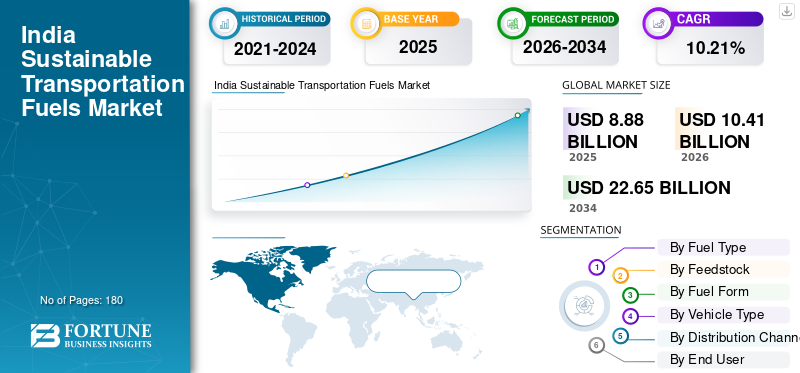
Download Free sample to learn more about this report.
INDIA SUSTAINABLE TRANSPORTATION FUELS MARKET TRENDS
Transition from Single-Fuel Decarbonization to a Multi-Fuel Mobility Ecosystem is the Key Market Trend
India's market is evolving from a predominantly ethanol-led strategy toward a multi-fuel mobility ecosystem, where fuel ethanol, Compressed Biogas (CBG), biodiesel, sustainable aviation fuel, and green hydrogen are being developed in parallel to carbon emission reduction across different transport segments. Rather than relying on a single alternative fuel vehicle, the Government of India is aligning fuel policies with vehicle technologies, feedstock availability, and sector-specific energy requirements. A notable shift is the integration of CBG into the national gas ecosystem through the CBG-CGD Synchronization Scheme, which mandates 1% CBG blending in CNG and PNG from FY2025–26, increasing to 5% by FY2028–29, creating long-term demand for renewable gaseous fuels.
In March 2025, ICRA highlighted that mandatory CBG blending obligations beginning from April 2025 would significantly strengthen Bio-CNG demand, while the entry of large energy companies is expected to accelerate commercialization. Simultaneously, India's transport decarbonization strategy is expanding to include SAF and green hydrogen for hard-to-abate sectors, establishing a diversified renewable fuel portfolio instead of dependence on a single technology. This integrated approach is expected to improve energy security, expand domestic biomass utilization, and support long-term carbon reduction targets.
MARKET DYNAMICS
MARKET DRIVERS
Download Free sample to learn more about this report.
Mandatory Compressed Biogas (CBG) Blending Obligation Accelerating Renewable Gas Adoption
The introduction of India's Compressed Biogas (CBG) Blending Obligation (CBO) is emerging as a major driver for the India sustainable transportation fuels market growth by creating assured long-term demand for renewable gaseous fuels. Unlike voluntary procurement mechanisms, the mandatory blending framework provides investment certainty for bioenergy developers, City Gas Distribution (CGD) companies, and agricultural waste aggregators while promoting the utilization of crop residues, municipal solid waste, and organic biomass. This policy is expected to diversify India's renewable transportation energy mix beyond ethanol and strengthen domestic energy security by reducing LNG imports.
Also, in April 2025, Bharat Petroleum Corporation Limited (BPCL) and GPS Renewables signed a joint venture agreement to establish 8–10 CBG plants across Bihar, Odisha, Punjab, Uttar Pradesh, and West Bengal. The projects will convert agricultural biomass into renewable transport fuel, supporting the SATAT initiative, the CBG Blending Obligation (CBO), and India's energy transition fuels market. Such investments are expected to diversify India's sustainable fuel portfolio, strengthen the domestic renewable fuel ecosystem, generate additional income for farmers through biomass procurement, and reduce dependence on imported fossil fuels. These factors are anticipated to drive the market growth during the forecast period.
|
Rank |
Market Driver |
Relative Impact on Market Growth |
CAGR Growth Contribution |
2026-2028 |
2029-2031 |
2032-2034 |
|
1 |
Expansion of ethanol production and higher blending adoption |
High |
3.65% |
High |
High |
Medium |
|
2 |
Mandatory CBG blending and expansion of Bio-CNG supply |
High |
2.85% |
Medium |
High |
High |
|
3 |
Investments in advanced biofuels, including 2G ethanol, SAF and Bio-LNG |
Medium-High |
2.35% |
Low |
Medium |
High |
|
4 |
Increasing utilization of agricultural residues, organic waste and used cooking oil |
Medium |
1.95% |
Medium |
Medium |
High |
|
5 |
Government focus on reducing crude-oil imports and improving domestic energy security |
Medium |
1.70% |
Medium |
Medium |
Medium |
|
6 |
Others |
Low |
1.26% |
Low |
Low |
Medium |
|
Total positive CAGR contribution |
|
|
13.76% |
|
|
|
MARKET RESTRAINTS
Limited Availability and Seasonal Variability of Sustainable Feedstocks to Hamper the Market Demand
The availability of sustainable feedstock remains a key restraint for India's sustainable transportation fuels market, as production depends heavily on agricultural outputs, crop cycles, competing food and industrial demand, and efficient biomass collection systems. Sugarcane, maize, agricultural residues, and used cooking oil are subject to seasonal fluctuations, weather conditions, and regional supply imbalances, which can affect biofuel production costs and long-term supply security.
Crop residue collection is also constrained by fragmented landholdings and underdeveloped biomass aggregation infrastructure, particularly in rural regions. In December 2023, the Government of India restricted the diversion of sugarcane juice and sugar syrup for ethanol production to prioritize domestic sugar availability, requiring ethanol producers to rely more heavily on molasses and grain-based feedstocks. The policy highlighted the vulnerability of ethanol production to agricultural output and food security considerations.
|
Rank |
Market Restraint |
Impact on Market Growth |
CAGR Decline Contribution |
2026-2028 |
2029-2031 |
2032-2034 |
|
1 |
Limited Availability and Seasonal Variability of Sustainable Feedstocks |
High |
−1.30% |
High |
High |
Medium |
|
2 |
High Capital Investment and Slow Commercialization of Advanced Biofuel Technologies (2G Ethanol, SAF, Green Hydrogen) |
Medium-High |
−1.05% |
High |
Medium |
Medium |
|
3 |
Feedstock Price Volatility and Competition with Food & Industrial Uses |
Medium |
−0.80% |
Medium |
Medium |
Low |
|
4 |
Limited Commercial Infrastructure for Emerging Sustainable Fuels (SAF, Bio-LNG, Green Hydrogen) |
Low |
−0.40% |
Medium |
Medium |
Low |
|
Total negative CAGR contribution |
|
|
−3.55% |
|
|
|
MARKET OPPORTUNITIES
Commercialization of Sustainable Aviation Fuel is Creating a New Growth Avenue
The commercialization of Sustainable Aviation Fuel (SAF) presents a significant long-term opportunity for India's sustainable transportation fuels market by expanding renewable fuel demand beyond road transport into the aviation sector. With India's aviation industry projected to become one of the world's largest, airlines and refiners are increasingly investing in low-carbon aviation fuels to meet future domestic and international emission reduction requirements. This creates opportunities for biorefineries to diversify production into advanced fuels derived from agricultural residues, used cooking oil, municipal solid waste, and other sustainable feedstocks.
In August 2024, Indian Oil Corporation (IOC), LanzaJet, and Praj Industries signed a Tripartite Memorandum of Understanding (MoU) to evaluate the production of Sustainable Aviation Fuel (SAF) in India using LanzaJet's Alcohol-to-Jet (ATJ) technology. The collaboration aims to establish domestic SAF production capabilities and leverage India's growing ethanol ecosystem as a feedstock source. As India's aviation decarbonization accelerates, investments in SAF production are expected to unlock new revenue streams, promote advanced biofuel technologies, and strengthen India's position in the sustainable fuels value chain.
MARKET CHALLENGES
Scaling Second-Generation (2G) Biofuel Technologies to Commercial Viability is a Major Market Challenge
A major challenge for India's sustainable transportation fuels market is the large-scale commercialization of second-generation (2G) biofuel technologies, which convert agricultural residues such as rice straw, wheat straw, and other lignocellulosic biomass into transport fuels.
Although 2G biofuels offer significant environmental benefits by utilizing non-food feedstocks and reducing stubble burning, commercial deployment remains constrained by high capital investment, complex conversion technologies, feedstock collection logistics, and lower operating efficiencies compared to first-generation biofuels. These factors increase production costs and extend project payback periods, slowing widespread industry adoption.
Segmentation Analysis
By Fuel Type
Fuel Ethanol Segment Dominated Due to Extensive Refining and Distribution Ecosystem
Based on the segmentation of fuel type, the market is classified into fuel ethanol, compressed biogas (CBG/Bio-CNG), biodiesel, and others.
In 2025, fuel ethanol dominated the market, accounting for 96.46% of the market share. Fuel ethanol is leading owing to its well-established domestic production ecosystem and seamless integration into the country's petroleum supply chain. India has significantly expanded its distillation capacity through investments in sugar- and grain-based ethanol plants, enabling large-scale supply to Oil Marketing Companies (OMCs). Ethanol-blended petrol is distributed through an extensive network of fuel retail outlets without requiring major modifications to conventional fueling infrastructure for low-level blends.
The compressed biogas (CBG/Bio-CNG) segment is expected to grow at a CAGR of 13.90% over the forecast period.
To know how our report can help streamline your business, Speak to Analyst
By Feedstock
Sugarcane-based Segment Dominated Due to its Wide Usability as Mature Feedstock Processing Infrastructure
Based on the segmentation of the feedstock, the market is classified into sugarcane-based, grain-based (maize, rice, damaged food grains), agricultural & organic waste, used cooking oil & animal fat, and others.
In 2025, the sugarcane-based segment led the Indian market, accounting for 57.62% of the market share. Most sugar mills are equipped to produce ethanol from sugarcane juice, B-heavy molasses, or C-heavy molasses, allowing flexible operations based on market conditions and government policies. The close integration of sugar production and ethanol manufacturing reduces logistics costs and improves production efficiency.
The grain-based segment is expected to grow at the highest CAGR of 11.33% over the forecast period.
By Fuel Form
Liquid Biofuels Segment Led Due to its Compatibility with Existing Vehicle Fleet
On the basis of fuel form, the market is bifurcated into liquid biofuels and gaseous biofuels.
In 2025, the liquid biofuels segment dominated the India sustainable transportation fuels market share. Liquid biofuels can be readily integrated into the country's existing vehicle fleet, refinery operations, fuel terminals, and retail distribution network with minimal infrastructure modifications. Ethanol-blended petrol and biodiesel market blends are compatible with conventional internal combustion engine technologies within approved blend limits, enabling faster market adoption than newer fuel alternatives.
The gaseous biofuels segment is expected to grow at a CAGR of 15.77% over the forecast period.
By Vehicle Type
Passenger Vehicles Segment Led Owing to Largest Petrol Vehicle Population
On the basis of vehicle type, the market is classified into passenger vehicles, commercial vehicles, two-wheelers, three-wheelers, and others.
In 2025, the passenger vehicles segment dominated the India market, accounting for a market share of 57.13%. Passenger vehicles are known for their substantial contribution to the country's petrol consumption and widespread compatibility with ethanol-blended fuels. The rapid growth of personal mobility, urbanization, and rising disposable incomes has expanded the passenger vehicle parc, increasing demand for renewable transport fuels.
The commercial vehicles segment is expected to grow at a CAGR of 11.12% over the forecast period.
By Distribution Channel
Oil Marketing Company (OMC) Fuel Stations Segment Dominated as it Represent the Extensive Nationwide Retail Network
On the basis of distribution channel, the market is classified into Oil Marketing Company (OMC) fuel stations, CBG dispensing stations, fleet & bulk supply, and others.
In 2025, the Oil Marketing Company (OMC) fuel stations segment dominated the India market, accounting for 91.63% of the market share. This segment serves as the primary distribution channel for ethanol-blended petrol and other renewable transportation fuels across the country. IndianOil, Bharat Petroleum, and Hindustan Petroleum operate the largest network of retail outlets, ensuring consistent fuel availability in urban, semi-urban, and rural areas.
The CBG dispensing stations segment is expected to grow at a CAGR of 12.28% over the forecast period.
By End User
Road Transportation Segment Dominated as it Accounts for the Largest Transportation Energy Consumption
On the basis of end user, the market is classified into road transportation, aviation, marine, railways, and others.
In 2025, the road transportation segment led the India market and accounted for 94.48% of market share. Passenger cars, two-wheelers, buses, trucks, and light commercial vehicles collectively consume the majority of transportation fuels, creating substantial demand for renewable fuel alternatives. Unlike aviation and marine transport, the road sector has an extensive fueling network and a large fleet capable of utilizing commercially available biofuel blends. Continuous expansion of freight movement, public transport services, and personal mobility further reinforces road transportation as the leading end-use segment for sustainable transportation fuels in India.
The aviation sector is expected to grow at a CAGR of 13.68% over the forecast period.
COMPETITIVE LANDSCAPE
Key Industry Players
Partnerships, Business Expansion, and Technological Advancements to Enhance Market Share of Key Players
In 2025, Indian Oil Corporation Limited (IOC), Bharat Petroleum Corporation Limited (BPCL), and Hindustan Petroleum Corporation Limited (HPCL) held majority of the market share. This share is attributed to the targeted growth strategies focused on strengthening their product portfolio, technical capability, expanding manufacturing presence, and other areas.
- In March 2025, Indian Oil Corporation Limited (IOC), Bharat Petroleum Corporation Limited (BPCL), and Hindustan Petroleum Corporation Limited (HPCL) jointly initiated a fresh biodiesel procurement tender for FY2025–26. Further, seeking approximately 200 million liters of biodiesel for the first procurement cycle. The initiative was launched to strengthen domestic biodiesel availability, encourage greater participation from biofuel producers, and support India's target of achieving 5% biodiesel blending by 2030 under the National Policy on Biofuels.
Other major players in the Indian sustainable transportation fuels industry include Praj Industries Limited, Reliance BP Mobility Limited, and Nayara Energy Limited. These companies are expected to prioritize new product launches and collaborations to increase their India market share during the forecast period.
LIST OF KEY INDIA SUSTAINABLE TRANSPORTATION FUELS COMPANIES PROFILED
- Indian Oil Corporation Limited (IOC) (India)
- Nayara Energy Limited (India)
- Bharat Petroleum Corporation Limited (BPCL) (India)
- Balrampur Chini Mills Limited (India)
- Hindustan Petroleum Corporation Limited (HPCL) (India)
- Triveni Engineering & Industries Limited (India)
- Praj Industries Limited (India)
- EID Parry (India) Limited (India)
- Reliance BP Mobility Limited (India)
- GAIL (India) Limited (India)
KEY INDUSTRY DEVELOPMENTS
- February 2025: Reliance BP Mobility Limited continued expanding its Jio-bp mobility network, integrating cleaner mobility solutions with conventional fuel retailing while strengthening its strategy for future low-carbon transportation fuels. The company enhanced its retail footprint by combining advanced fuel offerings, EV charging, and digital mobility services, creating a platform capable of supporting future commercialization of renewable transportation fuels.
- January 2025: HPCL continued expanding its grain-based ethanol production program through its subsidiary HPCL Biofuels Limited, increasing the utilization of maize and other surplus grains to support domestic ethanol availability. The initiative strengthens feedstock diversification, improves supply resilience, and supports India's long-term renewable transportation fuel strategy by reducing dependence on conventional sugar-based ethanol production.
- October 2024: Indian Oil Corporation (IOC) signed a 50:50 joint venture agreement with EverEnviro Resource Management Pvt. Ltd. to accelerate the development of compressed biogas (CBG), biofuels, and other renewable energy projects across India. The partnership focuses on converting agricultural residues and organic waste into renewable transportation fuels while strengthening the country's circular economy and supporting the SATAT initiative.
- September 2024: Praj Industries introduced its Praj GenX integrated bio-manufacturing platform designed to produce advanced biofuels, renewable chemicals, and sustainable aviation fuel (SAF). The platform combines multiple process technologies to improve feedstock flexibility, production efficiency, and carbon reduction, enabling biorefineries to diversify renewable fuel production beyond conventional ethanol.
- April 2024: BPCL invited tenders in India for the supply of advanced enzyme technology for its second-generation (2G) bioethanol refinery at Bargarh, Odisha. The refinery will utilize agricultural residues such as rice straw to produce cellulosic ethanol, supporting India's transition toward advanced biofuels and reducing dependence on food-based feedstocks for transportation fuel production.
REPORT COVERAGE
The India sustainable transportation fuels market analysis provides an in-depth study of the market size & forecast by all the market segments included in the report. It includes details on the market dynamics and the market trends expected to drive the market in the forecast period. It offers information on the technological advancements, new product launches, key industry developments, and details on partnerships, mergers & acquisitions. The market research report also encompasses a detailed competitive landscape with information on the market share and profiles of key operating players.
Request for Customization to gain extensive market insights.
Report Scope & Segmentation
| ATTRIBUTE | DETAILS |
| Study Period | 2021-2034 |
| Base Year | 2025 |
| Estimated Year | 2026 |
| Forecast Period | 2026-2034 |
| Historical Period | 2021-2024 |
| Growth Rate | CAGR of 10.21% from 2026 to 2034 |
| Unit | Value (USD Billion) |
| Segmentation | By Fuel Type, Feedstock, Fuel Form, Vehicle Type, Distribution Channel, and End User |
| By Fuel Type |
|
| By Feedstock |
|
| By Fuel Form |
|
| By Vehicle Type |
|
| By Distribution Channel |
|
| By End User |
|
Frequently Asked Questions
Fortune Business Insights says that the India market value stood at USD 8.88 billion in 2025 and is projected to reach USD 22.65 billion by 2034.
The market is expected to exhibit a CAGR of 10.21% during the forecast period.
The fuel ethanol segment led the market in terms of fuel type.
Increasing government mandates for biofuel blending, expanding domestic biofuel production, and rising investments in ethanol are the key factors driving the Indian market.
Indian Oil Corporation Limited (IOC), Bharat Petroleum Corporation Limited (BPCL), Hindustan Petroleum Corporation Limited (HPCL), and Praj Industries Limited are some of the prominent players in the market.
Expanding advanced biofuel production, mandatory CBG blending, and increasing feedstock diversification are the major factors expected to favor the market adoption.



- 2021-2034
- 2025
- 2021-2024
- 180
Get 30-60 hrs Free Customization
Expand Regional and Country Coverage, Segments Analysis, Company Profiles, Competitive Benchmarking, and End-user Insights.



















-
US +1 833 909 2966 ( Toll Free )
-
Get In Touch With Us