Real and Compound Chocolate Market Size, Share & Industry Analysis, By Category (Real Chocolate and Compound Chocolate), By Type (Milk Chocolate, Dark Chocolate, and White Chocolate), By Form (Chips, Slabs, Coatings, and Others), By Application (Confectionery, Bakery, Dairy and Frozen Desserts, Beverages, and Others), and Regional Forecast, 2026-2034
 Download Free Sample
(Offer valid till 30th Sep 2026)

Real and Compound Chocolate Market Size and Future Outlook
 Listen to Audio Version
The global real and compound chocolate market size was valued at USD 45.98 billion in 2025. The market is projected to grow from USD 41.04 billion in 2026 to USD 67.76 billion by 2034, exhibiting a CAGR of 6.47% during the forecast period.
Real chocolates are made from cocoa mass and cocoa butter, with compound chocolate referring to products where cocoa butter and cocoa powder are replaced with vegetable oil. During the manufacturing process of both real and compound chocolates, nutritious seeds are roasted, enhancing their flavor. These chocolates have high heat resistance, bloom resistance, and other technical properties, making them suitable for consumption in warmer and colder countries. Additionally, they are widely used in different food products due to these properties.
The market is gaining traction due to strong, growing demand for indulgent confectionery, premium dark chocolate, chocolate-coated bakery products, frozen desserts, chocolate beverages, and industrial chocolate ingredients. At the same time, high cocoa price volatility, climate-related supply risks, and the need for cost-efficient formulations are increasing the relevance of compound chocolate offerings across mass-market and foodservice applications. Manufacturers in the global market are increasingly developing products that align with consumer demand for affordable, versatile, and indulgent chocolate solutions by using vegetable fats instead of cocoa butter, enabling better cost efficiency, improved heat stability, and wider application across bakery, confectionery, ice cream, and snack products.
The global market demand is supported by leading companies such as Barry Callebaut AG, Cargill, Incorporated, Mars Incorporated, Mondelēz International, Inc., and FUJI OIL CO., LTD., all of which maintain active positions in consumer chocolate, industrial chocolate, cocoa ingredients, coatings, fillings, chips, and compound chocolate solutions.
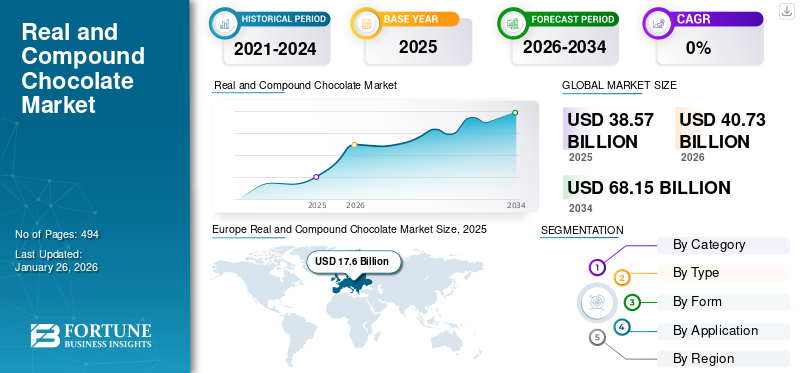
Download Free sample to learn more about this report.
REAL AND COMPOUND CHOCOLATE MARKET KEY TAKEAWAYS
 Global Market Size & Forecast
- 2025 Market Size: USD 45.98 billion
- 2026 Market Size: USD 41.04 billion
- 2034 Forecast Market Size: USD 67.76 billion
- CAGR: 6.47% from 2026–2034
 Market Share
- The milk chocolate segment dominated the global market, valued at USD 23.00 billion in 2025.
- The dark chocolate segment, valued at USD 18.78 billion in 2025, is projected to grow at the fastest CAGR of 6.78% during 2026–2034.
- The chip segment was valued at USD 12.92 billion in 2025, driven by cookies, muffins, bakery mixes, and household baking.
 Key Regional Highlights
North America
North America was valued at USD 8.22 billion in 2025 and is projected to reach USD 10.97 billion by 2034, growing at a CAGR of 5.85% over the forecast period.
Europe
Europe dominated the global market and was valued at USD 22.96 billion in 2025. The region is projected to reach USD 32.13 billion by 2034, growing at a CAGR of 5.55% over the forecast period.
Asia Pacific
Asia Pacific was valued at USD 6.34 billion in 2025 and is projected to reach USD 11.39 billion by 2034, growing at the fastest CAGR of 9.38% over the forecast period.
U.S.
The U.S. dominates the North American market, valued at USD 5.08 billion in 2025.
Japan
Growth is driven by rising disposable income, urbanization, expanding modern retail, growing café and bakery culture, premium gifting,
Read More

Real and Compound Chocolate Market Trends
Evolving Plant-based and Low-Sugar Chocolate Consumption to Shape Industry Trends
The chocolate confectionery sector has traditionally been driven by indulgence, but in recent years, there has been increased demand for “better-for-you” options. The rise of flexitarianism and health-conscious consumers has further fueled the demand for plant-based chocolates. Consumers’ expectations are changing as they are seeking products beyond dairy allergies and lactose intolerance. At the same time, millennials look for tasty yet "ethical" plant chocolates that are harmless to the planet and animals.
As consumers become increasingly concerned with fitness and health, these trends are having a strong impact on the chocolate confectionery industry. This shift is prompting companies and artisanal confectionery manufacturers to come up with vegan and low-sugar products.
- According to the Barry Callebaut global proprietary research report 2023, nearly 66% of consumers are showing interest in “less sugar” or “no sugar” chocolate confectionery
MARKET DYNAMICS
Market Drivers
Download Free sample to learn more about this report.
Rising Consumption of Chocolate Confectionery Across Everyday, Seasonal, and Gifting Occasions Is Supporting Market Growth
Chocolate confectionery continues to hold strong consumer relevance as it is purchased across multiple consumption occasions, including daily snacking, impulse purchases, festivals, birthdays, gifting, bakery use, desserts, and seasonal events such as Valentine’s Day, Easter, Halloween, Christmas, and Diwali in several Asian markets. In Europe, the strong presence of key chocolate and chocolate confectionery market players such as Nestlé S.A., Cemoi, Ferrero, and Mars Inc., and the strong marketing strategies adopted by them are projected to drive the sales of chocolate confectionery across the region.
- In the U.S., the National Confectioners Association reported that confectionery sales reached USD 55 billion in 2025, with chocolate, candy, gum, and mints expected to add another USD 7.3 billion in sales over the next five years and reach USD 62.2 billion by 2030.
Market Restraints
Cocoa Bean Supply Volatility and Price Fluctuations Are Pressuring Margins Across Real Chocolate Manufacturers
Real chocolate manufacturers remain highly exposed to cocoa bean, cocoa butter, cocoa liquor, cocoa powder, sugar, dairy, energy, packaging, and freight cost volatility because cocoa-derived ingredients form the core of real chocolate formulation. This has become a major restraint for the global market as manufacturers cannot always pass raw material inflation fully to retailers or consumers without affecting volume demand. Moreover, the structural challenge is further amplified by the geographic concentration of cocoa production. Cocoa beans are largely produced in tropical regions, while chocolate manufacturing, retailing, and consumption are spread across North America, Europe, Asia-Pacific, and other importing regions. This creates a supply chain where manufacturers in major consuming markets depend heavily on imported cocoa beans and semi-processed cocoa ingredients.
- The International Cocoa Organization (ICCO) estimated world cocoa production at 4.369 million tons in 2023/24 and 4.698 million tons in 2024/25, while global cocoa grindings declined from 4.810 million tons to 4.602 million tons, reflecting weaker processing activity amid high input costs.
Market Opportunities
Growth of Private Label and Value-Based Chocolate Products Across Modern Retail to Create a Strong Opportunity
The expansion of private-label and value-based chocolate products is creating a strong opportunity in the global real and compound chocolate market growth, particularly as consumers remain price-sensitive due to inflation, high cocoa costs, and pressure on household spending. Private-label chocolate products are no longer limited to low-cost alternatives; retailers are increasingly developing their own-brand chocolate bars, coated wafers, spreads, baking chocolate, seasonal packs, premium assortments, and confectionery coatings across economy, mainstream, and premium price tiers. This creates an opportunity for real and compound chocolate manufacturers to supply retailers with differentiated, cost-efficient, and scalable chocolate solutions.
- The broader private-label market provides strong evidence for this opportunity. According to the Private Label Manufacturers Association (PLMA), in the U.S., store-brand sales reached a record USD 271 billion in 2024, increasing by USD 9 billion year-on-year.
SEGMENTATION ANALYSIS
By Category
Real Chocolate Segment Dominated Due to Its Strong Use in Premium Confectionery, Gifting, and Branded Chocolate Products
Based on category, the market is segmented into real chocolate and compound chocolate.
The real chocolate segment dominated the global real and compound chocolate market share, valued at USD 41.00 billion in 2025, owing to its wider use in branded chocolate bars, premium confectionery, molded chocolate, gifting products, tablets, pralines, and high-cocoa formulations. Real chocolate benefits from strong consumer preference for authentic cocoa butter-based products, better melt profile, richer taste, and premium positioning.
The compound chocolate segment is projected to grow at the fastest CAGR of 8.42% during 2026–2034.
To know how our report can help streamline your business, Speak to Analyst
By Type
Milk Chocolate Segment leads Due to Its Mass Consumer Acceptance, Creamy Taste Profile, and Strong Use in Branded Confectionery
Based on type, the market is segmented into milk chocolate, dark chocolate, and white chocolate.
The milk chocolate segment dominated the global market, valued at USD 23.00 billion in 2025, due to its broad consumer appeal, smooth taste, strong use in bars and countlines, and wide presence across mainstream confectionery brands. Moreover, milk chocolate remains the preferred format for children, family consumption, impulse purchases, seasonal products, and value-added confectionery.
The dark chocolate segment, valued at USD 18.78 billion in 2025, is projected to grow at the fastest CAGR of 6.78% during 2026–2034.
By Form
Coatings Segment Dominated Market Due to Strong Use in Confectionery, Bakery, Ice Cream, and Industrial Food Manufacturing
Based on form, the market is segmented into chip, slab, coatings, and other types.
The coatings segment dominated the global market, valued at USD 20.57 billion in 2025, due to its wide use in chocolate-coated biscuits, wafers, bakery products, ice creams, frozen desserts, snack bars, and molded confectionery. Coatings are highly relevant for both real and compound chocolate as manufacturers require consistent texture, shine, viscosity, setting behavior, and cost effectiveness. The coatings segment is also projected to grow at the fastest CAGR of 6.96% during 2026–2034, supported by growth in bakery, frozen desserts, and convenience snacking.
The chip segment was valued at USD 12.92 billion in 2025, driven by cookies, muffins, bakery mixes, and household baking. The segment is expected to have a CAGR of 6.39% during the forecast period.
By Application
Confectionery Segment leads Due to Strong Demand for Bars, Countlines, Seasonal Chocolate, and Premium Gifting
Based on application, the market is segmented into confectionery, bakery, dairy and frozen desserts, beverages, and others.
The confectionery segment dominated the global market, valued at USD 21.22 billion in 2025, owing to strong demand for chocolate bars, molded chocolates, pralines, filled products, tablets, seasonal assortments, and gifting packs. Chocolate remains one of the most emotionally driven indulgence categories, and manufacturers continue to launch products around taste, texture, nostalgia, sharing occasions, and premium experiences.
The bakery segment valued at USD 11.01 billion in 2025, is projected to grow at the fastest CAGR of 7.01% during 2026–2034.
Real and Compound Chocolate Market Regional Outlook
Regionally, the market is studied across North America, Europe, Asia Pacific, South America, the Middle East, and Africa.
Europe
North America Fuel Ethanol Market Size, 2025 (USD Billion)
To get more information on the regional analysis of this market, Download Free sample
Europe dominated the global market and was valued at USD 22.96 billion in 2025. The region is projected to reach USD 32.13 billion by 2034, growing at a CAGR of 5.55% over the forecast period. Growth is supported by a deep chocolate consumption culture, strong premium chocolate demand, artisanal chocolate traditions, sustainable cocoa sourcing, private-label chocolate expansion, and a mature bakery and confectionery manufacturing base.
Germany Real and Compound Chocolate Market
Germany was valued at USD 5.01 billion in 2025, supported by high chocolate consumption, strong retail penetration, private-label confectionery, seasonal products, filled chocolate, chocolate tablets, and bakery applications.
U.K. Real and Compound Chocolate Market
The U.K. market was valued at USD 2.47 billion in 2025, driven by demand for branded chocolate bars, sharing bags, filled chocolate, seasonal confectionery, bakery coatings, and premium gifting products.
North America
North America was valued at USD 8.22 billion in 2025 and is projected to reach USD 10.97 billion by 2034, growing at a CAGR of 5.85% over the forecast period. Growth is driven by strong demand for chocolate confectionery, seasonal gifting, chocolate snacks, premium dark chocolate, bakery inclusions, and industrial chocolate ingredients across the U.S. and Canada.
U.S. Real and Compound Chocolate Market
The U.S. dominates the North American market, valued at USD 5.08 billion in 2025, supported by strong consumer demand for chocolate bars, countlines, seasonal confectionery, chocolate chips, bakery coatings, frozen dessert inclusions, and premium chocolate products.
Asia Pacific
Asia Pacific was valued at USD 6.34 billion in 2025 and is projected to reach USD 11.39 billion by 2034, growing at the fastest CAGR of 9.38% over the forecast period. Growth is driven by rising disposable income, urbanization, expanding modern retail, growing café and bakery culture, premium gifting, Western-style confectionery adoption, and increased use of chocolate in bakery, dairy, frozen desserts, and beverages.
China Real and Compound Chocolate Market
China’s market was valued at USD 2.45 billion in 2025, supported by premium gifting, e-commerce, imported chocolate demand, bakery chains, café culture, and seasonal chocolate consumption.
India Real and Compound Chocolate Market
India’s market was valued at USD 1.31 billion in 2025, supported by rising demand for affordable chocolate confectionery, compound chocolate coatings, bakery products, ice creams, and gifting formats.
South America
South America’s market was valued at USD 3.16 billion in 2025 and is projected to reach USD 4.56 billion by 2034, growing at a CAGR of 6.50% over the forecast period. Growth in the region is driven by chocolate confectionery consumption, bakery applications, dairy desserts, and the availability of cocoa-producing countries such as Brazil, Ecuador, Peru, and Colombia.
Middle East
The Middle East market was valued at USD 3.41 billion in 2025 and is projected to reach USD 5.72 billion by 2034, growing at a CAGR of 7.74% over the forecast period. Growth is supported by premium gifting, tourism, modern retail expansion, imported chocolate demand, bakery chains, hotel and foodservice consumption, and demand for heat-stable compound chocolate. Saudi Arabia, the UAE, Qatar, and Kuwait are important consumption markets due to high disposable income and a strong gifting culture.
UAE Real and Compound Chocolate Market
The UAE market was valued at USD 2.31 billion in 2025, supported by premium chocolate gifting, tourism, modern retail, luxury retail formats, hotel and foodservice demand, and strong consumption of imported chocolate products.
Africa
The African market was valued at USD 1.89 billion in 2025. Africa is the world’s most important cocoa-origin region and plays a critical role in the global real and compound chocolate value chain. The region’s relevance is driven by large-scale cocoa bean production in Côte d’Ivoire, Ghana, Cameroon, Nigeria, Uganda, Sierra Leone, and other producing countries.
COMPETITIVE LANDSCAPE
Key Industry Players
Major Players Focus on Cocoa Sourcing, Premium Chocolate, Compound Coatings, Sustainability, and Application-specific Innovation to Strengthen Market Position
The competitive landscape of the global real and compound chocolate market is shaped by cocoa sourcing capability, processing capacity, brand strength, formulation expertise, industrial customer relationships, sustainability programs, price management, and innovation in chocolate formats. Large B2B suppliers are focusing on couverture, compound coatings, chips, chunks, slabs, fillings, cocoa ingredients, and customized chocolate solutions for confectionery, bakery, dairy, frozen desserts, and beverage manufacturers.
Consumer-facing companies are strengthening their position through premium chocolate tablets, filled bars, seasonal packs, gifting formats, portion-control products, and brand-led innovation. Mondelēz has identified chocolate as one of its fast-growing core categories. Nestlé’s chocolate and confectionery portfolio includes KitKat and regional brands, and Mars lists major global chocolate brands such as M&M’S, Snickers, Galaxy, Dove, Twix, Maltesers, and Milky Way.
Key Global Players in the Real and Compound Chocolate Market
|
Rank |
Company Name |
|
1 |
Barry Callebaut AG |
|
2 |
Cargill, Incorporated |
|
3 |
Mars Incorporated |
|
4 |
Mondelēz International, Inc. |
|
5 |
Nestlé S.A. |
List of Key Real and Compound Chocolate Companies Profiled in Report
- Barry Callebaut AG (Switzerland)
- Cargill, Incorporated (U.S.)
- Cémoi Group (France)
- FUJI OIL CO., LTD. (Japan)
- Mars Incorporated (U.S.)
- Mondelēz International, Inc. (U.S.)
- Nestlé S.A. (Switzerland)
- Olam International (Singapore)
- Puratos Group (Belgium)
- The Hershey Company (U.S.)
KEY INDUSTRY DEVELOPMENTS
- May 2026: Barry Callebaut AG introduced two new product innovations, Cacao Max and ChoViva, at the Sweets & Snacks Expo 2026 in Las Vegas. The launches are part of the company’s strategy to offer a broader portfolio covering premium chocolate-like indulgence, cocoa-based coatings, and sustainable cocoa-alternative solutions.
- May 2026: Mars invested USD 255.87 million in its historic U.K. chocolate factory to strengthen its long-term manufacturing capabilities and modernize chocolate production operations.
- November 2025: Mars Wrigley India unveiled the all-new Galaxy chocolate range with the positioning “Melty Outside. Intense Inside.” The relaunch introduces a creamier and richer recipe, refreshed packaging design, and a new brand identity aimed at strengthening Galaxy’s premium indulgence positioning in India.
- August 2025: French chocolate manufacturer CÉMOI executed a major USD 45.22 million investment plan across its French production facilities. The investment plan focuses on modernizing production equipment, improving operational efficiency, and expanding CÉMOI’s business-to-business product portfolio. CÉMOI’s investment push is mainly driven by the sharp rise in cocoa prices, which has significantly increased production costs for chocolate manufacturers.
- March 2024: Cargill Incorporated launched a range of block chocolate, chocolate chips, and cocoa powder products under its NatureFresh Professional brand. The new range was showcased in the Indian Food and Bakery industry at AAHAR 2024.
REPORT COVERAGE
The global real and compound chocolate market report analysis the market in depth and highlights crucial aspects such as global market trends, market dynamics, supply chains, prominent companies, investment in research and development. Besides this, the report also provides insights into the global market analysis and highlights significant industry developments.
Request for Customization to gain extensive market insights.
Report Scope & Segmentation
| ATTRIBUTE | DETAILS |
| Study Period | 2021-2034 |
| Base Year | 2025 |
| Estimated Year | 2026 |
| Forecast Period | 2026-2034 |
| Historical Period | 2021-2024 |
| Growth Rate | CAGR of 6.47% from 2026 to 2034 |
| Unit | Value (USD Billion) and Volume (Thousand Tons) |
|
Segmentation |
By Category
|
|
By Type
|
|
|
By Form
|
|
|
By Application
|
|
|
By Region
|
Frequently Asked Questions
Fortune Business Insights says that the global market was valued at USD 45.98 billion in 2025 and is anticipated to reach USD 67.76 billion by 2034.
At a CAGR of 6.47%, the global market will exhibit steady growth over the forecast period.
By form, the coatings segment led the market.
Europe held the largest market share in 2025.
Rising consumption of chocolate confectionery across everyday, seasonal, and gifting occasions is supporting market growth.
Barry Callebaut AG, Cargill, Incorporated, Mars Incorporated, Mondelēz International, Inc., and FUJI OIL CO., LTD. are the leading players in the market.
Evolving plant-based and low-sugar chocolate consumption to shape industry trends.



- 2021-2034
- 2025
- 2021-2024
- 200
-
(Offer valid till 30th Sep 2026)
Get 30-60 hrs Free Customization
Expand Regional and Country Coverage, Segments Analysis, Company Profiles, Competitive Benchmarking, and End-user Insights.




















-
US +1 833 909 2966 ( Toll Free )
-
Get In Touch With Us