Inorganic Base Market Size, Share & Industry Analysis, By Type (Sodium Hydroxide, Calcium Hydroxide, Potassium Hydroxide, Ammonium Hydroxide, and Others), By Application (Chemical Manufacturing & Intermediates, Water & Wastewater Treatment, Pulp & Paper, Metallurgy, Mining & Alumina Refining, Environmental Applications, and Others), and Regional Forecast, 2026-2034
 Download Free Sample
Inorganic Base Market Size and Future Outlook
 Listen to Audio Version
The global inorganic base market size was valued at USD 21.34 billion in 2025 and is projected to grow from USD 22.75 billion in 2026 to USD 34.05 billion by 2034, exhibiting a CAGR of 5.2% during the forecast period. Asia Pacific dominated the inorganic base market with a market share of 34.44% in 2025.
Inorganic bases are alkaline chemical compounds widely used to neutralize acids, regulate pH levels, and support various chemical reactions in industrial processes. Key bases include sodium hydroxide, calcium hydroxide, potassium hydroxide, and ammonium hydroxide, each offering distinct solubility and reactivity characteristics. These compounds are essential in chemical manufacturing, water treatment, pulp & paper processing, metallurgy, and environmental applications. Their strong alkalinity and ability to precipitate impurities make them critical in industrial purification and refining processes. Rapid industrialization, urban infrastructure expansion, and growing environmental compliance requirements significantly support demand. Increasing wastewater treatment regulations and expanding chemical production capacities further reinforce consumption patterns.
As the industrial sector continues to prioritize efficiency and environmental control, inorganic bases maintain fundamental importance across global manufacturing value chains, reinforcing their strategic role in the specialty and bulk chemical markets. The major players operating in the market are Olin Corporation, The Dow Chemical Company, Occidental Petroleum Corporation, Tata Chemicals Limited, and Formosa Plastics Corporation.
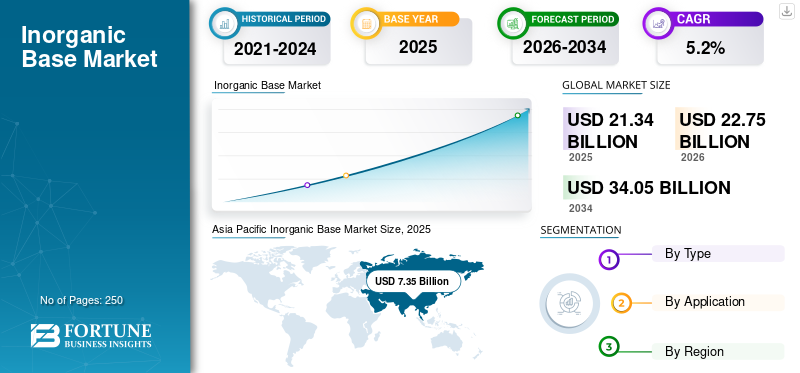
Download Free sample to learn more about this report.
Inorganic Base Market Key Takeaways
 Market Size & Forecast
- 2025 Market Size: USD 21.34 billion
- 2026 Market Size: USD 22.75 billion
- 2034 Forecast Market Size: USD 34.05 billion
- CAGR: 5.2% from 2026–2034
 Market Share
- Asia Pacific dominated the inorganic base market with a market share of 34.44% in 2025.
- The calcium hydroxide segment is anticipated to grow at a CAGR of 4.3% during the forecast period.
- The pulp & paper segment is poised to expand at a CAGR of 4.3% during the forecast period.
 Key Regional Highlights
Asia Pacific
Asia Pacific generated USD 7.35 billion in 2025 and remained the leading regional market, driven by industrial expansion and growing municipal water infrastructure investments.
North America
Asia Pacific generated USD 7.35 billion in 2025 and remained the leading regional market, driven by industrial expansion and growing municipal water infrastructure investments.
Europe
Europe witnessed steady demand due to stringent environmental regulations, emission control initiatives, and strong chemical and pharmaceutical manufacturing activities.
U.S.
The market reached USD 4.43 billion in 2025, supported by established chemical manufacturing capacity and strict environmental compliance requirements.
Japan
Demand is supported by advanced industrial processing, water treatment activities, and the country's focus on environmental sustainability and specialty chemical production.
Read More

Inorganic Base Market Trends
Environmental Regulations and Industrial Expansion to Reshape Consumption Patterns
The market is increasingly influenced by tightening environmental regulations requiring improved wastewater treatment and emission control. Sodium and calcium hydroxides are widely used in pH adjustment and pollutant removal processes, supporting the rising municipal and industrial treatment capacity. Additionally, the expansion of downstream chemical manufacturing in Asia and the Middle East is strengthening the demand for caustic soda and potassium hydroxide. The pulp & paper industry’s modernization and adoption of chlorine-free bleaching technologies also sustain alkali consumption. Furthermore, growing alumina refining and metallurgical activity in emerging economies is contributing to the steady industrial application demand. Technological improvements in membrane cell production methods are enhancing efficiency and reducing environmental impact. These regulatory and industrial shifts are reshaping demand dynamics, supporting long-term stability in the market.
MARKET DYNAMICS
MARKET DRIVERS
Download Free sample to learn more about this report.
Chemical Processing Expansion and Wastewater Treatment Demand to Drive Industry Growth
The primary driver of the inorganic base market growth is expanding chemical manufacturing activity, where alkalis are used as reactants, catalysts, and neutralizing agents. Sodium hydroxide plays a critical role in organic synthesis, soap production, and industrial intermediates. Additionally, growing wastewater treatment requirements are significantly increasing the demand for calcium and sodium hydroxide to control acidity and remove contaminants. Expanding pulp & paper production and alumina refining operations further contribute to consumption. Industrial growth in emerging economies and tightening environmental compliance frameworks strengthen alkali usage across sectors. These diversified industrial and environmental drivers sustain steady demand growth, maintaining stable expansion in the market.
MARKET RESTRAINTS
Energy-Intensive Production and Price Volatility to Limit Margin Stability
The production of inorganic bases, particularly sodium hydroxide, is energy-intensive due to electrolysis processes. Fluctuating electricity costs directly impact production economics and pricing stability. Additionally, chlorine-alkali production interdependence can influence the supply-demand balance for caustic soda. Environmental regulations concerning brine disposal and emissions may increase compliance costs. Transportation and storage challenges associated with corrosive materials also raise logistical expenses. The competition from alternative neutralizing agents in specific applications may limit growth in certain markets. These operational and cost-related constraints create margin pressures, moderating overall growth flexibility.
MARKET OPPORTUNITIES
Water Infrastructure Investments and Industrial Modernization to Create Growth Potential
Significant opportunities exist in expanding municipal water infrastructure and industrial wastewater treatment projects globally. Governments are increasing investments in sanitation and pollution control, boosting the consumption of alkaline chemicals for pH control and heavy metal removal. Rapid urbanization and smart city initiatives further increase the demand for reliable water treatment systems. Additionally, the growing demand for specialty chemicals, soaps, detergents, and alumina refining creates incremental consumption for sodium and potassium hydroxide. Renewable energy growth, particularly in battery materials and refining processes, also supports product usage. Emerging economies investing in manufacturing diversification present additional expansion avenues. As industrial and environmental compliance needs intensify, the inorganic base demand is expected to grow steadily, strengthening long-term market prospects.
MARKET CHALLENGES
Supply Chain Imbalances and Environmental Compliance to Influence Market Expansion
A key challenge in the market is maintaining supply-demand balance in the chlor-alkali value chain, where production levels of chlorine and caustic soda are interlinked. Market imbalances can affect pricing and capacity utilization rates. Additionally, stringent environmental regulations require continuous investment in cleaner production technologies and waste management systems. Raw material availability, particularly high-purity salt and lime, can influence production efficiency. Ensuring the safe storage and transportation of highly corrosive substances also adds operational complexity. These structural supply chain and regulatory pressures influence competitive positioning, shaping long-term stability in the market.
Research and Development Trends
Research and development activities in the market are increasingly focused on improving production efficiency, reducing environmental impact, and enhancing application performance. Manufacturers are investing in membrane cell electrolysis technology to reduce energy consumption and lower carbon emissions in sodium hydroxide production. The development of high-purity and specialty-grade bases is gaining importance for electronics, pharmaceuticals, and advanced chemical synthesis. In water treatment applications, R&D is directed toward optimizing dosing efficiency and improving contaminant removal performance. Additionally, companies are exploring carbon capture integration and green hydrogen-linked chlor-alkali processes to align with global decarbonization targets. Automation and digital process monitoring systems are also being implemented to enhance operational control and reduce waste. These sustainability-driven and efficiency-oriented innovations are reshaping production standards, strengthening long-term competitiveness in the market.
Segmentation Analysis
By Type
Sodium Hydroxide Segment Leads the Market driven by Extensive Chemical Processing Applications
Based on type, the market is segmented into sodium hydroxide, calcium hydroxide, potassium hydroxide, ammonium hydroxide, and others.
The sodium hydroxide segment holds the largest inorganic base market share due to its broad industrial utility in chemical synthesis, soap manufacturing, pulp & paper bleaching, and alumina refining. It is essential in chlor-alkali processes and serves as a primary neutralizing agent in wastewater treatment. Expanding industrial production and infrastructure development significantly sustain demand, maintaining its dominant position in the market.
Calcium hydroxide is widely used in water treatment, flue gas desulfurization, and soil stabilization applications. Its cost-effectiveness and strong alkalinity make it suitable for large-scale environmental remediation projects. The growing infrastructure and wastewater treatment expansion support steady demand, reinforcing segmental expansion. The segment is anticipated to grow at a CAGR of 4.3% during the forecast period.
By Application
To know how our report can help streamline your business, Speak to Analyst
Chemical Manufacturing & Intermediates Segment Dominates the Market Owing to Vital Role in Polymer Proudction
In terms of application, the market is segmented into chemical manufacturing & intermediates, water & wastewater treatment, pulp & paper, metallurgy, mining & alumina refining, environmental applications, and others.
The chemical manufacturing & intermediates segment represents the largest application segment, as inorganic bases are essential in organic synthesis, polymer production, and intermediate chemical processing. Growing industrial output and specialty chemical demand sustain high consumption, maintaining segment leadership.
The water & wastewater treatment segment is anticipated to expand at a CAGR of 6.0% during the forecast period. The product is widely used to adjust pH levels and remove heavy metals in municipal and industrial wastewater systems. Expanding sanitation infrastructure and stricter discharge regulations significantly support consumption, reinforcing this application segment.
The pulp & paper segment is poised to expand at a CAGR of 4.3% during the forecast period. Alkaline chemicals are essential in pulp digestion and bleaching processes. Growing packaging demand and modernization of paper production sustain steady inorganic base consumption, therefore supporting stable segment growth.
INORGANIC BASE MARKET REGIONAL OUTLOOK
On the basis of region, the market has been studied across North America, Europe, Asia Pacific, Latin America, and the Middle East & Africa.
Asia Pacific
Asia Pacific Inorganic Base Market Size, 2025 (USD Billion)
To get more information on the regional analysis of this market, Download Free sample
The Asia Pacific market size stood at USD 7.35 billion in 2025. The region holds the largest share in the market due to strong industrial growth and expanding municipal water infrastructure. China and India are major consumers of sodium hydroxide and calcium hydroxide, supported by large-scale chemical manufacturing and alumina refining operations. Rapid urbanization has significantly increased the demand for wastewater treatment chemicals, particularly for pH control and heavy metal removal.
China Inorganic Base Market
Based on Asia Pacific’s strong contribution and China’s position as the leading country in the regional market, the China market was valued at USD 2.57 billion in 2025, accounting for approximately 12.0% of the regional revenues. The market growth in the country is driven by large-scale chlor-alkali production, expanding alumina refining, and rising wastewater treatment infrastructure.
To know how our report can help streamline your business, Speak to Analyst
North America
North America represents a mature yet stable market supported by strong chlor-alkali production capacity and advanced industrial operations. The U.S. leads the regional demand, driven by chemical manufacturing, petroleum refining, and water treatment applications. Strict environmental discharge regulations increase sodium and calcium hydroxide consumption in wastewater treatment plants. The modernization of pulp & paper facilities and stable alumina refining activity also contribute to product demand. Additionally, growth in specialty chemicals and battery materials supports incremental potassium hydroxide usage.
U.S. Inorganic Base Market
The U.S. market reached a valuation of USD 4.43 billion in 2025, accounting for approximately 20.8% of the regional revenues. The market growth is fueled by established chemical manufacturing capacity and strict environmental compliance requirements.
Europe
The Europe market is shaped by stringent environmental regulations and advanced chemical manufacturing sectors. Countries such as Germany, France, and the U.K. maintain steady demand for sodium hydroxide and calcium hydroxide in wastewater treatment and industrial processing. The region’s focus on emission control and flue gas treatment supports lime-based alkali consumption. Additionally, specialty chemical and pharmaceutical production sustains potassium hydroxide demand.
Germany Inorganic Base Market
The Germany market reached a valuation of USD 1.43 billion in 2025, accounting for approximately 6.7% of the regional demand. The product demand is driven by advanced chemical engineering industries and strong emission control regulations.
Latin America & Middle East & Africa
The Latin America market demonstrates gradual growth, primarily driven by mining and metallurgical activity. Countries such as Brazil and Chile require sodium hydroxide and lime for ore processing and metal refining. Expanding municipal wastewater infrastructure also supports calcium hydroxide consumption. The growing construction activity contributes incremental environmental treatment demand.
The Middle East & Africa market is witnessing steady growth, supported by industrial diversification and water infrastructure expansion. The GCC countries are investing heavily in desalination and wastewater treatment facilities, increasing sodium and calcium hydroxide consumption. Expanding petrochemical and refining operations further strengthen alkali usage in chemical processing. In Africa, mining operations and growing urbanization contribute incremental demand.
GCC Inorganic Base Market
The GCC market was valued at USD 0.51 billion in 2025, accounting for approximately 2.4% of Latin America revenues. The market expansion is driven by desalination investments, petrochemical diversification, and expanding environmental treatment infrastructure.
COMPETITIVE LANDSCAPE
Key Industry Players
Leading Companies Focus on Long-term Supply Agreements to Strengthen Competitive Edge
The global inorganic base market is moderately consolidated, dominated by large chlor-alkali producers with integrated production facilities. Competitive advantage is strongly driven by access to low-cost electricity, brine resources, and vertically integrated supply chains. Major players benefit from economies of scale and long-term supply agreements with downstream industries such as chemical manufacturing, pulp & paper, and water treatment. Energy efficiency improvements in membrane cell technology further strengthen cost competitiveness. Regional producers compete based on pricing and distribution reach, while multinational corporations focus on operational reliability and regulatory compliance. High capital intensity and environmental regulations create strong entry barriers, reinforcing the dominance of established global manufacturers.
LIST OF KEY INORGANIC BASE COMPANIES PROFILED
- Olin Corporation (U.S.)
- The Dow Chemical Company (U.S.)
- Occidental Petroleum Corporation (OxyChem) (U.S.)
- Tata Chemicals Limited (India)
- Formosa Plastics Corporation (Taiwan)
- Westlake Corporation (U.S.)
- AGC Inc. (Japan)
- Tosoh Corporation (Japan)
- BASF SE (Germany)
- Solvay S.A. (Belgium)
REPORT COVERAGE
The global market research report provides a detailed analysis of the market and focuses on crucial aspects such as leading companies, type, and application. Furthermore, it offers insights into market trends and highlights vital industry developments. In addition to the factors mentioned above, the report encompasses various factors contributing to the market's growth in recent years. It further includes historical data & forecasts revenue growth at global, regional, and country levels and analyzes the industry's latest market dynamics and opportunities.
Request for Customization to gain extensive market insights.
Report Scope & Segmentation
| ATTRIBUTE | DETAILS |
| Study Period | 2021-2034 |
| Base Year | 2025 |
| Estimated Year | 2026 |
| Forecast Period | 2026-2034 |
| Historical Period | 2021-2024 |
| Unit | Value (USD Billion) and Volume (Million Ton) |
| Growth Rate | CAGR of 5.2% from 2026 to 2034 |
| Segmentation | By Type, Application, and Region |
| By Type |
|
| By Application |
|
| By Region |
|
Frequently Asked Questions
Fortune Business Insights says that the global market size was USD 21.34 billion in 2025 and is projected to reach USD 34.05 billion by 2034.
In 2025, Asia Pacific’s market size stood at USD 7.35 billion.
The market is projected to exhibit steady growth at a CAGR of 5.2% during the forecast period (2026-2034).
Based on application, the chemical manufacturing & intermediates segment led the market in 2025.
Chemical processing expansion and wastewater treatment demand are key factors driving market growth.
Olin Corporation, The Dow Chemical Company, Occidental Petroleum Corporation, Tata Chemicals Limited, and Formosa Plastics Corporation are the major players in the market.
Asia Pacific dominated the market in terms of share in 2025.



- 2021-2034
- 2025
- 2021-2024
- 250
Get 30-60 hrs Free Customization
Expand Regional and Country Coverage, Segments Analysis, Company Profiles, Competitive Benchmarking, and End-user Insights.


















Related Reports
-
US +1 833 909 2966 ( Toll Free )
-
Get In Touch With Us