Long Duration Energy Storage Market Size, Share & Industry Analysis, By Technology (Thermal, Electrochemical, and Mechanical), By Power Capacity (Upto 500 MW, 501 MW to 2000 MW, and Above 2000 MW), By Application (Renewable Energy, Off grid Microgrids, Power Backup, and Others), By End-User (Utility and Commercial & Industrial) and Regional Forecast, 2026-2034
 Download Free Sample
KEY MARKET INSIGHTS
 Listen to Audio Version
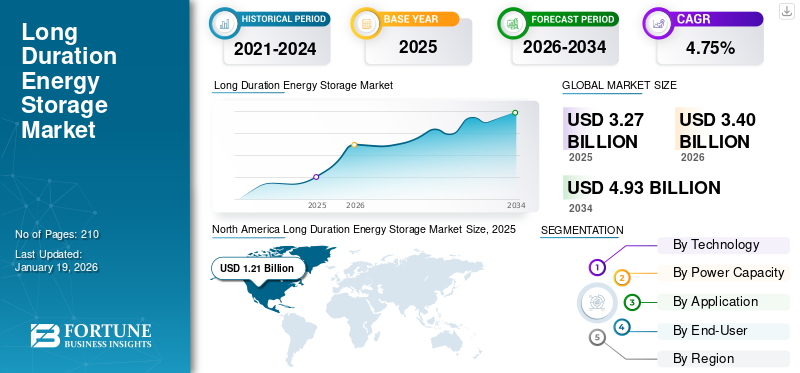
The global long duration energy storage market size was valued at USD 3.27 billion in 2025 and is projected to grow from USD 3.4 billion in 2026 to USD 4.93 billion by 2034, exhibiting a CAGR of 4.75% during the forecast period (2026-2034).
Long Duration Energy Storage (LDES) refers to technologies that can store energy for extended periods, typically 10 hours or more, and release it when needed. This allows for the storage of excess renewable energy (such as solar and wind) during times of high production and release during periods of high demand, ensuring a consistent and reliable power supply.
Long Duration Energy Storage (LDES) is experiencing growth due to increasing grid reliability needs, particularly with the integration of renewable energy sources such as solar and wind. Government incentives, rising energy costs, and the growth of electric vehicles are also key drivers. Furthermore, rapid industrialization in emerging economies and the deregulation of electricity markets are contributing to the expansion of LDES.
- In June 2025, the Long Duration Energy Storage (LDES) Council and the Greening the Islands (GTI) Foundation announced a strategic partnership to promote LDES in renewable energy grid integration across the globe. This collaboration would mainly focus on the development of large-scale 8-hour-plus energy storage solutions.
Sumitomo Electric is a prominent player in the long-duration energy storage (LDES) market, particularly known for its vanadium redox flow batteries (VRFBs) and cloud-based energy management solutions. Their LDES solutions are recognized for their ability to stabilize grids, integrate renewable energy, and participate in energy trading markets. Furthermore, Sumitomo is actively involved in grid modernization initiatives and the development of new energy storage projects in various regions.
Download Free sample to learn more about this report.
Long Duration Energy Storage Market Key Takeaways
 Market Size & Forecast
- 2025 Market Size: USD 3.27 Billion
- 2026 Market Size: USD 3.40 Billion
- 2034 Forecast Market Size: USD 4.93 Billion
- CAGR: 4.75% from 2026–2034
 Market Share
- North America dominated the long duration energy storage market with a 37.12% share in 2025.
- The mechanical segment is projected to account for 33.07% of the market in 2026.
- The renewable energy segment is projected to hold a 59.78% market share in 2026.
 Key Regional Highlights
North America
In 2025, North America represented USD 1.21 billion, accounting for 37.12% of the worldwide market, and is projected to grow to USD 1.26 billion in 2026.
Asia Pacific
Asia Pacific contributed 19.52% to the global market in 2025, with a valuation of USD 0.64 billion, and is projected to reach USD 0.66 billion in 2026.
Europe
The Europe market generated USD 1.03 billion in 2025, representing 31.46% of the global market landscape, and is expected to reach USD 1.07 billion in 2026.
U.S.
Market growth is fueled by rising demand for grid flexibility solutions and government-backed investments in long-duration energy storage technologies.
Japan
The country is witnessing growing opportunities for LDES deployment as it advances renewable energy integration, grid resilience, and long-term decarbonization goals.
Read More

MARKET DYNAMICS
MARKET DRIVERS
Growing Renewable Energy Integration is Driving the Market Growth
The growing integration of renewable energy sources is a major driver of the increasing demand for long-duration energy storage (LDES) systems. LDES technologies are crucial for balancing the intermittent nature of renewable energy sources such as solar and wind, ensuring a stable and reliable power supply. This is because LDES systems can store excess energy generated during periods of high renewable output and release it when demand is high or generation is low.
- In October 2025, the Ministry of New and Renewable Energy of India announced an investment plan for renewable integration. This plan is expected to increase energy generation capacity by 1,500 MW in the country. Such initiatives are expected to foster demand for LDES in the country over the forecast period.
The long-duration energy storage market is expected to experience significant growth in the coming years, driven by the increasing adoption of renewable energy and the growing need for more reliable and sustainable energy systems.
Government Incentives and Supportive Policies to Propel the Deployment of LDES
Government incentives and supportive policies for long-duration energy storage (LDES) include direct financial incentives, subsidies, tax credits, and dedicated procurement schemes. For example, the UK’s cap-and-floor regime guarantees a minimum revenue floor to de-risk investments and attract private capital.
- In the U.S., the Inflation Reduction Act offers tax credits, making storage deployments more financially viable. Similarly, India’s 2025 budget reduces import duties on battery minerals and allocates significant funding to boost domestic manufacturing.
Such measures complement financial incentives by reducing administrative barriers, ensuring market certainty, and fostering innovation and scaling of long-duration storage technologies over the forecast period.
MARKET RESTRAINTS
High Upfront Cost of Long-Duration Energy Storage to Restrain Market Growth
The high upfront capital cost is a major restraint for the growth of the long-duration energy storage (LDES) market. LDES technologies, such as flow batteries, thermal systems, and other mechanical storage, require substantial initial investments compared to short-duration storage solutions. These costs are driven by the complexity, size, and materials involved in LDES systems, which often need larger installations to deliver comparable capacity. Additionally, many LDES technologies are still in early phases of commercialization, limiting economies of scale.
According to the LDES council, the global average capex cost for pumped storage hydropower(PSH) is above USD 1,500 to 2,500 per kW. However, the high initial capital outlay, combined with relatively weak market incentives and regulatory frameworks that favor short-duration storage, continues to slow the broad adoption and investment in LDES projects.
MARKET OPPORTUNITIES
Growing Demand for Uninterrupted and Reliable Critical Power Supply Infrastructure to Create Lucrative Market Opportunities
Growing energy demands from emerging technologies such as data centers, electric vehicles, and AI applications, which require uninterrupted, reliable power, are expected to create lucrative opportunities. LDES systems are well-suited to provide grid flexibility by storing excess energy during low demand and supplying it during peak periods. The increasing frequency of extreme weather events driven by climate change is pushing utilities and governments to prioritize grid resilience. LDES solutions can provide long-duration backup power during outages, strengthening energy security.
- In December 2024, the California Energy Commission approved a USD 42 million grant for a long-duration energy storage and power backup project, the largest initiative of its kind undertaken in collaboration with the U.S. Department of Defense.
MARKET CHALLENGES
Complex Transmission and Distribution Grid Integration to Create Challenges for Market Players
Integration challenges for long-duration energy storage (LDES) into the electrical grid are multifaceted and significant. Technically, LDES systems must effectively respond to real-time fluctuations in voltage and frequency to maintain grid stability and power quality, requiring sophisticated control algorithms. Ensuring compliance with evolving region-specific grid codes covering reactive power support, fault ride-through, and frequency response is also complex, as standards continue to change with increasing renewable penetration.
Moreover, coordination with the grid’s energy management system (EMS) presents challenges in real-time communication, optimal charge/discharge decision-making, and synchronization with other resources such as renewable generation and demand response.
LONG-DURATION ENERGY STORAGE MARKET TRENDS
Deployment of Large Capacity LDES Projects to Shape the Future of the Market
Large-scale capacity deployment in the long-duration energy storage (LDES) market is a pivotal trend supporting the energy transition goals toward a decarbonized and resilient grid. High-power LDES systems are particularly gaining focus, as they strike an optimal balance between cost efficiency and the ability to address grid demands such as peak load management, renewable integration, and stability enhancement.
Globally, major projects are under development, such as Energy Vault’s 25 MW/100 MWh gravity energy storage system in China and India’s ambitious pumped hydro storage projects scaled up to 1,400-1,800 MW.
Supportive policy frameworks, declining technology costs, and growing investor interest are further accelerating deployment. As regulatory and grid integration challenges are addressed, large-scale LDES projects will become essential infrastructure, providing multi-day storage capacity crucial for high renewable energy penetration, energy security, and grid resilience over the forecast period.
Download Free sample to learn more about this report.
IMPACT OF TARIFFS ON THE MARKET
Tariffs have a significant impact on the global long-duration energy storage (LDES) market, primarily by increasing production and project costs. Tariffs on critical components and raw materials such as lithium, cobalt, and vanadium raise manufacturing expenses for LDES systems, including flow batteries and lithium-ion batteries, leading to higher prices for utilities and end-users. These cost pressures reduce profit margins for manufacturers and discourage investments, slowing down project deployment and long duration energy storage market growth.
SEGMENTATION ANALYSIS
By Technology
Mechanical Segment Dominated the Market Due to Long Operational Life
Based on technology, the market is segmented into thermal, electrochemical, and mechanical. The mechanical segment is expected to account for the largest long-duration energy storage market share of 33.07% in 2026. Demand for mechanical long-duration energy storage (LDES) is strong and growing, driven by its scalability, long operational life, and ability to store large amounts of energy efficiently for extended periods.
- In August 2025, State Grid Corporation of China announced the completion of the Fengning Pumped Storage Power Station development, which is the largest mechanical energy storage facility located in Hebei province, China. This project is equipped with a storage capacity of 3.6 GW. Such large-scale projects reinforce the domination of mechanical LDES across the globe.
The electrochemical segment emerged as the fastest-growing segment with a CAGR of 6.37%, driven by its scalability, cost-effectiveness, and operational flexibility.
To know how our report can help streamline your business, Speak to Analyst
By Power Capacity
Balance of Cost-Effectiveness and Scalability to Propel the Upto 500 MW Segment Growth
Based on power capacity, the long duration energy storage market is segmented into up to 500 MW, 501 MW to 2000 MW, and above 2000 MW. Upto 500 MW is expected to dominate the market with the revenue share of 76.82% in 2026, owing to the increasing need for grid stability, renewable integration, and decarbonization. Systems with upto 500 MW range are adopted for their balance of cost-effectiveness and scalability, serving applications such as peak load management, renewable smoothing, and grid resilience.
The above 2000 MW segment is expected to witness the fastest growth, with a CAGR of 9.15%, driven by the escalating need for grid-scale, multi-day storage solutions to support very high renewable energy penetration and ensure energy security.
By Application
Renewable Energy Segment Dominated the Market Owing to the Increasing Adoption of LDES
Based on application, the market is broadly categorized into renewable energy, off grid microgrids, power backup, and others. In 2026, renewable energy accounted for the largest market share of 59.78%, as renewable energy applications drive strong demand in the long-duration energy storage (LDES) market by addressing the intermittency and variability of resources such as wind and solar.
The power backup segment emerged as the fastest-growing application, with a CAGR of 5.14%, as Long-duration energy storage (LDES) provides critical power backup by delivering reliable, extended-duration electricity during grid outages or emergencies.
By End-User
Utility Segment Dominates the Market Owing to the Increasing Integration of Renewable Energy Sources
Based on end-user, the long-duration energy storage market is broadly categorized into utility and commercial & industrial. The utility segment is expected to emerge as a dominant segment, with a revenue share of 73.77% in 2026. Growth in the segment is driven by the increasing integration of renewable energy sources like solar and wind power.
- In June 2025, the Government of Spain recognized LDES as a key enabler for enhancing the country’s grid infrastructure and boosting electrification. Government inclination toward the integration of energy storage systems in transmission and distribution grids is expected to fuel the growth of long duration energy storage market across the globe.
The commercial & industrial is the fastest-growing segment, with a CAGR of 5.23%, owing to the increasing need for grid stability and the integration of long-duration energy storage with renewable energy sources.
LONG DURATION ENERGY STORAGE MARKET REGIONAL OUTLOOK
The market has been studied geographically across five main regions: North America, Europe, Asia Pacific, and the Rest of the World.
North America Long Duration Energy Storage Market Size, 2025 (USD Billion) To get more information on the regional analysis of this market, Download Free sample
North America
In 2025, North America represented USD 1.21 billion, accounting for 37.12% of the worldwide market, and is projected to grow to USD 1.26 billion in 2026. in the global long duration energy storage market, owing to the robust adoption of sustainable energy. Growth in the U.S. is fueled by the demand for solutions that can manage the variability of renewable energy sources such as solar and wind, with LDES technologies providing the necessary flexibility and reliability for a decarbonized power system.
- In June 2025, the U.S. Department of Energy announced funding of USD 15 million for the development of three energy storage technology projects across the country. Such government investments are expected to drive market growth in the country over the forecast period.
Europe
The Europe market generated USD 1.03 billion in 2025, representing 31.46% of the global market landscape, and is expected to reach USD 1.07 billion in 2026. The region is attracting substantial investments in advanced energy storage technologies, including lithium-ion batteries, flow batteries, compressed air energy storage, and thermal storage. For instance, in January 2025, Energy Storage Coalition partnered with Long Duration Energy Storage (LDES) Council to boost the decarbonisation of the European energy system by increasing the deployment of sustainable and clean energy storage solutions to support renewable integration.
Asia Pacific
Asia Pacific contributed 19.52% to the global market in 2025, with a valuation of USD 0.64 billion, and is projected to reach USD 0.66 billion in 2026. The Long Duration Energy Storage (LDES) market in the Asia Pacific region is expected to witness the fastest growth globally, with a CAGR of 5.18% over the forecast period. Growth in the region is primarily driven by the increasing integration of renewable energy sources into national power grids. Furthermore, the LDES market in the rest of the world is experiencing steady growth, driven by increasing renewable energy adoption and the need for reliable, long-duration power solutions in several GCC countries and Latin America.
COMPETITIVE LANDSCAPE
KEY INDUSTRY PLAYERS
Key Players are Focused on Technological Advancements and Product launches to Boost Their Market Share
The competitive landscape of the Long Duration Energy Storage (LDES) market is characterized by a mix of established players and emerging companies, with various technologies vying for market share. Key players include Sumitomo Electric Industries, ESS Tech, Energy Vault, Eos Energy Enterprises, and Invinity Energy Systems.
In June 2025, Hithium announced the mass manufacturing of the world’s first 1,000Ah+ battery cell, which is to be utilized in long-duration energy storage (LDES) applications. The market is being driven by the increasing demand for renewable energy integration and the growing need for grid-reliable energy storage solutions. However, it continues to face challenges related to technology maturity, cost, and infrastructure development.
List of the Key Long Duration Energy Storage Market Companies Profiled
- Sumitomo Electric Industries, Ltd. (Japan)
- MAN Energy Solutions (Germany)
- Energy Vault, Inc. (Switzerland)
- Eos Energy Enterprises (U.S.)
- Invinity Energy Systems (U.K.)
- CMBlu Energy (Germany)
- Highview Power (U.K.)
- Malta Inc. (U.S.)
- Primus Power (U.S.)
- Form Energy (S.)
- ESS, Inc. (U.S.)
KEY INDUSTRY DEVELOPMENTS
- In July 2025, Google partnered with Energy Dome with a strategic investment to utilize the Energy Dome CO2 Battery to enable carbon-free energy use at scale.
- In June 2025, Root-Power announced plans to develop 4 LDES projects with a capacity of 2.4 GWh. The projects will be located in West Yorkshire, North Yorkshire, Buckinghamshire, and Lincolnshire in the U.K.
- In October 2024, Highview launched the second phase of the LDES programme with the launch of a 2.5GWh Power Plant at Hunterston, Ayshire, Scotland. The project is delivering 5 times the country’s operational battery storage capacity through strategic placement with renewable energy grid integration.
- In April 2025, Frontier Power announced a collaboration with Ethos Green Energy to enhance the pipeline of the LDES project in the U.K. This collaboration supports 20 GWh of long-duration energy storage projects, including flow batteries with emphasis on the UK LDES Cap and Floor Scheme.
- In December 2023, Aquabattery and Statkraft announced a partnership for the development of flow batteries to improve long-term storage of electricity through a flow battery made with salt water.
Investment Analysis and Opportunities
The developing economies present a significant investment opportunity to the long duration energy storage market:
- In January 2025, the U.S. Department of Energy (DOE) announced a conditional commitment for a loan guarantee of up to USD 1.76 billion. GEM A-CAES, LLC is rolling out the Willow Rock Energy Storage Center, a cutting-edge Advanced Compressed Air Energy Storage (A-CAES) project in Eastern Kern County, California.
- In October 2024, the LDES Council and Kyoto Club signed a memorandum of understanding (MoU) to foster collaboration between the two organisations in advancing the awareness, evaluation, and adoption of long-duration energy storage (LDES) solutions. This partnership aims to accelerate systemic grid decarbonisation by addressing barriers, identifying opportunities, and supporting initiatives such as the development of educational materials, stakeholder workshops, webinars, and other engagement events.
REPORT COVERAGE
The report delivers a detailed insight into the market. It focuses on key aspects, such as leading companies in the market. Besides, the report offers regional insights and global market trends & technology, and highlights key industry developments. In addition to the factors above, the report encompasses several factors and challenges that contributed to the growth and downfall of the market in recent years.
Request for Customization to gain extensive market insights.
Report Scope and Segmentation
|
ATTRIBUTE |
DETAILS |
|
Study Period |
2021-2034 |
|
Base Year |
2025 |
|
Estimated Year |
2026 |
|
Forecast Period |
2026-2034 |
|
Historical Period |
2021-2024 |
|
Growth Rate |
CAGR of 4.75% from 2026 to 2034 |
|
Unit |
Value (USD Billion) |
|
Segmentation |
By Technology · Thermal · Electrochemical · Mechanical |
|
By Power Capacity · Upto 500 MW · 501 MW to 2000 MW · Above 2000 MW |
|
|
By Application · Renewable Energy · Off-grid Microgrids · Power Backup · Others |
|
|
By End-User · Utility · Commercial & Industrial |
|
|
By Region
|
Frequently Asked Questions
As per the Fortune Business Insights study, the market size was valued at USD 3.27 billion in 2025.
The market is likely to grow at a CAGR of 4.75% over the forecast period (2026-2034).
The utility segment leads the market.
The market size of North America stood at USD 1.21 billion in 2025.
Growing Renewable Energy Integration is Driving the Market Growth
Some of the top players in the market are Sumitomo Electric Industries, Ltd., MAN Energy Solutions, Energy Vault, Inc., Eos Energy Enterprises, Invinity Energy Systems, and CMBlu Energy.
The global market size is expected to reach USD 4.93 billion by 2034.



- 2021-2034
- 2025
- 2021-2024
- 210
Get 30-60 hrs Free Customization
Expand Regional and Country Coverage, Segments Analysis, Company Profiles, Competitive Benchmarking, and End-user Insights.



















Related Reports
-
US +1 833 909 2966 ( Toll Free )
-
Get In Touch With Us