Mental Health Counselling Market Size, Share & Industry Analysis, By Service Type (Individual Counseling, Couples & Marriage Counseling, Family Counseling, and Group Counseling), By Delivery Mode (In-person and Remote Counseling), By Application (Depression & Depressive Disorders, OCD & Trauma-related Conditions, Substance Use & Addictive Behaviors, and Family & Parenting Issues), By Age Group (Children & Adolescents, Adults, and Older Adults), By Service Provider (Private Practitioners, Community Health Centers, Educational Institutions, and Others), and Regional Forecast, 2026-2034
 Download Free Sample
Mental Health Counselling Market Size and Future Outlook
 Listen to Audio Version
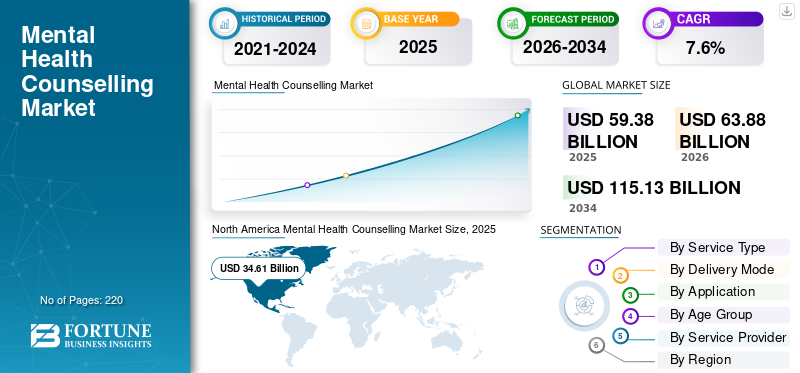
The global mental health counselling market size was valued at USD 59.38 billion in 2025. The market is projected to grow from USD 63.88 billion in 2026 to USD 115.13 billion by 2034, exhibiting a CAGR of 7.6% during the forecast period. North America dominated the mental health counselling market with a market share of 58.29% in 2025.
The mental health counselling market comprises professional therapeutic services designed to help individuals manage emotional, behavioral, interpersonal and psychological difficulties. Counselling services address conditions and concerns such as depression, anxiety, trauma, grief, stress, relationship problems, substance misuse, and workplace burnout. These services are delivered through individual, family, couples or group sessions using cognitive behavioral, interpersonal, psychodynamic, humanistic and solution-focused approaches. Market growth is supported by the increasing prevalence of mental health conditions, improving awareness, declining social stigma, and rising acceptance of professional psychological support. Expanding insurance coverage, workplace wellness benefits, school-based programs and community mental health initiatives are also improving access to counselling services.
Many key industry players, such as Talkspace, Inc., Kooth plc, Mindler AB, HelloBetter, and MindBeacon are focusing on developing various innovative technologies to offer better products with improved accuracy and efficiency.
Download Free sample to learn more about this report.
Mental Health Counselling Market KEY TAKEAWAYS
 Global Market Size & Forecast
- 2025 Market Size: USD 59.38 billion
- 2026 Market Size: USD 63.88 billion
- 2034 Forecast Market Size: USD 115.13 billion
- CAGR: 7.6% from 2026-2034
 Market Share
- North America dominated the global market with a 58.29% share in 2025.
- Individual Counseling held the largest service type share in 2025.
- In-person Counseling held the largest delivery mode share in 2025.
 Key Regional Highlights
North America
North America dominated the market with USD 34.61 billion in 2025.
Europe
Europe is projected to grow at 6.8% from 2026-2034 and reach USD 17.11 billion in 2026.
Asia Pacific
Asia Pacific is estimated to reach USD 7.10 billion in 2026.
U.S.
The market is expected to reach approximately USD 34.81 billion in 2026, accounting for roughly 54.5% of global sales.
Japan
The market is estimated to reach approximately USD 1.62 billion in 2026.
Read More

MENTAL HEALTH COUNSELLING MARKET TRENDS
Hybrid Counselling Models and Adoption of Digital Technologies to Emerge as a Prominent Trend
Hybrid counselling, combining face-to-face sessions with video consultations, telephone support, messaging, and digital therapeutic resources is emerging as a prominent market trend. This model offers greater flexibility while maintaining access to direct professional interaction. Digital assessment tools are increasingly used for intake, symptom monitoring, appointment scheduling, and treatment progress evaluation. Artificial intelligence may support administrative documentation, provider matching, and personalized resource recommendations, although clinical decision-making continues to require qualified professionals. Clients can choose delivery methods based on convenience, privacy, condition severity, and personal preference. Technology-supported counselling can also improve continuity between sessions and extend services to remote locations, supporting broader adoption of structured and personalized mental health treatment.
MARKET DYNAMICS
MARKET DRIVERS
Download Free sample to learn more about this report.
Increasing Mental Health Awareness to Drive Market Growth
Increasing awareness of mental health conditions is a major driver of the global mental health counselling market growth. Public education programs, workplace initiatives, educational institutions and community organizations are encouraging individuals to recognize symptoms and seek timely support. Reduced stigma surrounding therapy has improved participation among adults, adolescents, employees, and families. Greater understanding of the relationship between mental and physical health is also increasing referrals from primary care providers. Governments and employers are expanding preventive programs, confidential counselling benefits, and employee assistance services. Growing awareness of stress, depression, anxiety, trauma and burnout is expected to support earlier diagnosis, improve treatment acceptance, and sustain demand for professional counselling services across developed and emerging markets.
|
Rank |
Drivers |
CAGR Contribution, 2026–2034 |
Overall Impact |
2026–2028 |
2029–2031 |
2032–2034 |
|
1 |
Increasing awareness of mental health conditions |
+7.3% |
High |
High |
High |
High |
|
2 |
Expansion of tele-counselling and digitally delivered behavioral healthcare |
+5.8% |
High |
High |
High |
Medium |
|
3 |
Expansion of insurance coverage, reimbursement and public mental-health funding |
+4.8% |
High |
High |
High |
High |
|
4 |
Integration of counselling into primary care, community, workplace and educational settings |
+4.0% |
Medium |
Medium |
High |
High |
|
5 |
Improving mental-health awareness, early identification and willingness to seek professional help |
+4.7% |
Medium |
High |
Medium |
Medium |
|
6 |
Others |
+1.8% |
Low |
Low |
Low |
Low |
|
|
Total Positive Growth Contribution |
+28.4% |
|
|
|
|
MARKET RESTRAINTS
Shortage of Qualified Professionals and High Consultation Fees to Restrain Market Growth
The shortage of trained counselors, psychologists, and therapists is limiting the market’s ability to meet rapidly increasing demand. Rural and economically disadvantaged areas frequently experience insufficient provider availability, long waiting periods for appointments, and limited access to specialized mental health services. High consultation fees and inadequate insurance reimbursement can also prevent individuals from beginning or continuing counselling. Financial barriers are particularly significant in regions where mental health services require substantial direct out-of-pocket expenditure. In addition, heavy workloads among existing professionals can contribute to burnout, reduced appointment availability, and disruptions in continuity of care. Variations in licensing requirements, limited training capacity, and unequal distribution of qualified professionals further restrict market expansion despite the substantial unmet requirement for psychological treatment worldwide.
|
Rank |
Restraint |
CAGR Contribution, 2026–2034 |
Overall Impact |
2026–2028 |
2029–2031 |
2032–2034 |
|
1 |
Shortages of qualified mental-health counsellors and high consultation fees |
−7.2% |
High |
High |
High |
Medium |
|
2 |
Affordability constraints, reimbursement gaps and high out-of-pocket costs |
−5.8% |
High |
High |
Medium |
Medium |
|
3 |
Persistent stigma, cultural barriers, privacy concerns and low treatment-seeking behavior |
−4.9% |
Medium |
Medium |
Medium |
Low |
|
4 |
Others |
−2.9% |
Low |
Low |
Low |
Low |
|
|
Total Negative Restraint Contribution |
−20.8% |
|
|
|
|
MARKET OPPORTUNITIES
Growing Integration of Counselling Services into Workplace, Educational, and Community Healthcare Programs to Create New Growth Opportunities
The growing integration of counselling services into workplaces, schools, universities, and community healthcare systems presents significant opportunities for market growth. Employers are increasing investments in mental health benefits to address burnout, absenteeism, workplace stress and employee retention. Educational institutions are expanding counselling programs to support students experiencing academic pressure, social anxiety, depression, and adjustment difficulties. Community-based models can improve accessibility among low-income, rural, and culturally diverse populations. Additional opportunities exist in multilingual counselling, culturally responsive therapy, and specialized programs for caregivers, veterans, women and older adults. Partnerships among healthcare providers, insurers, employers, and public agencies can establish affordable referral networks and expand access beyond traditional hospital-based mental health settings.
MARKET CHALLENGES
Clinical Validation and Regulatory Compliance to Hinder Market Growth
Maintaining confidentiality, clinical quality, and regulatory compliance is a major challenge for mental health counselling providers. Mental health records contain highly sensitive information and require strong cybersecurity measures, secure communication systems, and transparent data-management procedures. Privacy concerns may discourage individuals from using digital platforms or openly discussing personal experiences. Variation in professional qualifications, treatment approaches, and quality-control systems can also produce inconsistent outcomes. Providers must establish appropriate crisis-response procedures, informed-consent practices, and clinical supervision standards. Cross-border virtual counselling additionally creates difficulties related to licensing, reimbursement and regional regulations. Balancing scalable digital technologies with empathy, therapeutic trust, and professional accountability will remain essential to the responsible expansion of mental health counselling services.
Segmentation Analysis
By Service Type
Personalized and Condition-specific Support Offered by Individual Counselling Boosted the Segment’s Growth
Based on service type, the market is divided into individual counseling, couples & marriage counseling, family counseling, and group counseling.
In 2025, individual counselling held the highest global mental health counselling market share. Certain factors such as confidentiality, personalized and condition-specific support, and patient specific treatment are actively supporting segment growth. Counselors can assess personal experiences, emotional triggers, behavioral patterns, and treatment progress, before adjusting therapeutic approaches to individual requirements. The service is widely used for depression, anxiety, grief, trauma, addiction, relationship difficulties, and workplace stress. Individual sessions can be delivered through private practices, hospitals, community clinics and virtual platforms. Furthermore, rising preference for personalized mental healthcare and measurable treatment outcomes is also expected to maintain the segment’s leading market position.
- For instance, in April 2026, Healthcare Triangle launched ZoraNex, an AI-driven digital self-care therapy platform that integrates evidence-based psychotherapies, including cognitive behavioral therapy (CBT), acceptance and commitment therapy (ACT), dialectical behavior therapy (DBT) and interpersonal therapy with mindfulness and wellness practices.
To know how our report can help streamline your business, Speak to Analyst
The group counseling segment is anticipated to rise with a CAGR of 8.4% over the forecast period.
By Delivery Mode
Strong Therapeutic Engagement and Benefits of Direct Communication Encouraged In-person Counseling Segment Growth
Based on delivery mode, the market is segmented into in-person counseling and remote counseling.
In 2025, the in-person counseling segment held the highest share of the global market. The segment’s growth is attributed to the benefits of direct communication, strong therapeutic engagement, and detailed behavioral observation. Face-to-face interaction enables counsellors to evaluate body language, facial expressions, emotional responses, and communication patterns that may be difficult to assess through text or telephone sessions. Moreover, physical counselling environments can also provide privacy, structure, and separation from everyday distractions. This mode of service delivery is particularly valuable for complex trauma, severe depression, substance misuse, family conflict, and cases requiring close risk monitoring. Furthermore, well-established networks of private practices, hospitals, rehabilitation centers, and community mental health clinics continue to support service availability.
The remote counseling segment is anticipated to grow at a CAGR of 13.0% over the forecast period.
By Application
Widespread Prevalence of Depression & Depressive Disorders Boosted Segment Growth
Based on application, the market is segmented into depression & depressive disorders, OCD & trauma-related conditions, substance use & addictive behaviors, family & parenting issues, and others.
In 2025, the depression & depressive disorders segment dominated the market, registering a 28.4% market share. The segment is growing due to their widespread prevalence, recurring nature, and significant impact on daily functioning, relationships, and workplace productivity. Individuals experiencing depression may require continuing counselling to address negative thinking, emotional difficulties, social withdrawal, and behavioral changes. Moreover, cognitive behavioral therapy, behavioral activation, and interpersonal counselling are among the most commonly used, either independently or with medical treatment. Increasing screening across primary healthcare settings, workplaces, and educational institutions are supporting earlier identification and timely access to professional counseling services.
- For instance, according to data published by the World Health Organization (WHO) in August 2025, an estimated 5.7% of the population suffer from depression.
The OCD & trauma-related conditions segment is anticipated to grow at a CAGR of 8.7% over the forecast period.
By Age Group
Major Occurrence of Chronic Illness and Psychological Pressures amongst Adult Population Accelerates Segment Growth
Based on age group, the market is segmented into children & adolescents, adults, and older adults.
In 2025, the adults segment held the highest market share, holding 69.7% market share, as they experience multiple psychological pressures related to employment, finances, relationships, caregiving, parenting, chronic illness, and major life transitions. Working-age adults commonly seek counselling for depression, anxiety, burnout, trauma, grief, and substance-related concerns. This population is also more likely to independently access private services or receive counseling through employers, health insurance, and government programs. In addition, increasing workplace awareness and the expansion of employee assistance services are further improving access among adults.
The children & adolescents segment is anticipated to grow at a CAGR of 9.2% over the forecast period.
By Service Provider
Specialized and Personalized Mental Healthcare Boost Private Practitioners & Group Practices Segment Growth
Based on service provider, the market is segmented into private practitioners & group practices, community mental health centers, educational institutions, and others.
In 2025, private practitioners & group practices held the highest market share. Independent practitioners often specialize in areas such as depression, trauma, couples counselling, family therapy, grief, and addiction, enabling them to build long-term relationships with clients. Group practices offer additional advantages through multidisciplinary expertise, extended operating hours, multiple practice locations, and participation in insurance networks. Clients also benefit from greater flexibility in selecting counsellors based on language, therapeutic method, cultural background, or appointment availability. Furthermore, the segment is set to hold 53.3% share in 2026.
The educational institutions segment is projected to grow at a CAGR of 9.0% during the forecast period.
Mental Health Counselling Market Regional Outlook
By geography, the market is categorized into Europe, North America, Asia Pacific, Latin America, and the Middle East & Africa.
North America
North America Mental Health Counselling Market Size, 2025 (USD Billion)
To get more information on the regional analysis of this market, Download Free sample
North America held the dominant share in 2024, valued at USD 32.46 billion, and also maintained its leading position in 2025, with USD 34.61 billion. The regional growth is attributed to high prevalence of mental health disorders and well-established behavioral healthcare infrastructure. In addition, a positive approach of the population toward adoption of mental health counselling is also expected to drive regional growth.
U.S. Mental Health Counselling Market
Based on North America’s strong contribution and the U.S. dominance within the region, the U.S. market is expected to reach around USD 34.81 billion in 2026, accounting for roughly 54.5% of global sales.
Europe
Europe is projected to record a growth rate of 6.8% during the forecast period. The market is expected to reach a valuation of USD 17.11 billion in 2026. The region is estimated to witness considerable market growth due to growing government investment in public mental health services, and rising awareness of depression, anxiety, and stress-related disorder.
U.K. Mental Health Counselling Market
The U.K. market is estimated to reach around USD 2.75 billion in 2026, representing roughly 4.3% of global revenues.
Germany Mental Health Counselling Market
Germany’s market is projected to reach approximately USD 5.57 billion in 2026, equivalent to around 8.7% of global sales.
Asia Pacific
Asia Pacific is estimated to reach USD 7.10 billion in 2026. Asia Pacific is expected to have strong growth in the market due to rapid adoption of digital health platforms and tele-counselling service.
Japan Mental Health Counselling Market
The Japanese market is estimated to reach around USD 1.62 billion in 2026, accounting for roughly 2.5% of global revenues.
China Mental Health Counselling Market
China’s market is projected to be one of the largest worldwide. The market is expected to reach around USD 2.27 billion, representing roughly 3.5% of global sales.
India Mental Health Counselling Market
The Indian market is estimated to reach around USD 0.45 billion in 2026, accounting for roughly 0.7% of global revenues.
Latin America and Middle East & Africa
The Latin America and the Middle East & Africa regions are expected to witness moderate growth in this market during the forecast period. The Latin America market is set to reach USD 1.36 billion in 2026. In the Middle East & Africa, the GCC is set to reach USD 0.74 billion in 2026.
South Africa Mental Health Counselling Market
The South Africa market is projected to reach around USD 0.18 billion in 2026, representing roughly 0.3% of global revenues.
COMPETITIVE LANDSCAPE
Key Industry Players
Key Players Focus on Expansion of Employer-sponsored Mental Health Programs and Strategic Partnerships to Boost their Market Position
The global mental health counselling market exhibits a semi-consolidated competitive landscape, with established counselling providers and digital behavioral health platforms accounting for a significant share of the market. Prominent players include Talkspace, Inc., Kooth plc, Mindler AB, HelloBetter, and MindBeacon. These companies are strengthening their market position through strategic partnerships, acquisitions, the expansion of employer-sponsored mental health programs, payer collaborations, and technology-enabled counselling services that improve access to licensed therapists and behavioral healthcare.
- For instance, in April 2025, Teladoc Health acquired UpLift, a virtual mental healthcare provider, to expand its insurance-covered therapy, psychiatry, and medication management services. The acquisition strengthened Teladoc Health's behavioral health portfolio and broadened access to licensed mental health professionals through health plans covering more than 100 million members.
Other notable players operating in the market include Wysa Ltd., Vittude, YourDOST, THIS WAY UP, and October Health. These companies are expected to focus on expanding provider networks, integrating digital and in-person counselling services, strengthening payer and employer partnerships, and enhancing personalized behavioral healthcare solutions to increase their global market share during the forecast period.
LIST OF KEY MENTAL HEALTH COUNSELLING COMPANIES PROFILED
- Talkspace, Inc. (U.S.)
- Kooth plc (U.K.)
- Mindler AB (Sweden)
- HelloBetter (Germany)
- MindBeacon (Canada)
- Wysa Ltd. (India)
- Vittude (Brazil)
- YourDOST (India)
- THIS WAY UP (Australia)
- October Health (South Africa)
KEY INDUSTRY DEVELOPMENTS
- November 2025: Kooth acquired Kismet Health’s pediatric telehealth platform, expanding interactive digital therapy capabilities for children aged five to twelve and strengthening early-intervention mental healthcare services globally.
- August 2025: Mindler acquired Ieso Digital Health UK, combining online counselling and cognitive behavioural therapy capabilities to expand accessible, evidence-based psychological care across the U.K.
- July 2025: Talkspace partnered with Tia Health to become its primary therapy and psychiatry provider, improving coordinated mental healthcare for women across different stages of their lives.
- March 2025: Headspace partnered with the U.S. Navy to provide service members with digital mental health resources, strengthening access to preventive support, coaching, and wellbeing services nationwide.
- October 2024: Thriveworks acquired Synchronous Health, integrating clinician-led telehealth with AI-supported coaching between sessions and expanding behavioral healthcare delivery through primary care and health system partnerships.
REPORT COVERAGE
The global mental health counselling market analysis includes a comprehensive study of the market size & forecast by all the market segments included in the report. It includes details on the market dynamics and trends expected to drive the market over the forecast period. It provides information on key aspects, including an overview of technological advancements, the regulatory environment, and product launches. Additionally, it details partnerships, mergers & acquisitions, along with key industry developments and investments by key regions. The global market research report also provides a depth competitive landscape with information on the market share and profiles of key operating players.
Request for Customization to gain extensive market insights.
Report Scope & Segmentation
| ATTRIBUTE | DETAILS |
| Study Period | 2021-2034 |
| Base Year | 2025 |
| Estimated Year | 2026 |
| Forecast Period | 2026-2034 |
| Historical Period | 2021-2024 |
| Growth Rate | CAGR of 7.6% from 2026-2034 |
| Unit | Value (USD Billion) |
| Segmentation | By Service Type, Delivery Mode, Application, Age Group, Service Provider, and Region |
| By Service Type |
|
| By Delivery Mode |
|
| By Application |
|
| By Age Group |
|
| By Service Provider |
|
| By Region |
|
Frequently Asked Questions
According to Fortune Business Insights, the global market value stood at USD 59.38 billion in 2025 and is projected to reach USD 115.13 billion by 2034.
In 2025, the market value stood at USD 34.61 billion.
The market is expected to exhibit a CAGR of 7.6% during the forecast period.
By service type, the individual counseling segment led the market.
Growing mental health awareness is a key factor driving market expansion.
Talkspace Inc., Kooth plc, Mindler AB, HelloBetter, and MindBeacon are the major players in the global market.
North America dominated the market in 2025.



- 2021-2034
- 2025
- 2021-2024
- 220
Get 30-60 hrs Free Customization
Expand Regional and Country Coverage, Segments Analysis, Company Profiles, Competitive Benchmarking, and End-user Insights.













.webp)






Related Reports
-
US +1 833 909 2966 ( Toll Free )
-
Get In Touch With Us