Mexican Food Market Size, Share & Industry Analysis, By Product Type (Tortillas & Wraps, Taco Shells & Meal Kits, Salsas & Sauces, Ready-to-Eat / Frozen Meals, Snacks, and Others), By Food Type (Veg and Non-Veg), By Distribution Channel (Hypermarkets/Supermarkets, Convenience Stores, Grocery Stores, and Online Sales Channels), and Regional Forecast, 2026-2034
 Download Free Sample
(Offer valid till 30th Sep 2026)

KEY MARKET INSIGHTS
 Listen to Audio Version
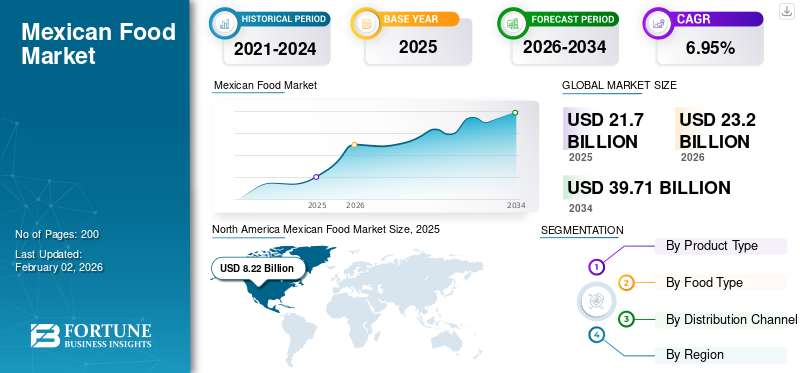
The global Mexican food market size was valued at USD 21.70 billion in 2025 and is projected to grow from USD 23.20 billion in 2026 to USD 39.71 billion by 2034, exhibiting a CAGR of 6.95% during the forecast period. North America dominated the mexican food market with a market share of 37.90% in 2025.
Mexican cuisine is vibrant food, characterized by the utilization of ingredients such as spices and traditional cooking methods. It's famous for foods such as tortillas, tacos, burritos, enchiladas, and other items that are packed with meat, cheese, beans, and salsas. The packaged and frozen food industry has developed continuously in the past few years, fueling the demand for Mexican delicacies. Besides, market players also target their product line expansion in each region by introducing local food items into global markets. Rising international travel and media have exposed and broadened consumers’ palates, as well as introduced people to authentic Mexican cuisine.
McCormick & Company, Hormel Foods Corporation, Insignia International (Flagship Food Group), General Mills Inc., and Azteca Foods Inc. are the top players operating in the global market.
Download Free sample to learn more about this report.
Mexican Food Market KEY TAKEAWAYS
 Market Size & Forecast
- 2025 Market Size: USD 21.70 Billion
- 2026 Market Size: USD 23.20 Billion
- 2034 Forecast Market Size: USD 39.71 Billion
- CAGR: 6.95% from 2026–2034
 Market Share
- North America dominated the Mexican food market with a 37.90% share in 2025.
- The tortillas & wraps segment dominates the global market.
- The non-veg segment dominates the global market.
 Key Regional Highlights
North America
North America generated USD 8.22 billion in 2025 and is projected to reach USD 8.70 billion in 2026.
Asia Pacific
Asia Pacific generated USD 5.98 billion in 2025 and is projected to reach USD 6.52 billion in 2026.
Europe
Europe generated USD 3.58 billion in 2025 and is projected to reach USD 3.83 billion in 2026.
U.S.
Consumer demand, diverse food preferences, Mexican-inspired products, and innovation drive market growth.
Japan
Growing interest in global cuisines, restaurant expansion, and demand for convenient ethnic foods support market growth.
Read More

MARKET DYNAMICS
MARKET DRIVERS:
Growing Demand for Convenient Foods to Drive Market Growth
The market is witnessing substantial growth, led by the rising need for convenience foods. Busy lifestyles of consumers and the need for saving time for meals have given a boost to ready-to-eat and ready-to-heat Mexican dishes. In addition, the emergence of technology has made it easier to order food, with online portals and mobile apps gaining prominence in buying Mexican food. In some developing regions, the rising middle class with increased purchasing power is further contributing to the demand for both convenience foods and ethnic cuisines.
MARKET RESTRAINTS:
Market Hindered by Regulations, Perceptions, and Competition
The Mexican food industry has been struggling to sustain its competitive advantage over global food trends, which will potentially limit its market size. Unfavorable perceptions, such as unhealthy food or spicy food, would be barriers to new and health-conscious consumers emergence. Supply chain disruptions can significantly impact product availability and lead to increased costs for businesses, especially when sourcing original ingredients. The growing popularity of Asian and Italian cuisines further presents a challenge to the expansion of the market for Mexican cuisine, as consumers increasingly seek diverse culinary experiences. This competition arises from the perceived novelty and sophistication of Asian and Italian flavors, as well as the rise of premium and experiential dining options within these cuisines. Moreover, following complex food labeling and health regulations may postpone product launches and raise compliance expenses.
MARKET OPPORTUNITIES:
Growing Focus On Expansion of Businesses in New Geographies to Offer Opportunities for the Market
The Mexican cuisine industry consists of local players, which exceed the number of international players present in the region. Local players are constantly focusing on increasing their presence in new countries and regions. Considering the increasing demand for different Mexican dishes, players in the industry are focusing on offering their products in international markets by expanding their presence through investments or partnering with other players in the local market, creating new opportunities for base expansion. For instance, in October 2024, GoVerden, a producer of ready-made guacamole, opened its new facility in the U.S. The expansion would support the company's rapid growth and strengthen its Mexican food business to serve markets throughout North America.
MEXICAN FOOD MARKET TRENDS:
Increasing Emphasis on Plant-Based and Vegan Food Options to Fuel Industry Growth
Plant-based diets have been growing steadily in popularity, and this trend is also being embraced within Hispanic cuisine. Traditional Mexican or Hispanic foods, which revolve around meats in food such as tacos, burritos, and enchiladas, are being reinvented using plant-based foods. This is due to increased demand for vegetarian and vegan food from customers, in line with the sustainability objectives. Manufacturers have been responding to this trend and launching innovative products in the market. For instance, in October 2024, Daring Foods, a startup company that produces plant-based chicken, launched two new vegetarian frozen entrees, Buffalo Mac and Cheese Plant Chicken Bowl and Queso Burrito Plant Chicken Bowl. The new range is appealing to consumers who are planning to reduce their meat consumption.
Download Free sample to learn more about this report.
Segmentation Analysis
By Product Type
Tortillas & Wraps Leads Market Due to their Prevalent use in Different Mexican Dishes
Based on the product type, the market is bifurcated into tortillas & wraps, taco shells & meal kits, salsas & sauces, ready-to-eat / frozen meals, snacks, and others.
The tortillas & wraps segment dominates the global market. Tortillas serve as a base for many flagship Mexican dishes such as tacos, burritos, enchiladas, and wraps, making them fundamental to Mexican cuisine’s global popularity and growth. Flour tortillas and other wrap-style products, including various flavored or specialty tortillas, also contribute significantly to the segment’s dominance as convenient, customizable foods with growing consumer demand for healthier and ethnic cuisine options.
The taco shells & meal kits segment is poised for strong growth within the global market. Packaged taco kits, including taco shells with fillings and toppings, are favored for convenience and customization in both retail and foodservice sectors. Multi-serve meal kits are popular for families, offering value and ease of preparation.
By Food Type
Widespread Consumption and Popularity to Boost Non-Veg Segment Expansion
Based on food type, the market is bifurcated into veg and non-veg.
The non-veg segment dominates the global Mexican food market share. This is largely due to the popularity of meat-based foods such as tacos, burritos, and other Mexican items of food that use beef, chicken, and pork. The number of meat choices that can be offered, including seasoned ground beef, shredded chicken, pork, and grilled steak, also supports the non-vegetarian segment growth.
The vegetarian segment is on the rise, driven by the global trend towards the adoption of plant-based eating and the growing alternatives for Mexican cuisine in the form of vegan and vegetarian food. Rising health awareness in food habits and increasing concern for environmental sustainability further fuel the growth of the market segment.
By Distribution Channel
Accessibility and Variety Under One Roof to Boost Hypermarkets/Supermarkets Segment Growth
Based on distribution channel, the market is segmented into hypermarkets/supermarkets, convenience stores, grocery stores, and online sales channels.
The hypermarkets/supermarkets segment leads the global market for Mexican food. These channels stock various brands and varieties of Mexican meals, such as taco shells, guacamole, tortilla chips, and frozen burritos. In addition, these stores provide several incentives, i.e., discounts and coupons, to enhance customers' shopping experience and thus attract a large consumer base under one roof.
The online segment is poised to grow with a high CAGR in the forecast period. The growth in e-commerce channels provides manufacturers with an opportunity to sell their products via mobile applications and websites brought to their doorstep. The online segment provides comfort and accessibility for consumers to buy products, which enables the market to expand.
Mexican Food Market Regional Outlook
By region, the market is categorized into North America, Europe, Asia Pacific, South America, and Middle East & Africa.
North America:
North America Mexican Food Market Size, 2025 (USD Billion)
To get more information on the regional analysis of this market, Download Free sample
The market in North America reached USD 8.22 billion in 2025, representing 37.90% of total market revenue, and is projected to reach USD 8.7 billion in 2026. North America is the global leader in Mexican food production, with countries such as the U.S. and Mexico leading the way. The mixture of Mexican cuisine and culinary practices, as well as local ingredients, has resulted in a rich array of dishes that symbolize the multicultural nature of the North American consumer. Mexican-based food's adaptability to diverse palates and its ability to seamlessly integrate into global culinary trends contribute to its continued relevance in North America. Mexican originated foods' popularity, particularly guacamole, has been steadily growing, fueled by increasing health awareness, the rise of plant-based diets, and the convenience of pre-packaged options. Manufacturers in the region have been launching innovative products to meet the rising demand. For instance, in June 2024, the Hormel Foods brand Wholly Guacamole, in partnership with MegaMex Foods, launched a refrigerated guacamole variety. The new product contains avocados, cilantro, lime juice, tomatoes, and jalapeño peppers.
Asia Pacific:
In 2025, the Asia Pacific market stood at USD 5.98 billion, representing 27.54% of global demand, and is projected to grow to USD 6.52 billion in 2026. The Asia Pacific region is anticipated to grow extensively over the forecast period, attributed to reasons such as increasing westernization and evolving consumer tastes for versatile dining options, especially in nations such as India and China. According to the National Bureau of Statistics of China, in 2023, the disposable personal income in China rose to USD 7,309.25 from USD 7,115.57 in 2022. Increased international travel and exposure to foreign cultures have also helped to create greater awareness and interest in Mexican food. In addition to that, online food delivery websites have facilitated greater access for consumers to various cuisines, including Mexican, from the comfort of their own homes.
Europe:
Europe contributed approximately USD 3.58 billion to the global market in 2025, accounting for 16.51% share, and is expected to reach USD 3.83 billion in 2026. Mexican cuisine is experiencing a surge in popularity across Europe, becoming a prominent force in the restaurant industry and increasingly common in-home cooking. The surge in consumer footfall in the food service market, including cafes, fast-food restaurants, and restaurants, has also largely fueled expansion of the popularity of Mexican cuisine. Globalization, travel, and media have also played a significant role in introducing Europeans to the food of Mexico, stimulating more interest in different cultures and their culinary ways. Mexican-made food's emphasis on fresh ingredients and produce such as avocados, beans, and vegetables also harmonizes with the increasing demand for healthy and plant-based diets, thus further raising its popularity. For instance, in February 2025, Heura Foods, a key player in the alternative protein category, launched a new flavor in Chunks, named “Tex-Mex.” The product is the brand’s first designed specifically for Mexican cuisine.
South America:
The South America region is anticipated to reflect a stable rate of Mexican food market growth within the forecast period. Similar to other regions of the globe, busy lifestyles and a growing income of the middle-class population of South American consumers, especially Brazil and Argentina, are fueling demand for convenient and easily available food items, including Mexican cuisine. The cultural diversity of Brazil and the culinary innovation have given rise to a plethora of dining facilities, including Mexican restaurants, that meet the needs of a multicultural customer base. Additionally, social media plays a significant role in making various food trends go viral, and Mexican cuisine, with its rich flavors and variety of dishes, is no exception.
Middle East & Africa:
Middle East & Africa maintained a strong presence in the global market, reaching USD 0.58 billion in 2025, accounting for 2.66% share, and is expected to reach USD 0.62 billion in 2026. Mexican food has been gaining increasing popularity throughout the Middle East and Africa, specifically within the UAE and other Gulf states. As Middle Eastern cuisine has taken center stage, a smoldering appetite for global cuisine has been brought forth among people for a wide range of culinary cuisines, including Mexican dishes. Over the past few years, the demand for authentic Mexican cuisine has grown in the region due to its rich cultural heritage, distinctive culinary methods, and bold flavors. Additionally, the influx of expatriates from all over the world also introduced a range of cuisines, including the spicy and colorful flavors of Mexico.
Rest of the World
The Latin America market accounted for USD 3.34 billion in 2025, representing 15.40% of the global industry, and is expected to reach USD 3.53 billion in 2026.
COMPETITIVE LANDSCAPE
Key Industry Players
Growing Focus on Innovative Launch to Expand Business
The key players in the global Mexican food market rely on two most important strategies: new product developments and base expansion. The companies are also focusing on mergers & acquisitions, investment, and promotional activities, which act as a strategy for strengthening their market presence. For instance, in April 2025, Baja Foods, a family-owned leader in authentic Mexican cuisine, launched its premium Chef Gustavo brand with products such as Chicken & Cheese Enchiladas with a Mild Jalapeño-Hatch Green Chile Crema Sauce. The new range is available throughout the Southeast region of the U.S in the frozen food section of select stores. McCormick & Company, Hormel Foods Corporation, Insignia International (Flagship Food Group), General Mills Inc., and Azteca Foods Inc. are among the prominent manufacturers in the market. Thus, are capable of fulfilling consumer demands and are expected to satisfy the evolving needs of consumers.
LIST OF KEYMEXICAN FOOD COMPANIES PROFILED:
- Insignia International (Flagship Food Group) (U.S.)
- Sabra Dipping Company, LLC (U.S.)
- Calavo Growers, Inc. (U.S.)
- La Tortilla Factory (U.S.)
- Aranda's Tortilla Company Inc. (U.S.)
- General Mills Inc. (U.S.)
- Azteca Foods Inc. (U.S.)
- Hormel Foods Corporation (U.S.)
- Amy's Kitchen (U.S.)
- McCormick & Company (U.S.)
KEY INDUSTRY DEVELOPMENTS:
- July 2025: Tres Picosos, known for its authentic Mexican cuisine, launched a bright new packaging design for its popular line of handcrafted burritos. The new products are available in convenience outlets, grocery stores, colleges, and hotels throughout the U.S.
- January 2025: Westfalia Fruit, a plant-based products company, acquired Syros, a Belgian avocado products processor and distributor. The acquisition will help Westfalia Fruit expand in the European market and increase its market share. Syros has been collaborating with the company for years to source avocados for its products, such as guacamole, meal kits, and avocado oil.
- June 2024: MegaMex Foods and Hormel Foods brand, Wholly Guacamole, launched a new refrigerated guacamole variety, extra chunky restaurant style guacamole. The new product contains chunks of 100% Hass avocados and includes tomatoes, red onions, cilantro, lime juice, and jalapeño peppers. It is designed to bring restaurant-quality flavor to at-home meals and snacking.
- February 2023: Rise & Puff, a U.S.-based better-for-you tortilla brand, launched three flagship products, including original tortillas, organic tortillas, and gluten-free tortillas.
- March 2022: Sana Foods, a plant-based gluten, grain, and dairy-free packaged food company in Egypt, launched SANA street taco tortillas. The new product is gluten-free certified and organic, and helps make healthy choices for consumers.
REPORT COVERAGE
The global market report provides the market size and forecast by all the segments. It includes details on the market dynamics and global Mexican food market trends, expected to drive the market in the forecast period. It offers information about the compounded annual growth rate (CAGR), key regions/countries, key industry developments, new product launches, and details on partnerships, mergers, and acquisitions. The global market analysis also covers a detailed competitive landscape with information on the market share and profiles of key players.
Request for Customization to gain extensive market insights.
Report Scope & Segmentation
|
ATTRIBUTE |
DETAILS |
|
Study Period |
2021-2034 |
|
Base Year |
2025 |
|
Forecast Period |
2026-2034 |
|
Historical Period |
2021-2024 |
|
Growth Rate |
CAGR of 6.95% from 2026-2034 |
|
Unit |
Value (USD Billion) |
|
Segmentation |
By Product Type, Food Type, Distribution Channel, and Region |
|
By Product Type |
|
|
By Food Type |
|
|
By Distribution Channel |
|
|
By Region |
|
Frequently Asked Questions
Fortune Business Insights says that the global market value stood at USD 23.20 billion in 2026 and is projected to reach USD 39.71 billion by 2034.
The market is expected to exhibit a CAGR of 6.95% during the forecast period.
The hypermarkets/supermarkets segment led the market by distribution channel.
Growing demand for convenient foods to drive market growth.
McCormick & Company, Hormel Foods Corporation, Insignia International (Flagship Food Group), General Mills Inc., and Azteca Foods Inc. are the top players in the market.
North America dominated the mexican food market with a market share of 37.90% in 2025.
Increasing emphasis on plant-based and vegan food options to provide growth opportunities.



- 2021-2034
- 2025
- 2021-2024
- 200
-
(Offer valid till 30th Sep 2026)
Get 30-60 hrs Free Customization
Expand Regional and Country Coverage, Segments Analysis, Company Profiles, Competitive Benchmarking, and End-user Insights.



















Related Reports
-
US +1 833 909 2966 ( Toll Free )
-
Get In Touch With Us