Microwave Devices Market Size, Share & Industry Analysis By Type (Active and Passive), By Frequency (Ku-Band, Ka-Band, S-Band, C-Band, X-Band, L-Band, and Others), By End-use Industry (Telecommunication, Space, Defense, Industrial, Healthcare, and Others), and Regional Forecast, 2026-2034
 Download Free Sample
KEY MARKET INSIGHTS
 Listen to Audio Version
The global microwave devices market size was estimated at USD 7.49 billion in 2025 and is projected to reach USD 8.03 billion in 2026 to USD 13.95 billion by 2034, growing at a CAGR of 7.15% from 2026 to 2034. North America dominated the microwave devices market with a market share of 34.31% in 2025.
Based on our analysis, the global market exhibited a decline of 7.5% in 2020 as compared to 2019. The global COVID-19 pandemic has been unprecedented and staggering, with microwave devices experiencing lower-than-anticipated demand across all regions compared to pre-pandemic levels.
Microwave devices are an integral part of the microwave system that operates on various frequency bands depending on the application. They offer benefits such as high data transfer rates, secure connections, and minimal power consumption. As a result, these devices are widely used in a variety of applications, including satellite communications and navigation, radar, electronic warfare, medical, location, and commercial communications. Communication satellites are equipped with devices that operate at shorter wavelengths compared to radio waves. Microwaves can pass directly through the ionosphere atmospheric layer, while the ionosphere reflects radio waves.
The Microwave Devices Market demonstrates sustained expansion as high-frequency electronic systems become integral to modern communication, defense, healthcare, and industrial platforms. Microwave devices operate across gigahertz frequency ranges, enabling signal transmission, sensing, amplification, and filtering functions essential for mission-critical and performance-sensitive applications. Growth reflects long-term investments rather than cyclical demand, reinforcing the market’s structural stability.
Telecommunication infrastructure remains a primary demand engine. The rollout of 5G networks, backhaul upgrades, and satellite communication systems increases reliance on microwave amplifiers, oscillators, filters, and waveguides. Microwave devices support high data throughput, low latency, and spectrum efficiency, positioning them as foundational components in both terrestrial and non-terrestrial networks. This demand profile contributes meaningfully to the Microwave Devices Market Size expansion.
Defense and space sectors represent another core growth pillar. Radar systems, electronic warfare platforms, missile guidance, and satellite payloads depend on high-reliability microwave components. Governments prioritize radar modernization, border surveillance, and space situational awareness, reinforcing procurement stability. Microwave devices engineered for high power, radiation tolerance, and thermal resilience maintain a strong market share within these programs.
Healthcare adoption broadens the market base. Microwave devices enable diagnostic imaging, hyperthermia therapy, and minimally invasive surgical systems. Medical manufacturers increasingly seek compact, high-precision microwave modules that meet strict regulatory and reliability standards. This diversification reduces dependency on any single industry vertical.
From a technology standpoint, advances in semiconductor materials, including gallium nitride and gallium arsenide, improve power density, efficiency, and operational bandwidth. These improvements align with broader Microwave Devices Market Trends favoring miniaturization, integration, and energy efficiency.
The use of radio frequency (RF) and microwave technologies for military and aerospace applications, such as weapons, communications, surveillance, and sensors, is required with more enhanced capabilities in an increasingly cluttered spectrum, while end-users around the world are demanding smaller size, lightweight, less power consumption, and lower cost devices with the ability to perform in harsh environments.
In February, the U.S. Air Force Research Laboratory (AFRL) announced that it awarded a USD 26 million contract to Leidos [LDOS] to develop the company’s Mjölnir High Power Microwave (HPM) weapon against adversary drones.
In July 2021, CAES, a leading provider of mission-critical electronic solutions, announced that it was awarded multiple contracts to provide RF and microwave rotary joints and waveguide products for a U.S. missile defense program. CAES rotary joints and waveguides will be fitted with the system’s missile seeker, providing industry-leading performance and reliability.
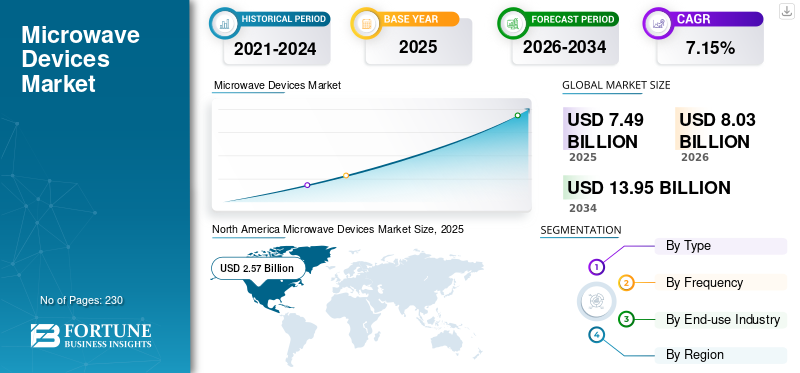
 Market Size & Forecast
- 2025 Market Size: USD 7.49 billion
- 2026 Market Size: USD 8.03 billion
- 2034 Forecast Market Size: USD 13.95 billion
- CAGR: 7.15% from 2026–2034
 Market Share
- North America dominated the microwave devices market with a 34.31% share in 2025.
- The active segment accounted for the largest market share in 2025.
- The telecommunication segment is projected to hold a 23.26% market share in 2026.
 Key Regional Highlights
North America
North America generated USD 2.57 billion in 2025 and is expected to reach USD 2.75 billion in 2026.
Europe
Europe is projected to grow steadily, driven by increasing demand from aerospace, defense, semiconductor, and healthcare industries.
Asia Pacific
Asia Pacific is expected to witness the fastest growth due to rising investments in telecommunications.
U.S.
The market is supported by defense modernization programs, 5G deployment, and growing investments in space exploration technologies.
Japan
Demand remains strong due to advanced manufacturing capabilities and the use of microwave devices in aerospace, defense, satellite communication, and automotive sensing applications.
Read More

RUSSIA-UKRAINE WAR IMPACT
Due to border conflicts, the ongoing war between Russia and Ukraine has led to a severe impact on the avionics and electronic industry around the world. These war crises around the globe, including Russia, launched of a large-scale invasion of Ukraine and the border dispute between China and India and have suddenly raised the demand for semiconductor devices for defense applications in countries such as India, the U.S., China, and Russia. Moreover, the ongoing war between Ukraine and Russia has totally disrupted the supply chain and distribution network for the defense and commercial aviation sectors.
Microwave devices are one of the major components of any avionics or electronic system. With the ongoing war, there is a supply chain disruption of raw materials. Ukraine is a provider of 70% neon gas. Lighting, vacuum tubes, high-voltage indicators, lightning arresters, wave meter tubes, television tubes, and helium-neon lasers are all examples of neon applications. Ukraine also supplies 90% semiconductor-grade neon to the U.S. The war will have a major impact on the market in the forthcoming years as it will take time to modify the supply chain and distribution network around the world.
MICROWAVE DEVICES MARKET TRENDS
Increase in Demand for 5G Network Services to Boost Market Growth
5G is widely regarded as a wireless product that will enable communication and networking devices to grow into a new set of applications, cases, and direct markets. It will contribute to driving autonomous vehicles by connecting them to millions of industrial sensors and network stations around the world. Over the last few years, microwave technology, such as E-Band, has become an essential part of 5G wireless backhaul support as E-Band enables the 5G network to make its presence around the world. Moreover, these microwave technology bands are low in cost and aid in less expensive microwave connections, which is considered a crucial factor in building 5G infrastructure in developing countries. North America witnessed microwave devices market growth from USD 1.90 billion in 2020 to USD 1.05 billion in 2021.
A prominent trend within the Microwave Devices Industry is the shift toward higher frequency bands. Applications increasingly utilize Ka-band and millimeter-wave ranges to support higher data rates and improved resolution. This transition drives demand for advanced materials and precision manufacturing techniques.
Miniaturization and integration also define current Microwave Devices Market Trends. System designers seek compact modules that combine multiple functions, reducing size, weight, and power consumption. Integrated microwave assemblies simplify system architecture while improving reliability.
Semiconductor innovation remains central. Gallium nitride and gallium arsenide technologies gain adoption due to superior power handling and efficiency. These materials enable higher operating temperatures and extended bandwidths, aligning with defense and space requirements. Another notable trend is increased emphasis on lifecycle reliability. End users prioritize components with predictable long-term performance and stable supply commitments. Vendors invest in qualification processes, redundancy, and lifecycle management to meet these expectations.
Digital control and monitoring capabilities are increasingly embedded within microwave systems. Smart calibration, adaptive tuning, and real-time diagnostics improve performance consistency and reduce maintenance costs. These trends collectively shape a Microwave Devices Market focused on performance optimization, integration, and operational assurance rather than commoditization.
Microwave devices will be an essential need for 5G network connections in urban, rural, and suburban areas around the world. For instance, 5G subscriptions reached 580 million by the end of 2021 and are continuously in demand due to the growing need for high-speed data and network services. Moreover, the growing demand for 5G services has led telecom operators to invest in and leverage innovative microwave technology with traditional frequencies in multi-band solutions to make 5G network connections available in all parts of the world.
Market Drivers
Increasing Demand for Medical Instruments Equipped with Microwave Devices to Boost Market Growth
There is rapid growth in the healthcare industry to increase the demand for medical equipment equipped with microwave technology, as these devices provide test results with a high degree of precision or accuracy. Microwave tomography, a form of medical imaging that uses microwave technology, is now widely used for detecting cancer. Microwaves play an important role in the fight against cancer, providing a new way to treat the disease. Microwave ablation is often used to remove unwanted tissue, for example, liver tumors, lungs, and prostate ablation, and to treat large tumors. In recent years, cancer has been the second-largest cause of death in the world.
According to the World Health Organization (WHO), cancer is one of the leading causes of death worldwide, accounting for nearly 10 million deaths in 2020. The increase in the number of cancer patients is due to the late detection of the disease. Therefore, the demand for cancer detection systems has greatly increased across the world as early diagnostic methods with suitable treatments improve the survival rates significantly.
Growing Need for Improved Communications Services to Aid Growth
Microwave devices use microwave data links to provide point-to-point communication, allowing the end-user to access precise information quickly and securely. As a result, microwave lines are used by the defense industry, space agencies, and a number of other national security agencies to transport classified information between their organizations. It also provides robust telecommunications protection, which benefits a wide range of space communications applications. The growing trend of space satellite launches to enhance space communication network services is driving the market growth in both developed and emerging countries. A state-of-the-art satellite communication system used by the U.S. Space Force is used to transmit secure information over the air, land, atmosphere, and shipping systems through microwave equipment.
Currently, operational U.S. satellite sensors, such as the Advanced Microwave Sounding Unit (AMSU) on one NASA satellite (Aqua) and four NOAA (15–18) satellites, and the special sensor microwave/imager (SSMI/S) on Department of Defense Satellite F-16, make use of this frequency range.
Rising demand for high-frequency communication infrastructure remains the strongest driver of the Microwave Devices Market. Global deployment of 5G networks requires microwave components for backhaul links, base stations, and spectrum management. Microwave devices enable reliable transmission across dense urban and remote environments where fiber deployment is constrained.
Defense modernization programs further strengthen demand. Radar upgrades, electronic countermeasure systems, and secure communication platforms rely heavily on microwave amplifiers, oscillators, and filters. Governments prioritize sensor accuracy, detection range, and signal integrity, sustaining long-term procurement cycles. These programs favor suppliers with proven reliability and compliance credentials.
Satellite communication growth also accelerates adoption. Low Earth orbit constellations and space-based broadband systems require microwave payloads optimized for power efficiency and thermal stability. Microwave devices support inter-satellite links, ground terminals, and tracking systems, expanding the market footprint.
Industrial automation and sensing applications contribute incremental growth. Microwave sensors enable material inspection, level measurement, and non-contact diagnostics across manufacturing and energy facilities. As industries digitize operations, demand for robust sensing technologies increases.
Healthcare applications add resilience to the demand mix. Medical imaging and therapeutic systems increasingly incorporate microwave technologies due to their precision and controllability. Together, these drivers reinforce a diversified and structurally sound Microwave Devices Market Growth trajectory.
Market Restraints
High Risk of Communication Jamming is a Major Challenge for the Market
The increased threat of communication jamming and congestion due to the changing nature of warfare is expected to limit the market growth. The worldwide radiation or magnetic field exposure to prevent the efficient use of the electromagnetic spectrum is known as electromagnetic (EM) jamming. It is a new form of electronic attack that is an integral part of the electric war. Electronic attack (EA) is a significant component of electronic warfare and refers to a range of technologies and tactics for attacking individuals, facilities, or equipment using electromagnetic energy or anti-radiation weaponry. EA is most typically employed to influence how an opponent uses the electromagnetic spectrum (EMS).
Electronic attack uses EM energy, direct energy, or anti-radiation weapons to confuse, disable, or destroy an enemy’s electronic systems. Weapons used for electronic attack leverage lasers, electro-optical, infrared, and RF/microwave technologies. With an increase in the adoption of microwave devices for military communication, the risk of communication jamming is also increasing. Moreover, the growing cyber threats and interruptions are one of the major factors hindering the market growth.
Despite strong fundamentals, the Microwave Devices Market faces several structural constraints. High development and manufacturing costs limit participation, particularly for advanced active microwave components. Precision fabrication, specialized materials, and rigorous testing raise capital requirements and extend product development cycles.
Supply chain complexity presents another restraint. Microwave devices depend on compound semiconductors, high-purity substrates, and specialized packaging processes. Disruptions in material availability or fabrication capacity can delay production schedules, affecting contract fulfillment, especially in defense and aerospace programs.
Design complexity also slows adoption among smaller system integrators. Microwave engineering requires specialized expertise in electromagnetic behavior, thermal management, and signal integrity. Skills shortages increase development costs and slow innovation timelines for downstream users.
Regulatory and compliance requirements introduce additional friction. Defense, aerospace, and medical applications demand extensive qualification, certification, and export control adherence. These requirements lengthen sales cycles and increase compliance costs, particularly for cross-border suppliers.
Market Opportunities
Emerging communication architectures present a substantial opportunity for the Microwave Devices Market. Expansion of satellite broadband, private 5G networks, and secure government communication systems creates demand for customized microwave solutions tailored to specific operational environments.
Defense spending patterns also open opportunities. Increased focus on unmanned systems, missile defense, and electronic warfare expands the scope for high-power and low-noise microwave components. Vendors offering application-specific designs gain a competitive advantage.
Healthcare technology development offers underpenetrated potential. Advances in microwave-based diagnostics and therapies support minimally invasive procedures and portable medical devices. Suppliers capable of meeting medical regulatory standards can diversify revenue streams beyond traditional defense and telecom markets.
Industrial sensing and automation represent another growth avenue. Microwave devices enable precise, non-contact measurement in harsh environments where optical or mechanical sensors underperform. As industrial digitalization accelerates, demand for reliable sensing solutions increases.
Geographic expansion into emerging markets also presents an opportunity. Infrastructure investment across Asia-Pacific, the Middle East, and Latin America supports new deployments of communication and defense systems. Vendors combining global reach with localized support structures are well-positioned to capture these incremental growth opportunities.
Download Free sample to learn more about this report.
SEGMENTATION ANALYSIS
The Microwave Devices Market exhibits distinct segmentation patterns shaped by performance requirements, operating environments, and application-specific constraints. Demand varies significantly across device types, frequency bands, and end-use industries, reflecting the technical diversity of microwave-enabled systems.
By Type Analysis
Active Segment to Dominate the Market Owing to Increased Demand for Telecom and Networking Services
Based on type, the market is bifurcated into active and passive. The active segment registered the largest market share in 2021. Active devices, such as transistors, amplifiers, oscillators, tubes, diodes, and integrated circuits, are widely used in electrical systems. This large share of active devices is due to the increasing development of advanced microwave systems used in various industries, such as telecommunications and networking. Microwave radio transmission is commonly used in point-to-point communication systems on the earth's surface, in satellite communications, and in deep space radio communications. Thus, this segment is expected to remain the largest component during the study period.
Active microwave devices generate, amplify, or control electromagnetic signals and represent a high-value segment of the Microwave Devices Market. These components include amplifiers, oscillators, transceivers, and power modules used in communication, radar, and electronic warfare systems. Their performance directly influences system range, resolution, and signal integrity.
Defense and aerospace applications dominate demand for active devices due to stringent power, reliability, and thermal requirements. Active components enable radar tracking accuracy, secure communication links, and missile guidance systems. In telecommunications, active devices support signal amplification in base stations and microwave backhaul networks.
Technological advances in compound semiconductors improve efficiency and power density, expanding active device adoption across higher frequency bands. However, development costs and qualification timelines remain significant, reinforcing supplier consolidation within this segment.
Passive microwave devices manage signal flow without amplification and include filters, couplers, attenuators, isolators, and waveguides. These components ensure signal purity, reduce interference, and maintain system stability across operating conditions.
Passive devices are essential across all microwave-enabled platforms due to their role in impedance matching, frequency selection, and noise reduction. Telecommunications networks rely on passive components to maintain signal quality, while defense systems use them to protect sensitive electronics.
This segment benefits from broader adoption due to lower cost relative to active devices and simpler manufacturing requirements. Continuous refinement focuses on miniaturization, improved material performance, and integration into compact assemblies. Passive devices contribute steadily to the Microwave Devices Market Size due to their universal applicability.
In addition, the passive segment is expected to grow at a significant annual growth rate between 2022-2029. Passive microwave passive devices are used in measuring instruments and to combine instruments to create more complex measurement systems. The growing demand for measuring devices with higher accuracy and precision is expected to boost the segment growth in the forthcoming years.
By Frequency Analysis
Rising Adoption of Ku-Band for Space and Defense Applications to Drive Segment Growth During 2022-2029
Based on frequency, the market is segmented into Ku-Band, Ka-Band, S-Band, C-Band, X-Band, L-Band, and others. The Ku-Band segment is projected to be the fastest-growing segment during the forecast period, owing to increasing satellite launches, and investment in space research & development activities is expected to drive the market growth. Moreover, the rising usage of Ku-Band systems and devices for defense applications is expected to fuel the market growth in the near future.
Ku-band microwave devices support satellite communication, radar, and broadcasting applications. Demand remains strong due to widespread use in satellite television, airborne radar, and maritime communication systems. Ku-band balances bandwidth availability with manageable atmospheric attenuation.
Ka-band represents one of the fastest-growing frequency segments within the Microwave Devices Market. Higher bandwidth availability enables increased data throughput, making Ka-band critical for satellite broadband, high-resolution radar, and advanced defense systems.
Adoption accelerates as operators deploy high-capacity satellite constellations and next-generation radar platforms. However, Ka-band systems require advanced materials and precise thermal management due to higher susceptibility to signal degradation. Vendors capable of addressing these challenges gain a competitive advantage.
Defense surveillance and commercial satellite operators sustain this segment. Manufacturers focus on enhancing efficiency and reducing size to support mobile platforms and compact terminals.
S-band devices serve weather radar, air traffic control, and maritime surveillance applications. Their resilience to atmospheric interference supports reliable operation across varied environmental conditions. Government agencies and aviation authorities sustain demand for S-band systems due to safety-critical requirements.
C-band microwave devices support satellite communication and radar systems where reliability and signal stability are prioritized. C-band remains valuable for applications in tropical and high-rainfall regions due to lower attenuation.
Telecommunication operators continue to deploy C-band infrastructure for regional connectivity, while defense programs use it for surveillance and tracking systems. Spectrum reallocation pressures introduce regulatory complexity, influencing long-term investment decisions.
X-band devices play a critical role in military radar, fire control systems, and space communication. Their balance between resolution and atmospheric performance makes them suitable for precision targeting and tracking applications.
Defense modernization programs drive sustained demand. Vendors prioritize ruggedization, thermal resilience, and low-noise performance to meet mission-critical specifications.
The L-Band segment held the largest market share in 2021. The dominance of the segment is due to the growing adoption of advanced L-Band microwave systems for Global Positioning Systems (GPS), radio, telecommunications, and aircraft surveillance applications.
Due to the rising usage of these bands for numerous applications, such as telecom, mobile phones, Bluetooth, GPS, radio communication, and space telemetry, the S-Band, X-Band, C-Band, and Ka-Band are expected to have a significant market share during the projected period.
By End-use Industry Analysis
To know how our report can help streamline your business, Speak to Analyst
Rising Demand for Telecommunication Services to Boost Segmental Growth
In terms of end-use industry, the market is segmented into telecommunication, space, defense, industrial, healthcare, and other applications. The telecommunication segment is projected to dominate the market with a share of 23.26% in 2026.
The telecommunication segment is estimated to be the largest segment in 2021. The dominance of the segment is attributed to the increasing adoption of point-to-point communication links, wireless networks, microwave radio relay networks, radar, satellite, and spacecraft communication systems. Thus, higher growth numbers are anticipated in the near future.
Telecommunication represents a major contributor to the Microwave Devices Market Share. Microwave devices enable wireless backhaul, base station connectivity, and spectrum management across urban and remote areas. Network densification and 5G deployment sustain long-term demand.
Operators prioritize components offering high efficiency, low latency, and operational reliability. Cost optimization pressures encourage modular designs and scalable manufacturing.
The space segment is projected to grow at the highest CAGR during the forecast period. Increasing satellite launches and investment in space research & development activities in developed and developing economies are anticipated to propel the market growth.
The space sector relies on microwave devices for satellite payloads, tracking systems, and inter-satellite communication. Demand increases with the expansion of commercial satellite constellations and government space programs.
Space-grade microwave components must meet strict radiation tolerance and thermal performance requirements. Vendors serving this segment invest heavily in qualification and long-term reliability.
Defense remains the most technically demanding end-use segment. Microwave devices support radar, electronic warfare, secure communication, and missile systems. Procurement cycles emphasize performance validation, redundancy, and lifecycle support. Geopolitical tensions and modernization initiatives sustain stable investment. Defense customers favor suppliers with proven compliance and domestic manufacturing capabilities.
Industrial applications include sensing, measurement, and process monitoring systems. Microwave devices enable non-contact measurement and material analysis in harsh environments. Growth remains incremental but stable as industrial automation expands. Reliability and maintenance efficiency drive purchasing decisions.
The healthcare segment is anticipated to witness significant growth due to the ongoing pandemic situation. Increased adoption of the product for cancer cell detection and treatment of major diseases is likely to drive significant growth in the healthcare sector.
Healthcare adoption grows as microwave devices support diagnostic imaging, therapeutic systems, and minimally invasive procedures. Medical manufacturers prioritize precision, safety, and regulatory compliance. This segment diversifies market exposure and introduces long-term growth potential, although adoption timelines remain cautious.
REGIONAL Analysis
North America Microwave Devices Market Size, 2025 (USD Billion)
To get more information on the regional analysis of this market, Download Free sample
North America Microwave Devices Market Analysis:
North America dominated the microwave devices market with a valuation of USD 2.57 billion in 2025 and USD 2.75 billion in 2026. The rise in the adoption of advanced communication systems in defense, aviation, and the industrial and commercial industries is expected to fuel the North America market growth. In addition, large defense spending and the presence of several key players in the U.S. are supporting the microwave devices market growth in North America.
North America holds a significant share of the Microwave Devices Market due to sustained defense spending, advanced telecommunications infrastructure, and space-sector investments. The region benefits from strong demand for radar, satellite communication, and electronic warfare systems. Government-backed research programs and early adoption of high-frequency technologies support continued innovation. Mature supply chains and domestic manufacturing capabilities strengthen regional competitiveness across both active and passive microwave device segments.
United States Microwave Devices Market:
The United States dominates the regional market through extensive defense modernization programs, 5G network expansion, and space exploration initiatives. Microwave devices are integral to radar systems, secure communications, and satellite payloads. Federal procurement standards emphasize reliability, lifecycle support, and domestic sourcing. Strong collaboration between defense contractors, semiconductor firms, and research institutions reinforces the United States’ leadership within the global Microwave Devices Market.
Europe Microwave Devices Market Analysis:
The European market is projected to grow moderately during the forecast period. Increasing automotive, semiconductor, manufacturing, and healthcare industries in Germany, the U.K., and France are expected to drive the market growth in Europe.
Europe demonstrates steady growth driven by aerospace programs, defense cooperation initiatives, and expanding satellite infrastructure. Regional demand emphasizes high-performance microwave components for radar, navigation, and secure communication. Regulatory alignment across European Union member states supports cross-border collaboration. Investments in next-generation radar and space systems sustain long-term demand, while industrial automation contributes incremental growth across civilian applications.
Germany Microwave Devices Market:
Germany represents a key European market supported by strong industrial manufacturing, defense procurement, and research-driven innovation. Microwave devices are widely used in radar systems, automotive sensing, and industrial measurement applications. German buyers prioritize precision engineering, durability, and compliance with stringent quality standards. The country’s emphasis on advanced manufacturing and export-oriented electronics strengthens its role within the broader European Microwave Devices Market.
United Kingdom Microwave Devices Market:
The United Kingdom maintains a consistent demand for microwave devices through defense modernization, aerospace programs, and satellite communication initiatives. Government-backed investments in radar, electronic warfare, and space technologies support the adoption of advanced microwave components. Collaboration between defense contractors, universities, and technology firms accelerates innovation. The UK market emphasizes high-frequency performance, system integration capability, and long-term supplier reliability.
Asia-Pacific Microwave Devices Market Analysis:
Asia Pacific is expected to grow at the quickest rate in the market. This increase can be ascribed to increased government spending on communication and networking services in China, Japan, India, and Australia, which is anticipated to foster the market growth during 2022- 2029. In addition, the growing aerospace and defense industries in the region support the market growth during the forecast period.
Asia-Pacific exhibits strong growth potential driven by expanding telecommunications infrastructure, rising defense budgets, and increasing satellite deployment. Countries across the region invest heavily in radar systems, 5G backhaul, and space programs. Manufacturing scale and cost efficiency support competitive production. Demand spans both commercial and defense sectors, positioning Asia-Pacific as a key contributor to future Microwave Devices Market expansion.
Japan Microwave Devices Market:
Japan’s market reflects advanced technological capability and precision manufacturing. Microwave devices support aerospace, defense radar, satellite communication, and automotive sensing applications. Japanese buyers emphasize reliability, miniaturization, and energy efficiency. Strong collaboration between electronics manufacturers and research institutions fosters continuous innovation. As space and defense programs evolve, demand for high-performance microwave components remains stable and strategically important.
China Microwave Devices Market:
China demonstrates rapid growth driven by telecommunications expansion, defense modernization, and aggressive space-sector investment. Microwave devices are critical to radar systems, satellite payloads, and network infrastructure. Domestic production capabilities reduce reliance on imports, while state-backed programs accelerate technology development. Increasing focus on high-frequency bands and integrated systems positions China as a major force in the global Microwave Devices Market.
Latin America Microwave Devices Market Analysis:
Latin America shows gradual adoption supported by telecommunications upgrades, satellite connectivity projects, and selective defense investments. Microwave devices enable wireless backhaul in remote regions and support border surveillance initiatives. Budget constraints influence procurement cycles, favoring cost-effective and modular solutions. As digital infrastructure expands, demand for reliable microwave components is expected to increase steadily across selected markets.
Middle East & Africa Microwave Devices Market Analysis
The Middle East & Africa market grows through defense procurement, satellite communication needs, and infrastructure development. Microwave devices support radar, surveillance, and secure communication systems. Regional demand emphasizes ruggedized solutions capable of operating in harsh environments. Government-led investments and strategic partnerships drive adoption, particularly in defense and aerospace applications.
Competitive Landscape
Key Players are Focusing on Providing Cost-efficient and Pocket-sized Products
The industry is highly fragmented, with companies such as Analog Devices Inc., Teledyne Technologies Incorporated, Thales Group, Communications & Power Industries LLC, L3Harris Technologies, Inc., and Qorvo Inc., among the leading participants. These companies concentrate on developing low-cost, small-scale microwave devices for use in the space, communication, commercial, and defense industries. In addition, corporations are focusing on expanding their capabilities and maintaining their market position through R&D investment, smart acquisitions, and collaborations. For instance, in August 2021, Analog Devices Inc. announced the acquisition of Maxim Integrated Products Inc. The acquisition was carried out for USD 20.8 billion. This acquisition will strengthen Analog’s market position as a high-performance semiconductor organization.
The Microwave Devices Market features a competitive landscape defined by established defense electronics firms, semiconductor specialists, and niche component manufacturers. Leading vendors focus on delivering high-performance active and passive microwave components tailored for defense, aerospace, and telecommunications applications. Their portfolios emphasize power efficiency, thermal management, and reliability across multiple frequency bands.
Large multinational suppliers leverage vertically integrated manufacturing, proprietary semiconductor processes, and long-standing defense relationships. These firms benefit from scale, certification expertise, and the ability to support long product lifecycles required by military and space customers. Continuous investment in gallium nitride and gallium arsenide technologies strengthens their competitive positioning.
Niche players occupy specialized segments such as millimeter-wave components, custom waveguides, and application-specific modules. These companies differentiate through design flexibility, rapid prototyping, and responsiveness to evolving technical requirements. Their agility allows them to serve research institutions, emerging satellite operators, and industrial customers with tailored solutions.
Strategic partnerships play a critical role in shaping competition. Semiconductor manufacturers collaborate with defense contractors to co-develop next-generation radar and communication systems. Joint ventures between microwave component suppliers and satellite integrators accelerate the deployment of high-frequency payloads. Academic and government research partnerships further support innovation and workforce development.
List of Top Microwave Devices Companies:
- Analog Devices Inc. (U.S.)
- Communications & Power Industries LLC (U.S.)
- General Dynamics Corporation (U.S.)
- Kratos Defense & Security Solutions, Inc. (U.S.)
- L3Harris Technologies, Inc. (U.S.)
- MACOM Technology Solutions Inc. (U.S.)
- Microsemi Corporation (U.S)
- Microwave Technology, Inc. (U.K.)
- Qorvo Inc. (U.S.)
- Richardson Electronics, Ltd. (U.S.)
- Teledyne Technologies Incorporated (U.S.)
- Thales Group (France)
- TMD Technologies Ltd (U.K.)
- Toshiba Corporation (Japan)
- Cytec Corporation (U.S.)
Microwave Devices Industry Key Developments
- March 2025: Northrop Grumman expanded its microwave component manufacturing capacity to support next-generation radar and electronic warfare systems, focusing on high-power gallium nitride amplifiers and advanced thermal management architectures.
- November 2024: Qorvo introduced a new Ka-band microwave module portfolio designed to improve efficiency and signal integrity for satellite communication payloads, targeting high-throughput satellite and spaceborne radar applications.
- September 2024: Raytheon Technologies advanced integrated microwave assemblies for air and missile defense systems, aiming to reduce system weight while enhancing frequency agility and electronic protection capabilities.
- June 2024: NXP Semiconductors launched industrial-grade microwave transceivers optimized for sensing and measurement applications, integrating improved noise performance and extended operating temperature ranges.
- February 2024: Mitsubishi Electric strengthened its microwave device roadmap by expanding development of X-band and Ku-band components for defense radar and space communication platforms, emphasizing reliability and long-term supply continuity.
MICROWAVE DEVICES MARKET REPORT COVERAGE
The global microwave devices market research report offers detailed research of the industry. It maps essential topics such as R&D capabilities and manufacturing process optimization. Moreover, this research report provides information about new market trends as well as key industrial developments. In addition to the elements mentioned above, the study focuses on a number of other aspects that have aided the developed market's rise in recent years.
Request for Customization to gain extensive market insights.
Report Scope & Segmentation
|
ATTRIBUTE |
DETAILS |
|
Study Period |
2021-2034 |
|
Base Year |
2025 |
|
Estimated Year |
2026 |
|
Forecast Period |
2026-2034 |
|
Historical Period |
2021-2024 |
|
Unit |
Value (USD Billion) |
|
Segmentation |
By Type, Frequency, End-use Industry, and Geography |
|
By Type
|
|
|
By Frequency
|
|
|
By End-use Industry
|
|
|
By Geography
|
Frequently Asked Questions
Fortune Business Insights says that the global market size was estimated at USD 7.49 billion in 2025 and is projected to reach USD 8.03 billion in 2026 to USD 13.95 billion by 2034, growing at a CAGR of 7.15% from 2026 to 2034.
The market will exhibit a CAGR of 7.15% during the forecast period.
The active segment is the leading type segment in the market.
Teledyne Technologies Incorporated, Thales Group, and L3Harris Technologies, Inc. are the leading players in the global market.
North America dominated the market in terms of share in 2025.



- 2021-2034
- 2025
- 2021-2024
- 230
Get 30-60 hrs Free Customization
Expand Regional and Country Coverage, Segments Analysis, Company Profiles, Competitive Benchmarking, and End-user Insights.




















Related Reports
-
US +1 833 909 2966 ( Toll Free )
-
Get In Touch With Us