Motorcycle Exhaust System Market Size, Share & Industry Analysis, By Motorcycle Type (Standard, Sports, Cruiser, Touring, and Others), By Component Type (Muffler/Silencer, Exhaust Pipe/Header, and Catalytic Converter), By Engine Capacity (Below 250cc, 250cc-500cc, and Above 500cc), By Technology (Conventional Exhaust System and Emission-Control Exhaust System), By Sales Channel (OEM and Aftermarket), and Regional Forecast, 2026-2034
 Download Free Sample
(Offer valid till 30th Sep 2026)

Motorcycle Exhaust System Market Size and Future Outlook
 Listen to Audio Version
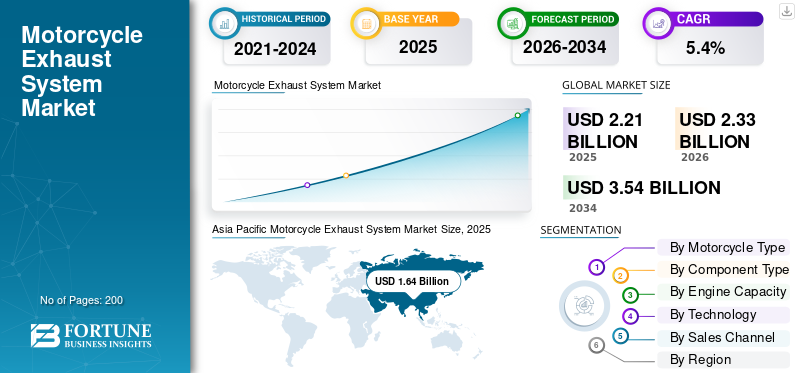
The global motorcycle exhaust system market size was valued at USD 2.21 billion in 2025 and is projected to grow from USD 2.33 billion in 2026 to USD 3.54 billion by 2034, exhibiting a CAGR of 5.4% during the forecast period. Asia Pacific dominated the motorcycle exhaust system market with a market share of 74.21% in 2025.
The global motorcycle exhaust system market represents the industry that designs, manufactures, and supplies exhaust assemblies used in internal combustion motorcycles. These systems collect exhaust gases, reduce noise, support emission control, and improve engine performance by managing back pressure and gas flow. These systems include mufflers, silencers, exhaust pipes, headers, catalytic converters, brackets, clamps, gaskets, and slip on exhaust systems used in both factory-fitted and replacement applications.
The market is closely linked to motorcycle production, active vehicle parc, replacement demand, emission rules, and rider preference for sound, appearance, and performance. In commuter-heavy regions such as Asia Pacific, South America, and the Middle East and Africa, exhaust systems are mainly used for standard motorcycles, scooters, underbone motorcycles, and delivery-use two-wheelers. In mature markets, demand is also supported by rise in sports motorcycles, cruisers, touring motorcycles, and performance upgrades.
The industry will evolve through two directions during the forecast period. Firstly, through low-cost conventional systems which will remain vital as standard motorcycles dominate the global fleet. Secondly, emission-control systems will gain value as catalytic converters, oxygen-sensor fittings, and compliant exhaust routing become more common. Lightweight systems, including stainless steel, carbon fiber, and titanium based products, will also gain demand in premium and racing applications.
Applications include OEM motorcycle production, accident replacement, corrosion repair, sound control, emission compliance, racing, touring, off-road use, and customization through single exhaust system and dual exhaust system configurations.
Key players such as Akrapovič d.d., Arrow Special Parts S.p.A., and SC-Project are expanding their systems offering, launching lighter products, and strengthening distribution to capture increased demand and improve the exhaust system market size.
Download Free sample to learn more about this report.
MOTORCYCLE EXHAUST SYSTEM MARKET TRENDS
Lightweight Performance Exhausts Gain Momentum in Premium Motorcycles
A clear trend in the market is the usage of lightweight exhaust systems for premium, touring, racing, and sports motorcycles. Riders are choosing titanium based, carbon-fiber, and stainless-steel systems to reduce weight, improve styling, and support engine performance. This trend is stronger in aftermarket channels, where customers willingly pay more for sound, appearance, and performance gains from single exhaust system and dual exhaust system designs.
- For instance, in 2026, Akrapovič’s Yamaha Tracer 9 GT/GT+ exhaust used carbon fiber, stainless steel, and titanium, reducing weight by 31% versus stock.
MARKET DYNAMICS
MARKET DRIVERS
Download Free sample to learn more about this report.
Rising ICE Motorcycle Use and Replacement Demand to Strengthen Market Progress
The global motorcycle exhaust system market growth is driven by high ICE two-wheeler sales and replacement demand. Standard motorcycles remain essential for commuting, delivery, and affordable transport, especially in Asia Pacific, South America, and the Middle East and Africa. As motorcycles age, mufflers, pipes, clamps, and catalytic sections require replacement, supporting steady market growth across OEM and aftermarket channels.
MARKET RESTRAINTS
Electric Two-Wheeler Adoption Reduces Exhaust Systems Demand in Urban Markets
Electric two-wheelers adoption may restrain the market as they do not require mufflers, headers, catalytic converters, or exhaust gases treatment systems. This affects small scooters and urban commuter motorcycles first, especially in China, Europe, India, and parts of Southeast Asia. The impact is gradual, but it reduces long-term demand for conventional systems and limits growth in low-displacement market segment categories.
- For instance, in May 2025, IEA reported electric two- and three-wheelers were the most electrified road transport segment, with over 9% of the global fleet electric in 2024.
MARKET OPPORTUNITIES
Emission-Compliant Exhausts to Create Higher-Value Growth Opportunities
Stricter emission rules create opportunities for emission-control exhaust systems. New motorcycles increasingly need catalytic converters, oxygen-sensor fittings, and compliant exhaust layouts. This improves the value of each system, especially in Europe, North America, India, China, and Japan. Suppliers that can provide cost-effective, regulation-ready, and durable systems will benefit from higher OEM demand and regulated aftermarket replacement.
- For instance, in January 2025, Europe fully moved to Euro 5+ motorcycle requirements, lifting the need for compliant exhaust and emission-control technologies.
MARKET CHALLENGES
Tariffs, Inflation, and Metal Costs Pressure Faced By Exhaust Manufacturers to Restrain Market Growth
The market faces challenges from inflation, tariffs, freight costs, and volatile prices of steel, aluminum, titanium, and catalyst materials. Exhaust manufacturers often depend on imported metals, sensors, substrates, and finished parts. When trade barriers rise, suppliers face higher costs, longer lead times, and weaker margins. This can make replacement products expensive and slow market growth, especially in price-sensitive regions.
Segmentation Analysis
By Motorcycle Type
Standard Motorcycles Dominate Due to High Commuting Use
On the basis of motorcycle type, the market is segmented into standard, sports, cruiser, touring and others.
Standard motorcycles dominate the global motorcycle exhaust system market share as they are widely used for daily transport, delivery, and low-cost mobility. Their large installed base creates strong OEM and aftermarket exhaust demand. This market segment is especially strong in India, Indonesia, Vietnam, Brazil, Mexico, and Africa, where affordable motorcycles remain more practical than cars.
The sports segment is expected to grow at a CAGR of 5.2% over the forecast period.
To know how our report can help streamline your business, Speak to Analyst
By Component Type
Muffler/Silencer Leads As Frequent Demand Arises from OEM Fitment, Corrosion, and Aftermarket Upgrades
On the basis of component type, the market is segmented into muffler/silencer, exhaust pipe/header, and catalytic converter.
Muffler/silencer dominates as it is the most visible and commonly replaced exhaust component. It supports sound control, appearance, and basic gas flow. Demand comes from OEM fitment, accident repairs, corrosion, aftermarket upgrades, and slip on exhaust systems. This segment is large in commuter-heavy regions and premium markets where riders are looking to upgrade sound and styling.
- For instance, in 2025, Yoshimura listed new exhaust products across street, racing, dual-sport, adventure, off-road, ATV, and UTV applications.
The catalytic converter segment is expected to grow at a CAGR of 5.9% over the forecast period.
By Engine Capacity
Below 250cc Governs Due to Usage of Low-Displacement Models
On the basis of engine capacity, the market is segmented into below 250cc, 250cc-500cc, and above 500cc.
Below 250cc dominates as majority ICE motorcycles sold globally are low-displacement models used for commuting, delivery, and daily mobility, including scooters and underbone motorcycles. These vehicles use simpler and more affordable exhaust systems. They have a very high number of sales volume. Asia Pacific, south America, and the Middle East & Africa are the key hubs for demand.
The 250cc-500cc segment is expected to grow at a CAGR of 5.7% over the forecast period.
By Technology
Conventional Exhaust Systems Takes the Lead in as Global Fleets Still Have Standard Motorcycles And Low-Displacement Two-Wheelers
On the basis of technology, the market is segmented into conventional exhaust system and emission-control exhaust system.
Conventional exhaust systems dominate as the global fleet is still being led by standard motorcycles and low-displacement two-wheelers. These systems mainly manage exhaust gases, noise, and basic engine operation at affordable cost. Although emission-control systems are growing faster, the demand for conventional systems remain higher due to high volumes in Asia Pacific and emerging MEA markets.
The emission-control exhaust system segment is expected to grow at a CAGR of 6.3% over the forecast period.
By Sales Channel
OEM is the Favored Sales Channel Owing to High Volumes of Production and Sales of ICE Motorcycles
On the basis of sales channel, the market is segmented into OEM and aftermarket.
OEM dominates as every new ICE motorcycle requires a factory-fitted exhaust system. Large production and sales of ICE motorcycles in India, Indonesia, Brazil, China, Thailand, and Vietnam in high volumes keep the demand for OEM strong. The channel also benefits from emission rules as manufacturers are required to install compliant systems before the sale. Aftermarket remains important, but OEM captures the first-fit system value.
- For instance, in January 2025, Brazil motorcycle production was projected at 1.88 million units for 2025, supporting strong OEM exhaust fitment demand.
The aftermarket segment is expected to grow at a CAGR of 5.3% over the forecast period.
Motorcycle Exhaust System Market Regional Outlook
By geography, the market is categorized into North America, Europe, Asia Pacific, South America, and Middle East & Africa.
Asia Pacific
Asia Pacific Motorcycle Exhaust System Market Size, 2025 (USD Billion)
To get more information on the regional analysis of this market, Download Free sample
Asia Pacific held the dominant share in 2025, valuing at USD 1.64 billion, and also maintained the leading share in 2024, with USD 1.56 billion. Asia Pacific dominates the global market owing to its largest ICE two-wheeler production and active motorcycle fleet. India, China, Indonesia, Thailand, Vietnam, and Japan support OEM demand, replacement demand, and emission-compliant systems. The region also has high standard motorcycle use, strong demand for below-250cc, and affordable aftermarket replacement. Growing demand for premium motorcycles for sports, performance exhausts, and titanium based systems are also expected to boost the regional market growth.
China Motorcycle Exhaust System Market
China’s market is projected to be one of the largest, with 2025 revenues reaching around USD 0.42 billion, representing roughly 18.8% of global market.
India Motorcycle Exhaust System Market
India market in 2025 was valued at around USD 0.61 billion, accounting for roughly 27.4% of global market revenues.
Europe
Europe is estimated to reach USD 0.17 billion in 2026 and secure the position of the second-largest region in the market. Europe is set to grow slowly but steadily, supported by Euro 5+ systems, premium motorcycles, touring bikes, and replacement demand. Emission-control exhausts will gain share, while conventional scooter exhausts face electric substitution. Italy, Germany, Spain, France, and the U.K. remain the main demand hubs.
Germany Motorcycle Exhaust System Market
Germany market in 2025 was at around USD 0.03 billion, accounting for roughly 1.5% of global market revenues.
Italy Motorcycle Exhaust System Market
Italy market in 2025 touched around USD 0.05 billion, accounting for roughly 2.2% of global market revenues.
North America
North America is projected to record a growth rate of 4.3% in the coming years, and reach a valuation of USD 0.16 billion by 2026. North America will grow through aftermarket replacement, cruiser exhaust upgrades, touring motorcycles, and Mexico’s commuter motorcycle expansion. The U.S. market is more value-driven than volume-driven as riders buy premium mufflers, dual exhaust system kits, and performance products. EPA rules also support compliant exhaust demand, while tariffs and inflation affect imported components.
U.S. Motorcycle Exhaust System Market
U.S. market in 2025 is was valued around at USD 0.10 billion in 2025, representing roughly 4.6% of global market.
Middle East & Africa
The Middle East and Africa market is set to progress through low-cost mobility, delivery fleets, taxi motorcycles, and replacement demand. UAE and South Africa support higher-value systems, while the rest of the countries in the region remain utility-led. Import dependence, shipping disruption, tariffs, and currency pressure remain some factors slowing the regional market growth.
South America
South America is expected to grow through motorcycle production in Brazil, commuter mobility, delivery use, and aftermarket repairs. Below-250cc motorcycles dominate in the region with mid-capacity models rising gradually. Inflation, interest rates, and currency weakness affect affordability, while local production helps sustain OEM exhaust demand.
COMPETITIVE LANDSCAPE
Key Industry Players
Product Innovation and Aftermarket Reach By Prominent Players to Shape Market Competition
The competitive landscape of the global motorcycle exhaust system market is moderately fragmented, with global premium brands, regional suppliers, and OEM-linked manufacturers competing across different price levels. Premium companies such as Akrapovič, Yoshimura, SC-Project, arrow special parts, Vance & Hines, FMF Racing, and Cobra USA compete through performance, lightweight design, racing heritage, homologation, and brand trust. Mass-market suppliers focus more on durability, cost efficiency, emission compliance, and long-term OEM relationships.
Key players are using several strategies to gain competitive advantage. They are launching lighter exhausts made from titanium, stainless steel, aluminum, and carbon fiber to improve engine performance and reduce motorcycle weight. The companies are also expanding slip on exhaust systems, full systems, and catalyst-compatible products for different motorcycles, including commuters, scooters, sports motorcycles, touring bikes, and off-road models. Furthermore, they are investing in motorsport partnerships as racing exposure improves brand credibility and supports premium pricing. Lastly, manufacturers are widening dealer and e-commerce networks to serve the aftermarket more rapidly.
Competition also differs by market segment. OEM suppliers compete based on cost, quality, compliance, and delivery reliability. Aftermarket players compete based on sound, design, weight saving, power gain, easy installation, and brand loyalty. In Europe and North America, compliance with road-usage rules is a major differentiator. In Asia Pacific and South America, affordable replacement systems and broad model coverage are more important.
Well-established companies combine product engineering, emission knowledge, brand recognition, and global distribution. This gives buyers better market insights into quality, fitment, and long-term durability.
LIST OF KEY MOTORCYCLE EXHAUST SYSTEM COMPANIES PROFILED
- Akrapovič d.d. (Slovenia)
- Arrow Special Parts S.p.A. (Italy)
- SC-Project (Italy)
- Graves Motorsports (U.S.)
- Yoshimura Group (Japan)
- Vance & Hines (U.S.)
- FMF Racing (U.S.)
- Sito Gruppo Industriale S.p.A. (Italy)
- MIVV S.p.A. (Italy)
- Termignoni S.p.A. (Italy)
- Two Brothers Racing (U.S.)
- Cobra Engineering, Inc. (U.S.)
- REMUS Innovation GmbH (Austria)
- GPR Exhaust Systems (Italy)
- IXIL Exhaust (Spain)
KEY INDUSTRY DEVELOPMENTS
- July 2025: SC-Project introduced a stainless-steel full exhaust system for the Yamaha MT-07 2025-2026. The company states the system cuts weight by over 70% versus the OEM exhaust and increases output.
- April 2025: Pro Circuit announced that its 2025 Kawasaki KX250 exhaust systems were arriving soon. The range included Ti-6 Pro Titanium, Ti-6 Titanium, T-6, and T-6 Slip-On systems for motocross riders.
- March 2025: Harley-Davidson introduced the limited-production CVO Road Glide RR, featuring an Akrapovič-designed full titanium 2-into-1 exhaust system. The exhaust includes titanium headers, titanium muffler shells, and carbon-fiber heat shields, helping reduce weight and support the bike’s performance-focused design for premium touring and high-output bagger customers.
- March 2025: Akrapovič announced a partnership with ARCH Motorcycle to develop and produce exhaust systems for ARCH models, beginning with the KRGT-1 performance cruiser. The collaboration focuses on high-end exhaust engineering, premium materials, sound tuning, and performance-oriented design for ARCH’s hand-built motorcycles, strengthening Akrapovič’s presence in the luxury cruiser segment.
- November 2024: SC-Project highlighted its exhaust role in Aprilia’s lineup at EICMA. The Aprilia Tuareg 660 Rally came with a Rally Raid titanium silencer, while RS660 and Tuono 660 received Euro 5+ compliant full exhaust systems.
REPORT COVERAGE
The global motorcycle exhaust system market analysis provides an in-depth study of market size & forecast by all the market segments included in the report. It includes details on the market dynamics and market trends expected to drive the market in the forecast period. It offers information on the technological advancements, new product launches, key industry developments, and details on partnerships, mergers & acquisitions. The research report also encompasses detailed competitive landscape with information on the market share and profiles of key operating players.
Request for Customization to gain extensive market insights.
Report Scope & Segmentation
| ATTRIBUTE | DETAILS |
| Study Period | 2021-2034 |
| Base Year | 2025 |
| Estimated Year | 2026 |
| Forecast Period | 2026-2034 |
| Historical Period | 2021-2024 |
| Growth Rate | CAGR of 5.4% from 2026-2034 |
| Unit | Value (USD Billion) |
| Segmentation | By Motorcycle Type, Component Type, Engine Capacity, Technology, Sales Channel, and Region |
| By Motorcycle Type |
|
| By Component Type |
|
| By Engine Capacity |
|
| By Technology |
|
| By Sales Channel |
|
| By Region |
|
Frequently Asked Questions
Fortune Business Insights says that the global market value stood at USD 2.21 billion in 2025 and is projected to reach USD 3.54 billion by 2034.
In 2025, the market value stood at USD 1.64 billion.
The market is expected to exhibit a CAGR of 5.4% during the forecast period.
Standard segment led the market by motorcycle type.
Rising ICE motorcycle use and replacement demand is driving the global market.
Akrapovič d.d., SC-Project, Arrow Special Parts, and Yoshimura are some of the top players in the market.
Asia Pacific dominated the market in 2025.



- 2021-2034
- 2025
- 2021-2024
- 200
-
(Offer valid till 30th Sep 2026)
Get 30-60 hrs Free Customization
Expand Regional and Country Coverage, Segments Analysis, Company Profiles, Competitive Benchmarking, and End-user Insights.




















Related Reports
-
US +1 833 909 2966 ( Toll Free )
-
Get In Touch With Us