Nonionic Surfactants Market Size, Share & Industry Analysis, By Type (Alcohol Ethoxylates, Fatty Alkanolamides, Amine Derivatives, Glycerol Derivatives, and Others), By Application (Home Care & Detergents, Personal Care & Cosmetics, Industrial & Institutional Cleaning, Agrochemicals, and Others), and Regional Forecast, 2026-2034
 Download Free Sample
Nonionic Surfactants Market Size and Future Outlook
 Listen to Audio Version
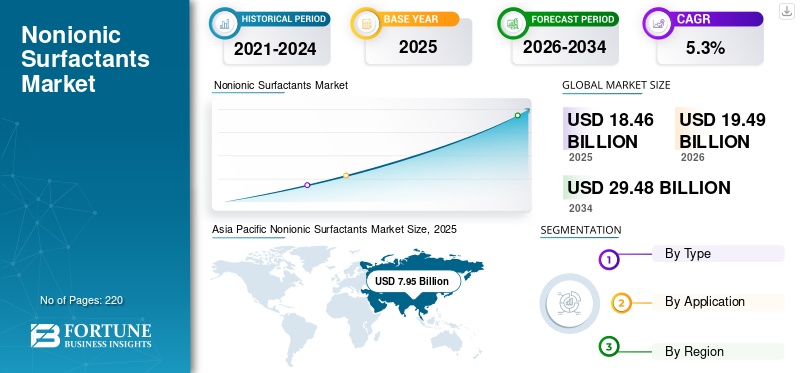
The global nonionic surfactants market size was valued at USD 18.46 billion in 2025 and is projected to grow from USD 19.49 billion in 2026 to USD 29.48 billion by 2034, exhibiting a CAGR of 5.3% during the forecast period. Asia Pacific dominated the nonionic surfactants market with a market share of 43.06% in 2025.
The nonionic surfactants market includes a broad range of surface-active agents used across multiple industrial and consumer applications, including household cleaning, personal care, textiles, agrochemicals, pharmaceuticals, and industrial processing. This market covers key products such as alcohol ethoxylates, fatty amine ethoxylates, alkylphenol ethoxylates, and other nonionic surfactants valued for their emulsifying, wetting, dispersing, and detergency performance. The market is increasingly influenced by demand for mild, versatile, and high-performance bio-based surfactants that support formulation stability, cleaning efficiency, and compatibility with different ingredients. The growing preference for effective cleaning systems, wider use in personal care and industrial formulations, and rising demand for multifunctional surfactant solutions are driving market growth.
The market is led by several key players, including BASF, Dow, Nouryon, Sasol Limited, and Stepan Company. Strong surfactant production capabilities, reliable access to raw materials, established global supply networks, and close alignmeant with demand across household cleaning, personal care, industrial processing, textiles, and other end-use sectors support their competitive position.
Download Free sample to learn more about this report.
Nonionic Surfactants Market KEY TAKEAWAYS
 Global Market Size & Forecast
- 2025 Market Size: USD 18.46 billion
- 2026 Market Size: USD 19.49 billion
- 2034 Forecast Market Size: USD 29.48 billion
- CAGR: 5.3% during 2026–2034
 Market Share
- Asia Pacific dominated the global market with a 43.06% share in 2025.
- Alcohol Ethoxylates held the largest share of the market in 2025.
- Home Care & Detergents held the largest application share in 2025.
 Key Regional Highlights
Asia Pacific
The market was valued at USD 7.95 billion in 2025, increasing from USD 7.48 billion in 2024.
Europe
The market is projected to reach USD 4.38 billion in 2026, supported by demand from home care and detergents.
North America
The region remains an established market, supported by demand for nonionic surfactants across home care.
U.S.
The U.S. market is estimated at USD 3.61 billion in 2026.
Japan
The Japanese market is estimated at USD 1.27 billion in 2026.
Read More

NONIONIC SURFACTANTS MARKET TRENDS
Growing Demand for Mild and Multifunctional Surfactants in Consumer and Industrial Formulations is a Key Market Trend
One of the key trends in the market is the growing shift toward mild, multifunctional surfactants across consumer and industrial formulations. End users are increasingly seeking ingredients that deliver effective cleaning, emulsification, wetting, and dispersing performance while also offering better compatibility with other formulation components. As a result, suppliers are expanding and developing nonionic surfactant offerings for household cleaning, personal care, textiles, agrochemicals, and industrial applications where formulation flexibility and performance are becoming more important. At the same time, the market is moving toward higher-value, performance-focused applications where mildness, stability, and formulation efficiency are becoming increasingly important.
- According to ScienceDirect, non-ionic surfactants generally have lower irritancy potential than ionic surfactants and are widely used for wetting, emulsifying, and foaming, reflecting the trend toward mild, multifunctional surfactant systems.
MARKET DYNAMICS
MARKET DRIVERS
Download Free sample to learn more about this report.
Rising Demand from Household Cleaning Applications Supports Market Growth
The primary driver of the nonionic surfactants market growth is the rising demand from household cleaning applications, where these surfactants play an essential role in detergents, surface cleaners, dishwashing products, and other cleaning formulations. The products are widely used in this segment as they provide strong cleaning performance, effective grease removal, and good compatibility with other formulation ingredients. An additional layer of support comes from the continued demand for high-performance cleaning products and the growing importance of versatile surfactants that enhance both formulation efficiency and end-use effectiveness.
- According to the U.S. EPA, nonylphenol ethoxylates are non-ionic surfactants used in a wide variety of consumer products, including laundry detergents, reflecting the importance of non-ionic surfactants in household cleaning applications.
MARKET RESTRAINTS
Raw Material Dependence and Cost Sensitivity Restrain Market Growth
The market faces a key restraint due to its dependence on petroleum-based and oleochemical raw materials, which can affect production economics and pricing stability. Since the products are widely used in household cleaning, personal care, textiles, agrochemicals, and industrial formulations, fluctuations in input costs can directly influence manufacturing expenses and product affordability. This creates pressure for producers to maintain both performance and competitive pricing across large-volume applications. As a result, cost sensitivity and raw material dependence can restrain broader market growth, especially in price-driven end-use segments.
- According to the U.S. EPA, nonylphenol ethoxylates (NPEs), a class of non-ionic surfactants, can degrade into nonylphenol, which is toxic to aquatic organisms, reflecting the regulatory pressure that can restrain broader market growth.
MARKET OPPORTUNITIES
Rising Demand from Personal Care Applications is Creating Market Growth Opportunities
One key market opportunity is the rising demand from the personal care industry. Products such as shampoos, body washes, facial cleansers, creams, and lotions are increasingly valued for their mild cleansing, emulsification, and formulation stability. As personal care manufacturers continue to focus on gentle ingredients, better skin compatibility, and improved product performance, the use of these products is becoming increasingly important. Another area of opportunity lies in the growing need for versatile surfactants that support both cleansing efficiency and smooth formulation performance across a wide range of personal care products.
- According to the Cosmetic Ingredient Review (CIR), ingredients such as decyl glucoside and other alkyl glucosides function in cosmetic formulations as surfactants, skin-conditioning agents, hair-conditioning agents, or emulsion stabilizers, underscoring the growing role of non-ionic surfactants in personal care applications.
MARKET CHALLENGES
Feedstock Supply Dependence and Price Volatility Challenge Market Growth
The market faces a key challenge due to its reliance on stable feedstock availability and the difficulty of maintaining cost-effective supply for large-volume end-use applications. Since nonionic surfactants are produced from petrochemical- and oleochemical-based raw materials and are used in household cleaning, personal care, textiles, agrochemicals, and industrial formulations, changes in feedstock prices and supply conditions can affect overall competitiveness and production planning. The challenge becomes more significant when buyers require stable pricing, large commercial volumes, and dependable delivery across multiple downstream applications. In many cases, producers need stronger sourcing strategies, better cost control, and more flexible production planning to meet market expectations.
- According to ScienceDirect, conventional surfactants are generally manufactured using petrochemical feedstock or a combination of renewable and petrochemical feedstocks, reflecting the feedstock dependence that challenges the market.
Segmentation Analysis
By Type
Alcohol Ethoxylates Lead Market Due to Their Broad Use in Cleaning and Industrial Formulations
Based on type, the market is segmented into alcohol ethoxylates, fatty alkanolamides, amine derivatives, glycerol derivatives, and others.
The alcohol ethoxylates segment holds the largest nonionic surfactants market share due to its broad use, strong commercial availability, and wide applicability across multiple end-use sectors. Alcohol ethoxylates are widely preferred as they provide effective detergency, wetting, emulsification, and grease removal in household cleaning, personal care, industrial cleaning, and textile processing applications. Their strong formulation versatility and reliable performance make them especially important in high-volume products where cleaning efficiency and compatibility with other ingredients are essential. Strong demand from consumer and industrial formulations continues to support the segment dominance.
- According to Dow, alcohol ethoxylates are used in high-performance cleaners and detergents, reflecting their established market role.
The fatty alkanolamides segment is expected to grow at a CAGR of 4.3% over the forecast period.
By Application
To know how our report can help streamline your business, Speak to Analyst
Growing Focus on Improving Cleaning Efficiency Boosted Home Care & Detergents Segment Expansion
In terms of application, the market is categorized into home care & detergents, personal care & cosmetics, industrial & institutional cleaning, agrochemicals, and others.
The home care & detergents segment held the largest share of the market in 2025, supported by the broad use of these surfactants in laundry detergents, dishwashing products, surface cleaners, and other household cleaning formulations. Nonionic surfactants are widely used in this segment as they provide effective grease removal, strong cleaning performance, and good compatibility with other ingredients used in detergent systems. Their role in improving cleaning efficiency and formulation stability makes them especially important in high-volume home care applications. Strong, ongoing demand for household cleaning products continues to support the segment's dominance.
- According to the U.S. EPA, nonylphenol ethoxylates are nonionic surfactants used in a wide variety of consumer products, including laundry detergents, reflecting the leading role of home care and detergents applications in the market.
The personal care & cosmetics segment is expected to grow at a CAGR of 5.4% over the forecast period.
Nonionic Surfactants Market Regional Outlook
By geography, the market is categorized into North America, Europe, Asia Pacific, Latin America, and the Middle East & Africa.
Asia Pacific
Asia Pacific Nonionic Surfactants Market Size, 2025 (USD Billion)
To get more information on the regional analysis of this market, Download Free sample
In 2024, Asia Pacific accounted for the largest share of the market, valued at USD 7.48 billion, and continued to lead in 2025, valued at USD 7.95 billion. The region benefits from its strong industrial base, large-scale household and industrial cleaning product consumption, expanding personal care demand, and well-established manufacturing activities across China, India, Japan, South Korea, and Southeast Asia. Nonionic surfactants are widely used in home care and detergents, personal care, textiles, agrochemicals, and industrial processing applications, all of which are high-consuming end-use sectors in the region. Rising urbanization, growing consumer goods demand, and continued expansion in downstream manufacturing activity continue to reinforce the Asia Pacific’s leading market position.
China Nonionic Surfactants Market
In 2026, the Chinese market is projected to reach USD 3.47 billion. China remains the region’s largest demand center, supported by its broad manufacturing base, strong household cleaning and personal care product demand, and extensive use of nonionic surfactants in detergents, textiles, industrial formulations, and other chemical applications. Growth is reinforced by large-scale production activity, rising consumer product demand, and continued expansion in downstream industrial processing.
To know how our report can help streamline your business, Speak to Analyst
India Nonionic Surfactants Market
The Indian market in 2026 is estimated at around USD 1.39 billion, accounting for roughly 16.5% of regional revenues.
Japan Nonionic Surfactants Market
The Japanese market in 2026 is estimated to be around USD 1.27 billion, accounting for roughly 15.1% of the regional revenues.
Europe
Europe is expected to experience significant market growth over the coming years. Throughout the forecast period, the region is expected to expand steadily, reaching a market valuation of USD 4.38 billion in 2026. Europe is projected to witness stable market growth during this period, supported by strong demand across home care and detergents, personal care, industrial cleaning, textiles, and agrochemical applications. The region also benefits from its established industrial base, advanced manufacturing capabilities, and increasing focus on high-performance, mild, and formulation-efficient surfactant systems.
U.K. Nonionic Surfactants Market
The U.K. market in 2026 is estimated at around USD 0.44 billion, accounting for roughly 10.1% of regional revenues.
Germany Nonionic Surfactants Market
Germany’s market in 2026 is estimated at around USD 1.24 billion, accounting for roughly 28.3% of regional revenues.
North America
North America remains a well-established and attractive market for nonionic surfactants, driven by strong demand across home care and detergents, personal care, industrial cleaning, and other consumer and industrial applications. The region benefits from its advanced production base, stable industrial demand, and widespread use of the product in formulations that require effective cleaning, emulsification, wetting, and formulation compatibility. Its mature industrial structure, strong manufacturing capabilities, and steady downstream consumption continue to underscore North America's importance in the market.
U.S. Nonionic Surfactants Market
Given North America’s significant contribution and the U.S. dominance in the region, the U.S. market is estimated at around USD 3.61 billion in 2026, accounting for roughly 88.8% of regional sales.
Latin America and Middle East & Africa
Latin America and the Middle East & Africa are relatively smaller in absolute size, yet continue to present meaningful growth prospects for the market. Growth in Latin America is supported by rising demand for household cleaning products, expanding personal care consumption, and increasing use of nonionic surfactants in textiles, agrochemicals, and industrial cleaning applications. The region is also benefiting from gradual industrial development, rising consumer product demand, and the broader adoption of formulation-efficient surfactants across downstream industries. The Middle East & Africa are also showing steady potential, supported by growing urbanization, expanding industrial and institutional cleaning demand, and increasing use of nonionic surfactants in personal care, home care, and industrial formulations. Rising consumer awareness, improving manufacturing activity, and stronger downstream processing across multiple end-use sectors are further supporting market opportunities across both regions.
Brazil Nonionic Surfactants Market
The Brazilian market in 2026 is estimated at USD 0.71 billion, accounting for approximately 48.2% of regional revenues.
COMPETITIVE LANDSCAPE
Key Industry Players
Production Scale, Feedstock Access, and Formulation Reach are Core Competitive Differentiators
The nonionic surfactants market is moderately fragmented, with competition driven by producers that can deliver reliable output, stable access to feedstock, efficient manufacturing systems, and strong distribution reach across end-use industries. Competitive advantage depends on the ability to maintain consistent product quality, support large-volume supply needs, and align production with demand from home care and detergents, personal care, industrial cleaning, textiles, agrochemicals, and other application areas.
Major participants such as BASF, Dow, Nouryon, Sasol Limited, and Stepan Company benefit from strong production capabilities, broad nonionic surfactant portfolios, and established global supply networks serving household, personal care, and industrial formulation markets. As competition continues to evolve, the market is increasingly favoring suppliers that combine dependable access to raw materials, scale advantages, and application-focused supply strategies rather than competing solely on volume.
LIST OF KEY NONIONIC SURFACTANT COMPANIES PROFILED
- BASF (Germany)
- Dow (U.S.)
- Clariant (Switzerland)
- Evonik Industries AG (Germany)
- Nouryon (Netherlands)
- Sasol Limited(South Africa)
- Stepan Company (U.S.)
- Croda International Plc (U.K.)
- Syensqo (Belgium)
- KLK OLEO (Malaysia)
- Wilmar International Ltd (Singapore)
- Innospec (U.S.)
- Kao Chemicals (Japan)
- Arkema (France)
- PCC Group (Germany)
KEY INDUSTRY DEVELOPMENTS
- April 2025: Stepan Company began production at its new alkoxylation facility in Pasadena, Texas, expanding manufacturing capacity for alkoxylates, a core chemical platform for many non-ionic surfactants.
- April 2024: Nouryon launched Structure M3 co-surfactant, a new biodegradable surfactant technology for personal care formulations, reflecting continued innovation in the broader surfactants space adjacent to nonionic systems.
REPORT COVERAGE
The global nonionic surfactants market analysis provides an in-depth study of the market size & forecast by all the market segments included in the report. It includes details on market dynamics and trends expected to drive the market during the forecast period. It offers information on technological advancements, new product launches, key industry developments, and partnerships, mergers & acquisitions. The market research report also includes a detailed competitive landscape, with market share and profiles of key players.
Request for Customization to gain extensive market insights.
Report Scope & Segmentation
| ATTRIBUTE | DETAILS |
| Study Period | 2021-2034 |
| Base Year | 2025 |
| Estimated Year | 2026 |
| Forecast Period | 2026-2034 |
| Historical Period | 2021-2024 |
| Growth Rate | CAGR of 5.3% from 2026 to 2034 |
| Unit | Value (USD Billion) Volume (Kiloton) |
| Segmentation | By Type, Application, and Region |
| By Type |
|
| By Application |
|
| By Region |
|
Frequently Asked Questions
Fortune Business Insights says that the global market size was valued at USD 18.46 billion in 2025 and is projected to reach USD 29.48 billion by 2034.
Recording a CAGR of 5.3%, the market is slated to exhibit steady growth during the forecast period of 2026-2034.
The home care & detergents application segment led in 2025.
Asia Pacific held the highest market share in 2025.
Rising demand from household cleaning applications supports market growth.



- 2021-2034
- 2025
- 2021-2024
- 220
Get 30-60 hrs Free Customization
Expand Regional and Country Coverage, Segments Analysis, Company Profiles, Competitive Benchmarking, and End-user Insights.


















Related Reports
-
US +1 833 909 2966 ( Toll Free )
-
Get In Touch With Us