Ovarian Cancer Therapeutics Market Size, Share & Industry Analysis, By Drug Class (PARP Inhibitors, Platinum-based Chemotherapy, Taxanes, VEGF/Anti-angiogenic Agents, and Antimetabolites), By Therapy (Chemotherapy, Immunotherapy, Targeted Therapy, and Hormone Therapy), By Disease Indication (Epithelial Ovarian Cancer, Fallopian Tube Cancer, Primary Peritoneal Cancer, Germ Cell Ovarian Tumors, and Others), By Route of Administration (Oral and Parenteral), By Distribution Channel (Hospital Pharmacies, Specialty Pharmacies, Retail Pharmacies, and Others), and Regional Forecast, 2026-2034.
 Download Free Sample
Ovarian Cancer Therapeutics Market Size and Future Outlook
 Listen to Audio Version
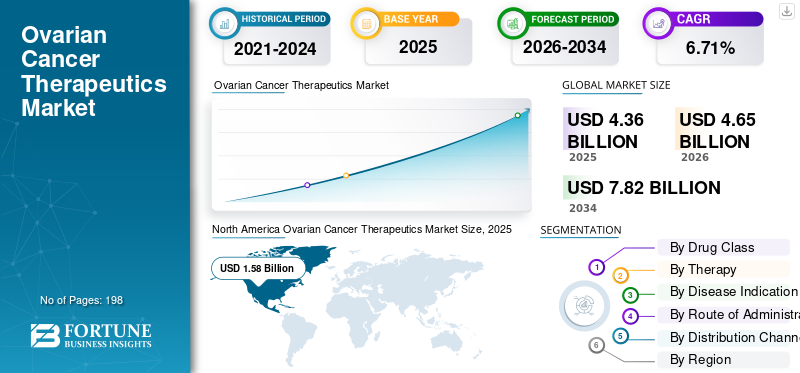
The global ovarian cancer therapeutics market size was valued at USD 4.36 billion in 2025. The market is projected to grow from USD 4.65 billion in 2026 to USD 7.82 billion by 2034, exhibiting a CAGR of 6.71% during the forecast period. North America dominated the ovarian cancer therapeutics market with a market share of 36.23% in 2025.
The global market comprises therapeutics used for the treatment of ovarian cancer, fallopian tube cancer, and primary peritoneal cancer. It includes chemotherapy, targeted therapy, immunotherapy, hormone therapy, and other emerging treatment approaches. The market is primarily driven by the high treatment burden of epithelial ovarian cancer, increasing use of PARP inhibitors and anti-angiogenic agents, and growing adoption of biomarker-based therapies for recurrent and advanced disease.
Furthermore, AstraZeneca, GSK plc, F. Hoffmann-La Roche Ltd, and AbbVie Inc. hold notable positions in the market due to their approved ovarian cancer therapies, strong oncology portfolios, and continued focus on targeted treatment options.
Download Free sample to learn more about this report.
Ovarian Cancer Therapeutics Market Key Takeaways
 Global Market Size & Forecast
- 2025 Market Size: USD 4.36 billion
- 2026 Market Size: USD 4.65 billion
- 2034 Forecast Market Size: USD 7.82 billion
- CAGR: 6.71% from 2026–2034
 Market Share
- North America dominated the ovarian cancer therapeutics market with a market share of 36.23% in 2025.
- The chemotherapy segment is set to hold 51.4% share in 2026.
- The epithelial ovarian cancer segment is set to hold 51.1% share in 2026.
 Key Regional Highlights
North America
The regional market reached USD 1.58 billion in 2025, supported by strong adoption of PARP inhibitors, biomarker-driven therapies, favorable reimbursement policies, and advanced oncology infrastructure.
Europe
The market is projected to expand at a 5.71% CAGR through 2034, driven by wider HRD testing, structured treatment guidelines, and increasing use of maintenance therapies.
Asia Pacific
The market is expected to reach USD 1.20 billion by 2026, fueled by a large patient population, improving diagnosis rates, expanding oncology infrastructure, and greater access to targeted therapies.
U.S.
The U.S. market is projected to be approximately USD 1.57 billion in 2026, representing about 33.7% of the global market.
Japan
The Japanese market is estimated at around USD 0.36 billion in 2026, accounting for roughly 7.7% of global revenues.
Read More

OVARIAN CANCER THERAPEUTICS MARKET TRENDS
Growing Adoption of Targeted and Personalized Therapies is a Prominent Trend Observed in Global Market
Growing adoption of targeted and personalized therapies is a key trend in the global market as treatment decisions are increasingly based on tumor biomarkers such as FRα, BRCA/HRD, and KRAS. This is shifting the market from broad chemotherapy use toward therapies designed for specific patient groups, improving treatment precision in recurrent and advanced disease. The trend is also supporting higher-value drug adoption, especially in platinum-resistant and low-grade serous ovarian cancer. These factors are supporting the overall global ovarian cancer therapeutics market growth.
- For instance, in May 2025, the U.S. FDA granted accelerated approval to avutometinib + defactinib for adult patients with KRAS-mutated recurrent low-grade serous ovarian cancer who had received prior systemic therapy.
MARKET DYNAMICS
MARKET DRIVERS
Download Free sample to learn more about this report.
Rising Prevalence of Ovarian Cancer is Driving Market Growth
Increasing prevalence of ovarian cancer is a key driver for the global market as a larger diagnosed patient pool increases demand for chemotherapy, PARP inhibitors, anti-angiogenic agents, ADCs, and other targeted therapies. The high recurrence rate and need for long-term maintenance therapy further expand treatment duration and drug utilization. This is especially important in advanced epithelial ovarian cancer, where patients often require multiple lines of systemic therapy. All these factors cumulatively drive the overall market growth.
- For instance, in January 2026, the American Cancer Society estimated around 20,890 new ovarian cancer cases and 12,730 deaths in the U.S. for 2025, highlighting the continued disease burden and need for effective treatment options.
MARKET RESTRAINTS
High Cost of Treatment to Limit Wider Adoption of Advanced Therapies
Elevated treatment expenses serve as a barrier for the global market since numerous advanced therapies, such as PARP inhibitors and antibody-drug conjugates, necessitate biomarker testing, ongoing dosing, and extended treatment periods. These expenses may restrict access in price-sensitive markets and postpone reimbursement choices, particularly for patients with platinum-resistant and recurrent ovarian cancer. A significant out-of-pocket cost may lower treatment adherence and limit the adoption of newer targeted therapies.
- For instance, in February 2024, a cost-effectiveness analysis published in the Journal of Gynecologic Oncology found that mirvetuximab soravtansine for FRα-high platinum-resistant recurrent ovarian cancer was not cost-effective in the U.S. at its current price, with ICERs exceeding the USD 100,000/QALY threshold.
MARKET OPPORTUNITIES
Rising Awareness Regarding Early Cancer Diagnosis to Offer Market Growth Opportunities
Rising awareness regarding early cancer diagnosis is creating an opportunity in the global market by encouraging women to recognize persistent symptoms earlier and seek timely medical evaluation. Earlier diagnosis can increase the use of first-line systemic therapies, biomarker testing, and maintenance treatment, thereby expanding the eligible treatment pool. Awareness programs are also supporting physician education and improving referral pathways for high-risk women. Additionally, strategic inititatives to increase the awareness also positively impact the market expansion. All these factors drive the market growth in the coming years.
- For instance, in September 2025, the American Cancer Society and Break Through Cancer announced the “Outsmart Ovarian Cancer” collaboration to advance ovarian cancer awareness, prevention, education, and clinical action for women at risk and their clinicians.
MARKET CHALLENGES
Stringent Regulatory Requirements to Pose a Prominent Challenge to Market Growth
Stringent regulatory approval processes remain a key challenge in the global market as new therapies must show clear clinical benefit, durable response, and acceptable safety in defined patient groups. Regulatory agencies are increasingly cautious in ovarian cancer, especially where survival benefit is uncertain or safety concerns emerge in later-line settings. This can delay launches, narrow eligible patient pools, and reduce commercial potential for pipeline therapies.
- For instance, in March 2024, the U.S. FDA formally withdrew several PARP inhibitor indications for advanced ovarian cancer after AstraZeneca, GSK, and Clovis voluntarily requested withdrawal of certain approved indications.
Segmentation Analysis
By Drug Class
PARP Inhibitors Segment Dominated Market Due to Recurring Use as Maintenance Therapy in Patients
On the basis of drug class, the market is segmented into PARP inhibitors, platinum-based chemotherapy, taxanes, VEGF/anti-angiogenic agents, antimetabolites, anthracyclines & topoisomerase-targeting agents, and others.
The PARP inhibitors segment led the global ovarian cancer therapeutics market share in 2025. This is due to their strong use as maintenance therapy in advanced ovarian cancer, especially among patients with BRCA-mutated and HRD-positive tumors. Their high treatment value, longer duration of therapy, and broad adoption in biomarker-selected patients supported the segment’s leading revenue share. Also, new product launches by key players further support the segment growth.
- For instance, in February 6, 2025, AstraZeneca reported that Lynparza remained the leading medicine in the global PARP inhibitor class by total prescription volume across approved tumor types, including ovarian cancer.
The VEGF/anti-angiogenic agents segment is anticipated to rise with a CAGR of 5.58% over the forecast period.
To know how our report can help streamline your business, Speak to Analyst
By Therapy
Broad First-line Usage in Large Patient Pool Supported Dominance of Chemotherapy Segment
Based on therapy, the market is segmented into chemotherapy, immunotherapy, targeted therapy, hormone therapy, and others.
The chemotherapy segment captured the leading position in the global market in 2025. This is due to its broad use as the standard treatment backbone across newly diagnosed, advanced, recurrent, and platinum-sensitive ovarian cancer. Platinum-taxane regimens continue to be widely used across regions, as they are clinically established, more accessible than many targeted therapies, and applicable to a larger patient pool regardless of biomarker status. Furthermore, the segment is set to hold 51.4% share in 2026.
- For instance, in May 2025, the National Cancer Institute updated its PDQ treatment summary, stating that chemotherapy remains one of the key treatment options for ovarian epithelial, fallopian tube, and primary peritoneal cancers.
The immunotherapy segment is anticipated to rise with a CAGR of 30.79% over the forecast period.
By Disease Indication
Epithelial Ovarian Cancer Segment Led Market Due to Higher Disease Burden
In terms of disease indication, the market is segmented into epithelial ovarian cancer, fallopian tube cancer, primary peritoneal cancer, germ cell ovarian tumors, sex cord-stromal tumors, and others.
The epithelial ovarian cancer segment dominated the market share in 2025 as it accounts for the majority of ovarian malignancies and is commonly diagnosed at an advanced stage, requiring systemic treatment across multiple lines. The segment also has the strongest use of chemotherapy, PARP inhibitors, anti-angiogenic agents, and newer biomarker-based therapies, which increases its overall revenue contribution. Furthermore, the segment is set to hold 51.1% share in 2026.
- For instance, in 3025, a JAMA review stated that approximately 90% of ovarian cancers are epithelial malignancies, with high-grade serous ovarian cancer representing the major subtype.
The sex cord-stromal tumors segment is anticipated to rise with a CAGR of 5.74% over the forecast period.
By Route of Administration
Parenteral Segment Led Market Due to High Use of Infusion-based Therapies
On the basis of route of administration, the market is segmented into oral and parenteral.
In 2025, the market share was primarily led by the parenteral segment. This is due to the wide use of injectable and infusion-based therapies such as platinum chemotherapy, taxanes, bevacizumab, and antibody-drug conjugates in ovarian cancer treatment. These therapies are commonly administered in hospitals or oncology infusion centers, especially for advanced, recurrent, and platinum-resistant disease, supporting the segment’s higher revenue share.
- For instance, in March 2024, AbbVie announced that the U.S. FDA granted full approval to ELAHERE, an intravenous antibody-drug conjugate, for FRα-positive, platinum-resistant epithelial ovarian, fallopian tube, or primary peritoneal cancer.
The oral segment is expected to grow at the fastest CAGR of 8.39% over the forecast period.
By Distribution Channel
Hospital Pharmacies Led Demand Due to High Infusion-based Treatment Volume
Based on distribution channel, the market is segmented into hospital pharmacies, specialty pharmacies, retail pharmacies, and others.
The hospital pharmacies segment accounted for the dominant market share in 2025 due to the high use of parenteral ovarian cancer therapies, including platinum chemotherapy, taxanes, bevacizumab, and ADC-based regimens. These drugs are commonly administered under oncologist supervision in hospitals or infusion centers, especially for advanced, recurrent, and platinum-resistant disease, which supports higher drug procurement through hospital pharmacies.
- For instance, in March 2026, the U.S. FDA approved relacorilant in combination with nab-paclitaxel for adults with platinum-resistant epithelial ovarian, fallopian tube, or primary peritoneal cancer, reinforcing the continued role of hospital/infusion-based regimens in ovarian cancer treatment.
In addition, specialty pharmacies segment are projected to witness 8.40% growth rate during the forecast period.
Ovarian Cancer Therapeutics Market Regional Outlook
By geography, the market is divided into, Europe, North America, Latin America, Asia Pacific, and the Middle East & Africa.
North America
North America Ovarian Cancer Therapeutics Market Size, 2025 (USD Billion)
To get more information on the regional analysis of this market, Download Free sample
The North America accounted for the largest share of the global market size and was valued at USD 1.49 billion in 2024. In 2025, the region maintained its dominance, with USD 1.58 billion. Growth in North America is supported by high uptake of PARP inhibitors, anti-angiogenic therapy, ADCs, and biomarker-led treatment in advanced and recurrent ovarian cancer. Strong oncology reimbursement, broader BRCA/HRD testing, and early access to U.S. FDA-approved therapies support higher treatment value per patient. The region also benefits from a large specialty oncology infrastructure and rapid adoption of maintenance therapy.
U.S. Ovarian Cancer Therapeutics Market
The U.S. market led the North American region and is projected to be approximately USD 1.57 billion in 2026, representing about 33.7% of the global market.
Europe
Europe’s market size is growing at a CAGR of 5.71% during the forecast period. Europe is growing due to wider HRD testing, structured oncology guidelines, and increasing use of PARP inhibitors as maintenance therapy in advanced ovarian cancer.
U.K. Ovarian Cancer Therapeutics Market
The U.K. market is estimated at around USD 0.20 billion in 2026, representing roughly 4.3% of global revenues.
Germany Ovarian Cancer Therapeutics Market
Germany market’s size is projected to reach approximately USD 0.24 billion in 2026, equivalent to around 5.1% of global sales.
Asia Pacific
The Asia Pacific market’s size is expected to reach a valuation of USD 1.20 billion by 2026. Asia Pacific is expected to grow at the fastest CAGR during the forecast period and is driven by the large patient pool in China, Japan, and India, improving diagnosis rates, and rising access to targeted therapies. China is expected to be a key growth contributor due to high disease burden, expanding oncology infrastructure, and improving availability of diagnostics and innovative treatments.
Japan Ovarian Cancer Therapeutics Market
The Japanese market is estimated at around USD 0.36 billion in 2026, accounting for roughly 7.7% of global revenues.
China Ovarian Cancer Therapeutics Market
China’s market is projected to reach revenues of around USD 0.38 billion in 2026, representing roughly 8.2% of global sales.
India Ovarian Cancer Therapeutics Market
The Indian market is estimated at around USD 0.11 billion in 2026, accounting for roughly 2.3% of global revenues.
Latin America and Middle East & Africa
The growth in the Latin America and Middle East & Africa regions is anticipated to be slower over the forecast period. The Latin America market is estimated at around USD 0.28 billion in 2026. Latin America is expected to grow due to increasing cancer medicine access initiatives, improving oncology treatment capacity, and rising demand for chemotherapy and targeted therapy in Brazil and Mexico.
On the other hand, in the Middle East & Africa the growth is supported by expanding cancer care investment, improving registration of innovative oncology therapies, and rising recognition of precision oncology in higher-income Gulf markets.
GCC Ovarian Cancer Therapeutics Market
The GCC market is projected to reach approximately USD 0.05 billion by 2026, representing about 1.0% of global revenues.
COMPETITIVE LANDSCAPE
Key Industry Players
Focus on Targeted Therapies, PARP Inhibitors, and Biomarker-based Ovarian Cancer Treatment by Key Players to Propel Market Competition
The global ovarian cancer therapeutics market is moderately consolidated, with companies such as Astrazeneca, GSK plc, AbbVie Inc., and F. Hoffmann-La Roche Ltd. holding notable shares. Strategic collaborations, product launches, and regulatory product approvals are helping companies strengthen their market presence.
- For instance, in March 2024, AbbVie received full U.S. FDA approval for ELAHERE for FRα-positive, platinum-resistant ovarian, fallopian tube, or primary peritoneal cancer, strengthening its position in the targeted ovarian cancer treatment space.
Other notable players in the market include Teva Pharmaceutical Industries Ltd., Sun Pharmaceutical Industries Ltd., Dr.Reddy’s Laboratories Ltd., and Bristol-Myers Squibb Company. These companies are expected to focus on generic oncology products, biosimilars, specialty distribution, targeted therapy launches, and regional access expansion to strengthen their market presence during the forecast period.
LIST OF KEY OVARIAN CANCER THERAPEUTICS COMPANIES PROFILED IN REPORT
- Astrazeneca (U.K.)
- GSK plc (U.K.)
- AbbVie Inc. (U.S.)
- Hoffmann-La Roche Ltd (Switzerland)
- Verastem, Inc. (U.S.)
- Teva Pharmaceutical Industries Ltd. (Israel)
- Sun Pharmaceutical Industries Ltd. (India)
- Reddy’s Laboratories Ltd. (India)
- Bristol-Myers Squibb Company (U.S.)
- Cybrexa (U.S.)
KEY INDUSTRY DEVELOPMENTS
- April 2026: Gilead entered into an agreement to acquire Tubulis, adding TUB-040, a NaPi2b-targeting ADC being developed for ovarian cancer and other solid tumors.
- February 2026: Merck announced the U.S. FDA approval of KEYTRUDA + paclitaxel ± bevacizumab for certain adults with PD-L1+ platinum-resistant epithelial ovarian, fallopian tube, or primary peritoneal carcinoma.
- October 2025: Cellipont and Ernexa entered a manufacturing partnership to advance ERNA-101, Ernexa’s lead cell therapy candidate for ovarian cancer, toward clinical trials.
- September 2025: Raludotatug deruxtecan received the U.S. FDA Breakthrough Therapy Designation for CDH6-expressing platinum-resistant ovarian, primary peritoneal, or fallopian tube cancers previously treated with bevacizumab.
- August 2025: GSK announced the availability of Zejula in India as a once-daily oral PARP inhibitor approved for first-line maintenance in advanced ovarian cancer across biomarker types.
REPORT COVERAGE
The global ovarian cancer therapeutics market analysis encompasses a comprehensive assessment of the market size and projections for each segment featured in the report. It provides an analysis of the market dynamics and trends anticipated to influence the market during the forecast period. It offers insight into key elements such as technological advancements, product developments, the regulatory landscape, pipeline evaluation, and the introduction of new products. The global market report also outlines collaborations, mergers & acquisitions, along with significant advancements in the industry within the market. The global market report further offers a comprehensive competitive overview, featuring details on market share and profiles of major active participants.
Request for Customization to gain extensive market insights.
Report Scope & Segmentation
| ATTRIBUTE | DETAILS |
| Study Period | 2021-2034 |
| Base Year | 2025 |
| Estimated Year | 2026 |
| Forecast Period | 2026-2034 |
| Historical Period | 2021-2024 |
| Growth Rate | CAGR of 6.71% from 2026-2034 |
| Unit | Value (USD Billion) |
| Segmentation | By Drug Class, Therapy, Disease Indication, Route of Administration, Distribution Channel, and Region |
| By Drug Class |
|
| By Therapy |
|
| By Disease Indication |
|
| By Route of Administration |
|
| By Distribution Channel |
|
| By Region |
|
Frequently Asked Questions
According to Fortune Business Insights, the global market value stood at USD 4.36 billion in 2025 and is projected to reach USD 7.82 billion by 2034.
In 2025, the North America’s market value stood at USD 1.58 billion.
The market is expected to exhibit a CAGR of 6.71% during the forecast period.
By drug class, the PARP inhibitors segment led the market.
Rising ovarian cancer prevalence and growing demand for personalized medicine is primarily driving market expansion.
Astrazeneca, GSK plc, AbbVie Inc., and F. Hoffmann-La Roche Ltd. are the top players in the global market.
North America held the largest market share in 2025.



- 2021-2034
- 2025
- 2021-2024
- 198
Get 30-60 hrs Free Customization
Expand Regional and Country Coverage, Segments Analysis, Company Profiles, Competitive Benchmarking, and End-user Insights.













.webp)






Related Reports
-
US +1 833 909 2966 ( Toll Free )
-
Get In Touch With Us