Protein Ingredients Market Size, Share & Industry Analysis, By Product Type (Protein Concentrates, Protein Isolates, & Others), By Form (Powder & Liquid), By Source (Plant-Based [Soy, Pea, Wheat, Rice, Potato, & Others], Animal-Based [Dairy Protein {Milk Protein, Whey Protein}, Egg Protein, Collagen, & Others], Insect-Based, & Microbial-Based), By Application (Food & Beverages [Bakery & Confectionary, Beverages, Breakfast Cereals, Dairy & Dairy Alternatives, Meat & Meat Alternatives], Dietary Supplements & Nutraceuticals, Pharmaceuticals, and Animal Feed), and Regional Forecast, 2026-2034
 Download Free Sample
(Offer valid till 15th Oct 2026)

Protein Ingredients Market Size and Future Outlook
 Listen to Audio Version
The global protein ingredients market size was valued at USD 67.81 billion in 2025 and is projected to grow from USD 72.18 billion in 2026 to USD 124.37 billion by 2034, exhibiting a CAGR of 7.04% during the forecast period. North America dominated the protein ingredients market with a market share of 36.67% in 2025. Growth is driven by the increasing adoption of high-protein diets for muscle health, weight management, and metabolic wellness, with protein-enriched foods and beverages now consumed well beyond sports nutrition.
Protein ingredients represent a structurally expanding category within the broader functional food, nutrition, and ingredient processing industries. These ingredients are derived from both plant-based and animal-based sources, including soy, pea, wheat, rice, dairy, egg, collagen, and emerging microbial or insect proteins. They are widely utilized across food & beverages, dietary supplements, sports nutrition, infant nutrition, pharmaceuticals, and animal feed due to their high nutritional value, functional formulation capabilities, and ability to support protein fortification strategies. Consumer demand for plant-based proteins in the global protein ingredients market is surging, driven by health, sustainability, and ethical factors, with market projections showing strong growth in 2034.
Protein ingredients provide essential amino acids, functional properties such as emulsification and gelation, and improved texture stability, making them integral components in processed foods, ready-to-drink beverages, nutritional powders, bakery products, and meat alternatives.
The global market demand is led by major players, including Archer Daniels Midland Company (ADM), Cargill Incorporated, Kerry Group plc, Glanbia plc, and International Flavors & Fragrances (IFF).
Rising Demand for Functional and Sustainable Protein Sources to Shape Industry Trends
Consumers globally are increasingly prioritizing high-protein diets, functional nutrition, and sustainable food systems, driving demand for diverse protein ingredients. Plant-based proteins such as soy, pea, and wheat have gained strong traction due to sustainability considerations and the rise of vegan and flexitarian diets. Meanwhile, animal-based proteins such as whey and collagen continue to dominate performance nutrition, infant formula, and clinical nutrition segments due to their superior digestibility and amino acid profile.
Food manufacturers are rapidly incorporating protein ingredients into ready-to-drink beverages, protein bars, fortified bakery products, plant-based meat alternatives, and dairy substitutes. Advances in protein extraction, fermentation technology, and fractionation processes are also enabling the development of high-purity protein isolates and specialty functional blends.
- According to the International Food Information Council (IFIC), in 2025, nearly 70% of global consumers actively seek protein in their daily diets, underscoring the growing role of protein fortification in food innovation.
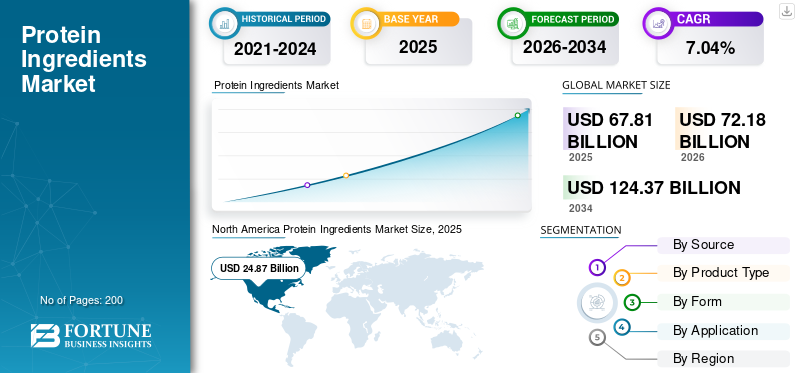
Download Free sample to learn more about this report.
Protein Ingredients Market Key Takeaways
 Market Size & Forecast
- 2025 Market Size: USD 67.81 billion
- 2026 Market Size: USD 72.18 billion
- 2034 Forecast Market Size: USD 124.37 billion
- CAGR: 7.04% from 2026–2034
 Market Share
- North America dominated the protein ingredients market with a 36.67% share in 2025.
- The powder segment led the market and was valued at USD 53.46 billion in 2025.
- The protein concentrates segment dominated the market, reaching USD 37.84 billion in 2025.
 Key Regional Highlights
North America
Valued at USD 24.87 billion in 2025, driven by strong demand for sports nutrition and functional food products.
Europe
Reached USD 19.71 billion in 2025, supported by dairy processing strength and growing plant-based protein demand.
Asia Pacific
Valued at USD 15.91 billion in 2025, fueled by rising incomes and increasing protein nutrition awareness.
U.S
Reached USD 19.61 billion in 2025, supported by soybean production and protein-enriched food demand.
Japan
Market data was not provided in the source information.
Read More

MARKET DYNAMICS
Market Drivers
Download Free sample to learn more about this report.
Growing Demand for High-Protein Diets and Functional Foods to Support Market Expansion
The increasing adoption of high-protein diets for muscle health, weight management, and metabolic wellness is a key driver of the global protein ingredients market growth. Protein-enriched foods and beverages are increasingly incorporated into everyday diets beyond sports nutrition and functional food applications. Technological improvements in protein extraction, membrane filtration, and enzymatic hydrolysis have increased the yield efficiency and functionality of protein ingredients, enabling their integration into a wider range of applications, such as plant-based meat, dairy alternatives, medical nutrition, and functional beverages.
- The USDA reports that global soybean production exceeded 390 million metric tons in 2024, reinforcing the availability of soy protein as a key raw material for the protein ingredients industry.
Market Restraints
Raw Material Price Volatility and Processing Costs to Limit Margin Stability
The protein ingredients industry remains sensitive to fluctuations in agricultural commodity prices, including soybeans, peas, wheat, and dairy inputs. Climate variability, feed costs, and global trade policies influence supply stability and production economics. Energy-intensive processes such as spray drying, ultrafiltration, and protein fractionation also increase operational costs for ingredient manufacturers. Supply chain disruptions and logistics costs further impact profitability. Moreover, competition between animal- and plant-based protein ingredients is intensifying as food manufacturers evaluate costs, sustainability, and consumer perceptions.
Market Opportunities
Expansion of Novel Proteins and Precision Fermentation Technologies to Pave Growth Opportunities
The emergence of alternative protein technologies, including microbial fermentation, algae proteins, and insect-based protein ingredients, is creating new opportunities for the protein ingredients market. These technologies offer high production efficiency, lower environmental impact, and scalable protein manufacturing capabilities.
Precision fermentation is enabling the development of bioidentical dairy and egg proteins, allowing manufacturers to produce functional proteins without traditional livestock production systems.
In addition, demand for high-purity protein isolates and specialized blends in sports nutrition, clinical nutrition, and functional beverages is growing rapidly. As consumers increasingly prioritize high-protein, low-sugar, and clean-label nutrition products, premium protein ingredients are expected to gain greater market share.
SEGMENTATION ANALYSIS
By Form
Powder Segment Dominated the Market Due to Shelf Stability and Formulation Flexibility
Based on form, the market is bifurcated into powder and liquid.
The powder segment dominated the global protein ingredients market share, accounting for USD 53.46 billion in 2025, primarily due to its longer shelf life, ease of transportation, and formulation flexibility. Powdered proteins are widely used in sports nutrition powders, bakery products, dietary supplements, infant nutrition, and food processing applications. These ingredients offer superior stability during storage and enable efficient bulk distribution across international markets. Powder formats also allow precise protein standardization and blending for food manufacturing.
Meanwhile, the liquid protein ingredients segment is projected to grow at the fastest CAGR of 7.99% during 2026–2034, driven by increasing demand for ready-to-drink protein beverages, dairy formulations, and liquid nutritional supplements.
By Product Type
Protein Concentrates Dominated the Market Due to Cost Efficiency and Balanced Functionality
Based on product type, the market is segmented into protein concentrates, protein isolates, and others.
The protein concentrates segment dominates the market, valued at USD 37.84 billion in 2025, supported by widespread use in food processing, dairy products, bakery formulations, and animal nutrition. Protein concentrates provide balanced functionality and cost efficiency, making them suitable for large-scale industrial food applications. Soy protein concentrate and milk protein concentrate remain widely used across processed food systems.
Meanwhile, the protein isolates segment is projected to grow at the fastest CAGR of 7.76% during the forecast period, driven by increasing demand for high-purity proteins in sports nutrition, clinical nutrition, and plant-based food formulations.
To know how our report can help streamline your business, Speak to Analyst
By Source
Animal-Based Segment Dominated the Market Due to Extensive Utilization of Dairy Protein Food
Based on the source, the market is segmented into plant-based, animal-based, insect-based, and microbial-based. The plant-based segment is further divided into soy, pea, wheat, rice, potato, and others. The animal-based segment is further categorized into dairy protein, egg protein, collagen, and others. The dairy-protein is further segment into milk protein and whey protein.
The animal-based segment dominated the global market, valued at USD 51.21 billion in 2025, supported by extensive utilization of dairy proteins, egg proteins, and collagen across food processing, sports nutrition, infant formula, and clinical nutrition applications. Animal-derived proteins such as whey, casein, milk protein concentrates, egg protein, and collagen peptides offer superior amino acid profiles, high digestibility, and proven functional benefits in formulation systems.
Meanwhile, the insect-based protein segment is projected to grow at the fastest CAGR of 11.22% during 2026–2034, driven by increasing investment in sustainable protein production, high feed conversion efficiency, and expanding regulatory approvals for insect protein applications in food and animal nutrition.
By Application
Food & Beverages Dominated Due to Extensive Protein Fortification Across Processed Foods
Based on application, the market is segmented into food & beverages, dietary supplements & nutraceuticals, pharmaceuticals, and animal feed. The food & beverages are further segmented into bakery & confectionary, beverages, breakfast cereals, dairy & dairy alternatives, meat & meat alternatives, and others.
The food & beverages segment dominated the global market, valued at USD 40.73 billion in 2025, as protein ingredients are extensively incorporated into processed foods, dairy beverages, snacks, and fortified ready meals. Functional properties such as emulsification, foaming, and gelation support product formulation across multiple food categories.
Meanwhile, the dietary supplements & nutraceuticals segment is projected to grow at the fastest CAGR of 8.29% during the forecast period, supported by increasing consumer focus on fitness, aging population nutrition, and preventive healthcare.
Protein Ingredients Market Regional Outlook
Regionally, the report covers the global market analysis across North America, Europe, Asia Pacific, South America, and the Middle East & Africa.
North America
North America Protein Ingredients Market Size, 2025 (USD Billion)
To get more information on the regional analysis of this market, Download Free sample
North America accounted for USD 24.87 billion in 2025, representing one of the most technologically advanced markets. The region dominated the global market and is projected to grow at a CAGR of 7.01% during 2026–2034, supported by strong demand for sports nutrition, dietary supplements, and functional food products. The presence of advanced ingredient processing facilities and strong food innovation ecosystems continues to support regional market expansion.
U.S. Protein Ingredients Market
The U.S. market was valued at approximately USD 19.61 billion in 2025, accounting for the majority of the market share. The country benefits from large-scale soybean production, advanced dairy processing infrastructure, and strong consumer demand for protein-enriched foods and beverages.
Europe
Europe led the global market in value terms, reaching USD 19.71 billion in 2025, and is projected to grow at a CAGR of 6.46% during the forecast period. The region benefits from strong dairy processing capabilities, increasing demand for plant-based proteins, and well-established functional food markets.
Germany Protein Ingredients Market
Germany’s market was valued at approximately USD 4.42 billion in 2025, making it one of Europe’s largest markets. The country’s strong food manufacturing sector and rising demand for plant-based foods support increased consumption of protein ingredients.
U.K. Protein Ingredients Market
The U.K. market was valued at approximately USD 3.69 billion in 2025. Growth is driven by expanding plant-based food innovation, protein-fortified beverages, and health-conscious consumer preferences.
Asia Pacific
Asia Pacific reached USD 15.91 billion in 2025 and is projected to grow at the fastest CAGR of 8.13% during 2026–2034. Rising disposable income, expanding middle-class populations, and increasing awareness of protein nutrition are driving demand across the region.
China Protein Ingredients Market
China’s market reached approximately USD 7.32 billion in 2025, accounting for the largest share in the Asia Pacific region. Demand is driven by increasing consumption of protein-fortified dairy beverages, infant nutrition products, and plant-based protein foods.
India Protein Ingredients Market
India’s market was valued at approximately USD 3.45 billion in 2025. Rising health awareness, increasing middle-class purchasing power, and growing demand for fortified foods and dietary supplements are supporting market growth.
South America and the Middle East & Africa
South America reached USD 4.96 billion in 2025, growing at a CAGR of 5.81% during 2026–2034. The region benefits from large agricultural production bases, particularly soybeans and animal proteins.
The Middle East and Africa market was valued at USD 2.35 billion in 2025, growing at a CAGR of 6.73% during the forecast period. Growth is supported by increasing food imports, rising protein supplement penetration, and expanding urban populations.
Brazil Protein Ingredients Market
Brazil’s market was valued at approximately USD 2.79 billion in 2025, accounting for the majority of South America’s market. The country benefits from strong soybean production and growing demand for protein-based nutrition products.
COMPETITIVE LANDSCAPE
Key Industry Players
Key Players Focus on Plant Protein Expansion, Functional Ingredient Innovation, and Sustainable Sourcing
Leading companies in the protein ingredients industry are investing in plant protein extraction technologies, fermentation-based protein production, advanced filtration systems, and sustainable agricultural sourcing. Market strategies increasingly focus on developing high-purity protein isolates, clean-label ingredients, and functional protein blends for food and nutrition applications.
Key Players in the Protein Ingredients Market
|
Rank |
Company Name |
|
1 |
Archer Daniels Midland Company (ADM) |
|
2 |
Cargill Incorporated |
|
3 |
Kerry Group plc |
|
4 |
Glanbia plc |
|
5 |
International Flavors & Fragrances (IFF) |
List of Key Protein Ingredients Companies Profiled
- Archer Daniels Midland Company (ADM) (U.S.)
- Cargill Incorporated (U.S.)
- Kerry Group plc (Ireland)
- Glanbia plc (Ireland)
- International Flavors & Fragrances – IFF (U.S.)
- Ingredion Incorporated (U.S.)
- Roquette Frères (France)
- Tate & Lyle PLC (U.K.)
- DSM-Firmenich (Netherlands)
- Omega Protein Corporation (U.S.)
KEY INDUSTRY DEVELOPMENTS
- March 2026: Bunge completed its acquisition of International Flavors & Fragrances (IFF)'s soy protein concentrate, lecithin, and soy crush businesses. The deal integrates IFF's established brands, such as Response, Alpha, Procon, and Solec, expanding Bunge's portfolio with textured, functional, and powdered soy protein concentrates for bakery, snacks, meats, and meat alternatives.
- March 2026: Healthier Comforts launched an animal-free egg white protein powder using EVERY Company's precision-fermented OvoPro ingredient, marking the first time this ingredient reaches home kitchens directly. The powder, sold in an 8 oz resealable bag, delivers 27g of protein per 30g serving (about 120 calories) with zero fat and minimal carbs, ideal for vegan baking including angel food cake and meringues.
- February 2026: Roquette launched NUTRALYS Pea 850F to address pea protein's common vegetal off-notes in plant-based foods and beverages. This pea protein isolate offers a cleaner, neutral taste profile confirmed by expert sensory panels, while matching the functionality of Roquette's NUTRALYS S85F, including high emulsion capacity, moderate gelling, and excellent solubility.
- November 2025: Tetra Pak launched sunflower protein to help food and beverage producers tap into the growing demand for plant-based and functional products. This plant-based ingredient contains up to 50% protein, plus fiber, vitamins, and antioxidants, with a neutral, slightly nutty flavor and off-white color.
- May 2025: Bunge introduced new soy protein concentrates and expanded production capacity through strategic investments and acquisitions to meet rising demand in plant-based and high-protein applications.
REPORT COVERAGE
The global protein ingredients market report analyzes the market in depth and highlights key aspects, including global market trends, dynamics, prominent companies, investment in research and development, and end-use. Besides this, the report provides insights into the industry, market research, and highlights significant industry developments.
Request for Customization to gain extensive market insights.
Report Scope & Segmentation
| ATTRIBUTE | DETAILS |
| Study Period | 2021-2034 |
| Base Year | 2025 |
| Estimated Year | 2026 |
| Forecast Period | 2026-2034 |
| Historical Period | 2021-2024 |
| Growth Rate | CAGR of 7.04% from 2026 to 2034 |
| Unit | Value (USD Billion) |
|
Segmentation |
By Form
|
|
By Product Type
|
|
|
By Source
|
|
|
By Application
|
|
|
By Region
|
Frequently Asked Questions
Fortune Business Insights says that the global market was valued at USD 67.81 billion in 2025 and is anticipated to reach USD 124.37 billion by 2034.
At a CAGR of 7.04%, the global market will grow steadily over the forecast period.
By form, the dry segment led the market.
North America held the largest market share in 2025.
Growing demand for high-protein diets and functional foods to support market expansion.
Archer Daniels Midland Company (ADM), Cargill Incorporated, Kerry Group plc, Glanbia plc, and International Flavors & Fragrances (IFF) are the leading companies in the market.
Rising demand for functional and sustainable protein sources to shape industry trends.



- 2021-2034
- 2025
- 2021-2024
- 200
-
(Offer valid till 15th Oct 2026)
Get 30-60 hrs Free Customization
Expand Regional and Country Coverage, Segments Analysis, Company Profiles, Competitive Benchmarking, and End-user Insights.




















-
US +1 833 909 2966 ( Toll Free )
-
Get In Touch With Us