Rare Disease Therapeutics Market Size, Share & Industry Analysis, By Therapy (Enzyme Replacement, Targeted Small Molecule, Biologics & Monoclonal Antibody, Gene, RNA-Based, Plasma-Derived & Coagulation), By Disease Indication (Genetic & Metabolic Disorders, Hematology Disorders, Neurological Disorders, Oncology Indications), By Age (Adults & Pediatrics), By Type (Branded and Generics), By Route of Administration (Oral, Injectable, Intravenous Infusion), By Distribution Channel (Pharmacies, Specialty Pharmacies, Retail Pharmacies, Online Pharmacies), and Regional Forecast, 2026-2034
 Download Free Sample
Rare Disease Therapeutics Market Size and Future Outlook
 Listen to Audio Version
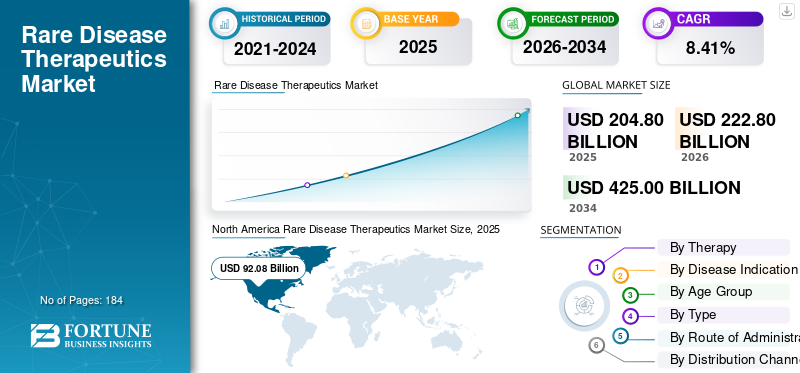
The global rare disease therapeutics market size was valued at USD 204.80 billion in 2025 and is projected to grow from USD 222.80 billion in 2026 to USD 425.00 billion by 2034, exhibiting a CAGR of 8.41% during the forecast period. North America dominated the rare disease therapeutics market with a market share of 44.96% in 2025.
The global market for rare disease therapeutics includes various therapies that are mainly used for conditions with low patient prevalence but high clinical burden, where treatment options are limited and long-term disease management is often required. The market is gaining importance because healthcare systems, regulators, and pharmaceutical companies are increasingly focusing on orphan drug development, faster approval pathways, newborn screening, genetic testing, and precision medicine. The global market demand is also supported by the growing use of branded specialty drugs, injectable biologics, intravenous infusion therapies, and advanced one-time or disease-modifying treatments such as gene and RNA-based therapies.
Key players in the global market consist of Sanofi, Takeda Pharmaceutical Company Limited, AstraZeneca, and Novartis AG among others. The leadership of these companies is supported by strong brand presence, global distribution network, and focus on investments on rare disease therapeutics.
Download Free sample to learn more about this report.
Rare Disease Therapeutics Market Key Takeaways
 Global Market Size & Forecast
- 2025 Market Size: USD 204.80 billion
- 2026 Market Size: USD 222.80 billion
- 2034 Forecast Market Size: USD 425.00 billion
- CAGR: 8.41% from 2026–2034
 Market Share
- North America dominated the rare disease therapeutics market with a market share of 44.96% in 2025.
- The branded segment is set to hold 90.6% share in 2026.
- The oral segment is set to hold 34.6% share in 2026.
 Key Regional Highlights
North America
The North America market reached USD 85.48 billion in 2024 and led the global market. In 2025, the region continued to hold its leading position, with USD 92.08 billion.
Europe
The market is projected to expand at a 7.41% CAGR during the forecast period, driven by favorable orphan drug regulations, increasing disease awareness, and broader access to specialty therapies.
Asia Pacific
The regional market is expected to reach USD 47.22 billion in 2026, supported by improving diagnosis rates, expanding healthcare infrastructure, and growing government initiatives for rare disease treatment.
U.S.
The U.S. market dominated the North American market and can be analytically approximated at around USD 92.40 billion in 2026, accounting for roughly 41.5% of global market.
Japan
The Japan market in 2026 is estimated at around USD 14.09 billion, accounting for roughly 6.3% of global market revenues.
Read More

RARE DISEASE THERAPEUTICS MARKET TRENDS
Advancements in Precision Medicine to Act as a Remarkable Market Trend
Advancements in precision medicine are becoming a major trend in the global market because many rare diseases are caused by specific genetic mutations, enzyme deficiencies, or molecular pathway abnormalities. As genetic testing and biomarker-based diagnosis become more common, companies can design therapies that target the root cause of disease rather than only managing symptoms. This is increasing the use of gene therapies, RNA-based therapies, targeted small molecules, and mutation-specific biologics across rare genetic, metabolic, neurological, and hematology disorders. Precision medicine also helps identify smaller but well-defined patient groups, which supports orphan drug development and faster clinical trial design. As a result, pharmaceutical companies are investing more in genomic screening, companion diagnostics, and advanced therapeutic platforms to improve treatment response and long term outcomes. This trend is also shifting the market from chronic supportive care toward disease-modifying and potentially one-time treatments. Overall, precision medicine is expected to strengthen innovation and premium-value therapy adoption in rare disease care. These factors are expected to support the overall global market growth during the forecast period.
- For instance, in August 2025, the U.S. FDA advanced its Rare Disease Evidence Principles (RDEP) initiative to provide greater speed and predictability for therapies intended for rare diseases with very small patient populations and known genetic defects, supporting precision medicine-based rare disease drug development.
MARKET DYNAMICS
MARKET DRIVERS
Download Free sample to learn more about this report.
Rising Prevalence of Rare Diseases is Driving Market Growth
The rising incidence of rare diseases is a significant factor for the market, as each condition may impact limited number of patients, but the overall burden remains substantial. Over 7,000 rare diseases have been recognized globally, with many being genetic, chronic, progressive, and life-threatening, highlighting a significant demand for long-term or disease-modifying therapies. Enhanced newborn screening, genomic testing, and improved disease registries are aiding in the identification of more patients who were once undiagnosed or incorrectly diagnosed.
As the pool of diagnosed patient population grows, there is a rising need for enzyme replacement therapies, biologics, targeted small molecules, gene therapies, RNA-based interventions, and plasma-derived/coagulation products. This motivates pharmaceutical companies to invest in orphan drug development and enhance access initiatives in major markets. The attention of government and regulators on rare diseases is also enhancing which is facilitating quicker development and market launch of treatments. Additionally, increasing acknowledged prevalence of rare conditions is directly boosting treatment demand and enhancing market expansion.
- For instance, in May 2025, the 78th World Health Assembly adopted a landmark resolution declaring rare diseases a global health priority. The resolution recognized that over 300 million people globally live with one of more than 7,000 rare diseases, highlighting the large unmet need for diagnosis, treatment access, and therapeutic innovation.
MARKET RESTRAINTS
Limited Disease Awareness and Difficulties in Early Diagnosis to Hamper Market Growth
- Restricted awareness of diseases and challenges in early detection pose significant obstacles for the rare disease treatment market growth, as numerous rare conditions exhibit non-specific symptoms that coincide with those of more prevalent illnesses. Consequently, patients frequently navigate through various specialists, undergo repeated testing, and follow incorrect treatment routes before obtaining an accurate diagnosis. This postpones the initiation of suitable treatments like enzyme replacement therapy, targeted small molecules, biologics, gene therapy, or RNA-based therapy. Limited awareness among primary care doctors and restricted access to genetic testing further decrease the number of patients recognized for authorized orphan medications as therapies for rare diseases rely on prompt patient identification and starting long-term treatment. A Delays in diagnosis restricts prescription adoption and also accelerate disease advancement, potentially diminishing treatment efficacy and heightening the overall healthcare load, leading to limited market access. For example, in May 2024, a study published in the European Journal of Human Genetics found that people living with rare diseases in Europe faced an average total diagnosis time of nearly 5 years, highlighting how long diagnostic journeys can delay care and treatment access.
MARKET OPPORTUNITIES
Rising Investments in Orphan Drug Development to Offer Market Growth Opportunities
Rising investments in orphan drug development are creating a strong market opportunity for the global market as rarest diseases still have limited or no approved treatment options. As companies see clearer regulatory incentives, premium pricing potential, and strong unmet medical need, they are increasing funding for gene therapies, RNA-based therapies, targeted biologics, and disease-modifying small molecules. These investments help move early-stage rare disease assets into clinical trials and support specialized manufacturing, patient identification, and global commercialization. They also reduce development risk by allowing companies to focus on genetically defined patient groups with clearer treatment targets. As more capital flows into orphan drug pipelines, the market is expected to see more product launches across genetic, hematology, metabolic, and neurological rare diseases. This creates opportunities not only for large pharmaceutical companies but also for smaller biotech firms with focused rare disease platforms. Overall, higher investment activity is expanding the innovation pipeline and strengthening long-term growth prospects for rare disease therapeutics. All these factors would drive the market growth in the coming years.
- For instance, in October 2025, Hemab Therapeutics announced a USD 157 million Series C financing to advance next-generation treatments for underserved bleeding disorders, including registration-stage preparation for sutacimig in Glanzmann thrombasthenia and continued development of HMB-002 in von Willebrand disease.
MARKET CHALLENGES
Limited Patient Populations for Clinical Trials Pose a Prominent Challenge to Market Growth
Restricted patient populations for clinical trials continue to pose a significant obstacle for the global market, as the majority of rare conditions feature very small and geographically dispersed patient clusters. This poses challenges for companies to find enough suitable participants within set deadlines, particularly when trials necessitate mutation-specific diagnoses, disease-stage requirements, or treatment-naïve individuals. Limited sample sizes also complicate the generation of statistically robust efficacy and safety data, which can heighten regulatory uncertainty and postpone approvals. In numerous rare diseases, patients may already be receiving existing treatments or are too clinically delicate to go to trial locations, which further decreases enrollment. These challenges raise trial expenses, prolong development schedules, and might compel companies to modify, halt, or terminate studies. Consequently, even hopeful treatments may encounter slower advancement in clinical settings and postponed entry into the market. In general, restricted patient access significantly impacts evidence creation and poses a major implementation hurdle for developers of drugs for rare diseases. All the factors cumulatively affect the market growth.
- For instance, in February 2026, Roche reportedly ended the SHIELD DMD trial, highlighting how recruitment and regulatory feasibility challenges are affecting rare disease drug development, particularly in Duchenne muscular dystrophy where eligible patient pools are limited and competition for trial participants is high.
Segmentation Analysis
By Therapy
Strong Clinical Use and Easy Commercialization Has Helped in Targeted Small Molecule Therapy Dominance
In terms of therapy, the market is divided into enzyme replacement therapy, targeted small molecule therapy, biologics & monoclonal antibody therapy, gene therapy, RNA-based therapy, plasma-derived & coagulation therapy, and others.
The targeted small molecule therapy segment accounted for the dominant global rare disease therapeutics market share in 2025 as these drugs are widely used across several rare metabolic, genetic, pulmonary, neurological, and oncology-related conditions. Additionally, small molecule therapies are easier to manufacture, scale, store, and distribute compared with complex biologics and cell or gene therapies, which supports broader commercial adoption. Many of these products are also available as oral therapies, improving patient convenience and long-term adherence in chronic rare diseases.
- For instance, in July 2025, PTC Therapeutics announced that the U.S. FDA approved SEPHIENCE (sepiapterin) for children and adults living with phenylketonuria (PKU), with broad labeling for patients aged one month and older with sepiapterin-responsive PKU. This approval strengthened the role of targeted oral small molecule therapy in treating rare inherited metabolic disorders.
The gene therapy segment is anticipated to rise with a CAGR of 16.50% over the forecast period.
To know how our report can help streamline your business, Speak to Analyst
By Disease Indication
High Genetic Burden and Treatment Intensity Has Boosted the Leading Position of Genetic & Metabolic Disorders
On the basis of disease indication, the market is segmented into genetic & metabolic disorders, hematology disorders, neurological disorders, oncology indications, immunology disorders, pulmonary disorders, and others.
The genetic & metabolic disorders segment dominated the global market in 2025. This is also due to rare diseases being inherited and linked to specific gene mutations, enzyme deficiencies, or metabolic pathway defects. The segment also benefits from stronger newborn screening, genetic testing, and earlier diagnosis compared to several other rare disease groups. In addition, many approved orphan drugs are concentrated in metabolic conditions such as lysosomal storage disorders, phenylketonuria, alkaptonuria, and other inherited disorders. As a result, genetic & metabolic disorders segment accounted for the largest share, supported by higher treatment intensity, premium pricing, and continued product approvals. The segment is set to hold 25.2% share in 2026.
- For instance, in June 2025, Cycle Pharmaceuticals announced that the U.S. FDA approved HARLIKU (nitisinone) Tablets for reducing urine homogentisic acid in adults with alkaptonuria, making it the first and only FDA-approved treatment for this ultra-rare genetic metabolic disorder.
The hematology disorders segment is growing at a CAGR of 6.56% over the forecast period.
By Age Group
Adults Segment Dominated Due to Limited Access to Genetic Testing and Long-term Treatment Use
Based on age group, the market is classified into pediatrics and adults.
The adults segment held the dominating share of the global market in 2025 owing to the late diagnosis of rare diseases due to low awareness, overlapping symptoms, and limited access to genetic testing in early life. A large number of patients continue treatment into adulthood for various rare disorders, creating a larger treated population base. The growth of the segment also derives from better insurance coverage, specialist access, and higher diagnosis rates in mature healthcare systems. The segment is set to hold 67.0% share in 2026.
- For instance, in August 2025, Sanofi announced that the U.S. FDA approved Wayrilz (rilzabrutinib) for adults with persistent or chronic immune thrombocytopenia who had an insufficient response to previous treatment, making it the first BTK inhibitor approved for this adult rare hematology condition.
The pediatrics segment is anticipated to rise with a CAGR of 7.12% over the forecast period.
By Type
Strong Brand Protection and High-value Orphan Drug Launches Propelled the Branded Segment’s Dominance
In terms of type, the market is divided into branded and generics/biosimilars.
The branded segment captured the highest share of the global market in 2025. Presently, most approved rare disease drugs are innovative therapies protected by patents, orphan drug exclusivity, and specialized regulatory incentives. Since many rare diseases still have no generic or biosimilar alternatives, physicians and payers largely depend on original branded products for treatment. These therapies also command premium pricing due to high unmet need, limited competition, and disease-modifying potential. In addition, companies continue to launch new branded orphan drugs for genetically defined and ultra-rare conditions, strengthening the segment’s revenue base. Furthermore, the segment is set to hold 90.6% share in 2026.
- For instance, in February 2025, SpringWorks Therapeutics announced that the U.S. FDA approved GOMEKLI (mirdametinib) for adults and pediatric patients aged 2 years and older with neurofibromatosis type 1-associated plexiform neurofibromas.
The generics/biosimilars segment is anticipated to rise with a CAGR of 13.26% over the forecast period.
By Route of Administration
Convenience and Long-term Use Has Made Oral Segment a Most Favoured Route of Adminstration
On the basis of route of administration, the market is divided into oral, injectable, intravenous infusion, and others.
The oral segment dominated with the highest rare disease therapeutics market share in 2025. Oral therapies reduce the need for hospital visits, infusion centers, trained administration support, and cold-chain handling compared to injectable or intravenous therapies. This improves patient adherence, especially in chronic rare disorders where treatment must be taken regularly over many years. Oral drugs are also widely used in targeted small molecule therapy, which remains one of the largest therapy categories in the market. Furthermore, the segment is set to hold 34.6% share in 2026.
- For instance, in July 2025, KalVista Pharmaceuticals announced that the U.S. FDA approved EKTERLY (sebetralstat), the first and only oral on-demand treatment for hereditary angioedema attacks in adults and pediatric patients aged 12 years and older.
The injectable segment is anticipated to rise with a CAGR of 7.12% over the forecast period.
By Distribution Channel
Strict Handling Procedures and Limited Distribution Networks Supported Specialty Pharmacies’ Segment’s Leadership
In terms of distribution channel, the market is segmented into hospital pharmacies, specialty pharmacies, retail pharmacies, online pharmacies, and others.
In 2025, the specialty pharmacies segment held the leading position in the global market. The segment’s dominance can be attributed to the high-cost, complex, close patient monitoring, reimbursement support, and strict handling procedures required for the rare disease drugs. Moreover, many manufacturers also prefer limited distribution networks through specialty pharmacies to maintain product control, ensure correct administration support, and collect patient outcomes data. Furthermore, the segment is set to hold 42.3% share in 2026.
- For instance, in August 2025, Walgreens Specialty Pharmacy announced that it expanded its limited distribution drug network to 265 products, stating that limited distribution drugs are often complex as high-cost medicines require special handling and selected specialty pharmacy access.
In addition, online pharmacies are projected to witness 13.97% growth rate during the forecast period.
Rare Disease Therapeutics Market Regional Outlook
By geography, the market is divided into North America, Latin America, Asia Pacific, Europe, and the Middle East & Africa.
North America
North America Rare Disease Therapeutics Market Size, 2025 (USD Billion)
To get more information on the regional analysis of this market, Download Free sample
The North America market reached USD 85.48 billion in 2024 and led the global market. In 2025, the region continued to hold its leading position, with USD 92.08 billion. North America is expected to remain a leading region in the global market due to strong orphan drug incentives, faster regulatory pathways, and high healthcare spending.
U.S. Rare Disease Therapeutics Market
The U.S. market dominated the North American market and can be analytically approximated at around USD 92.40 billion in 2026, accounting for roughly 41.5% of global market.
Europe
Europe market size is anticipated to grow at 7.41% CAGR during the forecast period. Europe is witnessing steady growth due to strong regulatory support for orphan medicinal products, increasing rare disease awareness, and expanding access to specialty medicines.
U.K. Rare Disease Therapeutics Market
The U.K. market in 2026 is estimated at around USD 11.52 billion, representing roughly 5.2% of global market revenues.
Germany Rare Disease Therapeutics Market
Germany market size is projected to reach approximately USD 12.88 billion in 2026, equivalent to around 5.8% of global sales.
Asia Pacific
The Asia Pacific market is expected to reach a valuation of USD 47.22 billion by 2026. Asia Pacific is expected to record strong growth due to improving diagnosis rates, expanding healthcare infrastructure, and rising government focus on rare diseases.
Japan Rare Disease Therapeutics Market
The Japan market in 2026 is estimated at around USD 14.09 billion, accounting for roughly 6.3% of global market revenues.
China Rare Disease Therapeutics Market
China’s market is projected to reach revenues of around USD 10.57 billion in 2026, representing roughly 4.7% of global market sales.
India Rare Disease Therapeutics Market
The India market in 2026 is estimated at around USD 4.04 billion, accounting for roughly 1.8% of global market revenues.
Latin America and Middle East & Africa
The Middle East & Africa and Latin America regions are likely to witness a slower growth throughout the forecast period. The market in Latin America is projected to attain a valuation of USD 10.63 billion by 2026. Prominent factors such as improving healthcare investment, better diagnostic capacity, and rising focus on genetic disorders are boosting the market growth in these regions.
In the Middle East and Africa region, the GCC market is projected to reach approximately USD 3.46 billion by 2026, representing about 1.6% of global market revenues.
COMPETITIVE LANDSCAPE
Key Industry Players
Large Pharma and Rare Disease-focused Biotechs are Leading Through Accqusitions and Orphan Drug Approvals
The global rare disease therapeutics market reflects a moderately competitive landscape, consisting of large pharmaceutical companies and specialized rare disease-focused biotech players. Key players include Sanofi, Takeda Pharmaceutical Company Limited, BioMarin, AstraZeneca, and Vertex Pharmaceuticals Incorporated among others. These companies are focusing on orphan drug approvals, pipeline expansion, acquisitions, specialty distribution, and precision medicine platforms to strengthen their market position.
- For instance, in February 2026, BioMarin announced U.S. FDA approval of PALYNZIQ (pegvaliase-pqpz) for adolescents aged 12 years and older with phenylketonuria (PKU), expanding the approved patient population for this enzyme substitution therapy.
Additional key contributors include F. Hoffmann-La Roche Ltd, Novartis AG, Pfizer Inc., CSL, and Sarepta Therapeutics, Inc.. These companies are also contributing to market growth by developing therapies for ultra-rare genetic, metabolic, hematology, neurology, and immunology disorders.
LIST OF KEY RARE DISEASE THERAPEUTICS COMPANIES PROFILED
- Sanofi (France)
- Takeda Pharmaceutical Company Limited (Japan)
- BioMarin (U.S.)
- AstraZeneca (U.K.)
- Vertex Pharmaceuticals Incorporated (U.S.)
- Hoffmann-La Roche Ltd (Switzerland)
- Novartis AG (Switzerland)
- Pfizer Inc. (U.S.)
- CSL (Australia)
- Sarepta Therapeutics, Inc. (U.S.)
KEY INDUSTRY DEVELOPMENTS
- April 2026: Ultragenyx announced U.S. FDA acceptance of the BLA resubmission for UX111, an AAV gene therapy being developed for Sanfilippo syndrome type A / MPS IIIA, supporting advancement of its rare genetic disease pipeline.
- March 2026: Denali Therapeutics announced the U.S. FDA accelerated approval of AVLAYAH (tividenofusp alfa-eknm) for Hunter syndrome / MPS II.
- November 2025: Orphalan announced the acquisition of Orphelia Pharma, a company focused on rare and serious pediatric diseases in neurology and oncology, to expand its orphan drug portfolio and strengthen its global rare disease footprint.
- November 2025: Novartis received U.S. FDA approval for Itvisma (onasemnogene abeparvovec-brve) for children two years and older, teens, and adults with spinal muscular atrophy (SMA), expanding gene replacement therapy availability beyond infants.
- May 2024: Sanofi completed the acquisition of Inhibrx, adding SAR447537 / formerly INBRX-101 to its rare disease pipeline for alpha-1 antitrypsin deficiency, with potential for less frequent dosing versus existing augmentation therapy.
REPORT COVERAGE
The global rare disease therapeutics market analysis encompasses an extensive examination of the market size and projections for all market segments featured in the report. It provides information on the market dynamics and trends that are anticipated to propel the market during the forecast period. It offers insights into crucial elements, such as innovations in products, pipeline analysis, the regulatory landscape, and the introduction of new productss. Furthermore, it outlines collaborations, mergers & acquisitions, along with significant advancements in the industry within the market. The global market forecast report additionally offers a comprehensive competitive landscape with details on market share and profiles of major active participants.
Request for Customization to gain extensive market insights.
Report Scope & Segmentation
| ATTRIBUTE | DETAILS |
| Study Period | 2021-2034 |
| Base Year | 2025 |
| Estimated Year | 2026 |
| Forecast Period | 2026-2034 |
| Historical Period | 2021-2024 |
| Growth Rate | CAGR of 8.41% from 2026-2034 |
| Unit | Value (USD Billion) |
| Segmentation | By Therapy, Disease Indication, Age Group, Type, Route of Administration, Distribution Channel, and Region |
| By Therapy |
|
| By Disease Indication |
|
| By Age Group |
|
| By Type |
|
| By Route of Administration |
|
| By Distribution Channel |
|
| By Region |
|
Frequently Asked Questions
According to Fortune Business Insights, the global market value stood at USD 204.80 billion in 2025 and is projected to reach USD 425.00 billion by 2034.
In 2025, the market value for North America stood at USD 92.08 billion.
The market is expected to exhibit a CAGR of 8.41% during the forecast period.
By therapy, the targeted small molecule therapy segment is expected to lead the market.
increasing prevalence of rare diseases coupled with growing focus on precision medicine are primarily driving market expansion.
Sanofi, Takeda Pharmaceutical Company Limited, BioMarin, and AstraZeneca are some of the prominent players in the global market.
North America dominated the market in 2025.



- 2021-2034
- 2025
- 2021-2024
- 184
Get 30-60 hrs Free Customization
Expand Regional and Country Coverage, Segments Analysis, Company Profiles, Competitive Benchmarking, and End-user Insights.













.webp)






Related Reports
-
US +1 833 909 2966 ( Toll Free )
-
Get In Touch With Us