Reclosable Zipper Packaging Market Size, Share & Industry Analysis, By Material (Polyethylene Terephthalate (PET), Polyethylene (PE), Polypropylene (PP), Ethylene Vinyl Alcohol (EVOH), Polyamide (PA), and Others), By Packaging Type (Bags & Pouches, Sachets, Wraps & Sleeves, and Others), By Application (Food & Beverages, Consumer Goods, Healthcare, and Others), and Regional Forecast, 2026-2034
 Download Free Sample
(Offer valid till 15th Sep 2026)

Reclosable Zipper Packaging Market Size and Future Outlook
 Listen to Audio Version
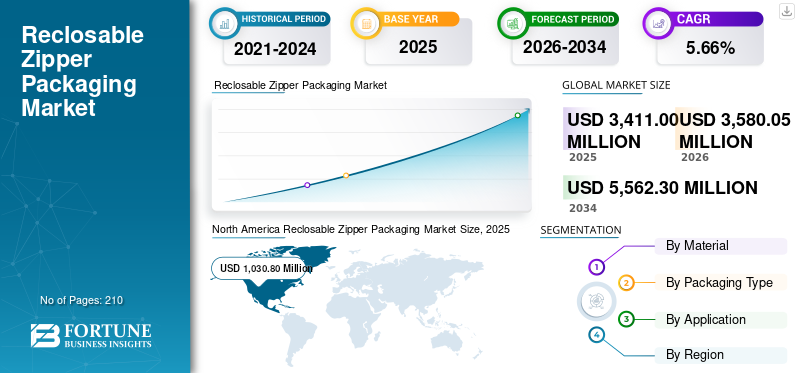
The global reclosable zipper packaging market size was valued at USD 3,411.00 million in 2025 and is projected to grow from USD 3,580.05 million in 2026 to USD 5,562.30 million by 2034, exhibiting a CAGR of 5.66% during the forecast period. North America dominated the global market with a market share of 30.21% in 2025.
The global market for reclosable zipper packaging comprises packaging solutions with integrated zipper or slider closures, enabling packages to be opened and securely resealed multiple times. This functionality helps maintain product freshness, safety, and usability across various applications, including food, beverage, pharmaceutical, and consumer goods. The main driving force behind this market is the rising disposable incomes and increasing consumer demand for convenient, reusable, and freshness-preserving packaging, especially for packaged foods and everyday products.
Furthermore, many key industry players, such as Amcor Plc, Sealed Air, and Constantia Flexibles, operating in the market, are focusing on developing innovative food products and conducting R&D.
Download Free sample to learn more about this report.
RECLOSABLE ZIPPER PACKAGING MARKET Key Takeaways
 Market Size & Forecast
- 2025 Market Size: USD 3,411.00 Million
- 2026 Market Size: USD 3,580.05 Million
- 2034 Forecast Market Size: USD 5,562.30 Million
- CAGR: 5.66% from 2026–2034
 Market Share
- North America dominated the reclosable zipper packaging market with a 30.21% share, generating USD 1,030.80 million in 2025.
- The Polyethylene Terephthalate (PET) segment accounted for the largest market share in 2025.
- The bags and pouches segment dominated the global market in 2025.
 Key Regional Highlights
North America
North America generated USD 1,030.80 million in 2025, driven by strong demand for convenience foods, pet food, and e-commerce packaging.
Asia Pacific
Asia Pacific reached USD 888.15 million in 2025, supported by rapid urbanization, rising disposable incomes, and growing packaged food consumption.
Europe
Europe accounted for USD 688.00 million in 2025 and is projected to grow at a CAGR of 5.29%, driven by sustainability regulations and demand for premium food packaging.
U.S.
The market was valued at USD 808.56 million in 2025.
Japan
The market reached USD 113.12 million in 2025
Read More

RECLOSABLE ZIPPER PACKAGING MARKET TRENDS
Premiumization & Customization in Consumer Packaging are Major Trends Observed in Market
A significant trend influencing the landscape of reclosable zipper packaging is the movement toward premiumization, customization, and improved design aesthetics. In addition to basic functionality, brands are increasingly utilizing zipper closures as a strategic differentiator to enhance shelf appeal and communicate quality. It encompasses customized zipper track colors, ergonomic slider mechanisms, printed or transparent windows, and personalized tactile features that align with branding objectives.
Moreover, the emergence of digitally printed, flexible packaging enables highly customized visuals and on-pack communications that enhance brand-to-consumer engagement. When combined with trends toward flexible formats (such as stand-up pouches with advanced zippers), premium, visually distinctive packaging plays a crucial role in achieving stronger market positioning and can support higher price points, especially in competitive retail settings.
Download Free sample to learn more about this report.
MARKET DYNAMICS
MARKET DRIVERS
Rising Consumer Demand for Convenience and Freshness is Driving Market Growth
A significant factor driving the global reclosable zipper packaging market growth is the growing consumer inclination toward packaging solutions that offer convenience, freshness preservation, and user-friendliness. Contemporary consumers, particularly in urban and time-sensitive environments, are increasingly favoring packaged products that allow for easy opening, portion control, and secure resealing.
This trend is particularly pronounced in the food industry, encompassing snacks, cereals, frozen foods, pet food, and ready-to-eat meals, where the preservation of freshness and product integrity after opening plays a crucial role in shaping purchasing decisions and minimizing waste. Additionally, the rise of e-commerce platforms further strengthens this trend, as secure reclosable packaging improves the unboxing experience, mitigates leakage during shipping, and encourages repeated use.
MARKET RESTRAINTS
High Material Costs and Price Sensitivity Restrict Market Growth
The volatility of material prices and end users' cost sensitivity are significant concerns. Most zipper systems depend on petroleum-based polymers including polyethylene and polypropylene, whose prices fluctuate with global crude oil markets. In recent years, rising polymer costs have directly increased production expenses for zipper components, thereby compressing profit margins, especially for small and medium-sized manufacturers that lack the scale to negotiate long-term contracts or absorb sudden price increases. These elevated costs and supply chain disruptions are often passed on to consumers or compel brands to eliminate zipper features on products that are sensitive to pricing.
MARKET OPPORTUNITIES
Innovation in High-Barrier and Sustainable Solutions Provides Potential Growth Opportunities
A significant opportunity exists in product innovation, especially in high-barrier, functional zipper technologies and sustainable material systems. Innovative zipper designs that enhance oxygen, moisture, and aroma barriers broaden the applicability of reclosable packaging to premium and sensitive product categories, including specialty coffee, nutraceuticals, and gourmet snacks, where maintaining product integrity and extending shelf life are essential.
These advancements may include double-lock tracks, tactile reseal feedback systems, antimicrobial properties, and easy-tear notches that enhance the user experience and differentiate brands from competitors. Currently, the global sustainability agenda, driven by regulatory requirements, retailer pledges, and consumer preferences for recyclable materials, presents an opportunity to incorporate monomaterial (e.g., PE/PP) zipper structures that align with circular-economy objectives.
MARKET CHALLENGES
Recycling Complexity and Infrastructure Gaps Pose a Critical Challenge to Market Growth
One of the most significant obstacles facing the global market is the ongoing challenge of recycling and managing products at the end of their life cycle. Many reclosable packages are made from multi-layer laminates that incorporate various polymers and adhesives, which complicates the separation of materials and the mechanical recycling process.
Even when solutions using a single material are developed, the global recycling infrastructure, especially in developing countries, often lacks the capacity to process flexible packaging effectively. Contamination from food residues and the presence of mixed material layers further reduce the value of recycling, leading to disposal in landfills or incineration rather than closed-loop reuse. This issue not only undermines sustainability claims but also subjects brands to regulatory scrutiny and consumer pressure.
Segmentation Analysis
By Material
Superior Barrier Performance and Versatility Drive Polyethylene Terephthalate (PET) Dominance
Based on material, the market is divided into Polyethylene Terephthalate (PET), Polyethylene (PE), Polypropylene (PP), Ethylene Vinyl Alcohol (EVOH), Polyamide (PA), and others.
The Polyethylene Terephthalate (PET) segment is expected to account for the largest reclosable zipper packaging market share owing to its remarkable combination of mechanical strength, barrier characteristics, and ease of processing. PET offers significant tensile strength, puncture resistance, and dimensional stability, making it ideal for flexible packaging formats that require durability during filling, transportation, and repeated opening and closing. Its robust barrier against moisture, gases, and odors helps maintain product freshness, which is essential for applications such as snacks, dry foods, pet food, and personal care items.
The polyethylene (PE) segment is expected to grow at a CAGR of 5.94% over the forecast period.
By Packaging Type
Convenience, Cost Efficiency, and Versatile Design Drive Dominance of Bags and Pouches
Based on packaging type, the market is segmented into bags & pouches, sachets, wraps & sleeves, and others.
In 2025, the bags and pouches segment dominated the global market. The bags and pouches segment leads the market primarily due to its exceptional convenience, lightweight properties, and broad applicability across various end-use industries. Stand-up pouches, flat pouches, and flexible bags can seamlessly incorporate reclosable zippers, allowing repeated opening and closing while preserving product freshness. This quality renders them particularly suitable for high-volume applications such as snacks, dry foods, pet food, frozen foods, and personal care items, where the ability to reseal directly improves consumer experience and minimizes food waste.
The sachets segment is projected to grow at a CAGR of 5.77% over the forecast period.
By Application
To know how our report can help streamline your business, Speak to Analyst
Due to Freshness, Convenience, and High Consumption, Pushes Segmental Growth
Based on application, the market is segmented into food & beverages, consumer goods, healthcare, and others.
The food and beverages segment is expected to hold a dominant market share over the forecast period as it effectively meets consumer needs for freshness, portion control, and user-friendliness. Items including snacks, cereals, frozen foods, ready-to-eat meals, and beverages benefit from resealable packaging, which helps preserve quality, prevent contamination, and minimize food waste after opening. The practicality of resealable zippers corresponds with fast-paced lifestyles, facilitating on-the-go consumption and repeated usage, a factor that is becoming more significant in urban markets.
The consumer goods segment is projected to grow at a CAGR of 5.69% over the forecast period.
Reclosable Zipper Packaging Market Regional Outlook
By geography, the market is categorized into Europe, North America, Asia Pacific, Latin America, and the Middle East & Africa.
North America
North America Reclosable Zipper Packaging Market Size, 2025 (USD Million)
To get more information on the regional analysis of this market, Download Free sample
North America held the dominant share in 2024, valued at USD 980.87 million, and maintained its leading position in 2025, with a value of USD 1,030.80 million. The market in North America is driven by significant consumption of convenience and ready-to-eat foods, a robust flexible packaging market, and a well-established retail environment. Furthermore, the expansion of pet food, frozen food, and e-commerce packaging, coupled with a rising preference for sustainable and recyclable zipper options, consistently bolsters regional demand.
U.S. Reclosable Zipper Packaging Market
Based on North America’s strong contribution and the U.S. dominance within the region, the U.S. market was approximated at around USD 808.56 million in 2025, accounting for roughly 23.70% of global sales. In the U.S., market growth is primarily driven by consumer preferences for portion control, minimizing food waste, and high-quality packaging. The rapid growth of the pet food and health snack sectors, along with a heightened awareness of convenience-focused packaging, further promotes adoption across various end-use industries.
Europe
Europe is projected to grow at 5.29% over the coming years, the third-highest among all regions, and reached a valuation of USD 688.00 million in 2025. Strict environmental regulations and a significant consumer preference for sustainable packaging largely influence the European market. Additionally, growth is bolstered by high-end food and beverage offerings, bakery products, and organic foods, where freshness preservation is essential.
U.K. Reclosable Zipper Packaging Market
The U.K. market in 2025 was valued at USD 101.69 million, representing approximately 2.98% of global revenues.
Germany Reclosable Zipper Packaging Market
Germany’s market reached a valuation of approximately USD 161.06 million in 2025, equivalent to around 4.72% of global sales.
Asia Pacific
Asia Pacific reached a valuation of USD 888.15 million in 2025 and secured second place in the market. In the Asia Pacific region, rapid urbanization, rising disposable incomes, and evolving lifestyles are the primary catalysts of growth. The rising consumption of packaged foods, snacks, and instant meals generates a significant demand for reclosable packaging solutions.
Japan Reclosable Zipper Packaging Market
The Japanese market in 2025 was valued at USD 113.12 million, accounting for roughly 3.32% of global revenues. A significant emphasis on precision, quality, and user-friendly packaging characterizes Japan's market. The high demand for confectionery, dry goods, and personal care products is driving increased use of zippers.
China Reclosable Zipper Packaging Market
China’s market is projected to be one of the largest globally, with 2025 revenues valued at around USD 308.83 million, representing roughly 9.05% of global sales.
India Reclosable Zipper Packaging Market
The Indian market in 2025 reached a valuation of around USD 257.05 million, accounting for roughly 7.54% of global high-revenue markets.
Latin America and the Middle East & Africa
The Latin America and Middle East & Africa regions are expected to witness moderate growth in this market during the forecast period. The Latin America market reached a valuation of USD 497.32 million in 2025. The expanding food and beverage processing sector and the increasing adoption of modern retail formats are bolstering growth in Latin America. The rising demand for packaged snacks, bakery products, and pet food is fueling the need for resealable packaging.
In the Middle East & Africa, the market is driven by rising packaged food consumption, strengthened food safety regulations, and the growth of urban populations. There is a growing demand for packaging solutions that extend shelf life in hot climates.
Saudi Arabia Reclosable Zipper Packaging Market
The Saudi Arabian market reached approximately USD 108.59 million in 2025, accounting for roughly 3.18% of global revenues.
South Africa Reclosable Zipper Packaging Market
South Africa reached a valuation of USD 72.51 million in 2025
COMPETITIVE LANDSCAPE
Key Industry Players
Collaborations among Operating Entities and R&D by Key Players to Propel Market Progress
The global market has a semi-consolidated structure, with prominent players including Amcor Plc, Constantia Flexibles, and Glenroy. The significant market share of these companies is due to numerous strategic initiatives, including collaborations among operating entities to advance research.
- For instance, in July 2025, Amcor partnered with Mediacor, a Slovenian producer of organic food, home cleaning items, and laundry products, to introduce a 2-liter spouted stand-up pouch for liquid goods, ready for recycling in Italy, Germany, and Austria. This innovative packaging solution has been unveiled alongside Mediacor’s Nana brand, which provides eco-friendly packaging solutions for cleaning products.
Other notable players in the global market include Huhtamaki, Mondi, and ProAmpac. These companies are expected to prioritize new product launches and collaborations to increase their global market share during the forecast period.
LIST OF KEY RECLOSABLE ZIPPER PACKAGING COMPANIES PROFILED IN REPORT
- Amcor Plc (Switzerland)
- Constantia Flexibles (Austria)
- Glenroy (U.S.)
- Huhtamaki (Finland)
- Mondi (U.K.)
- ProAmpac (U.S.)
- Sonoco Products Company (U.S.)
- Flair Packaging (Canada)
- Sealed Air (U.S.)
- Pactiv Evergreen (U.S.)
- Winpak (Canada)
- Transcontinental Inc. (Canada)
- Zip-Pak (U.S.)
- Paharpur 3P (India)
- CarePac (U.S.)
KEY INDUSTRY DEVELOPMENTS
- November 2025: TIPA Compostable Packaging, recognized as a global leader in compostable flexible packaging, and its European subsidiary, Bio4Pack, announced the acquisition of SEALPAP, an innovator in recyclable paper-based packaging. This acquisition represents a crucial advancement in TIPA’s objective to revolutionize the flexible packaging sector.
- September 2025: Presto Products Company’s Fresh-Lock brand, recognized as a leader in reclosable flexible packaging technology, unveiled two innovations that pave the way for the next generation of slider technology. The Fresh-Lock Ergo Ultra slider improves consumer accessibility with its contoured, easy-to-grip design. In contrast, the much-anticipated Child-Guard Edge slider system introduces child-resistant features to small-format pouches, creating new possibilities for flexible packaging.
- June 2025: The Fresh-Lock Closures team from TIPA and Presto Products has broadened the distribution of their certified home-compostable pouch zippers to the European and Asia Pacific regions. This expansion comes after the zippers were recently introduced in the U.S. these zippers combine TIPA's compostable packaging formulations with Presto’s Fresh-Lock closure technology.
- January 2024: Accredo Packaging, a frontrunner in creating innovative and sustainable packaging solutions for the food and consumer products sectors, has partnered with Fresh-Lock closures, a brand under Reynolds Consumer Products, to launch the first pouch made entirely from 100% biobased resin featuring a zipper closure. This groundbreaking product marks a significant step forward in sustainable packaging, meeting the growing demand for environmentally responsible alternatives to traditional packaging.
- May 2023: The fresh, chilled soup brand Pitango is set to introduce its new packaging, the Pitango resealable zipper pouch, which will be available in stores this winter. Pitango states that its new pouch for chilled soup features a design that is easy to open and easy to seal. The company informed PKN that it conducted thorough consumer home testing of different packaging options before concluding that a zippered pouch was the optimal choice.
REPORT COVERAGE
Request for Customization to gain extensive market insights.
Report Scope & Segmentation
|
ATTRIBUTE |
DETAILS |
|
Study Period |
2021-2034 |
|
Base Year |
2025 |
|
Estimated Year |
2026 |
|
Forecast Period |
2026-2034 |
|
Historical Period |
2021-2024 |
|
Growth Rate |
CAGR of 5.66% from 2026-2034 |
|
Unit |
Value (USD Million) |
|
Segmentation |
By Material, Packaging Type, Application, and Region |
|
By Material |
· Polyethylene (PE) · Polypropylene (PP) · Ethylene Vinyl Alcohol (EVOH) · Polyethylene Terephthalate (PET) · Others |
|
By Packaging Type |
· Bags & Pouches · Lids · Trays · Others |
|
By Application |
· Food & Beverages · Healthcare · Consumer Goods · Others |
|
By Region |
· North America (By Material, Packaging Type, Application, and Country) o U.S. o Canada · Europe (By Material, Packaging Type, Application, and Country/Sub-region) o Germany o U.K. o France o Italy o Spain o Russia o Poland o Romania o Rest of Europe · Asia Pacific (By Material, Packaging Type, Application, and Country/Sub-region) o China o Japan o India o Australia o Southeast Asia o Rest of Asia Pacific · Latin America (By Material, Packaging Type, Application, and Country/Sub-region) o Brazil o Mexico o Argentina o Rest of Latin America · Middle East & Africa (By Material, Packaging Type, Application, and Country/Sub-region) o Saudi Arabia o UAE o Oman o South Africa o Rest of Middle East & Africa |
Frequently Asked Questions
According to Fortune Business Insights, the global market value stood at USD 3,411.00 million in 2025 and is projected to reach USD 5,562.30 million by 2034.
In 2025, the market value stood at USD 1,030.80 million.
The market is expected to grow at a CAGR of 5.66% over the forecast period of 2026-2034.
By material, the Polyethylene Terephthalate (PET) segment is expected to lead the market.
Rising consumer demand for convenience and freshness is driving the market growth.
Amcor Plc, Constantia Flexibles, and Glenroy are the top players in the global market.
North America held the largest market share in 2025.



- 2021-2034
- 2025
- 2021-2024
- 210
-
(Offer valid till 15th Sep 2026)
Get 30-60 hrs Free Customization
Expand Regional and Country Coverage, Segments Analysis, Company Profiles, Competitive Benchmarking, and End-user Insights.









Related Reports
-
US +1 833 909 2966 ( Toll Free )
-
Get In Touch With Us