Space Economy Market Size, Share & Industry Analysis, By Value Chain (Upstream Space Infrastructure, Launch and Access to Space Services, Downstream Space Services), By Application (Satellite Communication, Earth Observation and Remote Sensing, Positioning, Navigation, and Timing, Space Exploration), By Infrastructure Type (Satellites, Launch Vehicles, Ground Segment, Orbital and In-Space, Deep-Space), By Orbit (Low Earth, Medium Earth, Geostationary Orbit, Cislunar and Deep-Space), By End User (Commercial Space Companies, Government Agencies, Defense), and Regional Forecast, 2026-2034
 Download Free Sample
Space Economy Market Size and Future Outlook
 Listen to Audio Version
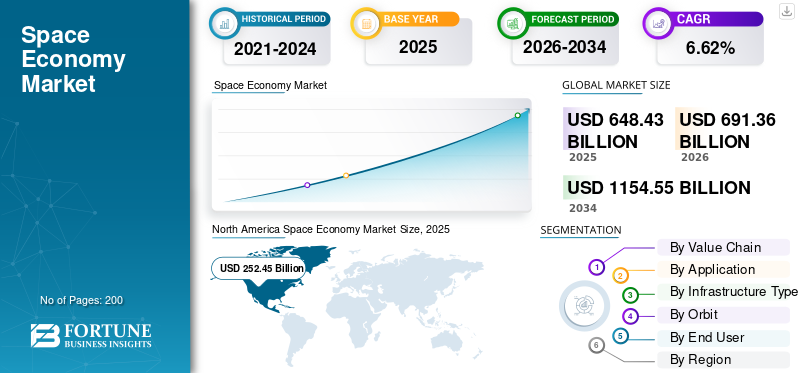
The global space economy market size was valued at USD 648.43 billion in 2025. The market is projected to grow from USD 691.36 billion in 2026 to USD 1154.55 billion by 2034, exhibiting a CAGR of 6.62% during the forecast period. North America dominated the space economy market with a market share of 38.93% in 2025.
The market covers all activities that create value from exploring, operating, managing, and using space. It includes satellites, launch services, ground stations, user terminals, Earth observation, satellite communication, positioning/navigation/timing, space exploration, defense space systems, and emerging in-space services. It is used across telecom, aviation, maritime, agriculture, defense, weather forecasting, logistics, disaster response, banking, insurance, and climate monitoring.
Key players include SpaceX in launch and Starlink broadband, Eutelsat/OneWeb in LEO connectivity, Iridium in mission-critical satcom and IoT, Lockheed Martin and Northrop Grumman in defense and national-security space, Airbus in satellites and commercial LEO infrastructure, and Planet Labs in Earth observation data analytics.
Download Free sample to learn more about this report.
Space Economy Market Key Takeaways
 Global Market Size & Forecast
- 2025 Market Size: USD 648.43 billion
- 2026 Market Size: USD 691.36 billion
- 2034 Forecast Market Size: USD 1154.55 billion
- CAGR: 6.62% from 2026–2034
 Market Share
- North America dominated the space economy market with a market share of 38.93% in 2025.
- The lunar and deep-space infrastructure segment is projected to grow at a high CAGR of 7.32% over the forecast period.
- Cislunar and deep-space domain are projected to grow at a high CAGR of 7.15% during the study period.
 Key Regional Highlights
North America
North America held the dominant share in 2024 at USD 239.06 billion, and also maintained the leading share in 2025, with USD 252.45 billion.
Europe
The regional market is projected to reach USD 166.40 billion in 2026, driven by coordinated space programs, infrastructure development, and expanding downstream applications.
Asia Pacific
The market is estimated to reach USD 152.66 billion in 2026, fueled by rising investments in launch capabilities, satellite constellations, and Earth observation services.
U.S.
The U.S. space economy is analytically estimated at approximately USD 168.01 billion in 2026, supported by federal programs, private investment, and a vertically integrated space industry.
Japan
Japan continues to strengthen its role in the global space economy through investments in satellite technologies, launch capabilities, and international space collaboration initiatives.
Read More

SPACE ECONOMY MARKET TRENDS
Rise in LEO Constellations and Downstream Services is a Market trend
Generative AI, physics-based simulation, and immersive design environments are reshaping aerospace digital twin workflows. Tools such as Siemens NX Immersive Designer combine AR, voice commands, and AI to allow engineers to interact directly with 3D aircraft models. This is shifting key design, testing, and certification decisions into the digital environment before physical parts are produced. Startups such as JetZero are using digital twin software to shorten aircraft development timelines, while initiatives such as the UK Digital Twin Centre in Belfast are showcasing growing public and private investment in aerospace-led digital twin standardization and adoption.
MARKET DYNAMICS
MARKET DRIVERS
Download Free sample to learn more about this report.
Next-Generation Satellite Constellations and Defense Programs to Drive Market Growth
Escalating deployment of LEO satellite constellations and rising government defense mandates are the most consequential drivers of the space economy. SpaceX's Starlink network generated an estimated USD 10.4 billion in revenue in 2025 and surpassed 9 million subscribers, with Amazon's Project Kuiper and other LEO constellations actively expanding, highlighting the commercial value of satellite broadband infrastructure. On the defense side, countries are investing to develop sovereign military space capabilities, with European and Asian countries pledging domestic military space programs amid regional conflicts, while the U.S. military spending on space is poised for rapid growth through programs including the proposed Golden Dome missile shield.
MARKET RESTRAINTS
Orbital Congestion and Fragmented Regulatory Frameworks to Restrain Market Expansion
The rate of expansion of the space sector is being slowed by structural obstacles caused by orbital sustainability and regulatory fragmentation. The density of active objects is now the same order of magnitude as space debris within some densely populated altitude bands in low Earth orbit. As a result, the number of events that trigger collision avoidance procedures increases annually; in 2024, several significant fragmentation events were recorded, adding thousands of new debris objects. In May 2025, the European Union introduced its own Space Act with extraterritorial requirements for businesses seeking to enter the European space markets, making compliance more difficult for international operators.
MARKET OPPORTUNITIES
Space-enabled Enterprise Applications Create New Opportunities
Space‑enabled enterprise applications are generating significant new opportunities by integrating space based connectivity, positioning, and Earth‑observation data into core business processes across industries such as logistics, agriculture, energy, insurance, and finance. These applications support advanced analytics, predictive maintenance, supply‑chain visibility, and climate‑risk modeling, enabling organizations to optimize operations and differentiate services. By linking space‑derived data with terrestrial digital platforms, enterprises can build resilient, data‑driven business models that respond dynamically to environmental and market changes, fostering innovation in both public and private sector and commercial ecosystems.
MARKET CHALLENGES
High Capital Cost and Long Payback Cycles Create Challenges for Growth
The space economy faces a persistent structural challenge due to high capital costs and long payback cycles inherent in developing and deploying satellites, launch systems, and ground infrastructure. Public‑and‑private analyses highlight that these assets require substantial upfront investment in engineering, testing, and regulatory compliance, while returns typically materialize only after years of operational service. Lengthy development timelines, coupled with technological and policy uncertainty, raise the perceived risk for investors and constrain the flow of capital, especially to smaller firms and niche applications. This elevated barrier discourages rapid scaling of space‑enabled services and limits the diversity of players in the ecosystem, even as reusable launch technologies and smaller satellites lower some operational costs, obstructing the space economy market growth.
Segmentation Analysis
By Value Chain
Expanding Data Monetization and Space-Enabled Services to Boost Downstream Space Services
Based on value chain, the market is segmented into upstream space infrastructure, launch and access to space services, downstream space services, space-enabled end-use economy, and others.
The downstream space services segment is anticipated to account for the largest space economy market share. The segment is growing because declining launch costs and proliferating LEO satellites have unlocked an entirely new class of space commercial services that package and sell space-derived data to terrestrial industries.
The launch and access to space services segment is anticipated to rise with a high CAGR of 7.26% over the forecast period.
By Application
Global Broadband Demand and Direct-to-Device Connectivity to Drive Satellite Communication Segment
Based on application, the market is segmented into satellite communication, earth observation and remote sensing, positioning, navigation, and timing, space exploration, national security and defense space, in-space services, and others.
In 2025, the satellite communication segment dominated the global market. The segment’s growth is driven by persistent global connectivity gaps and the commercial viability of LEO broadband constellations have made satellite communication the dominant application pulling investment across the space economy.
The in-space services is projected to grow at a high CAGR of 7.26% over the forecast period.
By Infrastructure Type
Virtual Prototyping Displacing Physical Build-and-Test Cycles to Drive Product Design and Concept Validation Segment
Based on infrastructure type, the market is segmented into satellites, launch vehicles, ground segment infrastructure, orbital and in-space infrastructure, lunar and deep-space infrastructure, and others.
The satellites segment is anticipated to witness a dominating market share over the forecast period. The segment is expanding as OEMs and startups may now construct constellations at commercially feasible scales thanks to significant reductions in per-unit satellite prices brought about by advancements in smallsat technology and automated production.
The lunar and deep-space infrastructure segment is projected to grow at a high CAGR of 7.32% over the forecast period.
By Orbit
Low Latency Requirements and Mega-Constellation Buildout to Sustain Low Earth Orbit Segment’s Dominance
Based on orbit, the market is segmented into low earth orbit, medium earth orbit, geostationary orbit, cislunar and deep-space domain, and others.
The low Earth orbit segment dominated the market share. The market is expanding as operators deploy satellites in LEO orbit owing to the technical demands of broadband connections, Earth observation, and IoT applications, which require the low latency and high revisit rates that only LEO orbits can provide.
In addition, cislunar and deep-space domain are projected to grow at a high CAGR of 7.15% during the study period.
By End User
To know how our report can help streamline your business, Speak to Analyst
Venture Capital Recovery and Commercial Contract Expansion to Strengthen Commercial Space Companies
Based on end user, the market is segmented into commercial space companies, government civil space agencies, defense and intelligence agencies, academic and research institutions, and others.
The commercial space companies segment dominated the market share in 2025. Improving launch economics, maturing business models, and expanding government procurement of commercial space services are collectively raising the commercial viability floor for private companies.
In addition, the defense and intelligence agencies are projected to grow at a CAGR of 7.07% during the forecast period.
Space Economy Market Regional Outlook
By geography, the market is categorized into Europe, North America, Asia Pacific, and the rest of the world.
North America
North America Space Economy Market Size, 2025 (USD Billion)
To get more information on the regional analysis of this market, Download Free sample
North America held the dominant share in 2024 at USD 239.06 billion, and also maintained the leading share in 2025, with USD 252.45 billion. The region anchors the global space economy through sustained federal investment, mature launch infrastructure, and a dense ecosystem of commercial operators and downstream service providers.
U.S Space Economy Market
Based on North America’s strong contribution and the U.S. dominance within the region, the U.S. market can be analytically approximated at around USD 168.01 billion in 2026, accounting for roughly 6.81% CAGR. The U.S. shapes the global space economy through major federal programs, robust venture‑style capital, and a vertically integrated industrial base spanning launch, spacecraft manufacturing, and digital infrastructure.
Europe
Europe is projected to reach USD 166.40 billion in 2026 and record a growth rate of 6.66% during the forecast period, which is the second highest among all regions. The region approaches the space economy as an integrated industrial and policy ecosystem, leveraging the European Space Agency and EU programmes to coordinate civil funding, build critical infrastructure, and foster downstream data‑driven services.
U.K Space Economy Market
The U.K. market in 2026 is estimated at around USD 52.56 billion, representing roughly 6.98% CAGR during the forecast period. The U.K. is positioning itself as a European hub for satellite manufacturing, small‑satellite launch, and Earth‑observation‑based digital services through targeted national strategies and public‑private co‑investment.
Germany Space Economy Market
Germany’s market is projected to reach approximately USD 46.10 billion in 2026. Germany anchors continental Europe’s space‑industry capabilities with strong governmental and industrial participation in satellite communications, navigation, and Earth observation.
Asia Pacific
Asia Pacific is estimated to reach USD 152.66 billion in 2026 and become the third-largest region. It is emerging as a key growth pole for the space economy, driven by national‑scale investments in launch, satellite constellations, and Earth‑observation‑enabled digital services.
China Space Economy Market
China’s market is projected to be one of the largest in Asia Pacific, with 2026 revenues estimated at around USD 48.22 billion. The country is scaling its space economy through centrally coordinated investment in launch infrastructure, navigation, and Earth‑observation systems, coupled with expanding downstream applications in environmental monitoring, transportation, and smart‑city services.
India Space Economy Market
In 2026, the Indian market is estimated at USD 42.29 billion. India is transitioning from a largely government‑led space sector to a hybrid model that integrates public‑sector infrastructure with a rapidly expanding private‑space ecosystem.
Rest of the World
The rest of the world include the Middle East & Africa and Latin America. These regions are developing and are at a nascent stage, however they are strategically important space economies centered on Earth‑observation, communications, and satellite‑based navigation for resource management, urban planning, and security. In 2026, the Middle East & Africa and Latin America markets are set to reach USD 62.58 billion and USD 40.89 billion respectively.
COMPETITIVE LANDSCAPE
Key Industry Players
Innovation and Partnerships by Prominent Companies Shape Market Positioning
The space economy market is moderately consolidated, anchored by major space‑oriented players such as NASA‑aligned industrial primes, ESA‑drawn aerospace groups (including Airbus, Thales Alenia Space, OHB), and national‑scale agencies and contractors in the U.S., Europe, China, and India. Significant positions are also held by large defense‑space integrators and emerging private‑space firms active in launch, small‑sat constellations, Earth observation, and in‑orbit services, which collectively shape a landscape that is neither highly fragmented nor fully oligopolistic.
Leading companies invest in reusable launch and satellite systems, advanced satellite platforms, on‑orbit servicing, and high‑precision Earth‑observation and communications payloads, while forming strategic alliances with national space agencies, commercial operators, and technology providers. These partnerships underpin large‑scale infrastructure such as navigation constellations, digital‑twin‑ready data layers, and secure‑communications networks, helping secure long‑term missions, co‑develop technical standards, and share infrastructure.
LIST OF KEY SPACE ECONOMY COMPANIES PROFILED
- SpaceX (U.S.)
- Boeing (U.S.)
- Lockheed Martin Corporation (U.S.)
- Northrop Grumman (U.S.)
- Airbus (France)
- Thales Alenia Space (France)
- Rocket Lab (New Zealand)
- Maxar Technologies (U.S.)
- OneWeb (U.K.)
- China Aerospace Science and Technology Corporation (CASC) (China)
KEY INDUSTRY DEVELOPMENTS
- April 2026: The U.S. Space Force's Space Systems Command has awarded Lockheed Martin a USD 105 million firm-fixed-price task order to support GPS IIIF launch and on-orbit testing. Services pertaining to the operational control system of the Architecture Evolution Plan (AEP) are covered under this contract along with support for GPS IIIF satellite launch, early orbit operations, and eventual disposal (space vehicles SV11-22).
- April 2026: A U.K. government department has given Network Innovations a multi-year contract to provide a new satellite-enabled personnel monitoring and situational awareness system that will serve employees stationed all over the world. In accordance with the deal, Network Innovations will offer a globally distributed, secure, and resilient architecture for hosting and managing the department's vehicle and personnel monitoring capabilities.
- February 2026: A Japanese satellite manufacturer was hired by JAXA to build and implement a lunar-orbit communications relay that will enable both crewed and uncrewed lunar missions in the future. The project's delivery phases and major milestones are scheduled for 2026.
- December 2025: The Space Development Agency (SDA) has awarded L3Harris Technologies a contract to construct eighteen infrared satellites for the Tranche 3 (T3) Tracking Layer. The deal, which has a maximum value of USD 843 million, covers operations, sustainability, and ground software. The SDA Proliferated Warfighter Space Architecture (PWSA) constellation, which is intended to defend the U.S. against sophisticated missile threats including hypersonic missiles, will be strengthened by these tracking layer satellites.
- September 2024: NASA has given Houston-based Intuitive Machines, LLC a contract to support the agency's lunar relay systems as part of the Near Space Network, which is run by the Goddard Space Flight Center in Greenbelt, Maryland.
REPORT COVERAGE
The global space economy market analysis includes a comprehensive study of the market size & forecast by all the segments included in the report. It includes details on the market dynamics and trends expected to drive the market over the forecast period. It provides information on key aspects, including an overview of technological advancements the regulatory environment, Porter’s five forces analysis, company profiles and retrofitting program. Additionally, it details partnerships, mergers & acquisitions, as well as key aviation industry developments and prevalence by key regions. The report also provides an in-depth competitive landscape with information on the market share and profiles of key operating players.
Request for Customization to gain extensive market insights.
Report Scope & Segmentation
| ATTRIBUTE | DETAILS |
| Study Period | 2021-2034 |
| Base Year | 2025 |
| Estimated Year | 2026 |
| Forecast Period | 2026-2034 |
| Historical Period | 2021-2024 |
| Growth Rate | CAGR of 6.62% from 2026-2034 |
| Unit | Value (USD Billion) |
| Segmentation | By Value Chain, Application, Infrastructure Type, Orbit, End User, and Region |
| By Value Chain |
|
| By Application |
|
| By Infrastructure Type |
|
| By Orbit |
|
| By End User |
|
| By Region |
|
Frequently Asked Questions
According to Fortune Business Insights, the global market value stood at USD 648.43 billion in 2025 and is projected to reach USD 1154.55 billion by 2034.
In 2025, the market value of North America stood at USD 252.45 billion.
The market is expected to grow at a CAGR of 6.62% during the forecast period of 2026-2034.
By value chain, the downstream space services segment is expected to dominate the market.
Next-generation satellite constellations and defense programs is a key factor driving market growth.
Boeing, Airbus, Lockheed Martin, Thales group, and Space X are few key players in the global market.
North America dominated the market in 2025



- 2021-2034
- 2025
- 2021-2024
- 200
Get 30-60 hrs Free Customization
Expand Regional and Country Coverage, Segments Analysis, Company Profiles, Competitive Benchmarking, and End-user Insights.




















Related Reports
-
US +1 833 909 2966 ( Toll Free )
-
Get In Touch With Us