Sulfides Market Size, Share & Industry Analysis, By Type (Sodium Sulfide, Hydrogen Sulfide, Iron Sulfide, and Others), By Application (Pulp & Paper, Leather Processing, Water Treatment & Mining, Oil & Gas, Glass & Optics, and Others), and Regional Forecast, 2026-2034
 Download Free Sample
Sulfides Market Size and Future Outlook
 Listen to Audio Version
The global sulfides market size was valued at USD 1,472.2 million in 2025. The market is projected to grow from USD 1,678.8 million in 2026 to USD 2,333.2 million by 2034, exhibiting a CAGR of 4.2% during the forecast period. Asia Pacific dominated the sulfides market with a market share of 54.55% in 2025.
Sulfides are inorganic and specialty sulfur-bearing compounds that contain sulfide ions or hydrogen sulfide functionality and are used as reducing agents, sulfur donors, flotation reagents, depilatory chemicals, metal precipitants, optical materials, and process gases. Commercial demand spans sodium sulfide flakes and hydrates, hydrogen sulfide streams and specialty gas grades, iron sulfide materials, sodium hydrosulfide and other alkali sulfides, zinc sulfide and other metal sulfides, and selected high-purity sulfide compounds. These materials are supplied for pulp and paper, leather processing, water treatment and mining, oil and gas, glass and optics, chemical intermediates, pigments, and other industrial applications.
Market growth is driven by the continued use of sodium sulfide in kraft pulping and leather depilation and rising demand for sulfide-based heavy-metal precipitation in wastewater treatment. Ore flotation requirements in mining, sour gas treatment and sulfur recovery activity in oil and gas, and growing use of specialty sulfides in infrared optics and high-performance materials are fueling product demand.
The market comprises several major players, including Solvay, Linde plc, Air Liquide S.A., American Elements, and NIHON SEIKO CO., LTD. Product purity, safe handling systems, sulfide concentration, access to sulfur and caustic soda feedstocks, regional distribution, technical support for mining and wastewater applications, and compliance with hazardous chemical transport and storage rules shape these companies' competitive positioning in the global market.
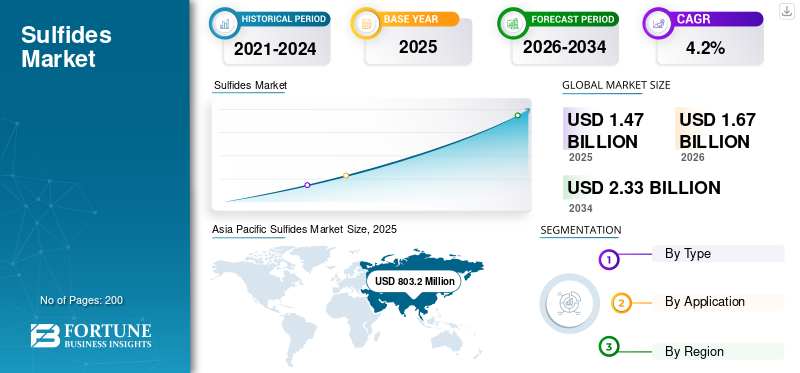
Download Free sample to learn more about this report.
Sulfides Market Key Takeaways
 Global Market Size & Forecast
- 2025 Market Size: USD 1,472.2 million
- 2026 Market Size: USD 1,678.8 million
- 2034 Forecast Market Size: USD 2,333.2 million
- CAGR: 4.2% from 2026-2034
 Market Share
- Asia Pacific dominated the sulfides market with a 54.55% share in 2025.
- The sodium sulfide segment held the largest share of 45.0% in 2025.
- The pulp & paper segment accounted for the largest share of 23.1% in 2025.
 Key Regional Highlights
North America
North America was valued at USD 199.3 million in 2025, supported by steady demand across key industrial applications.
Asia Pacific
Asia Pacific led the market at USD 803.2 million in 2025 and is projected to reach USD 932.6 million in 2026.
Europe
Europe reached USD 229.5 million in 2025 and is expected to experience steady growth over the forecast period.
U.S.
The market is estimated to reach USD 184.9 million in 2026, reflecting strong demand across industrial applications.
Japan
The market is projected to reach USD 209.2 million in 2026, accounting for approximately 12.5% of global sales.
Read More

SULFIDES MARKET TRENDS
Industrial Water Treatment, Mining Reagent Demand, and Specialty Sulfide Adoption are Significant Market Trends
Product demand is increasingly driven by the need to manage heavy metals, sulfur chemistry, and process efficiency across industrial applications. Pulp producers, tanneries, mining companies, wastewater operators, oil and gas processors, and optical material suppliers are placing greater weight on consistent sulfide strength, controlled impurity levels, safe packaging, traceable supply, and application-specific technical support. This is strengthening the commercial role of sodium sulfide, sodium hydrosulfide, hydrogen sulfide, iron sulfide, zinc sulfide, and other metal sulfides across both bulk industrial and specialty material applications.
Alongside industrial use, portfolio strategies are increasingly centered on purity grades and safer application formats. Pulp and paper buyers continue to rely on sodium sulfide-bearing white liquor chemistry; leather processors use sulfide-based depilation systems; mining customers use sulfide reagents for sulfidization, flotation, and metal recovery; wastewater operators use sulfide precipitation for heavy metals; and optics manufacturers use zinc sulfide for infrared windows and multispectral components. As environmental compliance and worker-safety expectations become stricter, suppliers are highlighting closed handling, lower-impurity grades, solution-based formats, and application engineering support.
- For instance, sodium sulfide flakes, sodium hydrosulfide solutions, controlled hydrogen sulfide cylinders, iron sulfide-based remediation materials, and zinc sulfide optical components are strengthening commercial demand for sulfides in industrial processing, wastewater treatment, mining, oil and gas, and glass and optics applications.
MARKET DYNAMICS
MARKET DRIVERS
Download Free sample to learn more about this report.
Kraft Pulping, Leather Processing, Mining, and Wastewater Treatment are Driving Market Growth
Pulp and paper and leather processing remain major demand centers as sulfide chemistry is required for delignification, cooking liquor balance, hide unhairing, and several chemical reduction steps. Sodium sulfide and related sulfide salts are used in kraft pulping, leather beamhouse operations, dye and pigment chemistry, and rubber chemical intermediates. Paper packaging, hygiene paper, leather goods, footwear, and industrial chemical production support demand. Asia Pacific consumption is particularly strong as China, India, and Southeast Asia have large pulp, leather, textile, mining, and chemical-processing bases.
Beyond traditional end uses, stricter industrial water discharge requirements and mining recovery needs are increasing demand for sulfide-based metal precipitation and ore-processing reagents. Sulfides can precipitate metals such as copper, lead, cadmium, zinc, mercury, and nickel from industrial effluents, while sulfide reagents are also used in flotation and sulfidization processes in mineral beneficiation. In oil and gas, hydrogen sulfide removal, acid gas handling, and sulfur recovery remain essential as sour crude and sour gas streams require safe treatment before processing and sale. These structural requirements keep sulfides relevant even when end-market cycles fluctuate.
- For instance, sodium sulfide in kraft pulping, sulfide depilatory agents in leather processing, sodium hydrosulfide in copper and molybdenum flotation, sulfide precipitation in wastewater treatment, and hydrogen sulfide recovery in oil and gas processing are increasingly used as they support process efficiency, compliance, and sulfur management.
MARKET RESTRAINTS
Toxicity, Odor, Corrosiveness, Handling Complexity, and Environmental Scrutiny Can Restrict Market Expansion
The market remains sensitive to hazardous handling requirements, odor concerns, corrosiveness, storage stability, transportation restrictions, and environmental compliance costs. Although sulfides are commercially important, Several sulfide products can release hydrogen sulfide when exposed to acids or moisture. Hydrogen sulfide is toxic, flammable, and corrosive, which increases the need for ventilation, gas detection, enclosed transfer systems, personal protective equipment, and trained handling. These requirements raise adoption costs and can limit consumption among smaller users and price-sensitive customers.
Environmental and operational complexity also restrains the sulfides market growth. Tanneries and pulp mills face pressure to lower sulfide emissions, wastewater sulfide loads, and odor nuisance. Mining and water-treatment users must carefully control dosing to avoid excess sulfide residuals and secondary emissions. In oil and gas, hydrogen sulfide management requires specialized sour-service equipment, corrosion control, and sulfur recovery systems. These factors can slow conversion toward higher-value grades and can push some customers toward alternative chemicals, enzyme-assisted leather processes, or lower-sulfide wastewater treatment routes where technically feasible.
MARKET OPPORTUNITIES
Wastewater Compliance, Sour Gas Treatment, and Specialty Optical Materials are Creating Lucrative Growth Opportunities
Opportunities are emerging from industrial wastewater tightening, mining projects, sour gas processing, and higher-value specialty sulfide applications. Suppliers that can offer stable sulfide solutions, customized concentration, low-iron and low-impurity grades, safe packaging, and technical support are positioned to benefit as industrial users prioritize compliant and efficient treatment systems. Demand is also expected to expand for sodium hydrosulfide, high-purity sodium sulfide, iron sulfide-based remediation materials, and zinc sulfide optics as mining, wastewater, and advanced optical systems continue to grow.
Additional opportunities exist in closed handling systems, liquid sulfide formats, on-site dosing support, and specialty grades for electronics, infrared optics, pigments, and chemical synthesis. Food packaging paper, recovered paper processing, leather goods, wastewater treatment for electroplating and mining, and oil and gas sulfur recovery are higher-value areas where safety, reliability, and performance can justify supplier differentiation. Asia Pacific industrial growth, Middle East sour gas projects, Latin American mining activity, and North American wastewater compliance are expected to support wider adoption over the forecast period.
MARKET CHALLENGES
Safety Management, End-Market Cyclicality, Feedstock Volatility, and Substitution Risk Can Hamper Market Growth
Producers and downstream buyers must balance sulfide performance with toxicity, odor, corrosiveness, effluent quality, worker exposure, packaging integrity, transport classification, and shelf-life control. A sulfide product that works well in one application may be difficult to apply in another due to pH, redox conditions, metal composition, temperature, sulfide concentration, or site ventilation. For example, sulfide precipitation can be very effective for heavy metals. Still, overdosing can create odor and residual sulfide issues, while leather depilation requires careful process control to reduce sulfide discharge.
Regional infrastructure gaps remain a challenge as hazardous chemical training, spill response capability, wastewater monitoring, and safe cylinder or drum logistics are uneven across regions. Adoption also depends on customer qualification, local environmental permitting, raw material availability, and reliability of long-distance shipping. Price volatility in sulfur, caustic soda, energy, and freight can further affect supplier margins. These factors can slow market expansion even when long-term industrial fundamentals remain favorable, especially in fragmented leather, wastewater, and small-scale mining markets.
Segmentation Analysis
By Type
Sodium Sulfide Dominated Market Due to Its Broad Use in Pulp & Paper, Leather Processing, Mining, and Water Treatment
Based on type, the market is segmented into sodium sulfide, hydrogen sulfide, iron sulfide, and others.
The sodium sulfide segment accounted for the largest sulfides market share in 2025, driven by its extensive use as a sulfur source and reducing agent in kraft pulping, leather unhairing, dye intermediates, ore flotation, wastewater treatment, and chemical manufacturing. Sodium sulfide benefits from bulk availability, established process chemistry, and strong use in Asia Pacific manufacturing hubs. Furthermore, the segment held a 45.0% share in 2025.
The hydrogen sulfide segment is expected to grow significantly, driven by ongoing processing requirements, regulatory pressure, and sulfur recovery needs rather than by rapid standalone expansion. The segment is projected to grow at around a 2.8% CAGR during the forecast period.
By Application
To know how our report can help streamline your business, Speak to Analyst
Pulp & Paper Segment Dominated Market Due to Extensive Use of Sulfide Chemistry in Kraft Pulping and Process Chemicals
By application, the market is categorized into pulp & paper, leather processing, water treatment & mining, oil & gas, glass & optics, and others.
The pulp & paper segment accounted for the largest share in 2025. The large global base of kraft pulp mills, packaging paper demand, tissue and hygiene paper production, and continued use of sulfide-bearing cooking liquor chemistry for lignin removal drives the segment's growth. Furthermore, the segment held a 23.1% share in 2025.
The water treatment & mining segment is also expected to grow favorably over the projected period. The segment's demand is driven by sulfide precipitation for heavy metals, mining flotation and sulfidization, mine wastewater management, and stricter industrial discharge norms. The segment is expected to grow at a 5.1% CAGR over the forecast period.
Sulfides Market Regional Outlook
By geography, the market is categorized into North America, Europe, Asia Pacific, Latin America, and the Middle East & Africa.
Asia Pacific
Asia Pacific Sulfides Market Size, 2025 (USD Million)
To get more information on the regional analysis of this market, Download Free sample
Asia Pacific held the dominant share in 2025, valued at approximately USD 803.2 million, and is expected to maintain its leading share in 2026, valued at around USD 932.6 million. The region benefits from its large pulp and paper production base, leather processing capacity, mining activity, textile and dye intermediate demand, wastewater treatment investments, and the central role of China, India, Japan, and South Korea in chemical manufacturing and industrial processing. China remains the largest market, while India, Japan, South Korea, and the broader Asia Pacific region continue to support demand, driven by packaging consumption, leather goods exports, metal processing, and environmental treatment requirements.
China Market
In 2026, the market in China is estimated to reach USD 378.3 million. China's market expansion is supported by its large chemical manufacturing base, pulp and paper production, leather and textile processing, mining and metallurgy activity, wastewater treatment needs, and growing use of specialty sulfides in pigments, optical materials, and industrial intermediates.
To know how our report can help streamline your business, Speak to Analyst
India Sulfides Market
The Indian market in 2026 is estimated at around USD 111.8 million, representing approximately 6.7% of global revenues.
Japan Sulfides Market
The Japanese market is projected to reach approximately USD 209.2 million in 2026, accounting for about 12.5% of global sales.
North America
North America is also a significant contributor to the market. The region was valued at USD 199.3 million in 2025. The market's growth is driven by oil and gas sulfur recovery, industrial wastewater treatment, pulp and paper production, mining chemicals, specialty gases, and high-value optical materials. Application intensity remains strong in the U.S., supported by sour gas handling, refining activity, water treatment compliance, paper packaging demand, and supplier focus on safer sulfide handling and specialty grades.
U.S. Sulfides Market
In 2026, the U.S. market is estimated to reach USD 184.9 million. The U.S. dominates regional consumption due to its large oil and gas processing base, pulp and paper industry, industrial wastewater treatment requirements, mining operations, specialty gas market, and demand for zinc sulfide optical materials in defense, security, thermal imaging, and industrial sensing applications.
Europe
Europe is expected to experience steady growth in the coming years. The European region reached a valuation of USD 229.5 million in 2025 and is projected to grow at approximately 4.0% CAGR during the forecast period. The market's growth is supported by pulp and paper activity, leather and textile finishing, strict industrial wastewater norms, chemical intermediates, specialty gases, and advanced optical materials. The region benefits from technical know-how, strong environmental enforcement, and a greater willingness among industrial customers to qualify safer, higher-purity, and lower-residual sulfide products.
U.K. Sulfides Market
The U.K. market in 2026 is estimated at around USD 32.5 million, representing approximately 1.9% of global revenues.
Germany Sulfides Market
Germany’s market is projected to reach approximately USD 87.7 million in 2026, accounting for about 5.2% of global sales.
Latin America
Latin America is experiencing steady growth. The Latin America market in 2025 reached USD 149.0 million in valuation. Demand is concentrated in mining, pulp and paper, leather processing, water treatment, oil and gas, and chemical intermediates, with Brazil, Mexico, Chile, and Peru representing important country markets. Sulfide reagents used in mineral processing and heavy-metal precipitation continue to support regional adoption, while pulp production and leather goods manufacturing strengthen long-term demand.
Brazil Sulfides Market
Brazil’s market is set to reach approximately USD 62.2 million in 2026, equivalent to around 3.7% of global sales.
Middle East & Africa
The Middle East & Africa region is gradually expanding, supported by GCC-led oil and gas processing, sulfur recovery, sour gas development, industrial water treatment, mining activity, leather processing, and growing chemical manufacturing. GCC countries have the strongest regional demand due to hydrocarbon processing and sour gas treatment requirements, while South Africa and the broader African market support demand from mining, wastewater treatment, leather processing, pulp and paper, and industrial chemicals.
GCC Sulfides Market
GCC is expected to reach USD 39.1 million in 2026, accounting for approximately 2.3% of global revenues.
COMPETITIVE LANDSCAPE
Key Industry Players
Leading Companies are Expanding Sulfide Product Grades to Maintain Their Market Positions
The market includes a mix of global chemical companies, sulfur chemistry specialists, inorganic chemical producers, specialty gas suppliers, mining reagent providers, optical material companies, and regional sodium sulfide manufacturers that supply products for pulp and paper, leather processing, water treatment and mining, oil and gas, glass and optics, dyes, pigments, rubber chemicals, and industrial synthesis. Competition is shaped by access to sulfur and caustic feedstocks, sodium sulfide and hydrosulfide production scale, hazardous chemical handling capabilities, concentration control, impurity management, packaging, logistics, and the ability to provide region-specific technical support.
Leading companies differentiate through high-grade sodium sulfide, sodium hydrosulfide solutions, hydrogen sulfide specialty gases, sulfide process chemistry, zinc sulfide optical materials, wastewater and mining application support, and reliable supply chains for hazardous chemicals. Some key market players include Solvay, Linde plc, Air Liquide S.A., American Elements, and NIHON SEIKO CO., LTD.
LIST OF KEY SULFIDE COMPANIES PROFILED
- Solvay (Belgium)
- Tessenderlo Kerley, Inc. (U.S.)
- Shandong Xuke Chemical Technology Co., Ltd. (China)
- SHANDONG HUNTEC CHEMICAL CO., LTD (China)
- Linde plc (U.K.)
- Air Liquide S.A. (France)
- NIHON SEIKO CO., LTD. (Japan)
- American Elements (U.S.)
- Vital Materials Co., Limited (China)
- SURAT CHEMICAL (India)
KEY INDUSTRY DEVELOPMENTS
- July 2025: Moleko launched new product brand names, including ekoSURE for its high-purity sodium hydrosulfide solution, signaling stronger product positioning and quality-focused branding for industrial sulfide chemical applications.
- November 2024: Baker Hughes and SOCAR signed a contract for an integrated gas recovery and hydrogen sulfide removal system at SOCAR’s Heydar Aliyev Oil Refinery in Baku, signaling stronger adoption of H₂S management technologies in refinery and oil & gas operations.
- September 2024: Aquacycl launched SulfideFix, a biology-based odor-control product for industrial wastewater tanks that removes hydrogen sulfide gases and converts them into biosulfur granules, signaling product innovation in sulfide-emission control for water treatment applications.
- September 2024: LOTTE Energy Materials completed a 70-ton/year pilot plant for sulfide-based solid electrolytes at its Iksan Plant 2 in Jeonbuk, signaling capacity development for specialty sulfide materials used in next-generation battery applications.
- October 2023: Idemitsu Kosan and Toyota started cooperation on mass-production technology and supply-chain development for sulfide solid electrolytes for battery electric vehicles, signaling faster commercialization of lithium sulfide-derived specialty materials.
- June 2022: Idemitsu Kosan and Umicore started joint development of high-performance materials combining cathode materials and solid electrolytes, signaling collaborative R&D momentum for sulfide-based solid-state battery
- November 2021: Idemitsu Kosan began operating a demonstration facility at its Chiba Complex for commercial production of solid electrolytes using high-purity lithium sulfide technology, signaling early industrialization of sulfide-based battery material production.
REPORT COVERAGE
The global sulfides market analysis provides an in-depth study of market size & forecast by all the segments included in the report. It includes details on market dynamics and trends expected to drive the market during the forecast period. It offers information on technological advancements, new product launches, key industry developments, and partnerships, mergers & acquisitions. The market research report also includes a detailed competitive landscape, providing market share and profiles of key players.
Request for Customization to gain extensive market insights.
Report Scope & Segmentation
| ATTRIBUTE | DETAILS |
| Study Period | 2021-2034 |
| Base Year | 2025 |
| Estimated Year | 2026 |
| Forecast Period | 2026-2034 |
| Historical Period | 2021-2024 |
| Growth Rate | CAGR of 4.2% from 2026 to 2034 |
| Unit | Value (USD Million) Volume (Kiloton) |
| Segmentation | By Type, Application, and Region |
| By Type |
|
| By Application |
|
| By Region |
|
Frequently Asked Questions
Fortune Business Insights estimates that the global market size was USD 1,472.2 million in 2025 and is projected to reach USD 2,333.2 million by 2034.
Recording a CAGR of 4.2%, the market is slated to exhibit steady growth during the forecast period.
The pulp & paper application segment led the market.
Asia Pacific held the highest market share in 2025.
Solvay, Linde plc, Air Liquide S.A., American Elements, and NIHON SEIKO CO., LTD. are some of the prominent players in the market.
Kraft pulping, leather processing, mining, and wastewater treatment are driving market growth.
Cost-effectiveness, strong reducing properties, broad industrial utility, and increasing demand from chemical processing and wastewater treatment are favoring sulfide adoption.



- 2021-2034
- 2025
- 2021-2024
- 200
Get 30-60 hrs Free Customization
Expand Regional and Country Coverage, Segments Analysis, Company Profiles, Competitive Benchmarking, and End-user Insights.


















Related Reports
-
US +1 833 909 2966 ( Toll Free )
-
Get In Touch With Us