Terrestrial Free Space Optical (FSO) Communication Market Size, Share & Industry Analysis, By Type (Point-to-Point (PtP) and Point-to-Multipoint (PtMP)), By Range (Short, Medium, and Long), By Component (Transmitter Assembly and Receiver Assembly), and Regional Forecast, 2026-2034
 Download Free Sample
KEY MARKET INSIGHTS
 Listen to Audio Version
The global Terrestrial Free Space Optical (FSO) Communication market size was valued at USD 279.3 million in 2025 and is projected to grow from USD 316.7 million in 2026 to USD 1005.6 million by 2034, exhibiting a CAGR of 15.54% during the forecast period. North America dominated the dental market with a market share of 72.44% in 2025.
A terrestrial Free Space Optical (FSO) communication is an optical wireless communication system that transmits data through the atmosphere. It uses laser beams that transmit data between two points on Earth. It is designed to offer high speed, high bandwidth, and secure communication. This system is adopted in environments where traditional wired connections, such as fiber optics, are difficult to install or are costly. FSO is not affected by electromagnetic interference, unlike radio frequency (RF) communication, ensuring reliable performance in noisy environments.
Key players in the market, such as fSONA, Mynaric AG, and others, are focused on the development of high-speed optical communications for various ground applications. They are invested in the design and implementation of transmitters, receivers, and optical components. Moreover, the companies are aiming at the expansion of use cases of FSO in ground applications such as last-mile connectivity, disaster recovery, and emergency communication for long distances, and others. In addition, companies such as Mynaric AG are manufacturing FSO terminals that operate in license-free spectrum.
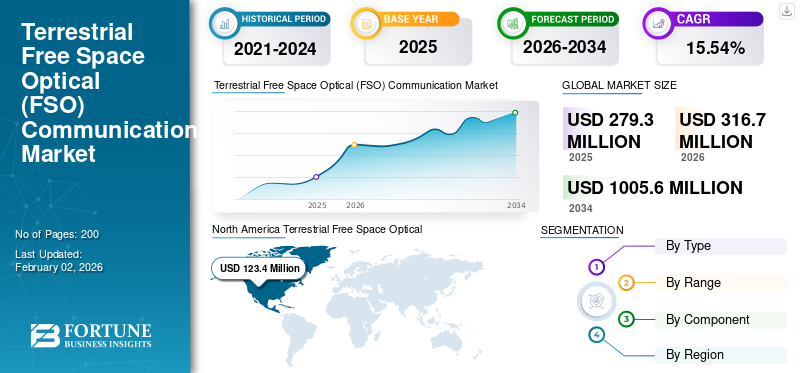
Download Free sample to learn more about this report.
Terrestrial Free Space Optical (FSO) Communication Market Key Takeaways
 Global Market Size & Forecast
- 2025 Market Size: USD 279.3 million
- 2026 Market Size: USD 316.7 million
- 2034 Forecast Market Size: USD 1,005.6 million
- CAGR: 15.54% from 2026–2034
 Market Share
- North America dominated the market with a 72.44% share, reaching USD 123.4 million in 2025.
- Point-to-Point (PtP) dominated the market due to its reliable and secure high-bandwidth communication.
- Short-range segment dominated the market owing to its cost-effectiveness and ease of deployment.
 Key Regional Highlights
North America
North America reached USD 123.4 million in 2025 and is projected to reach USD 133.7 million in 2026.
Asia Pacific
Asia Pacific reached USD 40.3 million in 2025 and is projected to reach USD 49.5 million in 2026.
Europe
Europe reached USD 115.3 million in 2025 and is projected to reach USD 133.1 million in 2026.
U.S.
The U.S. is witnessing rising adoption of FSO for defense and enterprise communications.
Japan
Japan is seeing steady growth, driven by expanding 5G and optical networks.
Read More

Terrestrial Free Space Optical (FSO) Communication Market Trends
SWIR Driving Evolution of Free Space Optical (FSO) Communication
Free Space Optical (FSO) communications rely heavily on the quality and reliability of transmitted signals. But due to the limitations of FSO communication, such as obstruction of signal transmission due to weather effects such as fog, rain, and snow. Moreover, challenges such as atmospheric conditions, including dust, water vapor, scintillation, scatter light and degrade the overall signal quality. Therefore, there is a growing trend in the integration of FSO systems with Short-Wave Infrared (SWIR) cameras, which offer several key benefits, making them a suitable choice for high-quality data transmission. With the integration of SWIR, FSO technology leverages the specific properties of SWIR land-based lasers, such as penetration of environmental obstacles, such as fog and dust. For instance, Xenics, a leading Exosens brand, offers the Cheetah+ series, a high-speed SWIR camera specifically designed for advanced Free Space Optical (FSO) communication systems.
Download Free sample to learn more about this report.
Market Dynamics
Market Drivers
Rise in Demand for High Bandwidth and High Speed Connectivity to Boost Market Expansion
The increase in data consumption across various sectors such as telecommunications, enterprise IT, cloud computing, video streaming, and others has driven the need for high bandwidth and high-speed communication structures. With the rise in installation of applications that work on an extensive amount of data, there is also an increase in pressure on existing network systems to deliver faster and more reliable data transmission continues to grow.
Terrestrial Free Space Optical (FSO) Communication systems are well-suited to address this demand as they are capable of delivering gigabit-per-second (Gbps) data rates, as compared to fiber optics networks. Unlike traditional wired systems, FSO uses laser-based optical transmission through air, enabling a high-capacity data transfer without the need for physical cables. All these factors are expected to create Terrestrial Free Space Optical (FSO) Communication as a suitable solution for applications such as last-mile connectivity, enterprise communication, and others.
Market Restraints
Atmospheric Interference Due to Weather Conditions and Turbulence to Hinder Market Growth
One significant restraint to Free Space Optics (FSO) is the atmospheric interference created by obstacles such as fog, rain, and dust. FSO systems are reliant on the transmission of light beams through the atmosphere to enable high-speed data communication. Obstacles such as fog, rain, snow, and even strong winds can scatter or absorb the optical signal, decreasing its intensity and potentially causing data loss or link failure. Temperature and pressure variations create turbulent eddies that distort the optical beam, causing fluctuations in signal strength (scintillation) and making it difficult to maintain a consistent connection. Therefore, such disadvantages are expected to hamper the Terrestrial Free Space Optical (FSO) Communication market growth in the coming years.
Market Opportunities
Adoption of Free Space Optics for 5G Backhaul/Fronthaul to Drive Growth Opportunities
Due to the rise in use of data-intensive applications, there is a need for communication technology to enable faster data speeds and lower latency. 5G is well-positioned to support such use cases that need continuous high-speed communication or rely on fast data transfer. Free Space Optics (FSO) is a technology that can be used for both backhaul and fronthaul in wireless communication networks, particularly in 5G and beyond. Free Space Optics (FSO) technology provides high bandwidth and is less likely to experience interference issues as compared to traditional radio frequency (RF) solutions.
Market Challenges
Lack of Standardization Poses a Significant Challenge for Market
The market still has no widely adopted single universal industry standard. This leads to compatibility issues between vendors and makes integration with existing telecom infrastructure more complex. FSO systems must comply with laser safety standards, which are categorized by wavelength and power density. Moreover, there is a need for the establishment of regulatory standards so that multiple Terrestrial Free Space Optical (FSO) communications can work together without creating interference among each other. Thus, the lack of standardization in the terrestrial segment of the global free space optical communication industry is expected to bring challenges for the growth of the market.
Segmentation Analysis
By Type
Point-to-Point (PtP) Segment Holds Largest Market Share Due to Straightforward Deployment and High Reliability
On the basis of range, the market is classified into Point-to-Point (PtP) and Point-to-Multipoint (PtMP).
The Point-to-Point (PtP) segment holds the largest Terrestrial Free Space Optical (FSO) Communication market share as it is preferred due to its straight deployment and increased reliability for establishing secure communication between fixed locations. The segment growth is significant as it is used increasingly for connecting buildings and last-mile access for single customers, fiber channel extension, and for applications that require high bandwidth and increased security.
The Point-to-Multipoint (PtMP) segment is expected to grow at the fastest CAGR over the forecast period, owing to its scalability and efficiency in serving multiple endpoints from a single transmitter. The PtMP communication reduces the need for high deployment costs for establishing individual PtP links for each connection.
By Range
Short Segment Held Largest Market Share Due to Cost-Effectiveness and Higher Efficiency
On the basis of range, the market is classified into short, medium, and large.
The short segment holds the largest share due to an increase in demand for high data rates and quick deployment. The short-range free space optical system is installed on a large scale as it provides cost- cost-effectiveness, ease of installation, and high bandwidth.
The medium segment is expected to grow at the fastest CAGR owing to its advantages, such as high performance and affordability. Moreover, medium-range free-space optical communication is expected to gain popularity due to its use for connecting buildings and providing access to high-speed internet. There rise in development and testing of free space optical communication for communication with different ranges. For instance, in April 2025, NEC Corporation conducted an observation test between a pair of FSO communication devices located more than 10 km apart.
To know how our report can help streamline your business, Speak to Analyst
By Component
Receiver Assembly Segment to Hold Largest Share Due to Increase in Demand for High Bandwidth and Secure Communication
On the basis of the component, the market is classified into transmitter assembly and receiver assembly.
The receiver assembly segment is projected to remain the dominant segment in the global market. The increasing demand for high-speed secure communication contributes to the growth of the segment. Moreover, there is a rise in research for designing effective and secure receiver assemblies, which also helps the market growth. For instance, in April 2025, researchers in Paris and Milan announced that they had developed a new type of secure receiver for free space optics.
The transmission assembly segment is estimated to grow at the fastest CAGR over the forecast period. Transmitters are key components in free space optics and play an essential role in allowing high-speed data and secure communication. Factors such as the rise of smartphones on and government initiatives promoting IoT are also driving the adoption of Terrestrial Free Space Optical (FSO) Communication technology, which in turn, drives the growth of the transmission assembly segment in the market.
Terrestrial Free Space Optical (FSO) Communication Market Regional Outlook
On the basis of region, the terrestrial FSO market is studied across North America, Europe, Asia Pacific, and the Rest of the World.
North America
North America Terrestrial Free Space Optical (FSO) Communication Market Size, 2025 (USD Million) To get more information on the regional analysis of this market, Download Free sample
The North America market generated USD 123.4 million in 2025, representing 72.44% of the global market landscape, and is expected to reach USD 133.7 million in 2026. North America currently holds the largest market share. The countries in the region use free space optical communication in various industries such as aerospace, enterprise, military, and others. Moreover, there is an increase in design and development of free-space optical (FSO) communication in the U.S. defense to aid communication within terrestrial and expeditionary applications. For instance, in April 2023, Viasat, a global communication company based in the U.S., debuted its Mercury Free Space Optical Communications (FSOC) terminal at a military event, U.S. Special Operations Command (SOCOM) Technical Experimentation (TE). The solution was designed for terrestrial communication applications, resistant to jamming, spoofing, and electromagnetic interference.
Europe
Europe contributed 80.03% to the global market in 2025, with a valuation of USD 115.3 million, and is projected to reach USD 133.1 million in 2026. The market is growing at a moderate rate in the region, owing to an increase in the use of free space optics for efficient communication. In addition, the demand for free space optical communication systems increases as the countries in the region are adopting free space optics technology for communication, defense, and smart city initiatives. Growing geopolitical tensions and the increasing importance of robust military capabilities are driving the adoption of FSO for secure tactical and strategic communication in European countries.
Asia Pacific
Asia Pacific accounted for USD 40.3 million in 2025, representing 84.30% of the global market share, and is projected to reach USD 49.5 million in 2026. Asia Pacific is growing at a significant rate in the market, owing to the surge in deployment of 5G infrastructure in countries such as China and Japan. This 5G connectivity fuels the demand for high-speed backhaul solutions that FSO can efficiently provide, especially in urban environments where fiber deployment is difficult. Moreover, FSO can be installed in developing countries of the region where fiber optics installation can be challenging or in remote areas where laying cables is impractical. In addition, there is evolution in optical networks in the region alongside terrestrial advancements and expansion of 5G and 6G technology. For instance, in February 2025, China Unicom launched its first free-space optical (FSO) communication service, deploying a 1.5-kilometer cross-lake link to an island.
Rest of the World
In 2025, the Rest of the World market stood at USD 0.3 million, and is projected to grow to USD 0.4 million in 2026. FSO is increasingly being used in the sub-regions of the rest of the world, such as Latin America, the Middle East & Africa for extending metro networks, connecting new networks, providing backhaul solutions for 5G, and enterprise applications. Moreover, the use of free space optics as backup, along with fiber optics networks for disaster and recovery applications, during last-mile connectivity is expected to propel the growth of the market during the forecast period. In addition, the Middle East region is strongly focusing on the creation of smart cities, which is expected to increase the demand for FSO to provide secure, high-speed communication for IoT devices and other applications.
Middle East & Africa
In 2025, Middle East & Africa reaching a valuation of USD 0.1 million, and is projected to grow to USD 0.2 million in 2026.
Competitive Landscape
Key Market Players
Key Players Focus on Investment in Research & Development and Strategic Partnerships to Enhance Their Market Presence
The market is highly competitive, driven by the increase in demand for high-speed and secure communication. Market players in the FSO market, such as Mynariac AG, fSONA, LightPointe Communications, and others, are focusing on key strategies such as R&D, product innovation, new product launches, acquisitions, partnerships, and geographic expansion to stay competitive. Moreover, there is also a rise in the collaboration with technology providers, system integrators, and telecom carriers to offer comprehensive solutions and expand market reach. In addition, the expansion of the use of free space optics in various industries, including defense sectors and telecommunications, and others, is prompting key players to design and develop advanced and customized FSO solutions.
LIST OF KEY TERRESTRIAL FREE SPACE OPTICAL (FSO) COMMUNICATION COMPANIES PROFILED:
- Mynaric AG (Germany)
- fSONA (Canada)
- Viasat, Inc. (U.S.)
- EC System (Czech Republic)
- Wireless Excellence Limited (U.K.)
- General Dynamics Mission Systems, Inc. (U.S.)
- Axiom Optics (U.S.)
- ALTAAS Topologies Sdn Bhd (Malaysia)
- Exosens (France)
- Exail (France)
- Mostcom JSC (Russia)
KEY INDUSTRY DEVELOPMENTS
- October 2025: Intelligent Waves LLC and Signify N.V. announced the formation of IllumiConn™, a joint venture focused on infrared-based wireless communications utilizing Free-Space Optics and LiFi technologies for mission-critical environments. The strategic objective was to deliver secure high-speed connectivity solutions for government and defense applications. Capabilities involved/Technologies included free-space optics, LiFi networking, infrared wireless transmission, cybersecurity integration, and terrestrial free space optical communication market secure connectivity capabilities.
- September 2025: AGPhotonics S.L. launched the Vulcan™ integrated photonic product line for free-space optical communication terminals, enabling compact optical wireless systems through chip-scale integration. The strategic objective was to reduce size, weight, and power requirements while expanding deployment opportunities for optical wireless links. Capabilities involved/Technologies included optical phased arrays, integrated photonics, on-chip beam steering, optical transceiver integration, and terrestrial free space optical communication market high-capacity transmission capabilities.
- September 2025: Voyager Technologies, Inc. announced the acquisition of BridgeComm Technologies’ optical communications assets, accelerating development of advanced laser-based communications solutions for defense and commercial networks. The strategic objective was to expand optical communications capabilities and shorten product development timelines. Capabilities involved/Technologies included laser communications, optical networking, secure data transmission, scalable communication architectures, and terrestrial free space optical communication market infrastructure capabilities.
- July 2025: General Dynamics Mission Systems, Inc. reported a successful 52-kilometer field demonstration of its PhantomLink™ free-space optics platform, supporting data rates of up to 10 Gbps for voice, video, and data transport applications. The strategic objective was to strengthen resilient communications options for contested and bandwidth-intensive environments. Capabilities involved/Technologies included free-space optical transmission, secure data transport, high-bandwidth networking, RF-interference immunity, and terrestrial free space optical communication market network resilience capabilities.
- April 2025: NEC Corporation announced the successful completion of Japan’s longest terrestrial free-space optical communication demonstration, achieving stable wireless optical transmission over distances exceeding 10 kilometers. The strategic objective was to accelerate commercialization of optical wireless networking for high-capacity and secure communications infrastructure. Capabilities involved/Technologies included automatic beam acquisition, optical beam tracking, atmospheric turbulence compensation, long-distance optical transmission, and terrestrial free space optical communication market connectivity capabilities.
- In December 2024, Airtel, a global telecommunication company, announced the use of Free-Space Optical Communications (FSOC) to overcome the limitations of fiber and microwave technologies for mobile backhaul.
- In April 2023, Viasat announced the launch of its new Mercury Free Space Optical Communications (FSOC) terminal during the U.S. Special Operations Command (SOCOM) Technical Experimentation (TE) event.
- In May 2023, Raytheon Technologies announced the launch of NexGen Optix, a tactical Free-Space Optical Communications system that enables high-speed, secure data transfer in challenging environments.
REPORT COVERAGE
The report provides a detailed analysis of the sector and focuses on important aspects such as key players, types, ranges, and components, depending on various regions. Moreover, the research report offers deep insights into the Terrestrial Free Space Optical (FSO) Communication market trends, competitive landscape, market competition, and market share and status, and highlights key industry developments. Additionally, it encompasses several direct and indirect factors that have contributed to the growth of the market in recent years.
Request for Customization to gain extensive market insights.
Report Scope & Segmentation
|
ATTRIBUTE |
DETAILS |
|
Study Period |
2021-2034 |
|
Base Year |
2025 |
|
Estimated Year |
2026 |
|
Forecast Period |
2026-2034 |
|
Historical Period |
2021-2024 |
|
Unit |
Value (USD Million) |
|
Growth Rate |
CAGR of 15.54% from 2026 to 2034 |
|
Segmentation |
By Type
|
|
By Range
|
|
|
By Component
|
|
|
By Region North America (By Type, By Range, By Component, and By Country)
Europe (By Type, By Range, By Component, and By Country)
Asia Pacific (By Type, By Range, By Component, and By Country)
Rest of the World (By Type, By Range, By Component, and By Country)
|
Frequently Asked Questions
Fortune Business Insights says that the global market stood at USD 279.3 million in 2025 and is projected to reach USD 1005.6 million by 2034.
By range, the short segment leads the market.
Mynaric AG (Germany), fSONA (Canada), Viasat, Inc. (U.S.), EC System (Czech Republic), Wireless Excellence Limited (UK) are some of the leading players in the market.
North America dominates the market in terms of share.
In 2025, the market value stood at USD 123.4 million.
The key factor driving the market is the rise in demand for high bandwidth and high-speed connectivity.



- 2021-2034
- 2025
- 2021-2024
- 200
Get 30-60 hrs Free Customization
Expand Regional and Country Coverage, Segments Analysis, Company Profiles, Competitive Benchmarking, and End-user Insights.




















Related Reports
-
US +1 833 909 2966 ( Toll Free )
-
Get In Touch With Us