Transportation Biofuels Market Size, Share & Industry Analysis, By Fuel Type (Bioethanol, Biodiesel/FAME, Renewable Diesel / HVO, Sustainable Aviation Fuel, and Others), By Feedstock (Maize / Corn, Sugarcane & Sugar Crops, Vegetable Oils, Used Cooking Oil, Tallow & Waste Oils, and Others), By Generation (First-generation Biofuels, Second-generation / Advanced Biofuels, Third-generation Biofuels, and Others), By End User (Passenger Vehicles, Commercial Vehicles, Heavy-duty Trucks & Buses, Aviation Operators, and Others), Regional Forecast, 2026–2034
 Download Free Sample
Transportation Biofuels Market Size and Future Outlook
 Listen to Audio Version
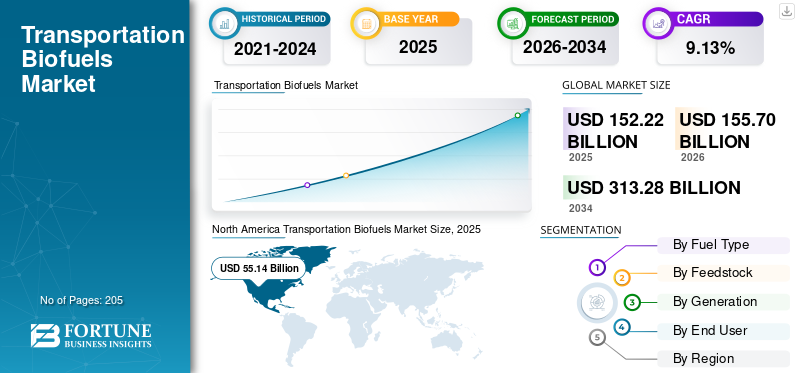
The transportation biofuels market size was valued at USD 152.22 billion in 2025. The market is projected to grow from USD 155.70 billion in 2026 to USD 313.28 billion by 2034, exhibiting a CAGR of 9.13% during the forecast period. North America dominated the transportation biofuels market with a market share of 36.22% in 2025.
Transportation biofuels are renewable fuels produced from biological feedstocks such as maize /corn, sugarcane & sugar crops, vegetable oils, used cooking oil, tallow & waste oils, and other biomass sources for use in the transportation sector. Major transportation biofuels include bioethanol, biodiesel (FAME), renewable diesel (HVO), sustainable aviation fuel (SAF), and others, each offering a lower-carbon alternative to conventional petroleum-based fuels. These fuels can be used either as blends with fossil fuels or, depending on the fuel type and engine compatibility, as direct replacements, helping reduce greenhouse gas emissions while supporting energy diversification.
The growing emphasis on decarbonizing road, aviation, and commercial transportation is driving the market growth worldwide. Increasing government mandates on renewable fuel blending, stringent emission regulations, rising investments in advanced biofuel production technologies, and the availability of sustainable feedstocks are also accelerating market growth. Transportation biofuels play a vital role in reducing lifecycle carbon emissions, enhancing energy security, promoting the circular economy through the utilization of waste-based feedstocks, and supporting global climate objectives. As countries pursue net-zero emission targets, governments, fuel producers, and the transport sector are increasingly investing in biofuel production capacity, supply chain infrastructure, and next-generation feedstocks to facilitate the transition toward a more sustainable transportation sector.
- For instance, in May 2026, Archer Daniels Midland Company (ADM) maximized its oilseed crushing networks to achieve record global site production, driven by the stabilization of U.S. Renewable Volume Obligations and biofuel policy clarity. By increasing North American crush rates by roughly 10%, this initiative improved low-carbon vegetable oil supply for renewable diesel production and reduced agricultural portfolio volatility. For more details
Some of the leading companies operating in the market include Neste Oyj, POET, LLC, Archer Daniels Midland Company, Valero Energy Corporation, Raízen S.A., BP Bunge Bioenergia, and Chevron Renewable Energy Group. These companies are actively involved in the transportation biofuels value chain, biofuel production, sustainable feedstock sourcing, advanced refining technologies, and capacity expansion. Their strategic initiatives, including new production facilities, partnerships, and investments in renewable fuel technologies, support the development and adoption of low-carbon transportation fuels globally.
Download Free sample to learn more about this report.
TRANSPORTATION BIOFUELS MARKET KEY TAKEAWAYS
 Global Market Size & Forecast
- 2025 Market Size: USD 152.22 billion
- 2026 Market Size: USD 155.70 billion
- 2034 Forecast Market Size: USD 313.28 billion
- CAGR: 9.13% from 2026–2034
 Market Share
- North America dominated the market with a 36.22% share in 2025.
- The Bioethanol segment held the largest market share 55.14% in 2025.
- The Maize/Corn segment held the largest market share 32.42% in 2025.
 Key Regional Highlights
North America
North America reached USD 55.14 billion in 2025 and is projected to reach USD 56.21 billion in 2026, supported by renewable fuel policies, blending mandates, and investments in renewable diesel and SAF.
Europe
Europe reached USD 41.29 billion in 2025, growing at a 7.94% CAGR, driven by stringent carbon-emission regulations and ambitious renewable energy targets.
Asia Pacific
Asia Pacific reached USD 38.95 billion in 2025, emerging as the fastest-growing region due to rising energy demand, supportive policies, and expanding biofuel production.
U.S.
The market reached USD 48.78 billion in 2025, accounting for approximately 32.04% of the global market, supported by strong biofuel production infrastructure and renewable fuel mandates.
Japan
Growth is supported by increasing adoption of low-carbon transportation fuels, government decarbonization initiatives, and investments in sustainable aviation fuel and advanced biofuel technologies.
Read More

TRANSPORTATION BIOFUELS MARKET TRENDS
Growing Demand for Advanced Biofuels and Sustainable Feedstocks are Key Market Trends
A key trend shaping the market is the increasing adoption of advanced biofuels produced from sustainable feedstock such as used cooking oil, animal fats, agricultural residues, and other waste-based biomass such as maize /corn, sugarcane & sugar crops, vegetable oils, used cooking oil, tallow & waste oils, and other. Growing concerns over carbon emissions, coupled with stringent government blending mandates and low-carbon fuel policies, are encouraging the use of renewable alternatives to conventional fossil fuels.
The market is further driven by rising demand for renewable diesel (HVO) and sustainable aviation fuel (SAF), particularly from commercial transportation and aviation sectors. In addition, continuous investments in advanced bio-refining technologies, feedstock diversification, and production capacity expansion are improving fuel efficiency, reducing lifecycle emissions, and supporting long-term growth of the market.
MARKET DYNAMICS
MARKET DRIVERS
Download Free sample to learn more about this report.
Rising Demand for Low-Carbon Transportation Fuels is Driving Market Growth
The increasing focus on reducing greenhouse gas emissions and achieving net-zero targets is a major driver of the transportation biofuels market growth. Governments across the globe are implementing renewable fuel blending mandates, low-carbon fuel standards, and supportive policies to encourage the adoption of sustainable alternatives such as bioethanol, biodiesel, renewable diesel (HVO), and sustainable aviation fuel (SAF). These initiatives are accelerating investments in biofuel production and expanding their use across road, commercial, and aviation transportation.
Furthermore, growing concerns over energy security, rising fossil fuel prices, and increasing demand for cleaner transportation fuels are driving market expansion. Advancements in biofuel production technologies, greater utilization of waste-based feedstocks, and continuous investments in production capacity are improving fuel availability and reducing lifecycle carbon emissions. These factors are expected to support the long-term growth of the market during the forecast period.
|
Rank |
Market Driver |
Relative Impact on Market Growth |
CAGR Contribution (%) |
2026-2028 |
2029-2031 |
2032-2034 |
|
1 |
Government Biofuel Blending Mandates and Renewable Fuel Policies |
High |
4.20% |
High |
High |
High |
|
2 |
Growing Decarbonization of Road Transportation and Net-Zero Commitments |
High |
2.80% |
Medium |
High |
High |
|
3 |
Expansion of Advanced Biofuel Production Capacity and Feedstock Availability |
High |
1.90% |
Medium |
High |
High |
|
4 |
Increasing Investments by Oil Companies in Renewable Diesel and Sustainable Biofuel Infrastructure |
Medium |
1.20% |
High |
Medium |
Medium |
|
5 |
Rising Demand from Commercial Fleets and Heavy-Duty Transport |
Medium |
0.80% |
Medium |
Medium |
High |
|
6 |
Others |
Low |
0.40% |
Low |
Medium |
Medium |
|
Total Positive CAGR Contribution |
|
|
11.30% |
|
|
|
MARKET RESTRAINTS
High Production Costs and Feedstock Availability Challenges to Hamper Market Expansion
One of the major restraints affecting the market is the high production cost associated with advanced biofuels and the limited availability of sustainable feedstocks. Producing bioethanol, renewable diesel (HVO), and sustainable aviation fuel (SAF) often requires significant capital investment in advanced processing technologies, refining infrastructure, and feedstock procurement. In addition, fluctuations in the supply and prices of crops, vegetable oils, and waste-based feedstocks can increase production costs and impact profit margins. These challenges, particularly in developing economies, may limit large-scale adoption and restrain the growth of the market during the forecast period.
|
Rank |
Market Restraint |
Negative CAGR Contribution (%) |
Impact on Market Growth |
2026-2028 |
2029-2031 |
2032-2034 |
|
1 |
Feedstock Price Volatility and Supply Constraints |
0.90% |
High |
High |
High |
Medium |
|
2 |
Competition from Electric Vehicles and Alternative Low-Carbon Fuels |
0.60% |
Medium |
Medium |
Medium |
High |
|
3 |
Sustainability Concerns and Land Use Regulations |
0.45% |
Medium |
Medium |
Medium |
Medium |
|
4 |
Others |
0.22% |
Low |
Low |
Low |
Low |
|
Total Negative CAGR Contribution |
|
2.17% |
|
|
|
|
MARKET OPPORTUNITIES
Growing Demand for Sustainable Aviation Fuel and Advanced Biofuels to Create New Opportunities
The increasing demand for sustainable aviation fuel (SAF) and advanced biofuels presents a significant growth opportunity for the market. As governments and aviation authorities introduce stringent carbon reduction targets, airlines and fuel producers are investing heavily in SAF production and next-generation biofuel technologies. Similarly, the growing use of waste-based feedstocks, such as used cooking oil, animal fats, and agricultural residues, is creating new opportunities for sustainable and cost-effective biofuel production.
Furthermore, continuous advancements in bio-refining technologies, expanding production capacities, and supportive government incentives are encouraging investments across the biofuel value chain. Rising adoption of renewable diesel (HVO) and advanced biofuels in commercial transportation, aviation, and heavy-duty vehicles is expected to create substantial growth opportunities for the market during the forecast period.
MARKET CHALLENGES
Lack of Standardized Policies and Incentive Frameworks to Challenge Market Growth
A major challenge in the industry is the lack of consistent global policies, standards, and incentive frameworks supporting biofuel production and adoption. Regulatory structures for blending mandates, sustainability certification, and carbon accounting vary significantly across regions, creating uncertainty for producers and investors. This lack of harmonization can limit cross-border trade and slow down the large-scale commercialization of advanced biofuels. In addition, unclear long-term policy commitments and fluctuating subsidy structures in some countries can impact investment confidence in biofuel production facilities and supply chains.
Segmentation Analysis
By Fuel Type
Bioethanol Dominates Due to its Widespread Availability and Established Production Infrastructure
Based on fuel type, the market is classified into bioethanol, biodiesel/FAME, renewable diesel / HVO, sustainable aviation fuel, and others.
In 2025, bioethanol dominated the market share, accounting for 55.14% of the market. This growth is primarily attributed to its well-established production infrastructure, widespread availability of feedstocks such as corn and sugarcane, and extensive use as gasoline blending fuel across major markets. Additionally, supportive government blending mandates, favorable renewable fuel policies, and increasing demand for low-carbon transportation fuels have significantly contributed to the dominance of the segment.
The renewable diesel / HVO segment is expected to grow at a CAGR of 11.80% over the forecast period.
To know how our report can help streamline your business, Speak to Analyst
By Feedstock
Maize / Corn Segment Dominants Owing to its Widespread Availability and High Bioethanol Production
Based on the segmentation of feedstock, the market is segmented into maize/corn, sugarcane & sugar crops, vegetable oils, used cooking oil, tallow & waste oils, and others.
In 2025, the maize / corn segment dominated the market, accounting for 32.42% of the market. This dominance is primarily attributed to the widespread availability of corn, its high ethanol yield, and the presence of well-established bioethanol production facilities. Additionally, favorable government blending mandates, strong agricultural production, and increasing demand for renewable transportation fuels have reinforced the leading position of the segment.
The used cooking oil, tallow & waste oils are expected to grow at a CAGR of 11.37% over the forecast period.
By Generation
First-generation Biofuels is Dominating Due to Their Commercial Maturity and Established Production Infrastructure
Based on the generation, the market is classified into first-generation biofuels, second-generation / advanced biofuels, third-generation biofuels, and others.
In 2025, the first-generation biofuels segment held the largest transportation biofuels market share, accounting for 76.39% of the market. This dominance is primarily attributed to their well-established production technologies, abundant availability of feedstock such as corn, sugarcane, and vegetable oils, and widespread commercial adoption. In addition, supportive government blending mandates, mature supply chains, and extensive production capacity have strengthened the market position of first-generation biofuels across the road transportation sector.
The second-generation / advanced biofuels segment is expected to grow at the highest CAGR of 9.96% during the forecast period.
By End User
Passenger Vehicles is Leading due to High Biofuel Consumption and Supportive Blending Mandates
Based on the end user, the market is divided into passenger vehicles, commercial vehicles, heavy-duty trucks & buses, aviation operators, and others.
In 2025, the passenger vehicles segment dominated the market, accounting for 44.55% of the market. This dominance is primarily attributed to the large global passenger vehicle fleet, widespread adoption of bioethanol-blended gasoline and biodiesel blends, and government policies promoting renewable transportation fuels. Increasing consumer demand for cleaner mobility solutions and stringent vehicle emission regulations have further supported the growth of this segment.
The aviation operators sector is predicted to grow at a CAGR of 12.65% during the forecast period.
Transportation Biofuels Market Regional Outlook
By geography, the market is categorized into North America, Europe, Asia Pacific, Latin America, and Middle East & Africa.
North America
North America Transportation Biofuels Market Size, 2025 (USD Billion)
To get more information on the regional analysis of this market, Download Free sample
North America has the largest market, valued at USD 55.14 billion in 2025, and is expected to reached a significant share in 2026 with USD 56.21 billion. North America has shown rapid expansion due to strong government support for renewable fuels, well-established bioethanol and biodiesel production industries, and stringent fuel blending mandates across the U.S. and Canada. Increasing demand for low-carbon transportation fuels, abundant availability of feedstocks such as corn and vegetable oils, and rising investments in renewable diesel (HVO) and sustainable aviation fuel (SAF) production are further supporting market expansion across the region.
U.S. Transportation Biofuels Market
Based on North America’s strong contribution, the U.S. market was at USD 48.78 billion in 2025, accounting for roughly 32.04% of the global market size.
Europe
European market accounted for the second-highest market share and is projected to record a growth rate of 7.94% in the coming years. It reached a valuation of USD 41.29 billion in 2025. Europe is a prominent market for transportation biofuels due to stringent carbon emission regulations, ambitious renewable energy targets, and strong government support for sustainable transportation.
Germany Transportation Biofuels Market
The Germany market in 2025 was at USD 9.10 billion and is estimated at around USD 9.12 billion in 2026, representing roughly 5.87% of the global revenues. Germany is the largest market for transportation biofuels in Europe, driven by strong renewable fuel policies, ambitious climate targets, and a well-established biofuel production industry. The country's increasing adoption of bioethanol, biodiesel, renewable diesel (HVO), and sustainable aviation fuel (SAF), supported by government blending mandates and investments in advanced biofuel technologies, continues to strengthen market growth.
Asia Pacific
Asia Pacific’s market reached USD 38.95 billion in 2025. Asia Pacific is the fastest-growing market, driven by rising energy demand, supportive government policies, and expanding biofuel production across China, India, Indonesia, Thailand, and Australia. Increasing renewable fuel blending mandates, abundant agricultural feedstocks, and growing investments in bioethanol, biodiesel, renewable diesel (HVO), and sustainable aviation fuel (SAF) production are accelerating market growth. Additionally, growing efforts to reduce transportation emissions and strengthen energy security continue to support the adoption of transportation biofuels across the region.
India Transportation Biofuels Market
The India market accounted for roughly 6.61% of global revenues in 2025. India is emerging as one of the fastest-growing markets for transportation biofuels due to the government's strong focus on ethanol blending, biodiesel adoption, and reducing dependence on imported fossil fuels.
China Transportation Biofuels Market
China’s market represented roughly 7.51% of the global market in 2025.
Indonesia Transportation Biofuels Market
The Indonesia market in 2025 was at USD 7.09 billion, accounting for roughly 4.66% of global revenues.
Latin America
Latin America is expected to witness moderate growth in this market space in the long term. The market was valued at USD 12.76 billion in 2025. It is a significant market for transportation biofuels, led by Brazil and supported by countries such as Argentina and Colombia. The region benefits from abundant feedstocks, particularly sugarcane and soybeans, along with well-established bioethanol and biodiesel industries. Strong government mandates, increasing investments in renewable fuel production, and growing demand for low-carbon transportation fuels are driving market expansion. Additionally, rising focus on energy security and greenhouse gas emission reduction continues to support the adoption of transportation biofuels across the region.
Brazil Transportation Biofuels Market
Brazil's market was at USD 10.05 billion in 2025, accounting for roughly 6.60% of the market.
Middle East & Africa
The Middle East & Africa are expected to witness significant growth in this market space during the forecast period. The market reached USD 4.08 billion in 2025. The region is experiencing growing demand for transportation biofuels due to increasing government initiatives to reduce carbon emissions, rising investments in sustainable fuel production, and growing adoption of bioethanol, biodiesel, and sustainable aviation fuel (SAF).
GCC Transportation Biofuels Market
The GCC market was at USD 1.17 billion in 2025, representing roughly 0.77% of the global market.
COMPETITIVE LANDSCAPE
Key Industry Players
Key Players are Expanding Production Capacities and Strengthening Sustainable Feedstock Supply Chains to Sustain Market Competition
The global transportation biofuels market exhibits a competitive and evolving market landscape, with key players such as Neste Oyj, POET, LLC, Archer Daniels Midland Company, and Valero Energy Corporation operating prominently across the industry. Companies in the market are focusing on strategic initiatives such as expanding production capacities, strengthening sustainable feedstock supply chains, advancing biofuel technologies, and enhancing their global presence.
Other major players in the market include Raízen S.A., BP, Bunge Bioenergia, Chevron Renewable Energy Group, Verbio SE, Eni S.p.A., and TotalEnergies SE. These companies are expected to emphasize capacity expansion, partnerships, acquisitions, and new product developments to strengthen their market position and capture emerging opportunities in renewable fuels during the forecast period.
- For instance, in February 2026, from an official post from Neste Corporation, Neste and World Fuel Services (World Fuel) extended their existing relationship with a five-year agreement that will expand the availability of Neste-supplied sustainable aviation fuel (SAF) at more than 100 airports across World Fuel’s U.K. and European network. The extended agreement helps support World Fuel's ability to secure sustainable aviation fuels SAF supply and comply with regulatory requirements, including the ReFuelEU Aviation Regulation and the U.K. SAF mandate. Through World Fuel's European network, SAF will be available to its commercial, business, and general aviation customers, ensuring a reliable supply of SAF for these customers.
LIST OF KEY TRANSPORTATION BIOFUELS COMPANIES PROFILED
- Neste Oyj (Finland)
- POET, LLC (U.S.)
- Archer Daniels Midland Company (U.S.)
- Eni S.p.A. (Italy)
- Raízen S.A. (Brazil)
- TotalEnergies SE (France)
- BP Bunge Bioenergia (Brazil)
- Chevron Renewable Energy Group (U.S.)
- Valero Energy Corporation (U.S.)
- Verbio SE (Germany)
KEY INDUSTRY DEVELOPMENTS
- July 2026: POET officially broke ground on a massive manufacturing expansion project at its flagship bioprocessing facility in Shelbyville, Indiana. The industrial upgrade will successfully double the plant's bioethanol capacity from 98 million to 193 million gallons annually, while expanding local grain procurement infrastructure and high-yield corn oil output.
- June 2026: Neste announced a major planned maintenance turnaround and infrastructure upgrade at its flagship Porvoo refinery to optimize future HVO production. The strategic adjustments focus on boosting long-term operational reliability, enhancing feedstock flexibility for sustainable aviation fuel, and protecting margins against ongoing biofuel supply chain volatility.
- February 2026: Verbio firmed up its positive financial forecast following a record production run of 618,023 tonnes of biodiesel and bioethanol. The supply boom was driven primarily by the highly successful commercial ramp-up of its combined bioethanol and biomethane production complex located in Nevada, Iowa.
- May 2025: Raízen signed a memorandum of understanding with SAFPAC (Hong Kong) to develop Alcohol-to-Jet (ATJ) SAF production in the Asia-Pacific region using sugarcane ethanol, including second-generation ethanol, as the primary feedstock.
- January 2025: Eni's mobility business, Enilive, commissioned its first Sustainable Aviation Fuel (SAF) production facility at the Gela biorefinery in Sicily, Italy. The plant has an annual production capacity of 400,000 tonnes of SAF, equivalent to nearly one-third of the expected European SAF demand in 2025 following the implementation of the ReFuelEU Aviation Regulation.
REPORT COVERAGE
The global transportation biofuels market analysis provides an in-depth study of the market size & forecast by all the market segments included in the report. It includes details on the market dynamics and the market trends expected to drive the market in the forecast period. It offers information on technological advancements, new product launches, key industry developments, and details on partnerships, mergers & acquisitions. The market research report also encompasses a detailed competitive landscape with information on the market share and profiles of key operating players.
Request for Customization to gain extensive market insights.
Report Scope & Segmentation
| ATTRIBUTE | DETAILS |
| Study Period | 2021-2034 |
| Base Year | 2025 |
| Estimated Year | 2026 |
| Forecast Period | 2026-2034 |
| Historical Period | 2021-2024 |
| Growth Rate | CAGR of 9.13% from 2026 to 2034 |
| Unit | Value (USD Billion) |
| Segmentation | By Fuel Type, Feedstock, Generation, End User, and Region |
| By Fuel Type |
|
| By Feedstock |
|
| By Generation |
|
| By End User |
|
| By Region |
|
Frequently Asked Questions
Fortune Business Insights says that the global market value stood at USD 152.22 billion in 2025 and is projected to reach USD 313.28 billion by 2034.
In 2025, the North America market value stood at USD 55.14 billion.
The market is expected to exhibit a CAGR of 9.13% during the forecast period of 2026-2034.
The bioethanol segment led the market by fuel type.
Rising demand for low-carbon transportation fuels is the key factor driving market.
Neste Oyj, POET LLC, Archer Daniels Midland (ADM), and Valero Energy Corporation are some of the prominent players in the market.
North America dominated the market in 2025.
Stringent decarbonization policies, expanding biofuel blending mandates, increasing demand for low-carbon transportation fuels, and growing investments in advanced biofuels is expected to accelerate transportation biofuels adoption.



- 2021-2034
- 2025
- 2021-2024
- 205
Get 30-60 hrs Free Customization
Expand Regional and Country Coverage, Segments Analysis, Company Profiles, Competitive Benchmarking, and End-user Insights.



















Related Reports
-
US +1 833 909 2966 ( Toll Free )
-
Get In Touch With Us