Wire and Cable Compounds Market Size, Share & Industry Analysis, By Compound Type (PVC {Polyvinyl Chloride}, XLPE {Cross-Linked Polyethylene}, TPE {Thermoplastic Elastomer}, Halogen-Free Materials, and Others) By Functional Class (Insulation Compounds, Sheathing/Jacketing Compounds, and Semiconductive/Shielding Compounds), By End-Use Industry (Construction, Power and Energy, Telecommunications, Automotive and EV, Industrial Machinery, and Consumer Electronics) Regional Forecast, 2026-2034
 Download Free Sample
Wire and Cable Compounds Market Size and Future Outlook
 Listen to Audio Version
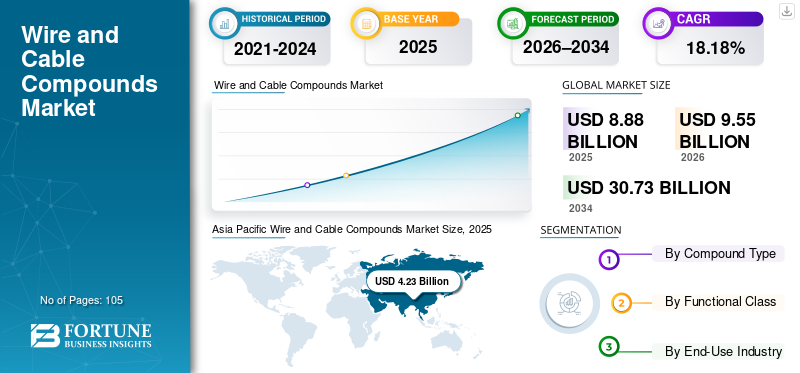
The global wire and cable compounds market size was valued at USD 8.88 billion in 2025 and is projected to grow from USD 9.55 billion in 2026 to USD 30.73 billion by 2034, exhibiting a CAGR of 18.18% during the forecast period. Asia Pacific dominated the wire and cable compounds market with a market share of 47.64% in 2025.
Increasing electrification, infrastructure upgrades, and material performance demands across all sectors are the main factors driving the growth of the market for wire and cable compounds. The rising need for low-voltage cables and building wires, where polymer compounds such as halogen-free materials, PVC, and XLPE are crucial for safety and insulation, is driven by rapid urbanization and construction. Driven by several factors throughout many sectors, such as energy, automotive, telecommunications, and construction, the need for the wires and cable compound market is rising dramatically. The demand for wire and cable compounds with improved performance, safety, and longevity is growing as sectors get more technologically sophisticated.
The need for versatile, lightweight, and high-performing materials is being driven by advances in the automobile and electric vehicle sectors, as well as by data center growth and industrial automation. The trend toward halogen-free and low-smoke materials is also being driven by stricter fire safety and environmental standards, which are raising the compound value per kilometer of cable and fostering long-term market expansion. There are a number of main reasons behind the move toward electric mobility, which has led to a fast expansion of the market for electric vehicle wire and cable compounds. The need for sophisticated wire and cable compounds has increased as the world's move toward EV adoption has gained pace.
In February 2025, the ECCOH XL cross-linkable flame-retardant product line from Avient expanded with the addition of the ECCOH XL 8054 compound, intended for fire-safe wire insulation with low smoke. This approach enhances processability for manufacturers, a significant improvement for wire and cable applications, and complies with strict electrical and fire safety regulations, such as EN 50363.
The efficient transfer of electrical energy across a range of applications, including residential, commercial, industrial, and utility-scale systems, depends on the use of wire and cable compounds for power transmission. In this case, wires and cables are used to carry electricity from generation sources (such as power plants) to distribution networks, and ultimately to the end user. Specialized wire and cable compounds are necessary for submarine cables, which are critical for long-distance underwater power transmission and communication systems, to ensure consistent operation under harsh environmental conditions.
Renewable energy projects frequently need cables that withstand extreme temperatures, high voltages, moisture, UV exposure, and other environmental variables, while delivering consistent, long-term performance.
Major players in the market for wire and cable compounds include Avient Corporation, Cabot Corporation, and BASF SE, which combine extensive knowledge of polymer science with a wide range of materials, a global production scale, and close adherence to changing regulatory and cable performance standards.
Download Free sample to learn more about this report.
Wire and Cable Compounds Market Key Takeaways
 Global Market Size & Forecast
- 2025 Market Size: USD 8.88 Billion
- 2026 Market Size: USD 9.55 Billion
- 2034 Forecast Market Size: USD 30.73 Billion
- CAGR: 18.18% from 2026–2034
 Market Share
- Asia Pacific dominated the wire and cable compounds market with a 47.64% share, generating USD 4.23 billion in 2025.
- The insulation compounds segment held the largest market share of 67.88% in 2025.
- The construction segment accounted for the highest market share of 30.15% in 2025.
 Key Regional Highlights
Asia Pacific
Asia Pacific generated USD 4.23 billion in 2025 and is projected to reach USD 4.55 billion in 2026.
Europe
Europe accounted for USD 2.18 billion in 2025 and is expected to reach USD 2.34 billion in 2026.
North America
North America generated USD 1.73 billion in 2025 and is projected to reach USD 1.86 billion in 2026.
U.S.
The wire and cable compounds market was valued at USD 1.37 billion in 2025.
Japan
Growing investments in power, telecom, and manufacturing drive wire compounds demand.
Read More

Wire and Cable Compounds MARKET TRENDS
Grid Expansion and Power Infrastructure Upgrades is a Key Market Trend
The wire and cable compounds sector is primarily driven by grid expansion and improvements to power infrastructure as nations modernize their electrical networks to meet growing electricity demand and higher reliability requirements. Cables are replacing older transmission and distribution systems with higher capacity and greater efficiency, which require cutting-edge insulation, jacketing, and semiconductor materials with exceptional thermal, electrical, and mechanical characteristics.
The U.S. Bipartisan Infrastructure Law chose Cabot to negotiate for up to USD 50 million in DOE funding to construct a U.S. plant for battery-grade carbon nanotubes and conductive additive dispersions, which are essential components of modern energy storage systems and grid applications. Although this project focuses on battery materials, the investment demonstrates Cabot's wider involvement in providing conductive materials utilized in electrical infrastructure, such as cables.
Download Free sample to learn more about this report.
MARKET DYNAMICS
MARKET DRIVERS
Telecommunication and Data Infrastructure Development to Drive the Market Growth
As the world's need for digital services and high-speed connections keeps growing, the development of telecommunications and data infrastructure is a major factor in the expansion of the wire and cable compounds industry. A huge amount of specific cables with sophisticated insulation, jacketing, and shielding materials is needed for the deployment of 5G networks, the extension of fiber optic backbones, and the growing installation of small cells and base stations. The usage of high-performance polymer compounds is directly increased by these applications' need for materials with better thermal stability, flexibility, electrical performance, and fire and environmental stress resistance.
In January 2026, in a sign of the quick development of data infrastructure, Meta Platforms reached a multiyear agreement with Corning worth up to USD 6 billion to provide fiber-optic cables to support the growth of its AI data centers in the U.S. The backbone of high-speed data transmission networks is fiber-optic wires, and speeding up the deployment of these networks helps meet demand for high-performance cables and related materials used for fiber protection, jacketing, and insulation. These efforts drive the wire and cable compounds market growth.
MARKET RESTRAINTS
High Capital and Technical Requirements Are Expected to Hamper the Market
The expansion of the wire and cable compounds industry, particularly for specialized and sophisticated materials, is predicted to be constrained by significant capital and technical demands. The production of high-performance compounds demands a large upfront investment in specialized mixing equipment, precise extrusion technology, and quality control systems to meet stringent electrical, thermal, and mechanical performance criteria. Additionally, developing compounds for demanding applications such as high-voltage power cables, EV wiring, and halogen-free solutions requires significant R&D, formulation testing, and certification, which extends the time to market and raises expenses.
These financial and technological obstacles may restrict the entry of new players and limit the expansion of capacity, particularly in developing markets. Due to their inability to keep up with changing regulatory standards and consumer demands, smaller and medium-sized producers frequently have difficulty competing, which results in industry consolidation and lower competitive pressure. Consequently, the ongoing need for capital investment and technical knowledge is projected to limit market expansion and delay the use of next-generation materials in cost-sensitive applications, even as demand for wire and cable compounds continues to increase.
MARKET OPPORTUNITIES
Advancements in Polymer Compounding Technology to Drive the Market Growth
The wire and cable industry is expanding as a result of improvements in polymer compounding technology, which are making it possible to create materials with improved electrical, thermal, and mechanical qualities. Modern compounding methods enable accurate control over polymer mixes, fillers, and additives, producing materials with increased heat resistance, better insulation qualities, greater flexibility, and extended service life. These advancements are essential for demanding applications where reliability and safety are of the utmost importance, such as high-voltage power cables, renewable energy connections, EV wiring, and high-speed data cables.
In October 2025, using its EVOLVE Sustainable Solutions technology platform, Cabot recently increased its North American production capacity for circular reinforcing carbon products, used in specialized cable compounds and related materials. These include cutting-edge carbon blacks and reinforcing carbons, as well as conductive and performance-enhancing additives that improve durability and conductivity in cable applications.
MARKET CHALLENGES
Raw Material Price Volatility to Hamper Market Growth
Due to the high dependence of wire and cable compounds on petrochemical-based polymers and specialized additives such as PVC, polyethylene, plasticizers, flame retardants, stabilizers, and fillers, fluctuations in the prices of raw materials are expected to impede the market's expansion. These inputs are priced based on geopolitical considerations, supply interruptions, and fluctuations in the markets for natural gas and crude oil, making it challenging for compound manufacturers to maintain consistent prices and production costs.
For compound manufacturers, frequent and unpredictable cost fluctuations reduce margins, while for wire and cable manufacturers, price uncertainty leads them to postpone purchases or renegotiate agreements during times of high volatility. Manufacturers may put off projects or seek less expensive options in cost-conscious industries such as construction and low-voltage cables, which would cause a slowdown in demand growth.
Segmentation Analysis
By Compound Type
PVC Segment Dominates Due to Its Cost-Effectiveness, Flame-Retardant, And Versatile Solutions
Based on compound type, the market is classified into PVC (Polyvinyl Chloride), XLPE (Cross-Linked Polyethylene), TPE (Thermoplastic Elastomer), Halogen-Free Materials, and others.
The PVC (Polyvinyl Chloride) segment dominated with the largest wire and cable compounds market share of 37.23% in the 2025. Due to its cost-effectiveness, adaptability, and well-known processing benefits across a wide range of wire and cable applications, polyvinyl chloride (PVC) dominates the wire and cable compounds market. Well-balanced in flame retardancy, flexibility, electrical insulation performance, and durability, PVC is particularly well-suited for control cables, low-voltage power cables, and building wires widely used in residential, commercial, and industrial construction.
The TPE (Thermoplastic elastomer) market segment is the fastest-growing segment in the market. It directly addresses the industry's move toward better performance, flexibility, and sustainability. The TPE (thermoplastic elastomer) sector is the fastest expanding area in the wire and cable compound market. They are perfect for dynamic and high-stress cable applications such as portable electronics, electric vehicles, charging cables, robotics, and industrial automation as they combine the flexibility of rubber with the simple processability of thermoplastics. These applications are growing quickly and need materials that can endure high temperatures, vibrations, and repeated bending. The TPE (thermosplastic elastomer) segment is projected to grow at a CAGR of 19.39% during the forecast period.
By Functional Class
Critical Role of Insulation Materials Across Wire and Cable Applications Drives Insulation Compounds Segment Growth
In terms of functional class, the market is categorized into insulation compounds, sheathing/jacketing compounds, and semiconductive/shielding compounds.
The insulation compounds segment dominated the market with a share of 67.88% in 2025. The vital role of insulation in all types of wires and cables requires the greatest material volume per unit length to guarantee electrical safety, performance, and durability in power, building, telecom, automotive, and industrial applications. This drives the segment growth.
Sheathing/jacketing compounds is the fastest-growing segment in the market. It is expected to grow at a CAGR of 19.09% during the forecast period. This growth is driven by the increased use of cables in demanding, outdoor, and safety-critical applications necessitates materials with better mechanical protection, weather resistance, chemical resistance, and fire safety.
By End-Use Industry
To know how our report can help streamline your business, Speak to Analyst
Rising Residential and Infrastructure Development Drives Construction Segment Growth
In terms of end-use, the market is categorized into construction, power and energy, telecommunications, automotive and EV, industrial machinery, and consumer electronics.
The construction segment dominated the market with a share of 30.15% in 2025. Due to the significant consumption of low-voltage cables in residential, commercial, and infrastructure buildings, the wire and cable compound market is dominated by the construction industry, which maintains a consistently high demand for insulation and jacketing compounds.
The power and energy segment is the second-dominating segment in the market. It is expected to grow at a CAGR of 19.88% during the forecast period. Grid extension, renewable energy integration, and transmission & distribution improvements require massive amounts of medium- and high-voltage cables that utilize high-performance insulation and shielding compounds.
Wire and Cable Compounds Market Regional Outlook
By geography, the market is categorized into Europe, North America, Asia Pacific, Latin America, and the Middle East & Africa.
Asia Pacific
Asia Pacific Wire and Cable Compounds Market Size, 2025 (USD Billion)
To get more information on the regional analysis of this market, Download Free sample
Asia Pacific held the dominant wire and cable compound market share in 2025, valued at USD 4.23 billion, and is expected to reach the valuation of USD 4.55 billion in 2026. The Asia Pacific wire and cable compound market is growing due to rapid urbanization, large-scale infrastructure and grid expansion, rising manufacturing activity, and accelerating EV and telecom investments across the region.
China Wire and Cable Compounds Market
In 2025, the Chinese market was valued at USD 1.48 billion. Massive power grid development, the introduction of electric vehicles and renewable energy at a fast pace, continuous urban development, and a robust local manufacturing industry are all contributing to the expansion of China's wire and cable compound market. In November 2025, to meet rising regional demand for petrochemical intermediates, BASF began production at its Zhanjiang Verbund facility in southern China. The location has a sizable ethylene steam cracker and downstream chemical facilities, which will increase BASF's capacity to supply base chemicals and polymer feedstocks used in wire and cable compound formulations for insulation and jacketing. In the face of robust regional development, the plant was expected to be fully operational by the end of 2025, bolstering BASF's local "in China, for China and Asia" manufacturing plan.
India Wire and Cable Compounds Market
The Indian market in 2025 was valued at USD 0.84 billion, accounting for roughly 19.89% share of the global market.
North America
North America was valued at roughly USD 1.73 billion in 2025 and is set to reach USD 1.86 billion in 2026. The demand for premium cable materials in North America is rising due to the modernization of the power grid, increased integration of renewable energy, expansion of electric vehicle and charging infrastructure, and ongoing investments in data centers and buildings.
U.S. Wire and Cable Compounds Market
The U.S. market was valued at USD 1.37 billion in 2025. It is expanding as a result of ongoing building projects, massive improvements to the power grid, the widespread use of renewable energy and EV infrastructure, and the growth of data centers and 5G networks, all of which are contributing to an increase in demand for electrical and communication cables.
Europe
Europe accounted for an estimated USD 2.18 billion in 2025 and is expected to reach USD 2.34 billion in 2026. Due to widespread power grid upgrades, renewable energy integration, the expansion of EV infrastructure, and more stringent environmental and fire safety standards, the market for wire and cable compounds in Europe is expanding. These factors are contributing to the demand for high-value and cutting-edge cable compounds.
U.K. Wire and Cable Compounds Market
The U.K. wire and cable compound market in 2025 was estimated to be around USD 0.13 billion, representing roughly 6.14% market share of the global market.
Germany Wire and Cable Compounds Market
The Germany market in 2025 was valued at around USD 0.43 billion, representing roughly 19.89% share of the global market.
Latin America & the Middle East Africa
Latin America and the Middle East & Africa accounted for an estimated USD 0.33 billion in 2025 and is expected to reach USD 0.41 billion in 2026. Due to growing renewable energy initiatives, increasing investment in telecommunications and electrification throughout the area, urban construction development, and expanding power and transmission infrastructure, the market for Latin American wire and cable compounds is expanding.
GCC Wire and Cable Compounds Market
The GCC market in 2025 was estimated at around USD 0.16 billion, representing roughly 40.14% market share of the global market.
COMPETITIVE LANDSCAPE
Key Industry Players
Wire and Cable Compound Vendors Are Gaining Traction by Expanding High-Performance and Halogen-Free Material Portfolios
In response to increasing demand and changing performance needs, wire and cable compound suppliers are making significant investments in innovation, capacity growth, and strategic alliances. They are developing high-performance and advanced compounds, including halogen-free, flame-retardant, and EV-grade materials, to meet stricter safety and environmental regulations. To increase dependability and lower prices for cable producers, vendors are also concentrating on regionalizing production and fortifying supply chains.
Key players of wire and cable compounds are ramping up their growth by adding more high-performance and halogen-free materials, as customers are seeking safer, compliant, & high-quality cable solutions to meet their needs for power, construction, EV, and telecommunications, leading to the increased acceptance of advanced compounds versus traditional materials in applications where they will be used.
In November 2025, with the introduction of its SOLONONplus XLPO LSZH XHHW-2 cable, Southwire developed new power cables featuring Low Smoke Zero Halogen (LSZH) insulated or jacketed conductors specifically suited for applications with critical considerations for reducing smoke and toxic by-products due to fire; meeting the applicable standards for permissible amounts of halogens (for example: ISO 6060-1) while providing maximum performance; ideal for use in applications where safety is paramount (e.g., fire safety/human health).
LIST OF KEY WIRE AND CABLE COMPOUNDS COMPANIES PROFILED
- Avient Corporation (U.S.)
- Cabot Corporation (U.S.)
- Trelleborg AB (Sweden)
- BASF SE (Germany)
- Mitsubishi Chemical Corporation (Japan)
- Southwire Company LLC (U.S.)
- Solvay S.A. (Belgium)
- Dow Inc. (S.)
- Eastman Chemical Company (U.S.)
- Borealis GmbH (Austria)
KEY INDUSTRY DEVELOPMENTS
- December 2025: Trelleborg announced that it will actively develop and supply proprietary products for the wire/cable industry through its Mixing Forsheda division. These include shielding materials that conduct electricity but don't carry it; insulation materials with high impedance to protect against ground fault current or lightning strikes; and thermally processed cable jacket material. These products play a critical role in the primary functions of any electric cable. They are used to conduct and insulate conductors, as well as to support one another during the construction of cables manufactured by Trelleborg with cross-linked polyethylene (XLPE) or ethylene propylene rubber (EPR) insulation.
- November 2025: BASF disclosed that it will provide Ultramid nylon polymer grades tailored for wire and cable applications. The nylon polymers are used to insulate/envelop cables, providing resistance to wear/tear while remaining flexible/chemical resistant (for building wire, power cable & other industrial wires). This portfolio will support performance and longevity in harsh conditions.
- October 2025: Borealis revealed an investment of two XLPE production facilities in Stenungsund, Sweden, which will greatly increase the company’s production capacity for insulation materials used in MV, HV, and EHV power cables. These cables are required to expand T&D networks to accommodate more renewable energy sources, adapt to the increasing need for electrification, and, in turn, support the energy transition.
- July 2025: Cabot's new LITX 95F Carbon Black is an advanced conductive carbon that has been specifically developed as a high-performance conductive additive for lithium-ion battery and Energy Storage Systems (ESS) applications. While targeted primarily at lithium-ion batteries, conductive carbons such as LITX95F also serve as essential components in semi-conductive and shielding layers of power and signal cables, thereby linking the company's innovative products to the technology used in state-of-the-art cable compounds.
- September 2024: The Dow Company introduced its new REVOLOOP resin, which uses Recycled Plastic (PCR) in cable jacketing materials from post-consumer sources. This aligns with the global wire and cable industry's sustainability objectives to create circularity of cable materials without sacrificing quality. As the focus on sustainability increases among cable manufacturers and end users, this trend highlights the need to develop environmentally friendly solutions.
REPORT COVERAGE
Request for Customization to gain extensive market insights.
Report Scope & Segmentation
| ATTRIBUTE | DETAILS |
| Study Period | 2021-2034 |
| Base Year | 2025 |
| Estimated Year | 2026 |
| Forecast Period | 2026-2034 |
| Historical Period | 2021-2024 |
| Growth Rate | CAGR of 18.18% from 2026-2034 |
| Unit | Value (USD Billion) |
| Segmentation | By Compound Type, By Functional Class, By End-Use Industry, and Region |
| By Compound Type |
|
| By Functional Class |
|
| By End-Use Industry |
|
| By Geography |
|
Frequently Asked Questions
Fortune Business Insights says that the global market value stood at USD 8.88 billion in 2025 and is projected to reach USD 30.73 billion by 2034.
The market is expected to exhibit a CAGR of 18.18% during the forecast period (2026-2034).
The construction segment led the market in terms of end-user in 2025.
Telecommunication and data infrastructure development are the key factors driving the market.
Avient Corporation, Cabot Corporation, BASF SE, and other companies are among the prominent players in the market.
Asia Pacific dominated the market with the largest share in 2025.
Advancements in polymer compounding technology favors product adoption.


- 2021-2034
- 2025
- 2021-2024
- 105
Get 30-60 hrs Free Customization
Expand Regional and Country Coverage, Segments Analysis, Company Profiles, Competitive Benchmarking, and End-user Insights.












Related Reports
-
US +1 833 909 2966 ( Toll Free )
-
Get In Touch With Us