Aircraft Pressurization System Market Size, Share & Industry Analysis, By System Type (Cabin Pressure Control System and Cabin Pressure Monitoring System), By Component (Outflow Valves, Cabin Pressure Controllers, and Pressure Sensors), By Aircraft Type (Narrow-Body Aircraft, Wide-Body Aircraft, and Business Jets), By Technology (Bleed Air-Based Pressurization and Electric Compressor-Based Pressurization), By Installation Type (Line-Fit/OEM Installation and Retrofit Installation), By End User (Aircraft OEMs, Airlines/Operators, and MRO Service Providers), and Regional Forecast, 2026-2034
 Download Free Sample

Aircraft Pressurization System Market Size and Future Outlook
 Listen to Audio Version
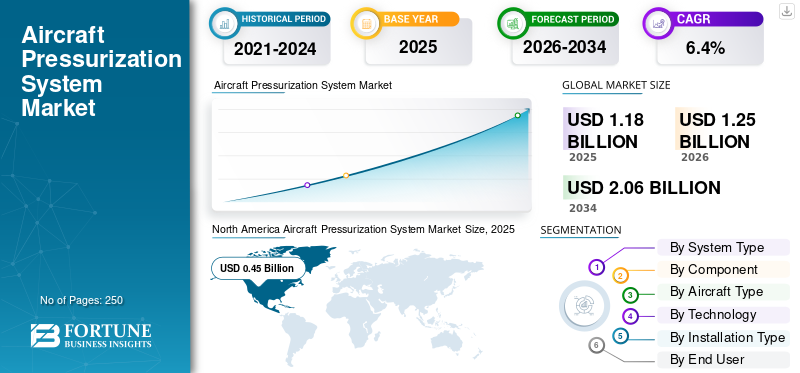
The global aircraft pressurization system market size was valued at USD 1.18 billion in 2025. The market is projected to grow from USD 1.25 billion in 2026 to USD 2.06 billion by 2034, exhibiting a CAGR of 6.4% during the forecast period. North America dominated the aircraft pressurization system market with a market share of 38.13% in 2025.
Aircraft pressurization systems are critical aircraft air-management and aircraft safety systems that regulate cabin, cockpit, cargo compartment, avionics bay, and mission-specific compartment pressure during flight, enabling safe and comfortable aircraft operations at high altitudes where outside atmospheric pressure is insufficient for normal human breathing. These systems maintain controlled cabin altitude by managing air supply, pressure sensing, outflow regulation, safety relief, and emergency pressure control while working closely with the aircraft environmental control system, bleed air system, electric compressor architecture, ventilation system, and thermal management network.
Industry leaders and specialized aircraft air-management system suppliers such as Honeywell Aerospace, Collins Aerospace, and Liebherr Aerospace are developing integrated pressurization solutions that combine cabin pressure controllers, outflow valves, safety valves, relief valves, pressure sensors, actuators, control panels, air ducts, and digital monitoring software.
Download Free sample to learn more about this report.
Aircraft Pressurization System Market Key Takeaways
 Global Market Size & Forecast
- 2025 Market Size: USD 1.18 billion
- 2026 Market Size: USD 1.25 billion
- 2034 Forecast Market Size: USD 2.06 billion
- CAGR: 6.4% from 2026-2034
 Market Share
- North America dominated the aircraft pressurization system market with a 38.13% share in 2025.
- The cabin pressure monitoring system segment is projected to grow at an 8.3% CAGR.
- The pressure sensors segment is projected to grow at an 8.5% CAGR.
 Key Regional Highlights
North America
North America reached USD 0.45 billion in 2025 and is projected to reach USD 0.47 billion in 2026.
Asia Pacific
Asia Pacific is projected to record the fastest adoption growth in the aircraft pressurization system market.
Europe
Europe is expected to witness strong market growth, supported by increasing Airbus commercial aircraft production.
U.S.
The market was valued at around USD 0.41 billion in 2025, supported by the country’s dominant position in North America.
Japan
The market was valued at around USD 0.06 billion in 2025, accounting for roughly 5.0% of global revenues.
Read More

AIRCRAFT PRESSURIZATION SYSTEM MARKET TRENDS
Shift Toward Digitally Monitored and More-Electric Pressurization Architecture is Emerging as a Defining Market Trend
The market is witnessing a shift from conventional pneumatic-heavy cabin pressure control toward digitally monitored, electronically controlled, and more-electric air-management architecture. Aircraft OEMs and Tier-1 system suppliers are increasingly focusing on cabin pressure sensors, electronic controllers, outflow valve actuation, integrated diagnostics, and system health monitoring to improve passenger comfort, reduce pilot workload, and support predictive maintenance. This trend is also linked with the broader movement toward more-electric aircraft, where traditional pneumatic and hydraulic functions are increasingly being optimized or replaced by electric and software-controlled systems.
- For instance, in December 2024, Woodward signed an agreement to acquire Safran Electronics & Defense’s electromechanical actuation business in North America, stating that the acquisition would provide an industry-proven electromechanical technology platform for next-generation aircraft.
This trend is expected to increase demand for electronic cabin pressure controllers, smart pressure sensors, electric actuation, digital monitoring software, and integrated aircraft air-management systems. Over the forecast period, aerospace cabin systems and pressurization systems are likely to become more closely connected with aircraft environmental control systems (ECS), cockpit alerting systems, aircraft health monitoring platforms, and more-electric aircraft architectures.
MARKET DYNAMICS
MARKET DRIVERS
Download Free sample to learn more about this report.
Rising Aircraft Production and Mandatory Cabin Pressure Safety Requirements are Propelling Market Growth
The market is driven by rising aircraft production, fleet replacement, and the mandatory need to maintain safe cabin pressure in high-altitude aircraft operations. Pressurization systems regulate cabin altitude, pressure differential, pressure-change rate, and emergency relief functions, making them safety-critical equipment across commercial aircraft, business jets, regional aircraft, military transport aircraft, and high-altitude special mission platforms. As aircraft OEMs increase production rates and airlines modernize fleets, demand for cabin pressure controllers, outflow valves, safety valves, pressure sensors, actuators, and integrated air-management hardware continues to grow.
- For instance, in October 2025, Airbus stated that it was increasing production across civil aircraft programs, with the A320 Family ramp-up focused on reaching a production capability of 75 aircraft per month in 2027.
This driver is expected to sustain demand from aircraft OEMs, Tier-1 environmental control system suppliers, airlines, MRO providers, defense agencies, and business jet manufacturers. The strongest demand will remain in aircraft categories where pressurization is essential, including narrow-body aircraft, wide-body aircraft, regional jets, business jets, military aircraft, and high-altitude ISR or mission aircraft.
MARKET RESTRAINTS
Strict Certification, Cabin Pressure Compliance, and Safety-Critical Validation to Limit Market Expansion
A key restraint for the aircraft pressurization system market growth is the strict certification and airworthiness compliance required for pressurized cabins and occupied compartments. Pressurization systems must meet requirements related to cabin altitude limits, pressure warning systems, decompression response, redundancy, sensor reliability, software validation, and emergency safety functions. Since any failure in cabin pressure control can affect passenger and crew safety, suppliers face long qualification cycles, high testing costs, strict documentation requirements, and complex OEM approval procedures.
For instance, in 2026, the U.S. Federal Aviation Administration’s 14 CFR 25.841 continues to require pressurized cabins and occupied compartments to maintain cabin pressure altitude not more than 8,000 feet under normal operating conditions.
This restraint is likely to affect smaller suppliers more severely as pressurization systems require aerospace-grade traceability, environmental testing, software assurance, reliability validation, and aircraft-level integration. Market entry remains difficult for new suppliers of pressure sensors, outflow valves, safety valves, controllers, and cabin pressure monitoring software.
MARKET OPPORTUNITIES
Expansion of Integrated Air Management and Aftermarket Support Presents Market Growth Opportunities
A major opportunity in the market lies in the expansion of integrated cabin air management systems and lifecycle support for aircraft fleets. Pressurization is increasingly managed as part of a broader environmental control and air-management architecture that also includes aircraft air conditioning systems, bleed air, ventilation, ice protection, fuel tank inerting, and liquid cooling. This creates opportunities for suppliers that can provide integrated system design, retrofit-ready monitoring, replacement components, MRO support, and digital diagnostics across commercial, military, fixed-wing, and helicopter platforms.
- For instance, in April 2025, Satair and Collins Aerospace signed a four-year extension of their cabin interior parts distribution agreement, continuing support for Collins products including oxygen systems and other cabin-related equipment across global aftermarket channels.
This opportunity is expected to increase demand for retrofit-ready cabin pressure monitoring systems, replacement valves, pressure sensors, environmental control units, oxygen-system interfaces, and aftermarket support packages. Over the forecast period, suppliers with strong OEM approvals, distribution networks, repair capability, and integrated ECS/air-management portfolios will be better positioned to capture recurring demand from aging fleets and high-utilization commercial aircraft.
MARKET CHALLENGES
Pressure Sensor Drift, Reliability Risks, and System Integration Complexity to Challenge Market
A major challenge for the market is maintaining sensor accuracy, valve reliability, software performance, and system-level integration across different aircraft platforms. Pressurization systems interact with integrated air system controls, air conditioning packs, bleed air systems, ventilation systems, cockpit warnings, oxygen systems, and avionics. Sensor drift, valve malfunction, software faults, or integration mismatches can affect cabin pressure control, create maintenance burden, and trigger operational restrictions or airworthiness action.
This challenge is expected to remain important as aircraft pressurization systems become more digital, sensor-dependent, and integrated with broader environmental control systems. Suppliers must balance weight reduction, redundancy, sensing accuracy, software reliability, maintainability, and cost while meeting strict OEM and regulatory standards.
Segmentation Analysis
By System Type
Mandatory Aircraft-Level Requirements for Safe Cabin Pressure Management Boosted Cabin Pressure Control System Segment Growth
Based on system type, the market is divided into cabin pressure control system, cabin pressure monitoring system, air supply & conditioning system, and safety & relief pressure system.
The cabin pressure control system segment held a leading market share in 2025 due to its central role in automatically regulating cabin altitude, pressure differential, and pressure-change rate during climb, cruise, descent, and emergency operating conditions. This system carries higher operational importance compared with monitoring-only or safety relief systems, as it directly controls pressurization performance through cabin pressure controllers, control logic, outflow valve commands, and cockpit interface functions. Its dominance is supported by mandatory aircraft-level requirements for safe cabin pressure management across commercial aircraft, business jets, military aircraft, and regional aircraft platforms.
- For instance, in December 2025, EASA issued Proposed Airworthiness Directive PAD 25-196 for Airbus aircraft, which specifically referenced dispatch restrictions related to the “Automatic Cabin Pressure Control System.
The cabin pressure monitoring system segment is positioned to record the fastest growth with a CAGR of 8.3% over the forecast period.
To know how our report can help streamline your business, Speak to Analyst
By Component
Primary Cabin Airflow Regulation Function Supported Outflow Valves Segment Dominance
By component, the market is segmented into outflow valves, cabin pressure controllers, pressure sensors, safety/relief valves, actuators, control panels, and others.
The outflow valves segment held a leading aircraft pressurization system market share in 2025, as these valves are the primary mechanical control point for regulating cabin air release and maintaining the required cabin pressure differential. Compared with sensors, panels, and actuators, outflow valves have a direct role in maintaining cabin altitude, pressure stability, and depressurization control across pressurized aircraft. Their importance is higher in commercial aircraft and business jets where pressurization must be automatically adjusted throughout all flight phases while also maintaining redundancy and safety compliance.
- For instance, under 14 CFR 25.841, the FAA requires pressurized cabins to include valves, controls, and indicators for cabin pressure control, including pressure relief valves with sufficient combined capacity to prevent excessive pressure differential in case of failure.
The pressure sensors segment is positioned to record the fastest growth with a CAGR of 8.5% over the forecast period.
By Aircraft Type
Narrow-Body Aircraft Led Market Due to High Production Volumes and Fleet Utilization
On the basis of aircraft type, the market is segmented into narrow-body aircraft, wide-body aircraft, regional aircraft, business jets, military aircraft, general aviation aircraft, helicopters & rotorcraft, and UAVs/advanced aircraft.
The narrow-body aircraft segment held a leading market share in 2025 due to the high production volumes, large installed fleet, and heavy utilization of single-aisle aircraft across domestic, regional, and short-to-medium-haul routes. Narrow-body aircraft require reliable cabin pressure control systems, outflow valves, pressure sensors, safety valves, and control panels as standard onboard systems. Their large delivery base and recurring maintenance demand make them the strongest contributor compared with wide-body, regional, business jet, military, and rotorcraft platforms.
- For instance, in October 2025, Airbus reported that the A320 Family programme continued to ramp up toward a production rate of 75 aircraft per month in 2027, while the A220 programme was targeting a rate of 12 in 2026.
The business jets segment is expected to grow with the fastest CAGR of 7.0% over the forecast period.
By Technology
Large Installed Fleet and Established Aircraft Architecture Led to Bleed Air-Based Pressurization Dominance
On the basis of technology, the market is segmented into bleed air-based pressurization, electric compressor-based pressurization, hybrid pressurization system, and digital/automatic pressurization control.
The bleed air-based pressurization segment held a leading market share in 2025, as most current commercial, regional, business, and military aircraft platforms continue to rely on engine bleed air or APU-supplied compressed air for cabin pressurization and environmental control. This technology remains dominant due to its mature certification base, established maintenance ecosystem, wide OEM adoption, and compatibility with existing aircraft pneumatic systems and ECS architectures. It also supports both line-fit and aftermarket demand across high-volume aircraft fleets.
- For instance, in August 2025, the FAA adopted an airworthiness directive for Airbus A319neo, A320neo, and A321neo aircraft related to high-pressure bleed valve issues under ATA Chapter 36 Pneumatic, reinforcing the continued operational relevance of bleed-air-based pneumatic architectures in modern narrow-body aircraft.
The electric compressor-based pressurization segment is expected to grow with the fastest CAGR of 11.6% over the forecast period.
By Installation Type
Line-Fit/OEM Installation Segment Dominated Due to New Aircraft Production and OEM System Integration
On the basis of installation type, the market is segmented into line-fit/OEM installation, retrofit installation, and aftermarket/replacement.
The line-fit/OEM installation segment held a leading market share in 2025, as pressurization systems are safety-critical systems integrated during aircraft manufacturing and certification. Cabin pressure controllers, outflow valves, safety valves, pressure sensors, ducting interfaces, and cockpit controls are typically installed and validated as part of the aircraft’s environmental control and air-management architecture before delivery. This gives OEM installation a stronger market position than retrofit activity, especially across new commercial aircraft, business jets, regional aircraft, and military platforms.
- For instance, in April 2025, Airbus signed a definitive agreement with Spirit AeroSystems to acquire selected industrial assets dedicated to Airbus commercial aircraft programmes, aiming to ensure supply stability for key aircraft work packages as production ramps continue.
The aftermarket/replacement segment is expected to grow steadily with a CAGR of 6.3% over the forecast period.
By End User
Aircraft-Level Certification and Integrated Air Management Needs Boosted Aircraft OEMs Segment Growth
By end user, the market is segmented into aircraft OEMs, airlines & operators, military & defense agencies, and MRO providers.
The aircraft OEMs segment held a leading market share in 2025, as pressurization systems are integrated at the aircraft design, certification, production, and delivery stages. OEMs define system architecture, supplier qualification, redundancy requirements, cockpit interface logic, ECS integration, and certification compliance for cabin pressure control. Their dominance is supported by high-value line-fit demand across commercial aircraft, business jets, regional aircraft, military transport aircraft, and special mission platforms.
- For instance, in December 2025, Airbus completed the acquisition of former Spirit AeroSystems assets dedicated to commercial aircraft programmes, including A350 aircraft pressurization system sections, A321 and A220 components, and A220 mid-aircraft pressurization system production, strengthening Airbus’ control over critical aircraft production work packages.
The MRO providers segment is expected to grow the fastest with a CAGR of 8.4% over the forecast period.
Aircraft Pressurization System Market Regional Outlook
By geography, the market is segmented into North America, Europe, Asia Pacific, Latin America, and the Middle East & Africa.
North America
North America Aircraft Pressurization System Market Size, 2025 (USD Billion)
To get more information on the regional analysis of this market, Download Free sample
North America dominated the market in 2025 with a valuation of USD 0.45 billion and is set to reach USD 0.47 billion in 2026. Boeing’s commercial aircraft production base supports market growth, Bombardier’s business jet manufacturing footprint in Canada, Lockheed Martin and Northrop Grumman defense aircraft programs, Airbus A220 activity in Canada, and a mature aerospace aftermarket and MRO ecosystem. Demand is being driven by narrow-body aircraft production, business jet deliveries, military aircraft manufacturing, cabin pressure component replacement, air-management system upgrades, and safety-driven inspection of pressure sensors, outflow valves, controllers, and relief valves across large commercial and defense fleets.
- For instance, in December 2025, Bombardier celebrated the entry into service of the Global 8000 business jet in Mississauga, Ontario, highlighting its lowest cabin altitude in business aviation production at 2,691 feet.
U.S. Aircraft Pressurization System Market
Based on North America’s strong contribution and the U.S. dominance within the region, the U.S. market was valued at around USD 0.41 billion in 2025. The U.S. dominated the North America market in 2025, supported by Boeing’s commercial aircraft programs, U.S.-based defense aircraft production, business aviation manufacturing, and the presence of major air-management and pressurization component suppliers such as Honeywell Aerospace, Collins Aerospace, Parker Meggitt, ITT Aerospace Controls, Aero Fluid Products, and Dukes Aerospace. The country benefits from high demand for line-fit pressurization systems, cabin pressure controllers, outflow valves, safety valves, pressure sensors, and aftermarket replacement components across commercial, military, business jet, and special mission aircraft fleets.
- For instance, in December 2025, Boeing completed the acquisition of Spirit AeroSystems, bringing Boeing-related commercial aircraft operations in-house, including 737 aircraft pressurization systems and major structures for the 767, 777, and 787 Dreamliner programs.
Europe
Europe is expected to witness strong growth in the market, supported by Airbus commercial aircraft production, Dassault Aviation business and fighter aircraft programs, Leonardo aircraft manufacturing, Saab defense aircraft activity, and the presence of major ECS and cabin pressure system suppliers such as Liebherr-Aerospace, Safran, Collins/Nord-Micro, and other European aerospace system specialists. Demand is being driven by A320 Family and A350 production, business jet manufacturing, military aircraft modernization, regional aircraft support, and replacement of cabin pressure sensors, controllers, outflow valves, and air-management components across the region’s large installed fleet.
U.K. Aircraft Pressurization System Market
The U.K. market in 2025 was valued at around USD 0.04 billion, representing roughly 3.4% of global revenues.
Germany Aircraft Pressurization System Market
The German market was valued at USD 0.06 billion in 2025, equivalent to around 5.4% of global sales.
Asia Pacific
Asia Pacific is projected to record the fastest adoption growth in the market, supported by aircraft production localization, growing commercial aviation fleets, defense aircraft procurement, and expanding aerospace industrial capability in China, India, Japan, and South Korea. Demand is being driven by Airbus final assembly expansion in China, COMAC aircraft activity, India’s defense aircraft production programs, regional airline fleet expansion, and increasing MRO requirements for cabin pressure sensors, outflow valves, controllers, and safety relief systems across high-utilization fleets.
- For instance, in October 2025, Airbus opened its second A320 Family Final Assembly Line in Tianjin, China, with preparations underway to assemble the first aircraft and full operation targeted for early 2026.
Japan Aircraft Pressurization System Market
The Japan market in 2025 was valued at around USD 0.06 billion, accounting for roughly 5.0% of global revenues.
China Aircraft Pressurization System Market
China’s market is projected to be one of the largest worldwide, with 2025 revenues valued at around USD 0.12 billion, representing roughly 10.5% of global sales.
India Aircraft Pressurization System Market
The India market in 2025 was valued at around USD 0.03 billion, accounting for roughly 2.6% of global revenues.
Latin America
Latin America’s market is led by Brazil, supported by Embraer’s commercial, executive, and defense aircraft manufacturing base, while Mexico contributes through aerospace manufacturing clusters, component supply, and MRO activity. Regional demand is supported by Embraer E-Jets, Praetor and Phenom business jets, C-390 defense aircraft, airline fleet renewal, executive jet operations, and maintenance of pressurization components across regional and business aviation fleets.
Brazil Aircraft Pressurization System Market
The Brazil market in 2025 was valued at around USD 0.03 billion, accounting for roughly 2.7% of global revenues.
Middle East & Africa
The Middle East & Africa market is supported by expanding airline fleets, premium long-haul aircraft operations, defense aviation programs, business jet activity, and aerospace localization initiatives in the UAE, Saudi Arabia, Israel, Turkey, and South Africa. Demand is being driven mainly by fleet expansion, MRO requirements, defense aircraft procurement, UAV and special mission aircraft activity, and the need to maintain cabin safety and passenger comfort in high-temperature and long-range operating environments.
UAE Aircraft Pressurization System Market
The UAE market in 2025 was valued at around USD 0.02 billion, accounting for roughly 1.7% of global revenues.
COMPETITIVE LANDSCAPE
Key Industry Players
Integrated Aerospace Air Management Capability, Certification Strength, Digital Control Expertise, and Aftermarket Support Drive Competitive Leadership
The global market is characterized by competition among aircraft OEM system integrators, Tier-1 environmental control system suppliers, cabin pressure control system manufacturers, valve and actuator specialists, pressure sensor providers, electronic controller companies, and aerospace MRO service providers. Competitive leadership is increasingly shaped by companies that can deliver reliable cabin pressure controllers, outflow valves, safety relief valves, pressure sensors, actuators, control panels, cabin comfort solutions, and integrated air-management solutions with high safety compliance, aircraft-level certification readiness, and consistent performance across commercial, business aviation, military, regional, rotorcraft, and advanced aircraft platforms.
LIST OF KEY AIRCRAFT PRESSURIZATION SYSTEM COMPANIES PROFILED
- Honeywell Aerospace (U.S.)
- Collins Aerospace / RTX (U.S.)
- Dukes Aerospace (U.S.)
- Liebherr-Aerospace (France)
- Safran (France)
- ACE Thermal Systems (U.S.)
- Aero Fluid Products (U.S.)
- Parker Meggitt (U.K.)
- ITT Aerospace Controls (U.S.)
- AMETEK Aerospace & Defense (U.S.)
KEY INDUSTRY DEVELOPMENTS
- January 2026: SAE International revised ARP1270C Aircraft Cabin Pressurization System Criteria, updating recommended practices for aircraft cabin pressure control systems and equipment, including performance objectives, requirements definition, operational scenarios, design practices, safety processes, and verification methods.
- January 2026: Bombardier announced that the Global 8000 received European Union Aviation Safety Agency certification, following Transport Canada certification in November 2025 and U.S. FAA certification.
- August 2025: Honeywell announced that a Honeywell-led consortium received approximately USD 17.8 million in U.K. Government funding through the ATI Programme for Project STRATA, focused on AI and additive manufacturing for complex environmental control systems and cabin pressure control systems.
- January 2024: The U.S. FAA adopted Emergency Airworthiness Directive 2024-02-51 for certain Boeing 737-9 aircraft after an in-flight mid-cabin door-plug departure caused rapid decompression.
REPORT COVERAGE
The global aircraft pressurization system market analysis provides an in-depth study of market size & forecast by all the segments included in the report. It includes details on the market dynamics, market trends, and regional analysis expected to drive the market over the forecast period. The market report includes Porter’s five forces analysis, which illustrates the potency of buyers and suppliers in the market. Market forecast offers information on the technological advancements, new product launches, key trends, major industry developments, and details on partnerships, mergers & acquisitions. Market analysis also encompasses a detailed competitive landscape with information on the market share and profiles of key players.
Request for Customization to gain extensive market insights.
Report Scope & Segmentation
| ATTRIBUTE | DETAILS |
| Study Period | 2021-2034 |
| Base Year | 2025 |
| Estimated Year | 2026 |
| Forecast Period | 2026-2034 |
| Historical Period | 2021-2024 |
| Growth Rate | CAGR of 6.4% from 2026 to 2034 |
| Unit | Value (USD Billion) |
| Segmentation | By System Type, By Component, By Aircraft Type, By Technology, By Installation Type, By End User, and Region |
| By System Type |
|
| By Component |
|
| By Aircraft Type |
|
| By Technology |
|
| By Installation Type |
|
| By End User |
|
| By Region |
|
Frequently Asked Questions
According to Fortune Business Insights, the global market value stood at USD 1.18 billion in 2025 and is projected to reach USD 2.06 billion by 2034.
In 2025, the market value in North America stood at USD 0.45 billion.
The market is expected to exhibit a CAGR of 6.4% during the forecast period of 2026-2034.
By aircraft type, the narrow-body aircraft segment led the market.
Rising aircraft production and mandatory cabin pressure safety requirements are propelling market growth.
Honeywell Aerospace, Collins Aerospace / RTX, and Dukes Aerospace are some of the major players in the global market.
North America dominated the market in 2025.


- 2021-2034
- 2025
- 2021-2024
- 250
Get 30-60 hrs Free Customization
Expand Regional and Country Coverage, Segments Analysis, Company Profiles, Competitive Benchmarking, and End-user Insights.




















Related Reports
-
US +1 833 909 2966 ( Toll Free )
-
Get In Touch With Us