 Download Free Sample



Get a Quote
Receive a tailored pricing based on your needs.
- Choose license type
- Multiple user options
- Custom scope & coverage
- Fast turnaround
"Electrifying your pathway to success through in-depth market research"
 Listen to Audio Version
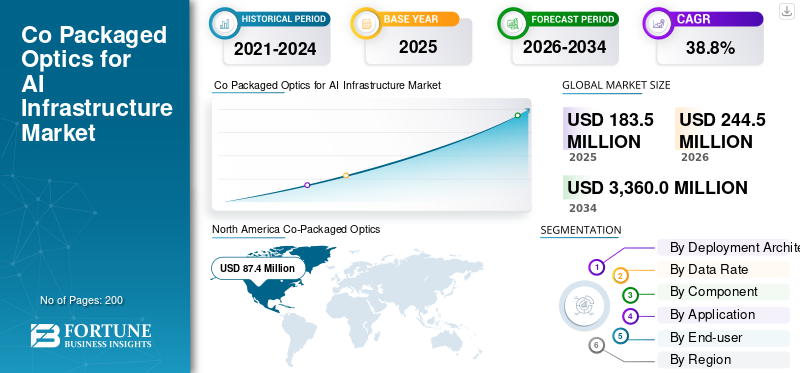
The global Co‑Packaged Optics (CPO) for AI infrastructure market size was valued at USD 183.5 million in 2025. The market is projected to grow from USD 244.5 million in 2026 to USD 3,360.0 million by 2034, exhibiting a CAGR of 38.8% during the forecast period. North America dominated the Co‑Packaged Optics (CPO) for AI infrastructure market with a market share of 47.62% in 2025.
The market covers optical interconnect solutions in which photonic engines, optical I/O modules, laser sources, and related packaging elements are positioned close to high-performance switch ASICs, GPUs, XPUs, and AI accelerator platforms. These solutions are designed to support the extreme data movement requirements of AI training clusters, inference clusters, GPU cloud platforms, hyperscale AI data centers, and high-performance computing environments. By reducing the distance between electrical processing silicon and optical transmission components, CPO helps improve bandwidth density, reduce signal degradation, and lower interconnect power consumption in AI-scale network fabrics.
The market is gaining importance as AI infrastructure shifts toward larger accelerator clusters, higher internal data traffic, and faster networking speeds such as 800G, 1.6T, and future 3.2T+ architectures. Traditional pluggable optics remain widely used, but their front-panel space, electrical reach, and power-efficiency limitations become more challenging as AI systems scale across racks and data halls. CPO addresses this issue by bringing optics closer to the source of data generation, enabling more efficient connectivity between switches, accelerators, memory systems, and storage infrastructure. This makes the technology particularly relevant for next-generation AI factories, GPU cloud capacity, and hyperscale environments where networking efficiency directly affects compute utilization and operating cost.
Key players such as Intel Corporation, Broadcom Inc., Cisco Systems, and NVIDIA Corporation are contributing to the development of this market through different parts of the CPO value chain. Intel is focused on silicon photonics and optical I/O technologies that can support high-bandwidth compute connectivity. Broadcom is advancing switch-level CPO platforms by combining high-capacity Ethernet switching silicon with integrated optical engines. Cisco is developing CPO system architectures around high-performance switching silicon and silicon photonics integration. NVIDIA is supporting CPO adoption through AI networking platforms designed for large GPU cluster environments. Together, these companies are helping move CPO from a research and demonstration-stage technology toward a practical architecture for power-efficient, high-bandwidth AI infrastructure.
Download Free sample to learn more about this report.
 Global Market Size & Forecast
 Market Share
 Key Regional Highlights
North America
North America market held the largest market at USD 87.4 million in 2025.
Europe
Europe is projected to grow at 37.1% over the coming years and reach a valuation of USD 20.8 million in 2025, as the region is moving toward AI infrastructure through a more regulated, power-conscious, and sovereign-compute-driven pathway.
Asia Pacific
Asia Pacific is expected to grow at the highest CAGR and reach a valuation of USD 64.1 million in 2025, the region is moving from AI infrastructure planning to large-scale execution across China, India, Japan, South Korea, ASEAN, and Taiwan-linked semiconductor supply chains.
U.S.
The market was valued at approximately USD 72.0 million in 2025, representing around 39.2% of global revenue, driven by hyperscale AI data center expansion.
Japan
The market was valued at approximately USD 8.7 million in 2025, accounting for roughly 4.7% of global revenue, supported by investments in advanced AI computing infrastructure.
Read More

Growing Focus on Power-Efficient Networking Due to AI Data Center Power Constraints is Emerging as a Key Trend
The growing focus on power-efficient networking is emerging as a key trend in the co-packaged optics market for AI infrastructure, as AI data centers are increasingly constrained by power availability, grid capacity, and cooling requirements. Large AI training and inference clusters require high-speed connectivity between accelerators, switches, and storage systems, which increases network power consumption as bandwidth scales toward 1.6T and 3.2T+. CPO supports this shift by placing optical engines closer to switching or compute silicon, reducing electrical signal loss and improving bandwidth density.
This is pushing AI infrastructure operators to prioritize energy-efficient interconnect architectures, creating stronger demand for CPO-enabled networking systems.
Download Free sample to learn more about this report.
Expansion of Hyperscale AI Data Centers and GPU Cloud Infrastructure Fuels Market Growth
The expansion of hyperscale AI data centers and GPU cloud infrastructure is driving demand for Co‑Packaged Optics (CPO) for AI Infrastructure, as AI clusters require faster and more efficient connectivity between accelerators, switches, and storage systems. Hyperscale cloud providers, AI infrastructure companies, and GPU cloud operators are increasing investments in high-density compute capacity to support model training, fine-tuning, and large-scale inference workloads. This is increasing network traffic inside data centers and creating demand for optical interconnects that can support higher bandwidth while reducing power loss.
These developments indicate that AI data center growth is directly increasing the need for high-bandwidth optical networking architectures, creating a stronger growth path for CPO-enabled switching fabrics and optical engines.
Serviceability and Repair Limitations Restrict Deployment in Commercial Data Centers
Serviceability and repair limitations are expected to restrain the adoption of co-packaged optics for ai infrastructure in commercial data centers. Current data center networks rely heavily on pluggable optical transceivers as they allow operators to replace failed modules independently without removing or disturbing the entire switch system. CPO changes this maintenance model by placing optical engines close to the switch ASIC or compute package, which improves signal efficiency but makes failure isolation, field replacement, sparing strategy, and repair workflows more complex. This creates concern for hyperscale cloud providers, GPU cloud providers, and colocation operators, where downtime, port-level failures, and maintenance delays can directly affect service availability.
However, shifting this critical optical layer from a replaceable module to an integrated package increases operational risk if reliability, diagnostics, and replacement procedures are not mature. Therefore, many commercial data center operators may delay large-scale CPO deployment until vendors prove stable field reliability, practical service models, replaceable optical assemblies, and diagnostics that can support high-uptime AI infrastructure environments.
Growing Adoption of GPU Cloud and AI-as-a-Service Platforms Creates Demand for High-Bandwidth Optical Interconnects
The growing adoption of GPU cloud and AI-as-a-service platforms is expected to create strong opportunities for the Co‑Packaged Optics (CPO) for AI Infrastructure market growth. GPU cloud providers are building large-scale clusters to offer AI training, fine-tuning, and inference capacity to enterprises, model developers, research organizations, and AI-native companies that do not want to own expensive accelerator infrastructure directly.
These platforms require dense, low-latency, and high-bandwidth connectivity between GPUs, switches, storage systems, and data center clusters, making optical interconnect performance a critical part of infrastructure scalability. As AI workloads move from experimental deployments to commercial production, GPU cloud providers need networking architectures that can support higher traffic volumes while reducing power consumption and signal loss. This creates an opportunity for CPO, as it places optical engines closer to switching or compute silicon and enables higher bandwidth density compared with traditional interconnect approaches.
Such large-scale GPU cloud contracts indicate that AI infrastructure demand is shifting beyond traditional hyperscalers, opening new deployment opportunities for CPO-enabled switching fabrics, optical engines, and advanced packaging solutions.
Hyperscale Cloud Service Providers Remain Key Buyers Due to Large-Scale AI Infrastructure Investment
Based on the end-user, the market is segmented into hyperscale cloud service providers, GPU cloud providers, data center & colocation providers, government & defense, and others.
The hyperscale cloud service providers segment held the majority share of the market in 2025. The segment dominated with a 40.7% share, as they are the earliest and largest deployers of high-density AI infrastructure. These companies operate massive AI data centers that require advanced networking between GPUs, switches, storage, and servers, making CPO attractive for improving bandwidth density and reducing power loss. They also have the financial strength, engineering capability, and deployment scale needed to test and adopt emerging architectures such as switch CPO and optical I/O before smaller enterprises.
GPU cloud providers are expected to witness the highest CAGR of 49.4% during the forecast period.
To know how our report can help streamline your business, Speak to Analyst
On-Board Optics Led Adoption Owing to Commercial Maturity and Easier System Integration
Based on the deployment architecture, the market is segmented into switch co-packaged optics, accelerator optical I/O, near-packaged optics, on-board optics, and others.
On-board optics held the majority share of the market in 2025. The segment dominated with a 31.6% share, as it is the most commercially mature and operationally familiar architecture compared to switch CPO and accelerator optical I/O. Data center operators have already used board-level optical integration to improve bandwidth density while avoiding the deeper packaging, thermal, and serviceability challenges associated with fully co-packaged optics.
The accelerator Optical I/O segment is expected to witness the highest CAGR of 51.1% during the forecast period.
Below 800G Segment Accounted for Major Share Due to Wider Use of Mature Optical Interconnect Architectures
Based on data rate, the market is categorized into below 800G, 800G, 1.6T, and 3.2T and above.
Below 800G held the majority share of the market in 2025. The segment dominated with a 46.3% share as the CPO for AI infrastructure market is still in an early commercialization phase, where most deployed systems are linked to 400G, early 800G-transition, and sub-800G optical architectures. Many data centers continue to rely on proven lower-speed interconnects due to cost, availability, compatibility, and lower operational risk compared to 1.6T and 3.2T+ systems. Higher data-rate CPO architectures are still emerging and require advanced optical engines, packaging, thermal design, and ecosystem readiness.
The 3.2T and above segment is expected to witness the highest CAGR of 53.8% during the forecast period.
Optical Engine Remained the Core Revenue Contributor Due to Role in High-Speed Signal Conversion
Based on the component, the market is categorized into optical engine, switch ASICs & electrical ICs, laser sources, connector & packaging, and other components.
Optical engine held the majority share of the market in 2025. The segment dominated with a 38.4% share as it is the core functional block that enables optical data transmission in CPO systems. In AI infrastructure, optical engines convert high-speed electrical signals from switch ASICs or accelerators into optical signals, making them critical for bandwidth density, low latency, and reduced power loss. Compared to connectors, packaging, lasers, and passive elements, optical engines carry a higher value as they include advanced photonic integration, modulation, signal conversion, and packaging complexity
The laser source segment is expected to witness the highest CAGR of 43.1% during the forecast period.
AI Training Clusters Captured Leading Share Driven by Massive Bandwidth Demand in Model Training
Based on application, the market is categorized into AI training clusters, AI inference clusters, HPC systems, AI cloud data centers, and others.
AI training clusters held the majority share of the market in 2025. The segment dominated with a 35.8% share as training large AI models requires massive data movement between GPUs, switches, memory, and storage systems. These clusters need extremely high-bandwidth and low-latency interconnects, making them one of the earliest and strongest use cases for CPO adoption. Compared to inference or edge AI workloads, training workloads are more bandwidth-intensive and are concentrated in large-scale hyperscale and GPU cloud environments.
AI cloud data centers are expected to witness the highest CAGR of 42.2% during the forecast period.
By region, the market is categorized into North America, South America, Europe, the Middle East & Africa, and Asia Pacific.
North America Co‑Packaged Optics (CPO) for AI Infrastructure Market Size, 2025 (USD Million)
To get more information on the regional analysis of this market, Download Free sample
North America holds the majority of the Co‑Packaged Optics (CPO) for AI infrastructure market share due to its strong concentration of hyperscale cloud providers, GPU cloud operators, AI model developers, semiconductor companies, and advanced data center infrastructure. The region has been an early adopter of high-density AI clusters, where massive east-west traffic between GPUs, switches, storage, and servers creates strong demand for bandwidth-efficient optical interconnects. The U.S. also has the deepest ecosystem for AI infrastructure investment, including cloud platforms, AI labs, chip developers, optical networking vendors, and colocation campuses.
North America market held the largest market at USD 87.4 million in 2025.
Given North America’s strong contribution and the U.S. dominance in the region, the U.S. market was estimated at around USD 72.0 million in 2025, accounting for roughly 39.2% of sales.
Europe is projected to grow at 37.1% over the coming years and reach a valuation of USD 20.8 million in 2025, as the region is moving toward AI infrastructure through a more regulated, power-conscious, and sovereign-compute-driven pathway. The U.K., Germany, France, the Nordics, and Benelux are expanding AI-ready data center capacity, but adoption is more measured due to power availability, permitting, sustainability rules, and data localization requirements. This creates steady demand for CPO as European AI clusters need higher bandwidth without sharply increasing network power consumption.
Growth will be significant, but more stable than Asia Pacific or the Middle East & Africa regions, as Europe’s adoption is driven by gradual hyperscale expansion, national AI programs, HPC upgrades, and colocation-led AI infrastructure rather than aggressive greenfield AI factory buildouts.
The U.K. market in 2025 was valued at around USD 3.1 million, representing roughly 1.6% of global revenues.
Germany’s market reached approximately USD 3.2 million in 2025, equivalent to around 1.7% of global sales.
Asia Pacific is expected to grow at the highest CAGR and reach a valuation of USD 64.1 million in 2025, the region is moving from AI infrastructure planning to large-scale execution across China, India, Japan, South Korea, ASEAN, and Taiwan-linked semiconductor supply chains. The region has a strong combination of AI data center expansion, cloud region buildouts, semiconductor manufacturing, optical component production, advanced packaging, and rising GPU cloud demand, which creates a favorable base for CPO adoption.
This combination of low-base growth, AI-ready data center expansion, and strong electronics/photonic manufacturing capacity makes Asia Pacific the fastest-growing region for CPO in AI infrastructure.
The Japan market in 2025 was valued at around USD 8.7 million, accounting for roughly 4.7% of global revenues.
China’s market is projected to be one of the largest worldwide, with 2025 revenues estimated at around USD 23.6 million, representing roughly 12.9% of global sales.
The India market in 2025 was estimated at around USD 8.1 million, accounting for roughly 4.4% of global market share.
The Middle East & Africa region is expected to grow at the second-highest CAGR, due to rapid sovereign AI investments, hyperscale cloud expansion, and AI-ready data center development across GCC countries, Israel, Turkey, and South Africa. The region is starting from a relatively low base, so new AI data center and GPU infrastructure projects create faster percentage growth compared to mature markets. GCC countries, in particular, are investing in AI infrastructure to support national AI strategies, smart cities, Arabic-language AI models, and government digital transformation.
South America is expected to grow at a slow and steady CAGR, CPO adoption in the region will depend mainly on gradual cloud, colocation, and enterprise AI infrastructure expansion rather than large-scale AI factory deployments. Brazil, Chile, and Colombia will support demand, but most projects will focus on hosted AI compute and regional data center capacity instead of advanced domestic CPO-enabled clusters.
The GCC market reached around USD 3.1 million in 2025, representing roughly 1.7% of global revenues.
Key Industry Players Driving Innovation and Strategic Expansion in the Market
Key players in the co-packaged optics for AI infrastructure market, including Intel Corporation, Broadcom, Cisco Systems, and NVIDIA, are advancing their solutions. It is to support the rising demand for high-bandwidth, low-latency, and power-efficient optical interconnects in AI training clusters, inference clusters, GPU cloud platforms, and hyperscale AI data centers. Leading companies are focusing on the integration of optical engines with switch ASICs, AI accelerators, silicon photonics platforms, external laser sources, advanced packaging, and fiber connectivity solutions to improve bandwidth density and reduce power loss in large-scale AI networks. Vendors are also strengthening their product portfolios around switch co-packaged optics, accelerator optical I/O, optical chiplets, 1.6T and 3.2T+ interconnects, and serviceable CPO architectures to address the performance and operational needs of AI infrastructure operators.
The CPO for AI infrastructure market report provides a comprehensive analysis of the industry, focusing on key market players and the overall competitive landscape. It offers valuable insights into current market trends, technological advancements, and significant industry developments. The report further examines key growth drivers, restraints, opportunities, and challenges influencing market expansion.
Request for Customization to gain extensive market insights.
| ATTRIBUTE | DETAILS |
| Study Period | 2021-2034 |
| Base Year | 2025 |
| Estimated Year | 2026 |
| Forecast Period | 2026-2034 |
| Historical Period | 2021-2024 |
| Growth Rate | CAGR of 38.8% from 2026-2034 |
| Unit | Value (USD Million) |
| Segmentation | By Deployment Architecture, Data Rate, Component, Application, End-user, and Region |
| By Deployment Architecture |
|
| By Data Rate |
|
| By Component |
|
| By Application |
|
| By End-user |
|
| By Region |
|
According to Fortune Business Insights, the global market value stood at USD 183.5 million in 2025. and is projected to reach USD 3,360.0 million by 2034
In 2025, the market value stood at USD 87.4 million.
The market is expected to grow at a CAGR of 38.8% over the forecast period.
By end-user, the hyperscale cloud service providers segment is expected to lead the market.
Expansion of hyperscale AI data centers and GPU cloud infrastructure fuels market growth.
Intel Corporation, Broadcom, Cisco Systems, and NVIDIA are the major players in the global market.
North America dominated the market in 2025.
Get 30-60 hrs Free Customization
Expand Regional and Country Coverage, Segments Analysis, Company Profiles, Competitive Benchmarking, and End-user Insights.




















Related Reports
Get In Touch With Us
US +1 833 909 2966 ( Toll Free )
Receive a tailored pricing based on your needs.
Discuss your questions with our industry experts.
Have questions? Get quick answers before you purchase.

