Commercial Aircraft Autoflight & Flight Controls Aftermarket Size, Share & Industry Analysis, By Component (Autoflight (Flight Control Computers, Sensors & Feedback Systems, & Others) and Flight Control (Elevator, Aileron, Rudder, Double-Slotted Flaps, Leading Edge Slats, Spoilers / Speed Brakes, Trim Systems, MCAS, Others)), By Offerings (MRO Services and Refurbished Parts (PMA and USM)), By Aircraft Family (Airbus A220, Airbus A320 Family (ceo/neo), Airbus A330 (ceo/neo), Airbus A350, Airbus A380, ATR 42/72, Boeing 747, Boeing 767, & Others), and Regional Forecast, 2025-2045
 Download Free Sample
Commercial Aircraft Autoflight and Flight Controls Aftermarket Overview
 Listen to Audio Version
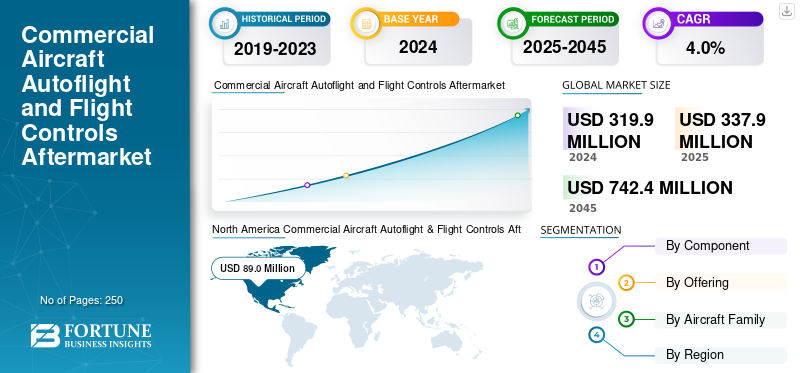
The global commercial aircraft autoflight & flight controls aftermarket size was valued at USD 319.9 million in 2024 and is projected to grow from USD 337.9 million in 2025 to USD 742.4 million by 2045, exhibiting a CAGR of 4.0% during the forecast period. North America dominated the global commercial aircraft autoflight & flight controls aftermarket with a market share of 27.82% in 2024.
Commercial aircraft autoflight & flight controls systems constitute a significant portion of the maintenance, repair, and overhaul (MRO) industry, providing for safe and reliable flight. Autoflight systems, comprise autopilot computers, flight dynamic, flight management systems, and auto-throttle units that offer automatic control and guidance. Flight control systems include primary surfaces (ailerons, elevators, rudder) as well as secondary systems (flaps, slats, spoilers), and their hydraulic, electromechanical, and fly-by-wire actuators.
The MRO operations for these systems include inspection, test, calibration, repair, and software update on electronic parts, along with structure restoration, replacement of seals, and hydraulic testing for actuators and control surface. Refurbished components in this case are parts taken out of service and rebuilt to an airworthy state by means of OEM or regulator approved procedures. This usually involves disassembly, non-destructive examination, life-limited item replacement, re-calibration, painting, and re-certification in FAA Form 8130-3 or EASA Form 1. The refurbished parts are not new but are in complete accordance with operational and flight safety requirements, giving operators a less expensive yet reliable option compared to new parts with the assurance of aviation authority compliance.
Furthermore, the market encompasses several major players with Collins Aerospace, Honeywell Aerospace, Thales Group, and Safran Electronics & Defense at the forefront. Broad portfolio with innovative product launch, and strong geographic presence expansion have supported the dominance of these companies in the global market.
Download Free sample to learn more about this report.
Commercial Aircraft Autoflight and Flight Controls Aftermarket KEY TAKEAWAYS
 Market Size & Forecast
- 2024 Market Size: USD 319.9 million
- 2025 Market Size: USD 337.9 million
- 2045 Forecast Market Size: USD 742.4 million
- CAGR: 4.0% from 2025-2045
 Market Share
- North America dominated the global commercial aircraft autoflight & flight controls aftermarket with a market share of 27.82% in 2024.
- The Airbus A320 family (ceo/neo) segment accounted for 32.6% of the market share in 2025.
- MRO services segment dominated due to aging fleets and extended aircraft lifecycles.
 Key Regional Highlights
North American
North America led the market with USD 89.0 million in 2024, supported by high fleet utilization and strong MRO activity.
Europe
Europe represent a major combined market due to large fleet bases and compliance-driven maintenance needs.
Latin America
Latin America are growing steadily, supported by refurbishment and fleet maintenance demand.
U.S.
Market supported by high maintenance activity across Boeing 737 and Airbus A320 fleets under FAA compliance requirements.
Japan
Stable aftermarket growth driven by long-term MRO agreements and ongoing fleet maintenance programs.
Read More

MARKET DYNAMICS
MARKET DRIVERS
Growing Fleet Modernization and Life Extension Programs to Drive Market Growth
One of the key commercial aircraft autoflight & flight controls aftermarket growth drivers is the growing interest in fleet modernization and aircraft life extension programs. Airlines are stretching the service life of narrow- and wide-bodied aircraft as a result of expensive new aircraft prices and delivery backlogs at Airbus and Boeing. This promotes direct demand for MRO and used integrated flight control and autoflight systems, as aging fleets need constant upgrades to ensure safety and efficiency.
- For example, in February 2025, Lufthansa Technik revealed the extension of its MRO agreements with Europe's major carriers to offer overhaul services for avionics and flight control parts on Airbus A320ceo and Boeing 737NG fleets.
MARKET RESTRAINTS
Strong Complexity and Expense of Overhaul of Flight Control Actuation Systems to Constrain Market Growth
The technical complexity of advance flight control actuation systems frequently hydraulic or electromechanical results in expensive and time-consuming maintenance, overhaul, and refurbishment. The stringent regulatory certification requirements and limited international repair capacity further compound the challenge. Cost-sensitive lower-cost operators in many markets postpone or minimize overhauls, delaying adoption.
- For instance, Parker Aerospace emphasized in 2024 that growing sophistication of fly by wire actuation units has increased lifecycle MRO expenses, complicating low-cost carriers with older fleets.
MARKET OPPORTUNITIES
Growth Opportunities through Expansion of Digital MRO and Predictive Maintenance Solutions
Combination of AI-based predictive maintenance and digital twin technologies is bringing new opportunities in autoflight and flight control system MRO. The solutions allow operators to anticipate component failures, manage refurbishment cycles more efficiently, and decrease unscheduled downtime, generating the need for intelligent MRO services.
- In April 2024, Collins Aerospace partnered with Airbus to expand predictive maintenance services for flight control computers and actuators under Airbus’ Skywise platform, targeting significant cost savings for airlines.
MARKET CHALLENGES
Supply Chain Disruptions and OEM Dependence Present Threats to MRO Providers
One of the biggest challenges is OEM dependence on spare parts, software codes, and repair licenses, with continuous supply chain disruptions. Airlines and independent MROs tend to experience delays in procuring certified components, which severely restrict their capacity to supply refurbished parts in timely fashion. It leads to operational risks and increased maintenance costs.
- For instance, during 2023–2024, suppliers to Boeing and Airbus experienced electronic component shortages for autoflight computers, which reflected directly in availability of refurbished parts and extended lead times for repairs.
COMMERCIAL AIRCRAFT AUTOFLIGHT & FLIGHT CONTROLS AFTERMARKET TRENDS
Adoption of Advanced Composite and Additive Manufacturing in Flight Control Refurbishment
One of the increasing trends is applying additive manufacturing (3D printing) and enhanced composite repair methods in overhauling flight control surfaces and actuation parts. Not only does this cut turnaround times but also increases part lifecycles while sustaining airworthiness certification.
- In October 2024, Lufthansa Technik finished its first certificated 3D-printed flight control actuator bracket repair for an Airbus A350, reflecting regulatory approval of additive solutions in vital control systems.
Download Free sample to learn more about this report.
Segmentation Analysis
By Component
Increasing Demand for Modernization of Fleets Fuels Autoflight Segment’s Growth
On the basis of component, the market is classified into autoflight and flight controls.
Autoflight is further divided into flight control computers, sensors & feedback systems, autopilot actuators & servos, control & display interfaces, autothrottle systems, yaw damper systems, wiring & power supply, and monitoring & test equipment.
Flight controls is further divided into elevator, aileron, rudder, double-slotted flaps, leading edge slats, spoilers / speed brakes, trim systems, artificial feel, mechanical locks, autopilot linkages, and maneuvering characteristics augmentation system (MCAS).
Autoflight segment dominates the market. The development of autoflight systems in commercial aircraft MRO and overhauling is fueled by increasing demand for modernization of fleets, higher aircraft utilization, and a need to improve operational efficiency and safety. With airlines stretching aircraft lifecycles as a result of heavy OEM delivery backlogs, autopilot, flight management, and auto-throttle system maintenance and upgrade becomes imperative. Additionally, increased use of digital and predictive maintenance technologies guarantees more efficient autoflight unit servicing.
- Collins Aerospace entered a contract in May 2024 with Emirates for providing autoflight and avionics systems maintenance and refurbishment services for its Airbus A380 fleet, marking this increasing demand.
Flight controls segment market is anticipated to grow at CAGR of 1.9% throughout the forecast period.
By Offerings
MRO Services are in High Demand Due to Rising Air Traffic and Aging Fleet
In terms of offerings, the market is categorized into MRO services and refurbished parts.
The MRO services segment captured the largest share of the market in 2024. Expansion of commercial aircraft refurbishing MRO operations is spurred by growing global air traffic, the aging fleet, and longer aircraft lifetimes in the face of backlogs at Airbus and Boeing manufacturing facilities. Airlines are more and more reliant upon MRO providers to keep older aircraft in serviceable flying condition, ranging from avionics and flight control overhauls to cabin and systems refurbishment. The need to reduce cost also drives the demand for remanufactured components as alternatives to new OEM parts.
- In July 2024, Lufthansa Technik formed a long-term agreement with Japan Airlines to provide integrated MRO solutions for Boeing 787 and 777 fleets of aircraft, where it is projected that the role of MRO will be larger to upkeep airline fleets globally.
Refurbished parts segment market is anticipated to grow at CAGR of 6.6% throughout the forecast period
By Aircraft Family
To know how our report can help streamline your business, Speak to Analyst
Commercial Aircraft MRO and Refurbishment Expansion Supplemented Airbus A320 family’s (ceo/neo) Growth
Based on aircraft family, the market is segmented into airbus a220, airbus a320 family (ceo/neo), airbus a330 (ceo/neo), airbus a350, airbus a380, atr 42/72, boeing 737 family (classic/ng/max), boeing 747, boeing 767, boeing 777, boeing 787, bombardier crj series, comac c919, de havilland dash 8 (q-series), embraer e-jets (e1/e2), and sukhoi superjet 100.
The Airbus A320 family (ceo/neo) held the dominating position in 2024. The segment fuels commercial aircraft MRO and refurbishment expansion due to the fact that it is the world's most productive narrow-body jet with more than 10,000 airplanes in operation. Its high utilization on short- and medium-haul flights creates continuous stress on significant systems such as flight controls, avionics, and landing gear, leading to recurring need for refurbished and MRO parts. Airlines are also keeping A320ceo fleets alive until A320neo delivery becomes a reality, adding maintenance requirements on top.
- ST Engineering in March 2025 revealed an extension of its Singapore A320 MRO capacity to respond to increasing global fleet demand.
Boeing 737 family max is anticipated to be the fastest growing segment with a CAGR of 4.2% during the forecast period.
Commercial Aircraft Autoflight & Flight Controls Aftermarket Regional Outlook
By geography, the market is categorized into Europe, North America, Asia Pacific, Latin America & Africa, and the Middle East.
NORTH AMERICA
North America Commercial Aircraft Autoflight & Flight Controls Aftermarket Size, 2024 (USD Million)
To get more information on the regional analysis of this market, Download Free sample
North America held the dominant commercial aircraft autoflight & flight controls aftermarket share in 2023 valuing at USD 87.3 million and also took the leading share in 2024 with USD 89.0 million. North America is seeing considerable demand for commercial aircraft aftermarket due to the presence of its high active fleet, primarily formed by its large airlines American, Delta, and United. These older narrow-body fleets in the region, specifically the Boeing 737 and Airbus A320 fleets, have significant continued maintenance and refurbishments efforts to remain serviceable with higher loads of passengers. Given the FAA regulatory demands of compliance, Portland, Oregon based, AAR Corp., in January 2025 of a multi-year contract with Alaska Airlines to perform heavy maintenance and component overhaul of its Boeing 737 fleet, is a clear indicator of the overall MRO activity in the region. The U.S. commercial aircraft autoflight and flight controls aftermarket includes the repair, overhaul, testing, exchange, and upgrade of systems that help keep an aircraft stable and on track. This includes autopilot and flight director systems, flight control computers, servos, actuators, trim systems, sensors, and related electronics.
- For instance, in June 2024, Thermo Fisher Scientific Inc. expanded its central laboratory operations in Wisconsin and Kentucky and region with an aim to serve the biotechnology and pharmaceutical and industries.
EUROPE and ASIA PACIFIC
Combined, Europe and Asia Pacific have one of the largest markets for commercial aircraft maintenance, rebuilding due to the huge fleets that are available, which include legacy narrow-bodies to new-generation wide-bodies. The European carriers are concerned about EASA compliance, and many of the Asia-Pacific airlines have high use rates, especially in India and Southeast Asia getting only substantially more passenger traffic than they anticipated. Delays in fleet modernization also meant they would have to be reliant refurbished parts. In November 2024 Lufthansa Technik and Air India signed a major agreement for aircraft maintenance repairs and rebuilding serves for the airline's Airbus and Boeing fleets, which shows strong regional momentum across both continents.
LATIN AMERICA & AFRICA and MIDDLE EAST
Over the forecast period, Latin America & Africa and Middle East & Africa regions would witness a moderate growth. Latin America market in 2025 is set to record USD 25.2 million as its valuation. In Middle East & Africa the market is set to attain the value of USD 39.6 million in 2025. The Middle East & Africa market is growing as the region is a global aviation hub and has lion's share of significant carriers including Emirates, Qatar Airways, and Ethiopian Airlines. Although Gulf carriers operate a younger fleet, their hard use for heavy use produces stable MRO demand yet African airlines age fleets for refurbishment service use. In October 2024, Emirates signed an agreement with Sanad, Abu Dhabi, to boost MRO potential by expanding the capabilities to include flight controls and avionics on both its Airbus and Boeing fleets.
COMPETITIVE LANDSCAPE
Key Industry Players
Wide Range of Product Offerings Coupled with Strong Distribution Network of Key Companies Supported their Leading Position
The competitive environment for commercial aircraft autoflight & flight controls aftermarket is driven by OEMs, tier-1 specialists, and nimble independents. OEMs including Honeywell, Collins, Thales, Safran/Liebherr, Moog, Parker, and Triumph continue to hold leverage by way of intellectual property, repair licenses, service bulletins/serviceable authorizations compliance, and visibility of latest-mod components, often bundling pool access and power by the hour program into the mix to secure customer buy-in. Tier-1 and airline-related MROs (Lufthansa Technik, ST Engineering, HAECO, SR Technics, StandardAero) have a global footprint to compete upon, while specializing in DER repairs, reliability engineering, and with the added benefit of footprints that allow for green-time/exchange that shortens TAT.
Independents and brokers (AJW, GA Telesis, AAR, AvAir) differentiate by availability of USM, teardown pipelines, and pricing flexibility, and are critical for legacy fleets (A320ceo/737NG, regional jets) whereby obsolescence/cost pressures drive PMA and DER. Distributors aligned with airframers (Satair, Boeing Distribution) offer scale, traceability and a warranty, giving them an edge over smaller traders.
Flight-control actuators, power-control units and spoiler/elevator components retain high-value due to safe-assured classifications and test-cell requirements, thus favoring certified shops with OEM tooling. Autoflight computers, FCCs, and autopilot system sensors face stricter software/configuration control, which reinforces OEM share, while providing opportunities for board-level repairs and module swaps.
LIST OF KEY COMMERCIAL AIRCRAFT AUTOFLIGHT & FLIGHT CONTROLS AFTERMARKET COMPANIES PROFILED:
- Collins Aerospace (U.S.)
- Honeywell Aerospace (U.S.)
- Thales Group (France)
- Safran Electronics & Defense (France)
- Liebherr-Aerospace (Germany)
- Moog Inc. (U.S.)
- Parker Aerospace (U.S.)
- Spirit AeroSystems (U.S.)
- ST Engineering Aerospace (Singapore)
- Lufthansa Technik (Germany)
KEY INDUSTRY DEVELOPMENTS
- July 2025: Samtel Avionics formed a strategic partnership with Aerospace Technology Systems Corp. (ATSC) in Malaysia to provide repair, overhaul, and post-sales support for the Royal Malaysian Air Force’s Su-30MKM avionics.
- July 2025: The Odisha state cabinet approved the establishment of an MRO facility at Bhubaneswar’s Biju Patnaik International Airport, undertaken by Air Works India, backed by approx. USD 17.43 million investment and enhanced state incentives.
- April 2025: Universal Avionics signed an agreement with De Havilland Canada to supply InSight flight deck upgrades (LCDs and synthetic vision) for Dash 8-100/-200 aircraft.
- March 2025: Falcon Technic announced a USD 100 million upgrade of its MRO facilities at Al Maktoum International Airport, Dubai, enhancing its CAR-145-certified maintenance capabilities.
- February 2025: AFI KLM E&M and Air Canada agreed on a 10-year component support contract for Boeing 787 aircraft, including establishing dedicated pool stock in Toronto.
- February 2025: HAECO signed with Tigerair Taiwan to conduct end-of-lease checks for Airbus A320 aircraft at its Hong Kong MRO facilities, covering five lease inputs from 2026–2028.
- February 2025: SolitAir partnered with Aero Inspection for CAMO (Continuing Airworthiness Management Organization) services to support its cargo operations.
REPORT COVERAGE
Request for Customization to gain extensive market insights.
Report Scope & Segmentation
|
ATTRIBUTE |
DETAILS |
|
Study Period |
2019-2045 |
|
Base Year |
2024 |
|
Estimated Year |
2025 |
|
Forecast Period |
2025-2045 |
|
Historical Period |
2019-2023 |
|
Growth Rate |
CAGR of 4.0% from 2025-2045 |
|
Unit |
Value (USD Million) |
|
Segmentation |
By Component, Offerings, Aircraft Family and Region |
|
By Component |
|
|
By Offerings |
|
|
By Aircraft Family |
|
|
By Region |
|
Frequently Asked Questions
Fortune Business Insights says that the global market value stood at USD 319.9 million in 2024 and is projected to reach USD 742.4 million by 2045.
In 2024, the market value stood at USD 89.0 million.
The market is expected to exhibit a CAGR of 4.0% during the forecast period of 2025-2045.
The MRO services segment led the market by offering.
The key factors driving the market are growing fleet modernization and life extension programs to drive market growth.
Collins Aerospace (U.S.), Honeywell Aerospace (U.S.), and Thales Group (France) are some of the prominent players in the market.
North America dominated the market in 2024.



- 2019-2045
- 2024
- 2019-2023
- 250
Get 30-60 hrs Free Customization
Expand Regional and Country Coverage, Segments Analysis, Company Profiles, Competitive Benchmarking, and End-user Insights.




















Related Reports
-
US +1 833 909 2966 ( Toll Free )
-
Get In Touch With Us