Cultured Cocoa Ingredients Market Size, Share & Industry Analysis, By Ingredient Type (Cultured Cocoa Flavor & Aroma Ingredients, Fermentation-Derived Cocoa Extenders, Cultured Cocoa Butter / Fat Ingredients, Cultured Cocoa Solids / Powder Ingredients, and Others), By Application (Confectionery, Bakery & Desserts, Beverages, Snacks & Cereals, Dairy & Frozen Desserts, Nutraceuticals & Functional Foods, and Others), By Form (Powder, Liquid Extracts, and Others), and Regional Forecast, 2026-2034
 Download Free Sample
(Offer valid till 31st Jul 2026)
Cultured Cocoa Ingredients Market Size and Future Outlook
 Listen to Audio Version
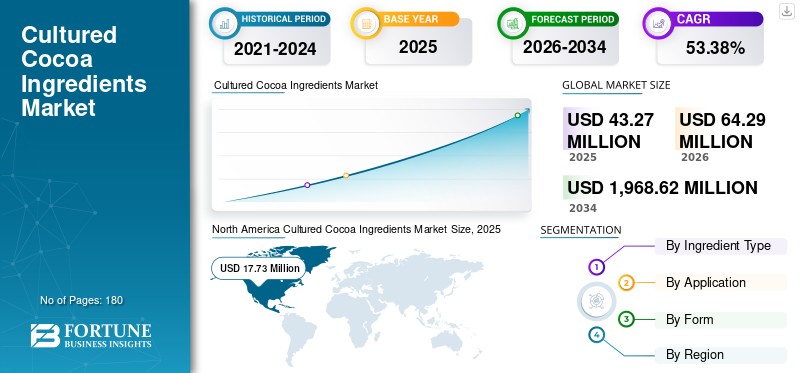
The global cultured cocoa ingredients market size was valued at USD 43.27 million in 2025. The market is projected to grow from USD 64.29 million in 2026 to USD 1,968.62 million by 2034, exhibiting a CAGR of 53.38% during the forecast period. North America dominated the cultured cocoa ingredients market with a market share of 40.97% in 2025.
Cultured cocoa ingredients are cocoa compounds produced using cellular agriculture, precision fermentation, and microbial fermentation. These ingredients are designed to replicate the sensory, chemical, and functional properties of traditional cocoa used in chocolate formulations, bakery, beverages, desserts, and confectionery applications. Cultured cocoa technologies help create stable, traceable, and lower-environmental impact production method for cocoa ingredients.
Companies such as California Cultured, Celleste Bio, and Kokomodo are some of the key players operating in this market. New investment and partnership is the key strategy which is boosting product sales and supporting the market growth.
Download Free sample to learn more about this report.
Cultured Cocoa Ingredients Market Key Takeaways
 Global Market Size & Forecast
- 2025 Market Size: USD 43.27 Million
- 2026 Market Size: USD 64.29 Million
- 2034 Forecast Market Size: USD 1,968.62 Million
- CAGR: 53.38% from 2026–2034
 Market Share
- North America dominated the cultured cocoa ingredients market with a 40.97% share in 2025.
- The fermentation-derived cocoa extenders segment is projected to grow at a CAGR of 53.56% during the forecast period.
- The bakery & desserts segment is expected to register a CAGR of 53.23% through 2034.
 Key Regional Highlights
North America
North America led the global market with a value of USD 17.73 million in 2025, driven by strong investments in cultured cocoa technologies.
Europe
Europe reached USD 14.01 million in 2025, supported by stringent sustainability standards and premium chocolate production.
Asia Pacific
Asia Pacific was valued at USD 7.89 million in 2025, benefiting from growing investments in cellular agriculture and alternative food technologies.
U.S.
The market was valued at USD 14.74 million in 2025, supported by active innovation in precision fermentation and sustainable ingredients.
Japan
The market reached approximately USD 2.00 million in 2025, accounting for around 4.61% of global market revenues.
Read More

CULTURED COCOA INGREDIENTS MARKET TRENDS
Shift Toward Precision-Fermented Cocoa Compounds is Reshaping Chocolate Ingredient Innovation
Companies are moving toward manufacturing cocoa compounds using precision fermentation without replicating cocoa cells. Using advanced technology manufacturers are focusing on recreating specific flavor molecules, cocoa fats, and aroma compounds to improve scalability and reduce production complexity. Strategic collaborations between biotech startups, food ingredient suppliers, and global confectionery brands are accelerating pilot projects and commercialization activities of cultured cocoa ingredient production. Moreover, investment in AI-powered fermentation and synthetic biology is also helping to make flavors more consistent, boosting production efficiency, and allowing customized ingredients production in cultured cocoa.
MARKET DYNAMICS
MARKET DRIVERS
Download Free sample to learn more about this report.
Cocoa Supply Volatility and Ethical Sourcing Pressure is Accelerating Cultured Cocoa Adoption
Rising cocoa beans price, unstable crops due to climate change, and growing sustainability concerns are the main factors driving the market. Cocoa is a plant based product which is primarily grown in West Africa, and extreme weather, poor soil, plant diseases, and stricter environmental rules are making it harder to ensure a steady supply of cocoa from this region. Therefore chocolate companies are investing in innovative methods such as cultured cocoa technology to maintain a steady supply of cocoa. Moreover, increasing consumer scrutiny regarding deforestation, child labor, and carbon emissions associated with traditional cocoa farming is also accelerating demand for ethically produced cocoa alternatives
MARKET RESTRAINTS
High Bioprocessing Costs and Flavor Replication Challenges Limiting Commercial Scale-Up
High production costs is the main factor hindering large-scale commercialization of cultured cocoa ingredients. Cellular agriculture and precision fermentation need costly growth media, specialized bioreactors, and advanced processing equipment. These requirements make cultured cocoa much more expensive than traditional cocoa ingredients. Unclear regulations for new foods, especially in Europe and some developing regions, could also delay the market entry of cultured cocoa. Limited ability to scale up production and a lack of manufacturing infrastructure also make it difficult for cultured cocoa producers to compete with established global cocoa suppliers.
MARKET OPPORTUNITIES
Growing Demand for Innovative Premium Chocolate is Creating Growth Potential for Cultured Cocoa Ingredients
Use of advanced technology also offers the opportunity to the manufacturers to customize cocoa flavor profiles, fat composition, and nutritional functionality through precision fermentation and cellular engineering. New partnerships between biotech companies and chocolate makers could help develop hybrid chocolate products, which use both traditional and cultured cocoa, and market products more effectively. As investment in alternative proteins and fermentation facilities increases in North America, Europe, and Asia Pacific, production costs are expected to decline in the future. This could support cultured cocoa adoption across mainstream confectionery and food processing markets.
Segmentation Analysis
By Ingredient Type
Need for Cost-Efficient Cocoa Taste Replication Fueled Dominance of Cultured Cocoa Flavor & Aroma Ingredients Segment
Based on ingredient type, the market is segmented into cultured cocoa flavor & aroma ingredients, fermentation-derived cocoa extenders, cultured cocoa butter / fat ingredients, cultured cocoa solids / powder ingredients, and others.
Cultured cocoa flavor & aroma ingredients segment accounted for the largest cultured cocoa ingredients market share in 2025. They can be directly integrated into existing chocolate and food manufacturing systems. Such ingredients mimic volatile compounds, roasted cocoa flavors, bitterness, and aromas that give cocoa its unique qualities, making it a viable alternative for cocoa solids or cocoa butter. Also, flavor ingredients are easier to use in recipes and can be added in smaller amounts, which helps them be adopted faster in commercial food products.
Fermentation-derived cocoa extenders is another major segment, amounting to 53.56% CAGR during the forecast period. They allow manufacturers to replace some traditional cocoa ingredients, helping to lower costs and make supply chains more reliable. More manufacturers are using these extenders in chocolate compounds, fillings, baked goods, and flavored drinks.
To know how our report can help streamline your business, Speak to Analyst
By Application
Rising Cocoa Supply Risks and Sustainability Pressure Boosted Dominance of Confectionery Applications
The market is segmented, by application into confectionery, bakery & desserts, beverages, snacks & cereals, dairy & frozen desserts, nutraceuticals & functional foods, and others.
The confectionery segment led the global market in 2025. Manufacturers are using cultured cocoa ingredients in premium chocolates, compound chocolates, fillings, coated snacks, and chocolate spreads. Cocoa flavors and aroma compounds made through fermentation can easily include such products. This can be done without fully replacing existing ingredients, which helps make early adoption more practical for businesses.
Bakery & desserts is another major segment that has a CAGR of 53.23% during the forecast period. Cultured cocoa ingredients are increasingly used in cakes, cookies, pastries, ice creams, mousses, and dessert sauces where cocoa functions primarily as a flavoring and visual ingredient rather than the core structural component. Manufacturers are using cultured cocoa extenders and flavor systems to control ingredient costs and maintain a steady supply as cocoa prices rise. But unlike confectionery products, bakery and dessert items usually need less cocoa and are not held to the same high standards for premium cocoa flavor. This means there is less pressure to quickly adopt cultured cocoa on a large scale.
By Form
Higher Shelf Stability and Manufacturing Compatibility Bolstered Dominance of Powder Segment
The market is segmented, by form into powder, liquid extracts, and others.
The powder segment led the global market in 2025. It gives manufacturers greater flexibility in how they create products, keeps ingredients fresh for a longer period, makes shipping easier, and integrates smoothly with current food production methods. Cultured cocoa powders are popular in products such as candy, baked goods, dessert mixes, drinks, and nutritional products, especially in large-scale production where dry ingredients are primarily used. Using powders helps manufacturers maintain flavor consistency, measure ingredients more accurately, and mix them easily with regular cocoa during large production runs. Powder forms are easier to store and less likely to become contaminated than liquids, making them a good choice for companies that ship ingredients globally. Precision-fermented cocoa flavors and extenders are also cheaper to sell as powders as they require less refrigeration and work better with automated food production.
Liquid extracts segment accounted for the second largest market share in 2025 and are expected to register a long term growth rate of 52.95% CAGR during the forecast period. They are increasingly used in ready-to-drink beverages, syrups, dessert sauces, dairy applications, and premium confectionery fillings requiring rapid dispersion and concentrated flavor delivery. Liquid cultured cocoa ingredients enable better solubility and easier incorporation into continuous manufacturing systems for beverages and semi-fluid formulations.
Cultured Cocoa Ingredients Market Regional Outlook
By geography, the market is categorized into Europe, North America, Asia Pacific, South America, and the Middle East & Africa.
North America
North America Cultured Cocoa Ingredients Market Size, 2025 (USD Million)
To get more information on the regional analysis of this market, Download Free sample
The market in North America reached a valuation of USD 17.73 million in 2025 and is the leading region in the world. Concerns about cocoa price fluctuations, supply chain disruption, and a growing demand for sustainable chocolate is driving the North American market. Food technology companies and precision fermentation startups in the U.S. are investing heavily in cell-cultured cocoa production to reduce dependence on conventional cocoa farming. Major confectionery and ingredient manufacturers are exploring the use of cultured cocoa butter and powder to stabilize the sourcing of raw materials for manufacturing premium chocolate, bakery, and drinks. Environmentally conscious and vegan consumers, especially those who buy premium chocolate, are also showing favoring toward innovative ingredients. North American brands are also promoting cultured cocoa as a low-deforestation, ethically sourced option, especially as concerns about child labor and carbon emissions in traditional cocoa supply chains grow.
U.S. Cultured Cocoa Ingredients Market
In 2025, the U.S. market reached a valuation of USD 14.74 million. The U.S. market is developing rapidly due to strong investment in cellular agriculture, precision fermentation, and sustainable food innovation. Venture-backed food-tech companies are collaborating with confectionery brands to commercialize cultured cocoa flavors, cocoa fats, and cocoa extenders that reduce dependence on volatile cocoa imports.
Europe
The European market reached a valuation of USD 14.01 million in 2025. Europe is another prominent market for cultured cocoa ingredients owing to its strict sustainability standards, openness to alternative foods, and strong presence in premium chocolate manufacturing. Switzerland, Germany, the Netherlands, and Belgium are exploring biotechnology-based cocoa alternatives to address higher cocoa bean costs and long-term supply risks. European food ingredient companies are developing fermentation-based cocoa compounds and cell-cultured cocoa fats that replicate traditional cocoa flavors while reducing environmental impact. European Union sustainability rules and companies' ESG goals are pushing chocolate makers to seek alternatives to traditional cocoa sourcing, which is at risk from climate change. Biotech startups, chocolate producers, and food research institutes are teaming up to speed up research and development.
Germany Cultured Cocoa Ingredients Market
The market in Germany reached around USD 3.26 million in 2025, representing roughly 7.53% of global market revenues. Consumer preference for traceable, low-carbon, and deforestation-free confectionery products is strongly influencing market development.
U.K. Cultured Cocoa Ingredients Market
The U.K. market reached approximately USD 2.24 million in 2025, equivalent to around 5.18% of global market sales.
Asia Pacific
The Asia Pacific market was valued at USD 7.89 million in 2025. Japan and Singapore are investing in advanced cellular agriculture research and they are receiving strong government support for alternative food technologies. In China, demand for premium chocolate is rising among health conscious consumer, and biotechnology is also advancing rapidly due to which there is increasing investment in cocoa compounds made by fermentation for use in functional foods and drinks. Moreover, urbanization is increasing and young consumers are increasingly seeking more sustainable food ingredients which is further boosting the cultured cocoa ingredients market growth.
India Cultured Cocoa Ingredients Market
The Indian market was valued around USD 0.56 million in 2025, accounting for roughly 1.29% of global market revenues.
China Cultured Cocoa Ingredients Market
China’s market was valued around USD 1.81 million in 2025, representing roughly 4.19% of global market share. China’s market is gaining momentum through rapid biotechnology commercialization and increasing premium chocolate consumption among urban consumers.
Japan Cultured Cocoa Ingredients Market
The Japanese market reached around USD 2.00 million in 2025, accounting for roughly 4.61% of global market revenues.
South America and Middle East & Africa
Over the forecast period, South America is expected to experience significant growth in this market. The South America market in 2025 was valued at USD 2.13 million. The South American market is still in its early stages. Brazil is becoming a center of innovation in this region, with food technology companies and research institutions exploring cultured cocoa to help manage climate-related crop problems and disease risks in cocoa plantations. In the region, there is strong interest in high-value cocoa products, especially premium chocolate and export-grade ingredients. Still, commercialization is limited owing to infrastructure challenges, unclear regulations, and low consumer awareness. Middle East & Africa region was valued USD 1.51 million in 2025. The Middle East & Africa market is gradually emerging due to increasing investments in food security technologies and premium confectionery manufacturing. Luxury chocolate manufacturers in the region are exploring sustainable cocoa alternatives to strengthen premium product positioning and supply-chain resilience.
UAE Cultured Cocoa Ingredients Market
UAE market is set to grow at a CAGR of 40.86% during the forecast period. Luxury chocolate manufacturers and hospitality-focused confectionery brands are increasingly exploring cultured cocoa ingredients to reduce exposure to imported cocoa price volatility and ensure sustainable product manufacturing.
COMPETITIVE LANDSCAPE
Key Industry Players
Partnership and Collaboration Are Key Strategies which is Supporting Market Growth
The cultured cocoa ingredient market is fragmented and niche market with several biotech companies partnering with chocolate manufacturers to develop new ingredients. Companies are making fermentation efficient, replicate cocoa flavors, and increasing production. New product launch and better product perfume are key parameters which is defining the market and manufacturers are ensuring that they are investing in the suitable technology to support market growth.
LIST OF CULTURED COCOA INGREDIENTS COMPANIES PROFILED IN REPORT
- California Cultured (U.S.)
- Celleste Bio (Israel)
- Kokomodo (Israel)
- Food Brewer (Germany)
- Puratos Group (Belgium)
- Mondelēz International (U.S.)
- Meiji Co., Ltd. (Japan)
- Voyage Foods (U.S.)
- Endless Food Co. (U.K.)
- Planet A Foods (Germany)
KEY INDUSTRY DEVELOPMENTS
- May 2026: Israeli food biotech company Celleste Bio partnered with the U.S. manufacturer Mondelēz International and produced milk chocolate bars made with cell-cultured cocoa butter.
- February 2026: Puratos launched the world’s first chocolate product for professionals, which contains cultured cocoa. The product is expected to be fully commercially available to Puratos customers in the U.S. in 2026.
- July 2025: Leading chocolate manufacturer Barry Callebaut partnered with the Zurich University of Applied Sciences (ZHAW) to assess the usage of cocoa cell culture technology to manufacture cocoa products.
- April 2025: Pluri Inc. completed the acquisition of 71% stake in Israel based startup Kokomodo Ltd. specializing in lab-grown cultivated cocoa, for USD 4.5 million in shares.
- February 2024: California Cultured entered into a 10-year commercial partnership with Japanese chocolate giant Meiji. As part of the partnership, the company incorporated its precision fermentation-based “Flavanol Cocoa Powder” into its packaged food products.
REPORT COVERAGE
The global cultured cocoa ingredients market research provides an in-depth study of market sizes & forecast by all the market segments included in the report. The market analysis includes details on the market dynamics and market trends expected to drive the market during the forecast period. It offers information on the technological advancements, new product launches, key industry developments, and details on partnerships, mergers & acquisitions. The report also encompasses detailed competitive landscape with information on the market segmentation, market share and profiles of key operating players.
Request for Customization to gain extensive market insights.
Report Scope & Segmentation
| ATTRIBUTE | DETAILS |
| Study Period | 2021-2034 |
| Base Year | 2025 |
| Estimated Year | 2026 |
| Forecast Period | 2026-2034 |
| Historical Period | 2021-2024 |
| Growth Rate | CAGR of 53.38% from 2026-2034 |
| Unit | Value (USD Million) |
| Segmentation | By Ingredient Type, By Application, By Form, and By Region |
| By Ingredient Type |
|
| By Application |
|
| By Form |
|
| By Region |
|
Frequently Asked Questions
Fortune Business Insights says that the global market value stood at USD 43.27 million in 2025 and is projected to reach USD 1,968.62 million by 2034.
In 2025, North America’s market value stood at USD 17.73 million.
The market is expected to exhibit a CAGR of 53.38% during the forecast period
By application, confectionery segment led the global market in 2025.
Cocoa supply volatility and ethical sourcing pressure accelerating cultured cocoa adoption.
California Cultured, Celleste Bio, and Kokomodo are the top players in the market.
North America held the largest market share in 2025.
Shift toward precision-fermented cocoa compounds is reshaping chocolate ingredient innovation.



- 2021-2034
- 2025
- 2021-2024
- 180
-
(Offer valid till 31st Jul 2026)
Get 30-60 hrs Free Customization
Expand Regional and Country Coverage, Segments Analysis, Company Profiles, Competitive Benchmarking, and End-user Insights.

















Related Reports
-
US +1 833 909 2966 ( Toll Free )
-
Get In Touch With Us