ESG Rating Services Market Size, Share & Industry Analysis, By Service Type (ESG Ratings and Scores, ESG Data Platforms and Benchmarking Tools, Climate Risk and Carbon Analytics, Controversy and Reputational Risk Monitoring, Supply Chain ESG Assessment, and Others), By Asset Coverage (Listed Equities, Corporate Fixed Income, Sovereign Debt, and Others), By Delivery Model (Subscription-based Platforms, Data Licensing / API Access, and Others), By End User (Asset Managers, Asset Owners and Pension Funds, Banks and Financial Institutions, and Others), and Regional Forecast, 2026 – 2034
 Download Free Sample
ESG Rating Services Market Size and Future Outlook
 Listen to Audio Version
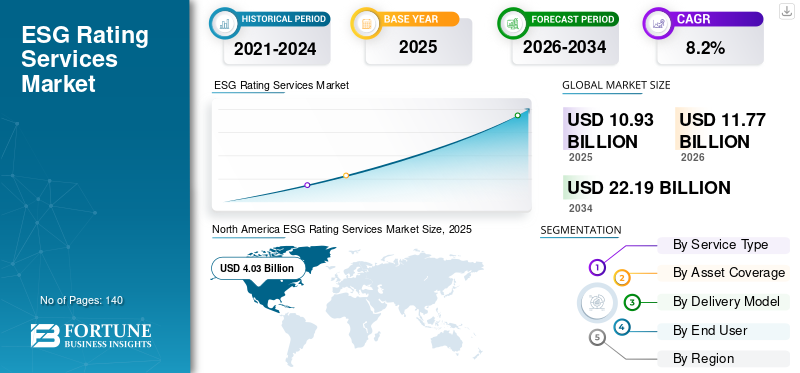
The ESG rating services market size was valued at USD 10.93 billion in 2025. The market is projected to grow from USD 11.77 billion in 2026 to USD 22.19 billion by 2034, exhibiting a CAGR of 8.2% during the forecast period. North America dominated the esg rating services market with a market share of 36.87% in 2025.
ESG rating services comprise specialized assessment, scoring, data analytics, and benchmarking solutions designed to evaluate corporate environmental, social, and governance performance across listed companies, private enterprises, financial institutions, sovereign entities, funds, and debt instruments. These services support the integration of structured ESG datasets, sustainability scoring models, climate-risk analytics, carbon exposure assessment, controversy monitoring, supply chain ESG evaluation, regulatory screening tools, and second-party opinion frameworks to deliver transparent and comparable sustainability intelligence across investment and corporate decision-making workflows. ESG rating services enable asset managers, banks, insurers, pension funds, corporates, and regulators to assess long-term ESG risks, identify sustainability-related risks and opportunities, improve portfolio screening, support credit risk evaluation, strengthen stakeholder reporting, and benchmark corporate ESG practices against peers. Increasing regulatory scrutiny, rising sustainable finance activity, growing demand for climate-risk visibility, and expanding use of ESG data in investment decisions and lending decisions are accelerating adoption of these solutions globally, particularly across developed financial markets such as the U.S. and Europe. These services are increasingly utilized across asset management, banking, insurance, private equity, corporate sustainability, supply chain due diligence, green bond issuance, sustainability-linked loans, and regulatory compliance applications, including sustainable finance disclosure regulation (SFDR) aligned reporting, where transparent ESG evaluation, data consistency, and risk-based decision-making are becoming critical requirements. In addition, growing focus on delivery model segmentation, including subscription-based platforms, data licensing/API access, customized assessment services, and report-based delivery, is further supporting commercialization of ESG rating and sustainability intelligence solutions globally, backed by rising sustained investment in ESG data infrastructure.
- For instance, in April 2026, the European Securities and Markets Authority advanced implementation preparations for the EU ESG Ratings Regulation, strengthening oversight expectations for ESG rating providers and increasing demand for transparent methodologies, governance controls, and comparable rating outputs across financial markets.
MSCI Inc., Morningstar Sustainalytics, S&P Global Inc., Moody’s Corporation, Institutional Shareholder Services Inc. / ISS ESG, LSEG / FTSE Russell, EcoVadis SAS, Fitch Ratings Inc., CDP Worldwide, RepRisk AG, Arabesque Group, and Clarity AI, Inc. are among the major companies operating in the market. Their market positioning is supported by expertise in ESG ratings, sustainability datasets, climate-risk analytics, controversy screening, corporate benchmarking, supply chain ESG assessment, sustainable finance evaluation, and portfolio risk intelligence. Additionally, continued investments in AI-enabled data extraction, alternative ESG datasets, regulatory reporting tools, carbon analytics platforms, issuer engagement models, and scalable cloud-based ESG data delivery also supports evolving investor, corporate, and regulatory sustainability requirements.
Download Free sample to learn more about this report.
ESG RATING SERVICES MARKET TRENDS
Growing Regulatory Oversight and Methodology Transparency is Evolving Market Trend
Demand for ESG rating services is increasingly being driven by the rising need for transparent, comparable, and regulation-aligned sustainability assessments across global financial sector. As investors, banks, insurers, pension funds, and corporates rely more heavily on ESG ratings for portfolio screening, credit risk assessment, sustainable finance decisions, and stakeholder reporting, regulators are placing greater emphasis on rating methodology disclosure, conflict-of-interest management, data traceability, and governance standards. The market is witnessing increasing demand for ESG rating platforms that can provide explainable scoring models, issuer-level data verification, climate-risk integration, controversy monitoring, and audit-ready documentation to support investment and compliance workflows. This shift is moving ESG rating services from broad sustainability scoring toward more structured, defensible, and decision-useful risk intelligence. In Europe, regulatory momentum is especially important as ESMA will directly supervise ESG rating providers offering services in the EU under Regulation (EU) 2024/3005, which focuses on the transparency and integrity of ESG rating activities. This is expected to increase demand for providers with stronger methodology governance, documented rating processes, and reliable ESG data controls.
- For instance, in September 2025, ISS-Corporate announced that it was named “Best Second Party Opinion Provider” dedicated to covered bonds by GlobalCapital, highlighting the growing role of ESG rating service providers in sustainable finance assessment and labeled debt verification.
MARKET DYNAMICS
MARKET DRIVERS
Download Free sample to learn more about this report.
Rising Demand for Transparent ESG Data, Climate Risk Intelligence, and Sustainable Finance Assessments Drives Market Growth
The ESG rating services market growth is driven by the rising integration of sustainability intelligence into investment screening, credit risk evaluation, portfolio monitoring, corporate benchmarking, and sustainable finance decision-making. As asset managers, banks, insurers, pension funds, private equity firms, and corporates face growing pressure to assess climate exposure, governance quality, supply chain risks, carbon transition readiness, and controversy-related reputational risks, demand for structured ESG ratings and data platforms is increasing across global financial industry. ESG rating services are becoming a critical component within modern investment and risk management ecosystems as financial institutions seek comparable scoring models, issuer-level ESG datasets, climate-risk analytics, controversy screening tools, and second-party opinions to support sustainable bond issuance, sustainability-linked loans, regulatory reporting, and stakeholder communication.
- For instance, in November 2025, Morningstar Sustainalytics announced that it was awarded Best ESG Data Provider at the 2025 Buy-Side Technology Awards, highlighting the growing importance of ESG data, technology, and third-party sustainability intelligence across capital markets and financial services.
MARKET RESTRAINTS
Methodology Differences, Data Inconsistency, and Rating Comparability Challenges Limits Market Expansion
The growth of the market is constrained by persistent challenges related to inconsistent rating methodologies, uneven corporate disclosure quality, limited data standardization, and low comparability across ESG scores issued by different providers. Unlike traditional financial metrics, ESG ratings often depend on provider-specific materiality frameworks, sector weightings, controversy interpretation, data estimation models, and qualitative judgment, which can result in different ratings for the same company. This creates uncertainty for investors, issuers, lenders, and regulators using ESG ratings for portfolio construction, credit evaluation, sustainable finance verification, and corporate benchmarking. In addition, many rated companies still face disclosure gaps across Scope 3 emissions, supply chain practices, biodiversity exposure, human rights risks, and governance controls, making it difficult for ESG rating providers to deliver fully consistent and comparable outputs across regions and industries.
MARKET OPPORTUNITIES
Expansion of Climate Analytics, Private Market Coverage, and Sustainable Finance Verification Creating Long-Term Market Opportunities
A major opportunity emerging within the market is the increasing demand for deeper climate-risk analytics, private company ESG coverage, and sustainable finance assessment across investment and corporate decision-making workflows. As investors, banks, insurers, private equity firms, and corporates move beyond traditional public-company ESG scores, demand is increasing for solutions that can assess carbon transition risk, physical climate exposure, supply chain sustainability, private market due diligence, and labeled debt credibility. This is creating substantial opportunities for ESG rating service providers offering AI-enabled data extraction, sector-specific scoring models, issuer engagement tools, controversy intelligence, second-party opinions, and API-based ESG datasets that can support portfolio screening, credit analysis, green bond issuance, sustainability-linked loans, and regulatory reporting. The opportunity is especially strong in climate analytics and sustainable finance verification, where financial institutions require more granular, explainable, and audit-ready ESG intelligence.
- For instance, in January 2025, RepRisk announced that its AI-powered business conduct and ESG risk data became accessible on the Bloomberg Terminal and for Bloomberg Data License subscribers, enabling investors and financial professionals to access actionable company risk insights within Bloomberg’s financial data environment.
MARKET CHALLENGES
Fragmented Sustainability Priorities, Rising Scrutiny, and ESG Data Credibility Issues Challenges Market Development
One of the major challenges affecting the market is the growing complexity of sustainability risk assessment amid fragmented regional regulations, shifting investor priorities, and increasing scrutiny of ESG data credibility. ESG rating providers must continuously update methodologies, datasets, and analytics models to reflect climate risks, business conduct issues, greenwashing concerns, biodiversity exposure, supply chain risks, and governance controversies across sectors and geographies. Similarly, users expect ESG ratings to be more transparent, financially material, and directly usable for investment, lending, compliance, and reporting decisions. This creates operational pressure for providers to improve data traceability, explainability, source transparency, and delivery formats while managing inconsistent corporate disclosures and fast-changing sustainability expectations across markets.
Segmentation Analysis
By Service Type
ESG Ratings and Scores Segment Dominates Owing to Broad Use Across Investment Screening and Corporate Benchmarking
By service type, the market is segmented into ESG ratings and scores, ESG data platforms and benchmarking tools, climate risk and carbon analytics, controversy and reputational risk monitoring, supply chain ESG assessment, and sustainable finance assessment and second-party opinions.
ESG ratings and scores held the largest ESG rating services market share as these services remain the most widely used and commercially established solution across the ESG rating services ecosystem. Asset managers, banks, insurers, pension funds, corporates, and private equity firms increasingly use ESG ratings and scores to evaluate company-level sustainability performance, compare issuers against sector peers, support portfolio screening, assess governance quality, and identify long-term environmental and social risks. Compared to specialized ESG solutions such as climate analytics or supply chain assessment, ESG ratings and scores have broader applicability across listed equities, fixed income, funds, private markets, and corporate benchmarking workflows, making them the core revenue-generating service category. Their adoption is further supported by growing investor demand for standardized ESG evaluation, increasing use of third-party scoring in sustainable investment products, and rising corporate focus on improving external ESG performance visibility.
- For instance, in March 2026, LSEG introduced the LSEG ESG Scores, built from more than 240 indicators across 12 ESG themes and covering over 16,000 companies worldwide. The redesigned scoring suite includes Theme Scores, the overall ESG Score, and ESG Score Plus to help users distinguish operational sustainability performance, broader sustainability impacts, and ESG-related risks.
Climate risk and carbon analytics is expected to witness the highest growth rate, with a CAGR of 9.9% over the forecast period, driven by increasing demand for carbon exposure assessment, physical climate risk analysis, transition-risk modeling, temperature-alignment metrics, financed-emissions tracking, and net-zero portfolio monitoring. The segment is gaining strong momentum as investors, lenders, insurers, and corporates increasingly require granular climate intelligence to support portfolio decarbonization, credit risk evaluation, regulatory disclosure, sustainability-linked financing, and long-term climate resilience planning.
To know how our report can help streamline your business, Speak to Analyst
By Asset Coverage
Listed Equities Segment Dominates Due to Wider Company Coverage and Strong Institutional Investor Adoption
By asset coverage, the market is segmented into listed equities, corporate fixed income, sovereign debt, funds and ETFs, private markets, and real assets and infrastructure.
Listed equities held the largest market share as publicly listed companies remain the primary coverage universe for ESG rating services. Asset managers, pension funds, insurers, banks, index providers, and research platforms widely use listed-company ESG ratings to support portfolio screening, benchmark construction, active ownership, stewardship programs, corporate peer comparison, and sustainability risk assessment. Compared to private markets, real assets, and sovereign debt, listed equities offer broader disclosure availability, stronger issuer visibility, higher investor demand, and more standardized company-level ESG datasets, making them the most commercially established asset coverage category.
Sovereign debt is expected to witness the highest growth rate, with a CAGR of 10.0% during the forecast period, driven by increasing integration of ESG factors into government bond analysis, sovereign credit risk assessment, climate vulnerability evaluation, sustainable debt issuance, and country-level transition-risk monitoring.
By Delivery Model
Subscription-Based Platforms Segment Led the Market Due to Continuous ESG Data Access and Scalable Investor Workflows
By delivery model, the market is segmented into subscription-based platforms, data licensing/API access, customized assessment services, and report-based delivery.
Subscription-based platforms held the largest market share as financial institutions, asset managers, banks, insurers, pension funds, and corporates increasingly require continuous access to ESG ratings, company scores, benchmarking dashboards, controversy alerts, climate-risk indicators, and portfolio screening tools. Compared to one-time reports or customized assessments, subscription-based platforms provide recurring access to updated ESG datasets, issuer-level analytics, peer comparisons, sector materiality insights, and workflow-integrated sustainability intelligence, making them the preferred delivery model for large institutional users.
Customized assessment services are expected to witness the highest growth rate, with a CAGR of 9.3%, driven by increasing demand for tailored ESG evaluations across private markets, supply chain due diligence, sustainable finance transactions, sector-specific benchmarking, and issuer-level improvement programs.
By End User
Asset Managers Segment Led the Market Owing to Strong Use of ESG Ratings in Portfolio Screening and Investment Risk Assessment
By end user, the market is segmented into asset managers, asset owners and pension funds, banks and financial institutions, insurance companies, corporates, private equity and venture capital firms, and government agencies and regulators.
Asset managers held the largest market share as they are the primary consumers of ESG ratings, ESG datasets, benchmarking tools, controversy alerts, and climate-risk analytics for investment decision-making. Asset managers increasingly use ESG rating services to support portfolio screening, fund classification, index-linked strategies, stewardship programs, issuer engagement, regulatory reporting, and sustainability-themed investment products. Compared to corporates, insurers, and regulators, asset managers require broader multi-company and multi-asset coverage across listed equities, fixed income, funds, ETFs, sovereign debt, and private markets, making them the largest revenue-generating end-user group for ESG rating service providers.
Corporates are expected to witness the highest growth rate, with a CAGR of 9.4% over the forecast period, driven by increasing corporate demand for ESG benchmarking, external rating improvement, supply chain ESG assessment, climate-risk disclosure, sustainable finance readiness, and investor communication.
ESG Rating Services Market Regional Outlook
By geography, the market is categorized into Europe, North America, Asia Pacific, South America, and the Middle East & Africa.
North America
North America ESG Rating Services Market Size, 2025 (USD Billion)
To get more information on the regional analysis of this market, Download Free sample
The North America market accounted for USD 4.03 billion in 2025, supported by strong institutional investor adoption, advanced capital market infrastructure, and rising demand for ESG data integration across investment, lending, insurance, and corporate risk management workflows in the U.S., Canada, and Mexico. Regional demand is strongly influenced by the widespread use of ESG ratings and scores, ESG data platforms, climate risk analytics, controversy monitoring tools, and sustainable finance assessments across asset managers, pension funds, banks, insurers, private equity firms, and large corporates. The region benefits from a mature asset management ecosystem, high ESG data subscription penetration, strong listed-company coverage, growing climate-risk assessment needs, and increasing use of ESG intelligence in portfolio screening, credit risk evaluation, shareholder engagement, sustainable investment products, and corporate benchmarking.
U.S. ESG Rating Services Market
The U.S. is expected to dominate the market with an estimated revenue of about USD 3.73 billion in 2026, driven by the country’s large asset management industry, extensive listed-company universe, deep corporate bond market, strong ETF ecosystem, and high adoption of third-party ESG ratings among institutional investors. Demand for ESG rating services remains particularly strong across asset managers, banks, pension funds, insurance companies, private equity firms, and corporates that rely on ESG scores, climate analytics, controversy screening, and issuer-level sustainability datasets for investment decision-making, portfolio risk monitoring, credit evaluation, regulatory reporting, and stakeholder communication. The country also shows strong demand for ESG data platforms and API-based delivery models as financial institutions increasingly integrate sustainability intelligence into internal risk systems, portfolio construction tools, and investment research platforms.
Europe
The Europe market is driven by strong sustainable finance regulation, high institutional ESG adoption, and increasing demand for transparent, comparable, and methodology-driven sustainability assessments across the U.K., Germany, France, Italy, Spain, BENELUX, Nordics, and other European markets. Regional demand is closely associated with ESG disclosure requirements, sustainable investment strategies, climate transition-risk assessment, SFDR-linked reporting, EU Taxonomy alignment, and sustainable debt issuance. Europe remains one of the most important consumption markets for ESG rating services as asset managers, banks, insurers, pension funds, and corporates increasingly use ESG ratings, climate-risk analytics, controversy monitoring, and second-party opinions to support investment screening, credit assessment, corporate benchmarking, and sustainable finance verification.
U.K. ESG Rating Services Market
The U.K. market in 2026 is estimated at around USD 0.69 billion, representing roughly 5.9% of global sales.
Germany ESG Rating Services Market
Germany’s market is projected to reach approximately USD 0.88 billion in 2026, equivalent to around 7.5% of global sales.
Asia Pacific
Asia Pacific remains the significant market and generated revenue of USD 2.29 billion in 2025. Regional market expansion is strongly associated with increasing ESG integration across capital markets, rising sustainable finance activity, expanding listed-company ESG disclosure, and growing demand for climate-risk analytics across Japan, China, India, South Korea, ASEAN, and Oceania. Product demand is also supported by rising use of ESG ratings and scores in portfolio screening, green bond assessment, corporate benchmarking, supply chain risk evaluation, and institutional investment due diligence.
China ESG Rating Services Market
China’s market is projected to remain the dominant in the Asia Pacific region, with 2026 revenues estimated at around USD 0.61 billion, representing roughly 14.2% of global sales.
Japan ESG Rating Services Market
The Japan market in 2026 is estimated at around USD 0.34 billion, accounting for roughly 7.9% of the global sales.
India ESG Rating Services Market
The India market in 2026 is estimated at around USD 0.57 billion, accounting for roughly 13.2% of global sales.
Middle East & Africa
The Middle East & Africa market is driven by rising sustainable finance activity, ESG disclosure adoption, and demand for third-party sustainability assessments across GCC countries, South Africa, North Africa, Israel, and Rest of Middle East & Africa. Demand is closely linked to sovereign wealth fund investments, green sukuk issuance, transition finance, renewable energy projects, infrastructure funding, banking-sector ESG integration, and listed-company sustainability benchmarking. GCC countries lead regional consumption due to strong sustainable debt activity and energy transition projects, while South Africa benefits from mature capital markets, pension funds, and mining-sector ESG scrutiny. North Africa and Rest of Middle East & Africa are gradually adopting ESG rating services through development finance, climate-risk assessment, and infrastructure-led sustainability evaluation.
GCC ESG Rating Services Market
The GCC market is projected to reach around USD 0.23 billion in 2026, representing roughly 5.4% of the global sales.
South America
The South America market is driven by growing sustainable finance activity, rising corporate ESG disclosure, and increasing use of third-party sustainability assessments across Brazil, Argentina, Chile, Colombia, and other regional markets. Demand for ESG rating services is primarily associated with asset managers, banks, pension funds, listed companies, mining firms, energy companies, agribusiness groups, and infrastructure developers seeking ESG ratings, climate-risk analytics, supply chain assessments, and sustainable finance verification.
Brazil ESG Rating Services Market
The Brazil market is projected to reach around USD 0.31 billion in 2026, representing roughly 7.2% of the global sales.
COMPETITIVE LANDSCAPE
Key Industry Players
Increasing ESG Data Coverage, Methodology Transparency, Climate Analytics, and Sustainable Finance Intelligence Drives Market Competition
The market is moderately concentrated, with competitive positioning shaped by capabilities in ESG scoring methodologies, company-level sustainability datasets, climate-risk analytics, controversy monitoring, supply chain ESG assessment, issuer engagement, and sustainable finance verification. Leading companies including MSCI Inc., Morningstar Sustainalytics, S&P Global Inc., Moody’s Corporation, ISS ESG, LSEG / FTSE Russell, EcoVadis SAS, Fitch Ratings Inc., CDP Worldwide, RepRisk AG, Arabesque Group, and Clarity AI maintain strong market positions through broad ESG data coverage, multi-asset research platforms, sector-specific scoring models, regulatory-aligned datasets, and integrated sustainability risk intelligence for investors, banks, corporates, and asset owners.
Competitive differentiation is gradually influenced by the ability to provide transparent rating methodologies, explainable ESG scores, AI-enabled data extraction, real-time controversy screening, climate transition-risk analytics, private company coverage, supplier sustainability ratings, and second-party opinions for green bonds and sustainability-linked finance. Companies are continuously investing in API-based ESG data delivery, cloud-enabled analytics platforms, carbon intelligence tools, portfolio screening solutions, issuer-level benchmarking dashboards, and audit-ready sustainability datasets to support investment screening, credit risk evaluation, regulatory reporting, corporate ESG improvement, and sustainable finance decision-making across global markets.
- For instance, in March 2026, EcoVadis announced the winners of its tenth annual Sustainability Achievement Awards at the EcoVadis Sustain 2026 conference in Paris. The company stated that more than 150,000 businesses use its ratings, risk, carbon management tools, and e-learning platform to accelerate resilience, sustainable growth, and positive impact worldwide.
LIST OF KEY ESG RATING SERVICES COMPANIES PROFILED
- MSCI Inc. (U.S.)
- Morningstar Sustainalytics (Netherlands)
- S&P Global Inc. (U.S.)
- Moody’s Corporation (U.S.)
- Institutional Shareholder Services Inc. / ISS ESG (U.S.)
- LSEG / FTSE Russell (U.K.)
- EcoVadis SAS (France)
- Fitch Ratings Inc. (U.S.)
- CDP Worldwide (U.K.)
- RepRisk AG (Switzerland)
KEY INDUSTRY DEVELOPMENTS
- May 2026: Moody’s Investors Service assigned Energie 360 Grad AG a Second Party Opinion - Green Bond Framework with an SQS2 Sustainability Quality Score, supporting sustainable finance assessment and labeled debt evaluation services.
- January 2026: CDP released its 2025 A List, highlighting continued global demand for high-quality environmental disclosure data from companies, cities, states, and regions, strengthening CDP’s role in sustainability data and scoring.
- October 2025: Fitch Ratings reported that ESG sukuk hit record issuance in 3Q25, with solid momentum expected into 2026, reinforcing demand for ESG-related sustainable finance assessment across emerging markets.
- July 2025: Fitch Ratings published its Global Structured Finance ESG Relevance Scores Update, detailing how environmental, social, and governance factors affect structured finance and covered bond ratings.
- April 2025: ESG Book launched LEO, a sustainability disclosure solution built with Google Cloud and developed with Boston Consulting Group to support regulatory reporting, risk management, and sustainability data workflows for corporates and financial institutions.
REPORT COVERAGE
The global ESG rating services market analysis includes a comprehensive study of the market size & forecast by all the market segments included in the report. It includes details on the market dynamics and market trends expected to drive the market over the forecast period. It provides information on key aspects, including an overview of technological advancements, the regulatory environment, and product launches. Additionally, it details partnerships, mergers & acquisitions, and key industry developments and prevalence by key regions. The global market research report also provides a depth competitive landscape with information on the market share and profiles of key operating players.
Request for Customization to gain extensive market insights.
Report Scope & Segmentation
| ATTRIBUTE | DETAILS |
| Study Period | 2021-2034 |
| Base Year | 2025 |
| Estimated Year | 2026 |
| Forecast Period | 2026-2034 |
| Historical Period | 2021-2024 |
| Growth Rate | CAGR of 8.2% from 2026-2034 |
| Unit | Value (USD Billion) |
| Segmentation | By Service Type, Asset Coverage, Delivery Model, End User, and Region |
| By Service Type |
|
| By Asset Coverage |
|
| By Delivery Model |
|
| By End User |
|
| By Region |
|
Frequently Asked Questions
According to Fortune Business Insights, the global market will stand at USD 11.77 billion in 2026 and is projected to reach USD 22.19 billion by 2034.
In 2025, North America’s market value stood at USD 4.03 billion.
The market is expected to exhibit a CAGR of 8.2% during the forecast period (2026-2034).
By end user, the asset managers segment leads the market.
Rising ESG integration, sustainable finance growth, regulatory disclosure pressure, climate-risk assessment, investor demand, and corporate benchmarking drive market growth.
MSCI Inc., Morningstar Sustainalytics, S&P Global Inc., Moody’s Corporation, ISS ESG, LSEG / FTSE Russell, EcoVadis, and RepRisk are the top players in the market.
North America held the largest market share in 2025.



- 2021-2034
- 2025
- 2021-2024
- 140
Get 30-60 hrs Free Customization
Expand Regional and Country Coverage, Segments Analysis, Company Profiles, Competitive Benchmarking, and End-user Insights.











Related Reports
-
US +1 833 909 2966 ( Toll Free )
-
Get In Touch With Us