Hydrolyzed Wheat Protein Market Size, Share & Industry Analysis, By Product Type (Standard Hydrolyzed Wheat Protein, Hydrolyzed Wheat Gluten, Wheat Protein Hydrolysates/Peptides, and Modified/Quaternized Hydrolyzed Wheat Protein), By Form (Dry and Liquid), By Hydrolysis Route (Enzymatic, Acid, and Alkaline Hydrolysis), By Application (Personal Care & Cosmetics [Hair Care and Skin Care Manufacturers], Food & Beverages [Bakery & Dough and Processed Food Manufacturers], Nutraceuticals & Dietary Supplements, and Animal Nutrition [Pet Food and Livestock]), and Regional Forecast, 2026-2034
 Download Free Sample
(Offer valid till 30th Sep 2026)

Hydrolyzed Wheat Protein Market Size and Future Outlook
 Listen to Audio Version
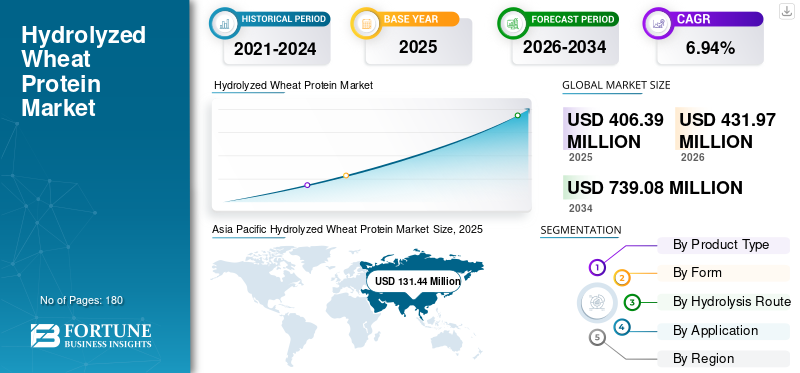
The global hydrolyzed wheat protein market size was valued at USD 406.39 million in 2025. The market is projected to grow from USD 431.97 million in 2026 to USD 739.08 million by 2034, exhibiting a CAGR of 6.94% during the forecast period. Asia Pacific dominated the hydrolyzed wheat protein market with a market share of 32.32% in 2025.
Hydrolyzed wheat protein comprises wheat-derived proteins that are enzymatically or chemically hydrolyzed into smaller peptides and amino acids. They improve solubility, digestibility, moisture retention, film-forming ability, emulsification, and conditioning performance. These functional proteins are widely used in food and beverage products, personal care formulations, cosmetics, animal nutrition, and selected pharmaceutical applications. The market is expanding as manufacturers increasingly seek multifunctional, plant-derived ingredients that enhance product performance while supporting clean-label development and sustainable sourcing.
Roquette Frères, BASF SE, and Croda International Plc are some of the key players in the market. New product launches are the key strategy, which is boosting market expansion.
Download Free sample to learn more about this report.
HYDROLYZED WHEAT PROTEIN MARKET TRENDS
Controlled Enzymatic Hydrolysis and Clean-Label Positioning Reshape Product Development
The market is shifting toward enzymatically hydrolyzed, application-specific, plant-based diets that are based on wheat protein ingredients. Enzymatic processing is gaining preference among manufacturers as it allows manufacturers to control peptide size and functional properties. Suppliers are manufacturing ingredients for beverages and nutrition products with less odor, less color, that can dissolve easily, and taste less bitter. In personal care, product makers are focusing more on protein concentrates, vegan ingredients, natural sources, and reducing the use of silicone. Product development is evolving from generic hydrolysates and shifting toward documented peptide profiles, targeted performance claims, and format-specific solutions.
MARKET DYNAMICS
MARKET DRIVERS
Download Free sample to learn more about this report.
Expansion of Plant-Based Proteins and Multifunctional Formulation Demand Accelerates Market Growth
Demand for hydrolyzed wheat protein is rising, as food, beverage, and personal care companies prefer plant-based ingredients with nutrition and practical benefits. In plant-based food, hydrolysis makes protein more soluble, easier to mix, easier to digest, and better at blending with drinks, nutrition powders, baked goods, and savory foods. In cosmetics, such ingredients are valued for their protective layer, moisturizing and conditioning properties. As more products use hydrolyzed wheat protein for protein-rich formulation, hair care, skin care, and clean-label formulas, demand for standardized grades is growing.
|
Rank |
Market Drivers |
Overall Impact Rank |
CAGR Contribution (2026-2034) |
Impact 2026-2028 |
Impact 2029-2031 |
Impact 2032-2034 |
|
1 |
Rising use in personal care, hair care, and skin care formulations |
High |
+2.20% |
High |
High |
High |
|
2 |
Growth in protein-fortified foods, bakery, plant-based foods, and processed food formulations |
High |
+1.80% |
High |
High |
Medium |
|
3 |
Expansion of nutraceuticals, sports nutrition, and functional nutrition products |
Medium-High |
+1.35% |
Medium |
High |
High |
|
4 |
Higher adoption of enzymatic hydrolysis and controlled peptide technologies |
Medium |
+1.05% |
Medium |
Medium |
High |
|
5 |
Growth in Asia Pacific, Middle East, South America, and import-led specialty ingredient markets |
Medium-Low |
+0.85% |
Medium |
Medium |
High |
|
6 |
Others (clean-label positioning, demand from bio-based technical applications, contract manufacturing growth, and improved ingredient distribution) |
Low |
+0.45% |
Low |
Low |
Low |
|
|
Total Positive Growth Contribution |
|
+7.70% |
|
|
|
MARKET RESTRAINTS
Wheat Allergen Concerns and Gluten-Related Labeling Requirements Limit Broader Formulation Flexibility
The market faces challenges due to wheat allergen labeling, concerns about gluten among consumers, and the need to meet specific regulatory requirements. Certain food companies making gluten-free or wheat-free products avoid using hydrolyzed wheat protein. This limits their ability to enter the fast-growing market for allergen-controlled foods. Personal care brands can face reduced consumer demand if wheat-based ingredients do not fit with sensitive-skin, allergen-aware, or simple product formulas. These issues lead to higher costs for testing, purification, and product development.
|
Rank |
Market Restraints |
Overall Impact Rank |
Negative CAGR Contribution (2026-2034) |
Impact 2026-2028 |
Impact 2029-2031 |
Impact 2032-2034 |
|
1 |
Wheat allergen, gluten-free restrictions, and labeling limitations |
High |
-0.30% |
High |
Medium |
Medium |
|
2 |
Competition from alternative plant proteins and hydrolysates |
Medium |
-0.25% |
Medium |
Medium |
High |
|
3 |
Raw material, processing, quality-control, and formulation-cost pressure |
Medium |
-0.16% |
Medium |
Medium |
Low |
|
4 |
Others (supply-chain variability, regional regulatory documentation, technical formulation limitations, and limited consumer recognition of wheat protein hydrolysates) |
Low |
-0.05% |
Low |
Low |
Low |
|
|
Total Negative Growth Impact |
|
-0.76% |
|
|
|
MARKET OPPORTUNITIES
Low-Molecular-Weight Peptides and Application-Specific Grades Create High-Value Growth Pathways
Key opportunity for hydrolyzed wheat protein market growth involves manufacturing hydrolyzed wheat protein grades that meet specific nutritional products and cosmetic needs. Food and beverage makers look for ingredients that dissolve easily and have little bitterness for products such as protein drinks, sports nutrition, baked goods, and savory foods. Personal care formulators want specific peptide sizes for better hair penetration, conditioning, film formation, and moisture control. Suppliers can use enzymatic hydrolysis, membrane separation, deodorization, and spray drying to make products that stand out, taste better, and work reliably. Suppliers who offer clear molecular-weight profiles, allergen information, product testing, and custom liquid or dry formats can build stronger partnerships in nutrition and personal care markets.
Segmentation Analysis
By Product Type
Standard Hydrolyzed Wheat Protein Segment Led Market as It Offers Good Solubility & Digestibility
By product type, the market is segmented into standard hydrolyzed wheat protein, hydrolyzed wheat gluten, wheat protein hydrolysates/wheat peptides, modified/quaternized hydrolyzed wheat protein, and others.
The standard hydrolyzed wheat protein segment held the largest market share in 2025. It is used in many food, beverage, nutrition, and personal care products, rather than being limited to just one specific function. These products are usually made to offer good solubility, digestibility, emulsification, moisture retention, and film-forming properties. They are widely compatible, easy to get from suppliers, and simple to use in formulas, these products are popular in many industries.
The hydrolyzed wheat gluten holds the second-largest market share and is expected to grow at a CAGR of 6.95% during the forecast period. Wheat gluten provides a concentrated protein feedstock that can be converted into peptide-rich ingredients for food, nutrition, fermentation, and industrial applications. Hydrolysis improves the solubility and digestibility of gluten, which is naturally less soluble in water, enabling its use in savory foods, protein formulations, bakery systems, and selected feed products. It can also provide flavor development, emulsification, and water-binding benefits.
To know how our report can help streamline your business, Speak to Analyst
By Form
Extended Shelf Life and Efficient Industrial Handling Boosted Dry Hydrolyzed Wheat Protein Segment Growth
Based on form, the market is segmented into dry hydrolyzed wheat protein and liquid hydrolyzed wheat protein.
The dry hydrolyzed wheat protein segment accounted for the largest market share in 2025. It provides longer shelf life, easier storage, lower transport cost, and more flexible industrial use than liquid formats. Spray-dried or otherwise dehydrated hydrolysates can be incorporated into bakery mixes, protein powders, seasoning systems, nutrition formulations, tablets, capsules, and powdered cosmetic blends. Manufacturers value dry forms as they support accurate dosing, premix production, simplified inventory management, and reduced microbial risk. Powdered ingredients can also be shipped internationally without intensive temperature control, making them more suitable for global B2B distribution.
The liquid hydrolyzed wheat protein segment holds the second-largest market share and is expected to grow at a CAGR of 7.17% during the forecast period. It can be incorporated directly into shampoos, conditioners, creams, liquid foods, sauces, and beverage systems without a separate dissolution stage. This format mixes quickly, spreads peptides evenly, and reduces dust during manufacturing. Personal care formulators use liquid grades as they blend easily into water-based surfactant and emulsion systems.
By Hydrolysis Route
Controlled Peptide Formation and Better Functional Preservation Propelled Enzymatic Hydrolysis Segment Growth
By hydrolysis route, the market is segmented into enzymatic hydrolysis, acid hydrolysis, alkaline hydrolysis, and multi-step/combined hydrolysis.
The enzymatic hydrolysis segment led the global hydrolyzed wheat protein market share in 2025. It provides greater control over peptide size, solubility, flavor, and functional performance than harsher chemical methods. Manufacturers use selected proteolytic enzymes to break wheat proteins into targeted peptide fractions under moderate temperature and pH conditions. This helps preserve nutritional quality while reducing unwanted color formation and excessive protein degradation.
The acid hydrolysis segment is set to register a CAGR of 6.94% during the forecast period. It offers a comparatively simple and cost-efficient method for breaking down wheat proteins at industrial scale. Acid-hydrolyzed wheat proteins can be used in savory formulations, seasonings, flavor systems, processed foods, and selected industrial applications. Acid hydrolysis may also create additional purification requirements and is less aligned with premium clean-label or minimally processed positioning.
By Application
Food & Beverages Segment Led Market Due to Hydrolyzed Wheat Protein’s Broad Nutritional Use and Processing Functionality
By application, the market is segmented into personal care & cosmetics, food & beverages, nutraceuticals & dietary supplements, animal nutrition, and others.
The food & beverages segment accounted for the largest market share in 2025. Hydrolyzed wheat protein adds nutritional value and helps with formulation in a wide range of products, including bakery products, savory foods, protein powders, nutritional drinks, soups, sauces, and meat alternatives. Manufacturers use this ingredient to boost protein content, improve how dough performs, help with water retention, and make the texture of processed foods better. As it works well with wheat-based production systems, it is especially useful in bakery and cereal products.
The personal care & cosmetics segment led the second-largest share in 2025 and is expected to register a CAGR of 7.08% during the forecast period. Hydrolyzed wheat protein functions as a film-forming, conditioning, moisture-retaining, and hair-strengthening ingredient. It is widely incorporated into shampoos, conditioners, hair masks, styling products, skin creams, lotions, and cleansing formulations. The ingredient also supports vegan, plant-derived, and silicone-reduction positioning, making it attractive to premium and clean-label beauty brands.
Hydrolyzed Wheat Protein Market Regional Outlook
By geography, the market is categorized into Europe, North America, Asia Pacific, South America, and the Middle East & Africa.
Asia Pacific
Asia Pacific Hydrolyzed Wheat Protein Market Size, 2025 (USD Million)
To get more information on the regional analysis of this market, Download Free sample
Asia Pacific led the market with USD 131.34 million in 2025. The market is driven by processed food production, personal care manufacturing, bakery growth, and rising demand for plant-derived functional ingredients. China, Japan, South Korea, India, and Southeast Asia offer different application opportunities. Regional growth is impacted by price, solubility, odor control, and meeting regulations. At the same time, premium enzymatic grades are becoming more popular in high-value cosmetic products.
India Hydrolyzed Wheat Protein Market
The India market in 2025 was valued around USD 19.09 million, accounting for roughly 4.70% of global revenues.
China Hydrolyzed Wheat Protein Market
China’s market in 2025 was valued around USD 58.77 million, representing roughly 14.46% of global sales. China’s market is growing, with uses in personal care products, processed foods, bakery items, flavor systems, and animal nutrition. Liquid hydrolysates are used in shampoos, conditioners, and products that focus on repair. Dry forms are added to food and nutrition products. Rapid product development and a strong manufacturing base are driving demand, but the quality can differ between suppliers.
Japan Hydrolyzed Wheat Protein Market
The Japan market in 2025 reached a valuation of around USD 16.87 million, accounting for roughly 4.15% of global revenues.
North America
The market in North America reached a valuation of USD 92.64 million in 2025. North America’s market is supported by strong demand from processed food, sports nutrition, bakery, hair care, and premium personal care manufacturers. Enzymatically hydrolyzed dry grades are especially relevant where manufacturers require better solubility, controlled peptide size, and reliable storage performance. Wheat allergen labeling and the rise of gluten-free products have slowed growth, limiting wheat use in certain food categories. Suppliers who offer solid technical documentation, low-odor options, and peptide profiles tailored to specific uses have an advantage.
U.S. Hydrolyzed Wheat Protein Market
In 2025, the U.S. market reached USD 63.42 million, and it is the leading country in North America. The U.S. market is driven by increased product usage for nutritional foods, bakery, savory products, shampoos, conditioners, and salon-grade repair treatments. The market benefits from strong ingredient innovation and technical formulation capabilities, but wheat allergen disclosure and gluten-free consumer demand restrict use in plant-based foods. Growth is strongest in vegan hair care, protein-based repair products, blended plant proteins, and premium functional formulations.
Europe
The European market reached a valuation of USD 111.68 million in 2025. Europe is an important market as it has well-developed bakery, specialty food, cosmetics, and professional hair care industries. Germany, France, Italy, the U.K., and Spain drive demand for hydrolyzed wheat high protein in baked goods, savory foods, shampoos, conditioners, hair masks, and skin care products. Enzymatic hydrolysis is preferred for manufacturing premium products to meet the growing demand for plant-based foods in the region.
Germany Hydrolyzed Wheat Protein Market
The market in Germany in 2025 reached around USD 28.36 million, representing roughly 6.98% of global revenues. Advanced food processing, professional hair care, clean-label preferences, and strict documentation requirements shape Germany’s market. Hydrolyzed wheat protein is used in bakery, meat alternatives, savory foods, shampoos, conditioners, and natural-positioned cosmetic products.
U.K. Hydrolyzed Wheat Protein Market
The U.K. market reached approximately USD 15.57 million in 2025, equivalent to around 3.83% of global sales.
South America and Middle East & Africa
The South America market in 2025 recorded USD 31.65 million. The market in South America is growing in areas such as bakery, processed foods, animal nutrition, shampoos, conditioners, and professional hair treatments. Personal care products often deliver more value than food uses. Growth in the market is limited by the cost of imported ingredients, unstable currency, and a lack of local expertise.
The Middle East & Africa region reached a valuation of USD 39.08 million in 2025. The Middle East & Africa market remains relatively small but is gaining relevance in personal care, bakery, processed foods, and specialty nutrition. Gulf markets rely heavily on imported cosmetic and food ingredients, creating opportunities for distributors offering halal-compliant, stable, and well-documented hydrolyzed wheat protein grades. Growth in African nations faces challenges from wheat allergen concerns, reliance on imports, and limited awareness of specialized protein hydrolysates. In premium regional markets, personal care products are expected to grow faster than food applications.
UAE Hydrolyzed Wheat Protein Market
The UAE market is set to grow at a CAGR of 5.76% during the forecast period. The UAE relies on imports, especially for premium personal care items, hotel and salon products, specialty foods, and goods for regional distribution. Buyers opt for halal-certified products, proper documentation, products that stay fresh on shelves, and dependable distributors.
COMPETITIVE LANDSCAPE
Key Industry Players
Rising Demand for Multifunctional Plant-Derived Ingredients Intensifies Competition Among Manufacturers
The global hydrolyzed wheat protein market is highly competitive. Specialty ingredient makers, plant protein processors, cosmetic raw material suppliers, and functional food ingredient companies are increasing their market share. Companies in this market compete based on protein purity, peptide profile, hydrolysis technology, protein impact for different applications, regulatory standards, and supply chain reliability. Manufacturers are investing in enzymatic processing technologies to improve protein efficiency, enhance nutritional value, and reduce unwanted flavors. Companies that provide steady raw material quality, technical support, expand production capacity, and a wide range of ingredients are building long-term partnerships with food, beverage, personal care, and cosmetic manufacturers across the globe.
LIST OF KEY HYDROLYZED WHEAT PROTEIN COMPANIES PROFILED
- Roquette Frères (France)
- BASF SE (Germany)
- Croda International Plc (U.K.)
- TRI-K Industries, Inc. (U.S.)
- SEPPIC S.A. (France)
- Provital S.A. (Spain)
- The Lubrizol Corporation (U.S.)
- Ashland Inc. (U.S.)
- Kerry Group plc (Ireland)
- Archer Daniels Midland Company (U.S.)
KEY INDUSTRY DEVELOPMENTS
- April 2026: Haircare brand Pureance launched a new targeted haircare collection which is designed for damaged hair and is formulated with Hydrolyzed Wheat Protein to address structural protein loss at the level of the hair cortex, offering an alternative to traditional silicone-based products.
- October 2025: Active Concepts, a haircare solution provider, launched hydrolyzed wheat protein. Based on an enzyme named AC Curezyme in the market. The product is aimed at providing deep nourishment to the hair.
- June 2025: Roquette launched NUTRALYS plant protein portfolio composed of NUTRALYS T WHEAT 600L textured wheat protein and NUTRALYS T PEA 700XC textured pea protein, which are designed to help food manufacturers meet growing demand for nutritious, affordable, and sustainable proteins.
- September 2024: Croda International launched Coltide HSi, an advanced copolymer which is made of hydrolyzed wheat protein and silicone that provides combined functionality of 2 ingredients in one solution.
- March 2022: BASF developed a naturally derived hydrolyzed wheat protein product, named Enameguard. The product supports the buffering effects of saliva and supports natural remineralization of tooth enamel.
REPORT COVERAGE
The global hydrolyzed wheat protein market report provides an in-depth study of market size & forecast by all the market segments included in the report. The market analysis includes details on the market dynamics and market trends expected to drive the market during the forecast period. It offers information on the parent market such as the global wheat protein market, technological advancements, supply chain, new product launches, key industry developments, and details on partnerships, mergers & acquisitions. The market forecast also encompasses a detailed competitive landscape with information on market segmentation, market share, and market research of profiles of key operating players.
Request for Customization to gain extensive market insights.
Report Scope & Segmentation
| ATTRIBUTE | DETAILS |
| Study Period | 2021-2034 |
| Base Year | 2025 |
| Estimated Year | 2026 |
| Forecast Period | 2026-2034 |
| Historical Period | 2021-2024 |
| Growth Rate | CAGR of 6.94% from 2026 to 2034 |
| Unit | Value (USD Million) |
| Segmentation | By Product Type, By Form, By Hydrolysis Route, By Application, and Region |
| By Product Type |
|
| By Form |
|
| By Hydrolysis Route |
|
| By Application |
|
| By Region |
|
Frequently Asked Questions
Fortune Business Insights says that the global market value stood at USD 406.39 million in 2025 and is projected to reach USD 739.08 million by 2034.
In 2025, the Asia Pacific’s market value stood at USD 131.34 million.
The market is expected to exhibit a CAGR of 6.94% during the forecast period.
By product type, the standard hydrolyzed wheat protein segment led the global market.
Expansion of plant-based nutrition and multifunctional formulation demand accelerates market growth.
Roquette Frères, BASF SE, and Croda International Plc are the key players in the market.
Asia Pacific held the largest market share in 2025.
Controlled enzymatic hydrolysis and clean-label positioning reshape product development.



- 2021-2034
- 2025
- 2021-2024
- 180
-
(Offer valid till 30th Sep 2026)
Get 30-60 hrs Free Customization
Expand Regional and Country Coverage, Segments Analysis, Company Profiles, Competitive Benchmarking, and End-user Insights.




















Related Reports
-
US +1 833 909 2966 ( Toll Free )
-
Get In Touch With Us