Natural Sugar Reduction Ingredients Market Size, Share & Industry Analysis, By Product Type (Natural High-Intensity Sweeteners [Stevia and Monk Fruit-Based Sweeteners], Rare & Reduced-Calorie Sugars [Allulose and Tagatose], Natural-Origin Polyols [Erythritol, Xylitol, and Sorbitol], and Natural Sugar-Replacement Fibers), By Source (Botanical-Derived, Microbial Fermentation-Derived, and Enzymatically Converted), By Physical Form (Dry, Liquid, and Semi-Solid), By Application (Tabletop Sweeteners, Beverages, Bakery Products, and Confectionery/Dairy Products), and Regional Forecast, 2026-2034
 Download Free Sample
(Offer valid till 15th Oct 2026)

Natural Sugar Reduction Ingredients Market Size and Future Outlook
 Listen to Audio Version
The natural sugar reduction ingredients market size was valued at USD 4.69 billion in 2025 and is projected to grow from USD 5.02 billion in 2026 to USD 9.02 billion by 2034, exhibiting a CAGR of 7.61% during the forecast period. Asia Pacific dominated the natural sugar reduction ingredients market with a market share of 34.54% in 2025.
The market includes ingredients that are derived from natural or bio-based sources. These are used to reduce sugar content in food and drinks, maintaining the sweetness, texture, and other attributes. These ingredients are available in both dry and liquid forms. They are used in drinks, candy, chewing gum, baked goods, dairy products, frozen desserts, nutrition products, and tabletop sweeteners. The market is growing due to taxes on sugar based products in certain countries, and growing consumer concerns about obesity, diabetes, and health disorders.
Companies such as Cargill, Incorporated, Ingredion Incorporated, and Tate & Lyle PLC., are some of the key players in the market. New product launch is the key strategy boosting market expansion.
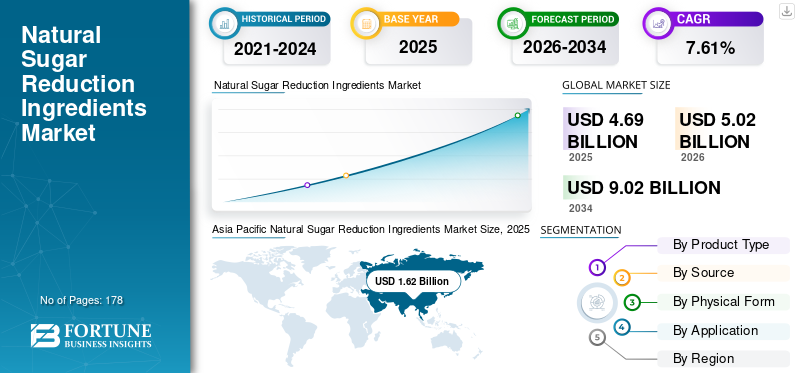
Download Free sample to learn more about this report.
Natural Sugar Reduction Ingredients Market Key Takeaways
 Global Market Size & Forecast
- 2025 Market Size: USD 4.69 Billion
- 2026 Market Size: USD 5.02 Billion
- 2034 Forecast Market Size: USD 9.02 Billion
- CAGR: 7.61% from 2026-2034
 Market Share
- Asia-Pacific dominated the global market with a strong revenue share of 34.54% in 2025.
- Germany accounted for roughly 5.54% of the global market, supported by a large premium food industry.
- China held a notable 12.37% share of the global market, driven by strong fermentation and production capacity.
 Key Regional Highlights
North America
North America reached USD 1.56 billion in 2025, supported by strong beverage and dairy reformulation activity.
Europe
Europe reached USD 1.23 billion in 2025, driven by strong clean-label positioning across premium food categories.
Asia-Pacific
Asia-Pacific held the largest regional share at 34.54% in 2025, supported by abundant agricultural resources and low-cost manufacturing.
U.S.
The U.S. reached USD 1.31 billion in 2025, driven by a strong low-sugar beverage and dairy product ecosystem.
Japan
Japan reached around USD 0.21 billion in 2025, accounting for roughly 4.48% of global market revenues.
Read More

NATURAL SUGAR REDUCTION INGREDIENTS MARKET TRENDS
Fiber Enrichment, Clean-Label Positioning, and Bio-Based Conversion are Reshaping Product Development
The market is increasingly moving toward sugar reduction strategies that provide additional nutritional and sustainability benefits. Rather than positioning products only as low-carb ingredients or sugar-free, manufacturers are using natural sugar-replacement fibers and bulking agents to support fiber enrichment, prebiotic claims, digestive-health positioning, and improved satiety. Chicory-root fiber, oligofructose, acacia fiber, resistant dextrin, citrus fiber, and other soluble fiber systems are becoming increasingly important in reduced-sugar formulations. Their ability to replace part of sugar’s bulk while improving nutritional composition makes them particularly relevant in beverages, confectionery, bakery products, dairy products, and nutritional foods.
MARKET DYNAMICS
MARKET DRIVERS
Download Free sample to learn more about this report.
Rising Reformulation of Sugar-Intensive Foods and Beverages Drives Demand for Natural Sugar Reduction Ingredients
The increasing reformulation of sugar-intensive food and beverage products is a major driver of the natural sugar reduction ingredients market growth. Governments, healthcare organizations, retailers, and consumers are placing greater emphasis on reducing added sugar intake due to its association with obesity, diabetes, cardiovascular conditions, and other metabolic disorders. This pressure is leading manufacturers to update their recipes for beverages, confectionery, chewing gum, bakery products, dairy items, frozen desserts, nutritional foods, and tabletop sweeteners. Companies use sugar replacement systems such as natural polyols, soluble fibers, plant-based sweeteners, and blends to reduce sugar while keeping the same sweetness, texture, and overall feel of the product. Candy and chewing gum makers are also reformulating their products and using sugar alcohols such as xylitol, sorbitol, maltitol, erythritol, Isomalt, and fiber-based fillers to create sugar-free and reduced-sugar options.
|
Rank |
Market Drivers |
Overall Impact Rank |
CAGR Contribution (2026-2034) |
Impact 2026-2028 |
Impact 2029-2031 |
Impact 2032-2034 |
|
1 |
Expanding sugar-reduction regulations, fiscal policies and labeling requirements |
High |
+2.55% |
High |
High |
High |
|
2 |
Rising demand for low-/no-added-sugar and naturally positioned products |
High |
+2.20% |
High |
High |
High |
|
3 |
Technological advances improving taste, functionality and sugar-replacement performance |
High |
+1.80% |
Medium |
High |
High |
|
4 |
Expansion of production capacity and improvement in ingredient cost-in-use |
Medium |
+1.55% |
Medium |
High |
High |
|
5 |
Wider adoption across beverages, confectionery, bakery, dairy and specialized nutrition |
Medium |
+1.35% |
Medium |
High |
High |
|
6 |
Others |
Low |
+0.75% |
Low |
Low |
Low |
|
Total Positive Growth Contribution |
+10.20% |
MARKET RESTRAINTS
Sensory, Digestive-Tolerance, and Formulation Challenges Restrain Wider Market Adoption
Replacing sugar is technically challenging, which continues to restrict market growth. It helps with bulking, browning, keeping in moisture, crystallization, supporting fermentation, developing viscosity, and controlling freezing points. Polyols from natural sources can mimic some of sugar’s physical roles, but have their own formulation challenges. Consuming polyols in large quantities can lead to stomach discomfort. As a result, some companies choose to reduce sugar partially instead of replacing it completely, thus limiting market growth.
|
Rank |
Market Restraints |
Overall Impact Rank |
Negative CAGR Contribution (2026-2034) |
Impact 2026-2028 |
Impact 2029-2031 |
Impact 2032-2034 |
|
1 |
Higher ingredient costs and complex formulation requirements |
High |
-1.00% |
High |
Medium |
Medium |
|
2 |
Regulatory fragmentation, approval delays and inconsistent natural-origin definitions |
High |
-0.78% |
High |
High |
Medium |
|
3 |
Concentrated supply chains, trade measures and feedstock/freight volatility |
Medium |
-0.56% |
High |
Medium |
Medium |
|
4 |
Others |
Low |
-0.25% |
Low |
Low |
Low |
|
Total Negative Growth Impact |
-2.59% |
MARKET OPPORTUNITIES
Integrated Polyol-Fiber Systems Create Significant Market Opportunities in Beverages and Confectionery
There is a rising demand for customized blends designed for particular applications, processing conditions, and nutritional targets. In beverages, blended systems can improve sweetness onset, mouthfeel, flavor persistence, and solids content while reducing calories. Polyols such as erythritol can soften the aftertaste of high-intensity sweeteners, while soluble fibers can improve body health and provide additional nutritional value. The rapid expansion of functional beverages, hydration products, energy drinks, and low-sugar dairy beverages offers a large platform for such systems. Opportunities are especially strong for suppliers capable of delivering complete formulation solutions rather than individual commodity ingredients. This approach can also support higher margins and stronger customer retention.
Segmentation Analysis
By Product Type
Functional Versatility and Broad Application Use Positioned Natural-Origin Polyols as the Dominant Segment
The market is segmented, by product type, into natural high-intensity sweeteners, rare and reduced-calorie sugars, natural-origin polyols, natural sugar-replacement fibers and bulking agents, and others.
Natural-origin polyols segment held the largest natural sugar reduction ingredients market share in 2025. Erythritol, xylitol, sorbitol, maltitol, mannitol, and similar ingredients add bulk and texture to foods. They also help keep food moist, control crystallization, retain moisture, and manage freezing points. Since they have many uses, these ingredients are found in products such as candy, chewing gum, drinks, baked goods, dairy items, frozen desserts, nutritional foods, and tabletop sweeteners.
Natural sugar-replacement fibers and bulking agents holds the second-largest market share, and is expected to grow at a CAGR of 7.55% during the forecast period. These ingredients are particularly important in bakery products, dairy products, frozen desserts, confectionery, nutrition bars, beverages, and reduced-calorie foods. They can improve body, creaminess, moisture retention, and solids content while also supporting fiber-enrichment claims. The segment benefits from increasing consumer interest in digestive health, prebiotic ingredients, and fiber-fortified foods.
By Source
Botanical-Derived Segment Led Due to Established Plant Supply Chains and Consumer Acceptance
Based on source, the market is segmented into botanical-derived, microbial fermentation-derived, enzymatically converted, precision-fermentation-derived, bio-based catalytic conversion, and multi-source formulated systems.
Botanical-derived segment accounted for the largest market share in 2025 as people recognize their plant origins and they are widely used in many sugar-reduction products. Food and beverage manufacturers frequently use botanical origin as a differentiating attribute, particularly in products positioned around wellness, reduced calories, natural formulation, and ingredient transparency. Stevia, monk fruit, chicory-root fiber, and acacia fiber have particularly strong recognition in premium and health-oriented product categories.
Bio-based catalytic conversion make up the second-largest share of the market is expected to grow at a CAGR of 7.49% during the forecast period as it enables manufacturers to convert renewable carbohydrate feedstock into functional sugar-reduction ingredients at commercial scale. The segment benefits from high process consistency, controlled purity, and reduced dependence on the naturally occurring concentration of specific compounds in plants. Enzymatic and bioconversion technologies also support the development of specialty ingredients with improved sweetness or metabolic characteristics.
By Physical Form
Shelf Stability and Efficient Industrial Handling Augmented Dry Ingredients Segment Dominance
The market is segmented, by physical form into dry, liquid, and semi-solid.
Dry segment led the global market in 2025. Powders, granules, and crystalline materials are easier to store, cost less to transport, and work well with many types of industrial food processing. Polyols from natural sources, soluble fibers, bulking agents, botanical extracts, and custom sweetener blends are usually provided as dry products. Crystalline erythritol, xylitol, sorbitol powder, inulin, soluble fibers, and powdered botanical sweeteners can be used in drinks, candy, chewing gum, baked goods, dairy mixes, powdered foods, and tabletop sweeteners.
Liquid segment is another major segment, expected to grow at a CAGR of 7.31% during the forecast period. They are valued for their quick dispersion, precise dosing, and easy integration into continuous food and beverage production. Liquid formats work especially well in beverages, syrups, sauces, dairy products, and frozen dessert bases. Using pre-dissolved ingredients helps reduce mixing time and makes production more consistent. Large beverage companies prefer liquid systems since they can be added straight into production lines and spread evenly throughout the product.
By Application
To know how our report can help streamline your business, Speak to Analyst
High Reformulation Intensity and Public-Health Pressure Propelled Beverages Segment Leadership
The market is segmented, by application into tabletop sweeteners, beverages, bakery products, confectionery and chewing gum, spoonable dairy and frozen desserts, cereals, bars and snack products, sauces, dressings and condiments, spreads and fruit preparations, specialized nutrition products, and other food applications.
Beverages segment accounted for the largest market share in 2025 and they account for a substantial share of added sugar consumption and remain a primary target of sugar taxes, nutrition policies, and corporate reformulation programs. The beverage industry uses a wide range of ingredient systems, including erythritol, soluble fibers, botanical sweeteners, rare sugars, and customized blends. Fruit-derived sweeteners, particularly monk fruit extracts, are expanding in premium beverages and wellness products that emphasize natural ingredient sourcing.
Confectionery and chewing gum segment accounted for second largest share in market in 2025. The segment is expected to register a CAGR of 7.80% during the forecast period. This application depends heavily on natural-origin polyols as sugar performs multiple functions in confectionery, including sweetness, bulk, crystallization, texture, moisture control, and structural development. Xylitol and sorbitol are particularly important in chewing gum, while maltitol and isomalt are widely used in chocolate and hard confectionery.
Natural Sugar Reduction Ingredients Market Regional Outlook
By geography, the market is categorized into Europe, North America, Asia Pacific, South America, and Middle East & Africa.
Asia Pacific
Asia Pacific Natural Sugar Reduction Ingredients Market Size, 2025 (USD Billion)
To get more information on the regional analysis of this market, Download Free sample
The Asia Pacific market was valued at USD 1.62 billion in 2025 and is the leading region globally. Asia Pacific represents both the world's largest production hub and one of the fastest-growing consumption markets for natural sugar reduction ingredients. The region benefits from abundant agricultural resources, large-scale fermentation infrastructure, competitive manufacturing costs, expanding middle-class populations, rapid urbanization, and increasing health awareness. As people have more disposable income, adopt more Western eating habits, and face higher rates of obesity and diabetes, food manufacturers are speeding up efforts to reduce sugar in drinks, dairy, sweets, baked goods, and nutritional foods.
India Natural Sugar Reduction Ingredients Market
The India market in 2025 was valued at around USD 0.12 billion, accounting for roughly 2.56% of global market revenues. Personalized nutrition is expected to support market growth by increasing demand for sugar-reduction solutions tailored to different health issues.
China Natural Sugar Reduction Ingredients Market
China’s market in 2025 was valued around USD 0.58 billion, representing roughly 12.37% of global market share. China is a leading producer due to fast-growing consumer preferences for natural sugar reduction ingredients. China’s low manufacturing costs, strong fermentation capacity, large food-processing industry, and access to natural sweeteners such as stevia and monk fruit helps in supplying steviol glycosides, monk fruit extracts, erythritol, xylitol, and other sweeteners globally.
Japan Natural Sugar Reduction Ingredients Market
The Japan market in 2025 reached a valuation of around USD 0.21 billion, accounting for roughly 4.48% of global market revenues.
North America
The market in North America reached a valuation of USD 1.56 billion in 2025. The growth comes from many companies reformulating beverages, dairy products, nutritional foods, confectionery, bakery items, and tabletop sweeteners. Manufacturers in North America have developed a strong low-sugar product ecosystem. Natural high-intensity sweeteners are preferred, especially in carbonated drinks, flavored waters, energy drinks, dairy alternatives, and powdered mixes.
U.S. Natural Sugar Reduction Ingredients Market
In 2025, the U.S. market reached USD 1.31 billion. The U.S. is one of the largest market for natural sugar reduction ingredients, due to its large beverage, dairy, nutrition, confectionery, and processed food industries. Packaged foods, and premium wellness products are widely available and consumed among end-users. Ongoing product innovation helps manufacturers offer both affordable and premium natural sweeteners.
Europe
The European market reached a valuation of USD 1.23 billion in 2025. The region also benefits from one of the world's largest premium food industries, where consumers are increasingly willing to pay higher prices for clean label products. Germany, the U.K., France, Italy, Spain, and the Netherlands account for majority of regional ingredient consumption due to their extensive beverage, dairy, confectionery, and bakery manufacturing sectors. Europe also hosts several leading ingredient manufacturers investing in next-generation steviol glycosides, fermentation technologies, and customized sweetening solutions.
Germany Natural Sugar Reduction Ingredients Market
The market in Germany, in 2025, reached around USD 0.26 billion, representing roughly 5.54% of global market revenues. Germany is one of Europe’s largest national markets for natural sugar reduction ingredients due to its sizeable food-processing sector, high consumption of dairy, bakery, confectionery, and beverage products, and strong consumer preference for natural and organic positioning.
U.K. Natural Sugar Reduction Ingredients Market
The U.K. market reached approximately USD 0.16 billion in 2025, equivalent to around 3.41% of global market sales.
South America and Middle East & Africa
The South America market in 2025 recorded a value of USD 0.14 billion. South America is emerging as an important regional market, supported by expanding processed food production, improving macroeconomic stability in major economies, increasing health conscious consumers and favorable agricultural conditions for botanical sweetener cultivation. The region’s long history with keto-friendly sweeteners such as stevia cultivation provides manufacturers easy access to local botanical raw materials and helps them promote clean-label products.
Middle East & Africa region reached a valuation of USD 0.14 billion in 2025. The market is developing steadily, supported by improving food processing infrastructure, rising urbanization, increasing disposable incomes in Gulf countries, and growing government efforts to address obesity and diabetes. Expansion of modern retail, international foodservice chains, and multinational packaged food manufacturers is increasing demand for healthier food and beverage products across the region. The Gulf Cooperation Council countries, particularly the United Arab Emirates and Saudi Arabia, account for the majority of regional consumption due to higher purchasing power, significant imports of premium packaged foods, and growing consumer preference for healthier beverage alternatives.
UAE Natural Sugar Reduction Ingredients Market
UAE market is set to grow at a CAGR of 4.82% during the forecast period. The United Arab Emirates leads the Gulf region in the market for natural sugar reduction ingredients. This is due to its high per-capita income, modern retail infrastructure, significant food and beverage imports, nutraceutical industry growth and a large hospitality sector.
COMPETITIVE LANDSCAPE
Key Industry Players
Product Breadth, Formulation Expertise, and Bio-Based Processing Capabilities Intensify Market Competition
The market for natural sugar reduction ingredients is quite fragmented. Competitors range from large ingredient companies and polyol specialists to fiber suppliers, botanical extract producers, and businesses working with biotechnology-based conversion. Companies that handle starch, sugar, or agricultural processing in-house have more reliable access to raw materials and better control over production costs. Strategic partnership is on rise as companies pair biotechnology platforms with established networks for distribution, formulation, and customer service. Expanding capacity, forming joint development agreements with food and beverage manufacturers, and launching products for specific applications are also making the market more competitive. Suppliers who offer polyols, fibers, bulking agents, sensory optimization, regulatory support, and help with application development are likely to improve their market position. Non-GMO sweeteners are becoming an important product-positioning factor as consumers and retailers place greater emphasis on ingredient transparency, traceability, and agricultural sourcing
LIST OF NATURAL SUGAR REDUCTION INGREDIENTS COMPANIES PROFILED
- Cargill, Incorporated (U.S.)
- Ingredion Incorporated (U.S.)
- Tate & Lyle PLC (U.K.)
- Archer Daniels Midland Company (U.S.)
- Roquette Frères SA (France)
- BENEO GmbH (Germany)
- Royal Cosun / Cosun Ingredients—Sensus (Netherlands)
- Jungbunzlauer Suisse AG (Switzerland)
- Samyang Corporation (South Korea)
- Shandong Sanyuan Biotechnology Co., Ltd. (China)
KEY INDUSTRY DEVELOPMENTS
- May 2026: AUSTRIA JUICE launched new fermentation technology that reduces sugar content by 30% in 100% fruit juice.
- November 2025: Oobli, a U.S. based company launched a new natural sweetener which is derived from proteins. This product mimics the taste of sugar and has received GRAS (Generally Recognized as Safe) certification for commercial use.
- July 2025: Layn Natural Ingredients launched SteviUp M2 (Reb M2), a plant-based sweetener that works well in many food and drink products. It offers a sugar-like taste, dissolves easily, and leaves less aftertaste than other steviol glycosides.
- October 2024: NutraEx Food Inc. launched natural sweetener which is made with dry-embedding technology which reduces overall calorie intake associated with normal sugar.
- June 2023: Tate & Lyle, a global F&B ingredients supplier, partnered with, a bio-alternatives scale-up platform named Manus, and launched a premium stevia-derived sweetener. The products were launched as a part of The Sweetener Alliance.
REPORT COVERAGE
The global natural sugar reduction ingredients market report provides an in-depth study of market size & forecast by all the market segments included in the report. The market analysis includes details on the dynamics and trends expected to drive the market during the forecast period. It offers information on the technological advancements, supply chain, new product launches, key industry developments, and details on partnerships, mergers & acquisitions. The market forecast also encompasses detailed competitive landscape with information on the segmentation, share and research of profiles of key operating players.
Request for Customization to gain extensive market insights.
Report Scope & Segmentation
| ATTRIBUTE | DETAILS |
| Study Period | 2021-2034 |
| Base Year | 2025 |
| Estimated Year | 2026 |
| Forecast Period | 2026-2034 |
| Historical Period | 2021-2024 |
| Growth Rate | CAGR of 7.61% from 2026-2034 |
| Unit | Value (USD Billion) |
| Segmentation | By Product Type, By Source, By Physical Form, By Application, and Region |
| By Product Type |
|
| By Source |
|
| By Physical Form |
|
| By Application |
|
| By Region |
|
Frequently Asked Questions
Fortune Business Insights says that the global market value stood at USD 4.69 billion in 2025 and is projected to reach USD 9.02 billion by 2034.
In 2025, Asia Pacific’s market value stood at USD 1.62 billion.
The market is expected to grow at a CAGR of 7.61% during the forecast period of 2026-2034.
Beverages was the leading segment, by application, in the market.
Rising reformulation of sugar-intensive foods and beverages is driving the market growth.
Cargill, Incorporated, Ingredion Incorporated, and Tate & Lyle PLC are a few key players in the market.
Asia Pacific held the largest market share in 2025.
Fiber enrichment, clean-label positioning, and bio-based conversion are major market trends.



- 2021-2034
- 2025
- 2021-2024
- 178
-
(Offer valid till 15th Oct 2026)
Get 30-60 hrs Free Customization
Expand Regional and Country Coverage, Segments Analysis, Company Profiles, Competitive Benchmarking, and End-user Insights.




















Related Reports
-
US +1 833 909 2966 ( Toll Free )
-
Get In Touch With Us