Dashboard Camera Market Size, Share & Industry Analysis, By Distribution Network (OEM and Aftermarket), By Camera Configuration (Single Channel, Dual Channel, and Multi-Channel), By Vehicle Propulsion (ICE Vehicles and Electric Vehicles), By Vehicle Type (Sedans & Hatchbacks, SUVs, LCVs, and HCVs), By Connectivity Type (Standalone Drive Recorders and Connected/Cloud-Enabled Drive Recorders), By Camera Placement (Front Dashcam, Rear Dashcam, In-Cabin, and Side-Facing), By End Users (Individual Consumers and Fleet Operators), and Regional Forecast, 2026-2034
 Download Free Sample
(Offer valid till 30th Sep 2026)

Dashboard Camera Market Size and Future Outlook
 Listen to Audio Version
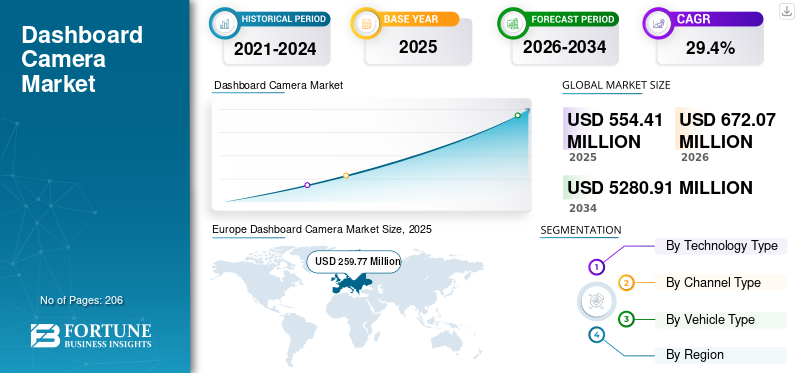
The global dashboard camera market size was valued at USD 5.86 billion in 2025. The market is projected to grow from USD 6.43 billion in 2026 to USD 11.25 billion by 2034, exhibiting a CAGR of 7.3% during the forecast period. Asia Pacific dominated the dashboard camera market with a market share of 48.97% in 2025.
A dashboard camera, or dashcam, is an in-vehicle camera system that continuously records road, cabin, or parking footage to support safety, evidence, monitoring, and driver assistance applications. The market growth is driven by rising road-safety concerns, insurance and legal evidence needs, fleet monitoring demand, ADAS integration, connected camera features, and growing aftermarket installation across passenger and commercial vehicles.
The leading players comprise Thinkware Corporation, Shanghai 70mai Digital Technology Co., Ltd., Pittasoft Co., Ltd., Garmin Ltd., MiTAC Holdings Corporation, and VIOFO Ltd. Thinkware Corporation leads through its advanced dashcam portfolio, ADAS-enabled features, strong parking surveillance solutions, and established international presence.
Download Free sample to learn more about this report.
DASHBOARD CAMERA MARKET Key Takeaways
 Global Market Size & Forecast
- 2025 Market Size: USD 5.86 billion
- 2026 Market Size: USD 6.43 billion
- 2034 Forecast Market Size: USD 11.25 billion
- CAGR: 7.3% from 2026–2034
 Market Share
- Asia Pacific dominated the dashboard camera market with a market share of 48.97% in 2025.
- The SUVs segment is estimated to exhibit the fastest growth at a CAGR of 8.6% over the forecast period.
- The connected and cloud-enabled drive recorders segment is anticipated to depict the fastest growth at a CAGR of 11.8%.
 Key Regional Highlights
Asia Pacific
The region led the global market with a 48.97% share in 2025, supported by a large passenger vehicle base, strong demand for in-vehicle safety solutions, and increasing dashcam adoption across China, India, Japan, South Korea, and Southeast Asia.
North America
The second-largest regional market in 2025, driven by growing adoption across personal vehicles, ride-hailing services, logistics operators, and commercial fleets seeking improved safety and fleet management.
Europe
The third-largest market in 2025, supported by established automotive manufacturing, stringent vehicle safety standards, and increasing adoption of advanced in-vehicle technologies.
U.S.
The U.S. market is estimated to touch a value of around USD 1.13 billion in 2026, accounting for roughly 17.6% of global market revenues. Growth is driven by insurance evidence, rideshare usage, fleets, and connected dashcams.
Japan
The Japan market is estimated to reach around USD 0.59 billion in 2026, accounting for roughly 9.1% of global market revenues. Growth is driven by mature vehicle adoption, road safety focus, and insurance evidence needs.
Read More

DASHBOARD CAMERA MARKET TRENDS
AI-Enabled Video Analytics Emerges as a Core Product Trend
AI-enabled video analytics is one of the emerging and major market trends, as dash cams evolve from passive recording devices into intelligent safety and monitoring systems. Traditional dash cams mainly captured footage for post-incident review, while newer AI-powered systems can detect risky driving behavior and generate real-time alerts. These capabilities may include distracted driving detection, fatigue monitoring, harsh braking identification, lane departure warnings, tailgating alerts, forward collision risk detection, pedestrian recognition, and event-based video tagging.
- In June 2025, Lytx launched the Surfsight AI-14 dash cam to enhance commercial fleet safety and efficiency. The device uses machine vision and AI for proactive risk detection, real time monitoring, driver alerts, road-facing ADAS features, event tagging, touchscreen-based setup, privacy controls, and over-the-air updates, supporting fleets with improved risk management and operational visibility.
Multi-Channel and Connected Dash Cam Adoption Gains Momentum
Multi-channel and connected dash cam adoption is gaining momentum as users increasingly seek wider vehicle visibility and remote access to recorded footage. While single-channel dash cams remain relevant for cost-sensitive buyers, dual-channel and multi-channel systems are becoming more popular among commercial fleets, taxis, ride-hailing vehicles, buses, delivery vans, rental vehicles, and premium passenger cars. These systems can record front, rear, cabin, and side-view areas, helping users capture a more complete view of road incidents, passenger activity, parking damage, theft, vandalism, and cargo-related disputes.
- In March 2026, iiwey introduced its N5, N5 Pro, N6, and N9 multi-channel dash cam series for North America. The lineup features 4- and 5-channel recording, front, rear, cabin, and side-view monitoring, Wi-Fi 6 connectivity, GPS, infrared night vision, supercapacitor-based reliability, and parking surveillance to improve vehicle protection and incident documentation.
MARKET DYNAMICS
MARKET DRIVERS
Download Free sample to learn more about this report.
Rising Road Safety Concerns to Drive Dash Cam Installations
An increase in concerns associated with road safety is a key driver for dashboard camera market growth, as vehicle owners, fleet operators, insurers, and mobility service providers increasingly require reliable video evidence for accident documentation and risk reduction. Growing traffic density, distracted driving, aggressive driving behavior, expanding vehicle ownership, and higher commercial vehicle movement have increased the need for in-vehicle monitoring solutions. Dash cams help record crashes, hit-and-run incidents, sudden braking, unsafe lane changes, road rage, parking damage, pedestrian-related incidents, and false liability claims. This makes them valuable for both private vehicle owners and commercial operators.
- In March 2026, NHAI announced plans to deploy AI-powered dashcam analytics across around 40,000 km of India’s National Highway network. Mounted on Route Patrol Vehicles, the system will conduct weekly surveys, detect over 30 road defects, monitor pavement conditions, signage, lighting, encroachments, and maintenance issues, supporting faster repairs, improved safety, and technology-driven highway operations management nationwide.
Expansion of Commercial Fleets to Drive Enterprise Dash Cam Demand
The growth of commercial fleets is strongly supporting the increasing demand for dash cams across logistics, e-commerce delivery, ride-hailing, taxi fleets, public transport, school buses, construction vehicles, waste management fleets, rental cars, and field-service vehicles. These vehicles often operate for long hours, cover dense urban routes, and are handled by multiple employees, contractors, or gig workers. This increases exposure to accidents, driver misconduct, theft, passenger disputes, cargo claims, customer complaints, and vehicle misuse. Dash cams help fleet operators improve accountability by providing visual evidence for incident review, driver monitoring, and operational decision-making.
- In January 2026, Motive launched AI Dashcam Plus to improve fleet safety by detecting driving risks faster and helping prevent collisions. The system can run over 30 AI models simultaneously, uses dual forward-facing stereo vision, and includes hands-free two-way calling. Motive also released its 2026 AI Road Safety Report based on 1.2 billion hours of dashcam video.
Insurance and Liability Management to Drive Dash Cam Value Proposition
Insurance and liability management are important drivers for the market, as dash cam footage helps vehicle owners and fleet operators reduce uncertainty during claim settlement and accident dispute resolution. In many traffic incidents, photographs, written statements, and eyewitness accounts may not clearly establish the sequence of events. Dash cam footage can help verify vehicle movement, lane position, traffic signal status, braking behavior, road conditions, pedestrian movement, driver reaction, and third-party fault. This makes dash cams valuable for documenting accidents and supporting evidence-based insurance claims.
- In January 2022, AXA XL highlighted an increasing commercial fleet interest in in-cab and mounted vehicle cameras to improve safety, support faster claims resolution, and defend against false insurance claims. The company noted that dash camera footage can provide unbiased accident evidence, assist liability assessment, strengthen driver training, reduce litigation exposure, and support broader fleet risk management programs.
MARKET RESTRAINTS
Privacy and Data Protection Concerns May Restrain Product Adoption
Privacy and data protection concerns remain a significant restraint for the market, particularly as dash cam systems become more connected, data-intensive, and capable of recording both external road conditions and in-cabin activity. Modern dash cams can capture pedestrians, vehicle registration plates, passengers, employees, private properties, customer delivery points, and, in some cases, audio conversations inside the vehicle. This creates sensitivity around personal data collection, surveillance, employee monitoring, and third-party consent. The issue is especially relevant for commercial fleets, taxis, ride-hailing vehicles, buses, logistics operators, and public transport vehicles, where recorded footage may involve multiple stakeholders beyond the vehicle owner.
MARKET OPPORTUNITIES
Video Telematics and Fleet Platforms to Create New Growth Avenues
Video telematics creates a significant opportunity for dash cam vendors to shift from one-time hardware sales toward recurring service-based revenue. Instead of supplying only recording devices, vendors can offer integrated platforms that combine dash cam footage with cloud storage, live vehicle tracking, event-based video upload, driver scoring, AI alerts, compliance reporting, safety dashboards, maintenance insights, and telematics data. This model is particularly attractive for logistics companies, bus operators, school transport providers, taxi fleets, ride-hailing fleets, rental operators, construction vehicles, emergency vehicles, and field-service fleets.
- In December 2025, SelectCam AI launched its flagship AI-powered video telematics solutions, including the M8 8-channel 4G MDVR and DC20 6-channel 4G dashcam for freight fleets. As claimed by the company, the systems have been designed to improve safety and operational efficiency through rugged hardware, AI optimization, localization, and fleet-focused video telematics for global markets.
OEM Integration to Create Long-Term Opportunities for Market Growth
The OEM integration presents a strong long-term opportunity for the market, particularly as automakers expand connected vehicle, safety, security, and driver assistance features. At present, many dash cams are installed through the aftermarket, but factory-integrated systems can offer better reliability, cleaner installation, stronger aesthetics, improved power management, warranty coverage, and compatibility with vehicle electronics. OEM-installed drive recorders can use existing vehicle cameras, infotainment screens, GPS modules, telematics units, parking sensors, and Advanced Driver Assistance Systems (ADAS), reducing the need for separate windshield-mounted devices.
- In October 2025, Toyota announced its enhanced Toyota Audio Multimedia system, launching with the 2026 RAV4. The update includes a standard built-in Drive Recorder Dash Cam that uses the vehicle’s exterior cameras to capture manual and triggered events. Video playback is available on the head unit, while clips can be downloaded through a USB flash drive.
MARKET CHALLENGES
Price Sensitivity and Installation Complexity to Create Challenges for Market Expansion
Price sensitivity and complexities associated with installation represent key challenges for the market, particularly among budget-conscious consumers, small fleet operators, used vehicle owners, and buyers in emerging markets. While entry-level plug-and-play dash cams are widely available, advanced systems with 4K recording, dual or multi-channel coverage, cabin monitoring, LTE connectivity, GPS, AI-based alerts, cloud storage, parking surveillance, and hardwired power supply can substantially increase the total cost of ownership.
Segmentation Analysis
By Vehicle Type
High Ownership Volumes across Urban and Semi-Urban Markets to Fuel Sedans & Hatchbacks Segment Growth
Based on vehicle type, the market is segmented into sedans & hatchbacks, SUVs, LCVs, and HCVs.
The sedans & hatchbacks segment leads the market due to their high ownership volumes across urban and semi-urban markets. The growing consumer focus on accident evidence, insurance companies support, road safety, and affordable aftermarket installation is supporting steady adoption, particularly across Asia Pacific and Europe, where compact passenger vehicles dominate vehicle sales.
- In April 2025, Tesla highlighted its integrated vehicle dashcam, offering standard multi-camera coverage, event-triggered recording, Sentry Mode, in-car and mobile playback, and seamless security features, positioning Tesla’s built-in system against aftermarket dashcam options for driver protection.
SUVs are witnessing strong dashcam adoption and the segment is estimated to exhibit the fastest-growth at a CAGR of 8.6% over the forecast period. The growth is due to the increasing consumer preference for feature-rich vehicles, higher disposable incomes, and greater demand for safety, surveillance, and connected mobility solutions. Premium and mid-size SUVs are more likely to support dual-channel cameras, cloud connectivity, ADAS-linked recording, and factory-fitted systems, accelerating revenue growth across both OEM and aftermarket channels.
To know how our report can help streamline your business, Speak to Analyst
By Connectivity Type
Lower Price, Simple Installation, and Wide Availability to Fuel Standalone Drive Recorders Segment Growth
Based on connectivity type, the market is segmented into standalone drive recorders and connected/cloud-enabled drive recorders.
The standalone drive recorders segment dominates the global market share due to their lower price, simple installation, and wide availability across retail and online channels. Consumers prefer these devices for accident recording, theft protection, parking monitoring, and insurance claim support, especially in price-sensitive markets where factory-fitted connected systems remain limited.
The connected and cloud-enabled drive recorders segment is gaining strong momentum and is anticipated to depict the fastest growth at a CAGR of 11.8% over the analysis period. The segment is expanding as consumers and fleet operators increasingly prefer real-time video access, remote monitoring, GPS tracking, emergency alerts, and cloud storage. The integration with mobile applications, telematics platforms, ADAS features, and AI-based event detection is supporting increasing product adoption across premium vehicles, commercial fleets, and urban mobility applications.
- In July 2025, Pioneer announced plans to supply network-connected dash cams to Tokio Marine & Nichido Fire Insurance for its Drive Agent Personal plan in Japan, enabling automated incident notification, emergency calls, video transmission, driving-data uploads, and OTA updates.
By Camera Configuration
High Requirement of Front-road Video Recording and Strong Aftermarket Presence to Propel Single Channel Segment Growth
Based on camera configuration, the market is segmented into single channel, dual channel, and multi channel.
The single channel segment dominates the global dashboard camera market share as they meet the basic requirement of front-road video recording at a comparatively lower cost. Their strong presence in the aftermarket, easy plug-and-play installation, and wide availability across online and retail channels make them highly suitable for personal vehicles and price-sensitive customers.
The multi-channel segment is expected witness the fastest-growth at a CAGR of 13.2% during the forecast period, as fleet operators, premium vehicle owners, and commercial mobility providers increasingly require front, rear, side, and cabin coverage. These systems improve incident reconstruction, parking surveillance, blind-spot monitoring, driver behavior analysis, and passenger safety, making them valuable for logistics, ride-hailing, taxis, and high-value personal vehicles.
- In January 2025, Verizon Connect introduced Extended View Cameras, a multi-channel fleet dashcam system with rear, side, cargo, in-cab, and road-facing cameras, enabling broader incident visibility, driver monitoring, ADAS event capture, in-cab live views, and risk mitigation.
By Camera Placement
Wide Use across Passenger Cars, Taxis, Commercial Vehicles, and Fleet Operations to Augment Front Dashcams Segment Growth
Based on camera placement, the market is segmented into front dashcam, rear dashcam, in-cabin, and side-facing.
The front dashcams segment dominates the market due to their wide use across passenger cars, taxis, commercial vehicles, and fleet operations. Their ability to capture forward road conditions, collisions, traffic violations, and driving behavior makes them the preferred first-installation option for both OEM and aftermarket customers.
- In May 2026, THINKWARE launched the TOY2KD dash cam in Australia, offering Toyota-certified dual-channel 2K front and Full HD rear recording, Sony STARVIS sensor, Super Night Vision 2.0, GPS alerts, parking surveillance, and smartphone connectivity.
The side-facing dashcams segment is gaining momentum and set to expand at the fastest CAGR of 16.0% during the analysis period as vehicle owners and fleet operators increasingly seek wider surveillance coverage beyond front and rear recording. These systems help monitor blind spots, side impacts, parking damage, lane-change incidents, and vandalism, making them valuable for premium vehicles, commercial fleets, ride-hailing vehicles, and urban logistics operations.
By Vehicle Propulsion
Hatchbacks & Sedans Segment Dominates the Market due to Extensive Consumer Adoption
Based on vehicle propulsion, the market is segmented into ICE vehicles and electric vehicles.
The ICE vehicles segment continue to dominate the global market due to their vast vehicle parc across passenger cars, commercial vehicles, taxis, and private fleets. Most dashcam demand currently comes from existing ICE vehicles, where consumers install standalone or dual-channel devices for accident evidence, theft protection, parking surveillance, and insurance claim support.
Electric vehicles are becoming a high-growth category for dashboard cameras as EV buyers generally show a stronger preference for advanced safety, connectivity, and digital vehicle features. The segment is expected to exhibit the fastest growth at a CAGR of 14.8% over the forecast period. Automakers are increasingly integrating dashcams with ADAS, parking surveillance, infotainment, cloud storage, and vehicle event recording systems, supporting stronger OEM adoption across premium and mass-market EV platforms.
- In June 2025, Kia’s Carens Clavis EV testing was spotted in India ahead of its expected launch, featuring Level 2 ADAS, dual-camera dash cam, 360-degree camera, V2L/V2V charging, and battery options offering up to 473 km range.
By Distribution Network
Broad Category Access and Price Flexibility to Drive Aftermarket Segment Dominance
Based on distribution network, the market is segmented into OEM and aftermarket. The aftermarket is further bifurcated into new vehicles and used vehicles.
The aftermarket segment dominates the global market as most dashcams are purchased separately by consumers after vehicle acquisition. Online platforms, electronics retailers, automotive accessory stores, and installation workshops provide broad access to standalone, dual-channel, and connected dashcams, making the channel highly attractive across both developed and emerging markets.
- In March 2025, 70mai introduced the 4K Omni, a 360° rotating dash cam with dual-channel recording, 4K 60FPS front capture, 1080P HDR rear camera, AI motion detection, 24-hour parking surveillance, 4G connectivity, ADAS, and Wi-Fi 6.
The OEM segment is poised to depict the fastest-growing CAGR of 12.1% during the forecast period. OEM dashcam adoption is increasing as automakers integrate drive recording features into new vehicles, especially premium models, electric vehicles, SUVs, and connected mobility platforms. Factory-installed systems offer better design integration, warranty support, power management, data security, and compatibility with ADAS, telematics, parking surveillance, and vehicle event recording functions.
By End Users
Purchases for Theft Prevention and Insurance Claim to Support Individual Consumers Segment Growth
Based on end users, the market is segmented into individual consumers and fleet operators.
The individual consumers segment dominates the market as dashcams are widely purchased for accident evidence, theft prevention, parking surveillance, and insurance claim support. Growth is particularly strong among private car owners seeking affordable standalone and dual-channel products through online platforms, electronics retailers, and automotive accessory stores.
The fleet operators segment is anticipated to expand at a CAGR of 13.6% during the forecast period. These operators are rapidly adopting dashboard cameras to improve driver accountability, reduce accident-related claims, monitor risky driving behavior, and support real-time vehicle visibility. Logistics companies, ride-hailing fleets, taxis, delivery operators, and commercial transport providers are increasingly integrating dashcams with telematics, GPS tracking, cloud storage, and AI-based event detection systems.
- In June 2026, SureCam launched Vantage, a 360° fleet camera system with up to six synchronized views, AI-powered DMS and ADAS, cloud uploads, in-cab monitoring, Geotab compatibility, and scalable configurations to improve fleet safety and regulatory compliance.
Dashboard Camera Market Regional Outlook
By geography, the market is categorized into Asia, Australia, North America, Europe, South America, the Middle East, and Africa.
Asia
Asia Dashboard Camera Market Size, 2025 (USD Billion)
To get more information on the regional analysis of this market, Download Free sample
Asia dominates the global market due to its large passenger vehicle base, dense urban traffic, and strong consumer preference for in-vehicle safety and surveillance products. Mature dashcam adoption in Japan and South Korea and rising penetration in China, India, and Southeast Asia continue to support strong regional revenue growth.
- In May 2026, Geotab launched GO Focus Plus AI dash cam and video intelligence platform in Indonesia, combining edge AI, real-time telematics, risk prioritization, privacy-focused recording modes, and compliance features to improve fleet safety across complex transport environments.
China Dashboard Camera Market
The China market is estimated to reach a value of around USD 1.99 billion in 2026, accounting for roughly 31.0% of global market revenues. The market growth in the country is supported by high vehicle ownership, e-commerce sales, and safety awareness.
Japan Dashboard Camera Market
The Japan market is estimated to reach around USD 0.59 billion in 2026, accounting for roughly 9.1% of global market revenues. Growth is driven by mature vehicle adoption, road safety focus, and insurance evidence needs.
India Dashboard Camera Market
The India market is estimated to touch a valuation of around USD 0.12 billion in 2026, accounting for roughly 1.8% of the global market revenues. Growth is supported by rising car ownership, urban congestion, fleet adoption, and affordability.
Australia Dashboard Camera Market
The market growth in Australia is supported by rising consumer awareness of accident documentation, insurance claim support, and vehicle security. Dashcams are commonly adopted by private vehicle owners, ride-share drivers, and commercial fleets, with demand concentrated around standalone and dual-channel systems available through online and automotive accessory channels.
- In March 2026, THINKWARE launched the U3000 PRO in Australia, featuring 4K front and 2K rear recording, dual Sony STARVIS 2 sensors, RADAR parking surveillance, GPS, dual-band Wi-Fi, optional LTE connectivity, and THINKWARE CONNECTED app support.
North America
North America was the second-largest market in 2025. The region is witnessing steady dashcam demand across personal vehicles, ride-hailing fleets, logistics operators, and commercial transport fleets. Consumers are increasingly using drive recorders for accident evidence, theft protection, and parking surveillance, while fleet operators are adopting connected cameras to improve driver behavior, reduce liability, and support claims management.
- In May 2026, Wolfbox debuted the G900 Pro dashcam bundle for RVs, camper vans, truck campers, and overlanding rigs, featuring 4K front recording, 2.5K waterproof rear camera, touchscreen rear-view mirror, GPS tracking, collision recording, Wi-Fi, and voice commands.
U.S. Dashboard Camera Market
The U.S. market is estimated to touch a value of around USD 1.13 billion in 2026, accounting for roughly 17.6% of global market revenues. Growth is driven by insurance evidence, rideshare usage, fleets, and connected dashcams.
Europe
Europe was the third-largest market in 2025. The presence of leading automotive manufacturers and stringent vehicle safety regulations is supporting the demand for high-performance brake pads across Europe. The increasing focus on sustainable mobility and low-emission transportation technologies is encouraging the adoption of advanced and environmentally friendly braking materials in the region.
- In September 2023, Magna announced the production of its Gen5 front camera module, offering 8MP resolution, a wide field of view, long-range perception, side-object detection, sensor fusion scalability, and ADAS features such as hazard detection.
Germany Dashboard Camera Market
The Germany market is estimated to touch a valuation of around USD 0.22 billion in 2026, accounting for roughly 3.5% of global market revenues. Growth is shaped by premium vehicle adoption, fleet monitoring, and connected vehicle technologies.
Russia Dashboard Camera Market
The Russia market is estimated to reach a value of around USD 0.36 billion in 2026, accounting for roughly 5.6% of global market revenues. Growth is supported by strong consumer use, accident evidence needs, and harsh driving conditions.
South America
South America is among the fastest-growing markets, supported by rising safety concerns and expanding aftermarket penetration. The regional market is growing as vehicle owners increasingly use dashcams for road incident recording, theft prevention, and insurance evidence. The product demand is gradually improving in Brazil, Argentina, and other urban markets where traffic congestion, vehicle security concerns, and aftermarket accessory adoption are supporting product penetration.
- In June 2026, iStarVideo showcased flagship 4G dash cam solutions at EXPOSEC Brazil, presenting 4K UHD recording, 4G remote live view, AI ADAS, DMS, motion detection, cloud parking monitoring, and multi-lens fleet surveillance products.
Brazil Dashboard Camera Market
The Brazil market is estimated to reach around USD 0.12 billion in 2026, accounting for roughly 1.8% of global market revenues. The market growth in the country is supported by vehicle safety concerns, aftermarket demand, and urban traffic risks.
Middle East
The Middle East region held the fourth-largest market share in 2025. This market is gaining traction as consumers and fleet operators increasingly adopt dashcams for accident documentation, vehicle security, and driver accountability. High penetration of premium vehicles, commercial transport activity, and urban mobility services across key Gulf markets is supporting the demand for advanced front, rear, and connected recording systems.
- In May 2026, AWPRO highlighted Dubai’s legal approval of dash cams, noting responsible use under UAE privacy laws and rising opportunities for motorists and businesses through accident evidence, insurance support, GPS tracking, collision detection, night vision, and 4K recording.
UAE Dashboard Camera Market
The UAE market is estimated to reach around USD 0.02 billion in 2026, accounting for roughly 0.3% of global market revenues. Growth is driven by premium vehicles, fleet monitoring, and road safety awareness.
Africa
The Africa market is anticipated to be the fastest-growing region expanding at a CAGR of 11.1% over the forecast period. The regional market is at an early stage but adoption is rising due to increasing vehicle ownership, road safety concerns, fleet security needs, and demand for accident evidence. Growth is supported by urban mobility expansion, commercial transport activity, and the gradual availability of affordable aftermarket dashcams through online and retail channels.
- In May 2025, Bolt launched a smartphone dash cam program in South Africa with Driver Technologies, giving driver partners discounted AI-based recording, cloud video storage, app integration, interior and exterior footage, and evidence support for safety, disputes, insurance, and law enforcement.
South Africa Dashboard Camera Market
The South Africa market is estimated to touch a value of around USD 0.03 billion in 2026, accounting for roughly 0.4% of global market revenues. Growth is supported by security concerns, insurance evidence needs, and fleet adoption.
COMPETITIVE LANDSCAPE
Key Industry Players
Companies Focus on through Reliability, Video Quality, Pricing, Connected Features, and Brand Strength to Differentiate Themselves
The dashboard camera market is highly competitive, with players differentiating through reliability, video quality, pricing, connected features, brand strength, and distribution reach. Key competition centers on 4K recording, multi-channel systems, parking surveillance, cloud storage, app connectivity, ADAS alerts, AI event detection, fleet monitoring, and telematics integration. Leading companies include Thinkware, 70mai, Pittasoft, Garmin, MiTAC, and VIOFO, each competing through premium features, affordability, cloud connectivity, GPS/LTE capability, or enthusiast-focused dashcam solutions.
LIST OF KEY DASHBOARD CAMERA COMPANIES PROFILED
- Garmin Ltd. (U.S.)
- Pittasoft Co., Ltd. (South Korea)
- Thinkware Corporation (South Korea)
- MiTAC Holdings Corporation (Taiwan)
- Pioneer Corporation (Japan)
- JVCKENWOOD Corporation (Japan)
- Transcend Information, Inc. (Taiwan)
- Cedar Electronics Holdings Corporation (U.S.)
- Shanghai 70mai Digital Technology Co., Ltd. (China)
- Nextbase (U.K.)
- Shenzhen Jimi IoT Co., Ltd. (China)
- VIOFO Ltd. (China)
- Vantrue Technology Co., Ltd. (China)
- Rexing Inc. (U.S.)
- AZDOME Technology Co., Ltd. (China)
KEY INDUSTRY DEVELOPMENTS
- January 2026: Garmin introduced dēzl DualView, a rugged two-camera system for trucks, providing live side views, blind-spot awareness, merging alerts, 1080p recording, incident saving, and Garmin Drive app video sharing, expanding its dash cam relevance from passenger vehicles into professional trucking safety.
- January 2026: Vantrue debuted the Pilot 2 at CES 2026, introducing a dash cam system with thermal imaging, Apple CarPlay, Android Auto, voice control, Wi-Fi 6, and a 6.25-inch touchscreen hub, targeting older vehicles needing advanced visibility and infotainment upgrades.
- January 2026: Nextbase signed a partnership with Mitsubishi Motors North America to make dash cams available through Mitsubishi dealers as part of the company’s accessory program. The collaboration uses Nextbase’s Vehicle Accessory as a Service platform, enabling customers to purchase installed, warranted dash cams during the vehicle-buying process while supporting dealer accessory revenue.
- November 2025: THINKWARE unveiled the U3000 PRO, upgrading its flagship dash cam with 4K front and 2K rear recording, Sony STARVIS 2 sensors, HDR, radar-based parking detection, GPS, Wi-Fi, optional LTE connectivity, and remote monitoring functions for parked-vehicle security.
- August 2025: VIOFO promoted the A229 Ultra series as a flagship multi-channel dash cam platform, offering 4K front, 4K rear, and 1080p cabin recording, triple Sony STARVIS 2 sensors, professional HDR, and advanced imaging for higher-quality evidence capture in varied driving conditions.
- February 2025: JVCKENWOOD introduced the MDR-L612W/L612 Saisoku-Navi systems, strengthening dash cam integration through compatible navigation-linked drive recorder functions, and GPS-based position recording. Additional features comprise six-axis sensor support, two-screen video-map display, and improved in-car evidence review directly on the navigation screen.
- June 2024: Cobra introduced the SC 250R dual-view smart dash cam with 4K front recording, rear-view coverage, cloud video management, heads-up navigation, emergency Mayday notifications, and remote live view. The launch expanded its premium connected dash cam offerings for daily drivers.
REPORT COVERAGE
The global dashboard camera market analysis provides an in-depth study of the market size & forecast by all the market segments included in the report. It includes details on the market dynamics and trends expected to drive the market over the forecast period. It offers information on technological advancements, new product launches, key automotive industry developments, and details on partnerships, mergers, and acquisitions. The market report scope also encompasses a detailed competitive landscape with information on the market share and profiles of key operating players.
Request for Customization to gain extensive market insights.
Report Scope & Segmentation
| ATTRIBUTE | DETAILS |
| Study Period | 2021-2034 |
| Base Year | 2025 |
| Estimated Year | 2026 |
| Forecast Period | 2026-2034 |
| Historical Period | 2021-2024 |
| Growth Rate | CAGR of 7.3% from 2026 to 2034 |
| Unit | Value (USD Billion) |
| Segmentation | By Vehicle Type, By Distribution Network, By Camera Configuration, By Vehicle Propulsion, By Connectivity Type, By Camera Placement, By End Users, and By Region |
| By Vehicle Type |
|
| By Distribution Network |
|
| By Camera Configuration |
|
| By Vehicle Propulsion |
|
| By Connectivity Type |
|
| By Camera Placement |
|
| By End Users |
|
| By Region |
|
Frequently Asked Questions
Fortune Business Insights says that the global market value stood at USD 5.86 billion in 2025 and is projected to reach USD 11.25 billion by 2034.
In 2025, the Asia market value stood at USD 2.87 billion.
The market is expected to exhibit a CAGR of 7.3% during the forecast period of 2026-2034.
The sedans & hatchbacks segment leads the market by vehicle type.
Rising road safety concerns driving dash cam installations is a key factor propelling market expansion.
The leading players in the market are Thinkware Corporation, Shanghai 70mai Digital Technology Co., Ltd., Pittasoft Co., Ltd., Garmin Ltd., MiTAC Holdings Corporation, and VIOFO Ltd.
Asia holds the largest share of the market.



- 2021-2034
- 2025
- 2021-2024
- 206
-
(Offer valid till 30th Sep 2026)
Get 30-60 hrs Free Customization
Expand Regional and Country Coverage, Segments Analysis, Company Profiles, Competitive Benchmarking, and End-user Insights.




















Related Reports
-
US +1 833 909 2966 ( Toll Free )
-
Get In Touch With Us