Smart Water Bottle Market Size, Share & Industry Analysis, By Technology (Hydration Tracking Sensors, Bluetooth /Wi-Fi Connectivity, Temperature Control Technology, and Others), By Material (Stainless Steel, Metal, Plastic (BPA-Free/Tritan), Glass, and Others), By End User (Individual Consumers, Fitness Enthusiasts/Athletes, Healthcare Institutions, and Others) By Distribution Channel (Online and Offline), and Regional Forecast, 2026-2034
 Download Free Sample
(Offer valid till 30th Sep 2026)

Smart Water Bottle Market Size and Future Outlook
 Listen to Audio Version
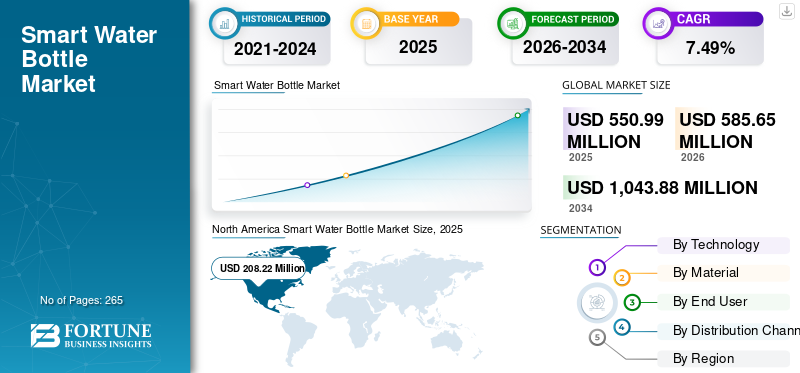
The smart water bottle market size was valued at USD 550.99 million in 2025. The market is projected to grow from USD 585.65 million in 2026 to USD 1,043.88 million by 2034, exhibiting a CAGR of 7.49% during the forecast period. North America dominated the smart water bottle market with a market share of 37.79% in 2025.
The market is growing steadily due to growing awareness of health and the importance of hydration, combined with increasing adoption of connected and fitness-tracking devices. These advanced bottles features app connectivity, temperature tracking, and hydration alarms, which align with other wearable technology products. For instance, according to the American Medical Association, dehydration is highly prevalent among older adults, with reported 17% to 28% prevalence rates in the U.S. Smart bottles are designed to cater to this emerging need rather than traditional water bottles.
Furthermore, growth in fitness-tracking applications and devices has contributed to the sales of smart water bottles to tech-savvy individuals. UV-C sterilization and bluetooth-enabled hydration tracking are new features companies are adding to smart water bottles to enhance their value proposition.
Key players, including Xiaomi, LARQ, Philips, HidrateSpark, and Thermos LLC, are undertaking multiple growth strategies to stay afloat in this highly competitive market. Players are focusing on wearable compatibility and IoT integration, while emphasizing product innovation such as UV-C purification technology. Further, brands are leveraging their legacy through product diversification and expansion into connected health ecosystems.
Download Free sample to learn more about this report.
Smart Water Bottle Market Key Takeaways
 Market Size & Forecast
- 2025 Market Size: USD 550.99 Million
- 2026 Market Size: USD 585.65 Million
- 2034 Forecast Market Size: USD 1,043.88 Million
- CAGR: 7.49% from 2026–2034
 Market Share
- North America dominated the smart water bottle market with a 37.79% share in 2025.
- Hydration-tracking sensors held the largest technology segment share in 2025.
- Stainless steel accounted for the largest material segment share in 2025.
 Key Regional Highlights
North America
North America led the global market with a 37.79% share in 2025.
Europe
Europe witnessed steady market growth driven by increasing adoption of connected health and wellness devices.
Asia Pacific
Asia Pacific is expected to expand rapidly due to rising health awareness and growing wearable technology adoption.
U.S.
Strong consumer demand for smart wellness products continues to support market growth.
Japan
Increasing focus on personal health monitoring is driving adoption of smart water bottles.
Read More

SMART WATER BOTTLE MARKET TRENDS
Rising Integration of Smart Hydration with Digital Health Ecosystems is Emerging Market Trend
The growing adoption of wearable technology and digital health-tracking tools is booming, especially amongst millennials and Gen Z. As consumers increasingly rely on mobile apps and devices to track fitness and wellness metrics, demand for coordinated hydration-tracking solutions is rising. This has prompted companies to launch advanced water bottles integrated with platforms such as Fitbit and Apple Health, thereby improving the user experience and engagement. This has resulted in a rising trend of individualized health insights and promotes consistent hydration habits. Consequently, smart drinking water bottles are no longer limited to standalone devices, thereby increasing adoption.
MARKET DYNAMICS
MARKET DRIVERS
Download Free sample to learn more about this report.
Growing Consciousness and Health Awareness Around Hydration to Accelerate Market Expansion
Increased awareness of the health hazards of dehydration is one of the main reasons for smart water bottle market growth. Clinically, dehydration often presents with symptoms ranging from mild fatigue to serious complications, including confusion, dizziness, hypotension, and multiple organ dysfunction. It is one of the common causes of hospital admission and can lead to morbidity or mortality in case of severe concerns. The growing trend toward preventive healthcare and wellness has forced consumers to take their daily hydration very seriously. As a result, smart bottles have witnessed increased adoption, with some connected to Fitbit and Apple Health. Thus, consumers' increasing health consciousness has played a crucial role in driving the growth of the smart drinking water bottles market.
MARKET RESTRAINTS
Hefty Product Prices and Restricted Mass Affordability are Hampering Market Growth
One of the major factors restraining the growth of the smart water bottles market is that smart water bottles are priced higher than conventional water bottles. Smart water bottles feature many high-end features, such as Bluetooth connectivity and UV-C purifiers. This has made smart water bottles costlier than conventional water bottles. This has restrained the growth of smart water bottles, leading many people to opt for conventional water bottles instead.
MARKET OPPORTUNITIES
Expansion into Emerging Markets and Mass-Market Segments to Create Market Opportunity
Factors such as growing urbanization, rising disposable income leading to greater consumer spending power, and high smartphone penetration in developing markets present strong growth opportunities for players. As consumers transition toward a health-centric lifestyle and connected devices, demand for convenient, cost-effective, and advanced smart bottles is on the rise. This has prompted market players such as Xiaomi to launch an affordable product range catering to price-sensitive markets. Subsequently, players are strengthening their distribution networks, focusing on localization and competitive pricing.
MARKET CHALLENGES
Data Privacy Concerns and Limited Consumer Trust Hampers Market Growth
The rise of smart water bottles connected to apps has also raised concerns regarding data privacy and consumer security. As smart water bottles are used to collect data on consumers' health and hydration, consumers are increasingly concerned about the data they collect. Thus, there has been hesitation in adopting smart water bottles that connect to Apple Health, Fitbit, and other apps. Additinally,data privacy concerns may pose a challenge to the adoption rate of smart water bottles.
Segmentation Analysis
By Technology
Core Functionality to Drive Growth of Hydration Tracking Sensors Segment
The market is segmented by technology into hydration-tracking sensors, bluetooth/Wi-Fi connectivity, temperature-control technology, and others.
The hydration-tracking sensor holds the highest smart water bottle market share in terms of revenue and is fastest growing segment due to its importance to overall smart water bottle functionality. It is the main feature that addresses the main need for hydration tracking. In recent times, the need for personal health has increased significantly. This has led to a surge in the need for precise daily water intake measurement. This has further led to investments in advanced sensor technology for real-time tracking and syncing with apps such as Apple Health and Fitbit. This has further underscored the importance of products with reliable sensors, which have become essential for consumers.
The bluetooth/Wi-Fi connectivity segment is anticipated to rise at the second-fastest CAGR of 7.84% over the forecast period.
To know how our report can help streamline your business, Speak to Analyst
By Material
Durability and Premium Appeal to Drive Stainless Steel Material Segment Expansion
Based on the material, the market is divided into stainless steel, metal, plastic (BPA-Free/), Glass, and others.
Stainless steel leads the market in terms of revenue share owing to insulation properties, superior durability, and premium positioning. Consumers are increasingly opting for temperature-retaining, long-lasting bottles, thereby generating demand for stainless steel variants. This material also complements advanced features such as temperature-control technology while aligning with sustainability practices, thereby enhancing overall product value. Thus, the segment holds largest revenue share by combining aesthetic, functionality, and eco-conscious appeal.
The glass segment is anticipated to rise at the second-fastest CAGR of 7.84% over the forecast period.
By End User
Mass Adoption and Daily Use of the Product by Individuals to Drive Segmental Growth
Based on end user, the market is segmented into individual consumers, fitness enthusiasts/athletes, healthcare institutions, and others.
The individual consumer segment led overall growth. The segment’s growth is attributed to widespread adoption for daily hydration tracking and wellness management. With growing knowledge and importance around hydration, a large chunk of the population is investing in upgraded lifestyle solutions. This vast user base considerably outweighs niche segments, including fitness enthusiasts/athletes or healthcare institutions.
In addition, the fitness enthusiasts/athletes segment is projected to grow at the second-fastest CAGR of 7.04% during the forecast period.
By Distribution Channel
E-commerce Expansion and Wider Accessibility to Drive Growth of Online Channel
Based on distribution channel, the market is segmented into online and offline.
The online segment dominates the market in 2025. This high market share was driven by rapid growth of e-commerce and direct-to-consumer platforms, combined with the convenience they offer. Moreover, broad product assortments, easy price comparisons, discounted product prices, reviews & ratings, along with easy returns and exchanges, attract consumers, which has spurred the growth of online distribution channel.
In addition, the offline segment is projected to grow at the second-fastest CAGR of 7.04% during the forecast period.
Smart Water Bottle Market Regional Outlook
By geography, the market is categorized into Europe, North America, Asia Pacific, South America, and Middle East & Africa.
North America
North America Smart Water Bottle Market Size, 2025 (USD Million)
To get more information on the regional analysis of this market, Download Free sample
North America has emerged as a key region. It is projected to grow at a CAGR of 7.66% in the coming years, with the highest market share among all regions, and reached a valuation of USD 208.22 million in 2025. The regional market growth is driven by increasing health consciousness, strong consumer awareness of health and hydration, and early adoption of connected fitness technologies and wearable devices. The region also benefits from a well-established digital health ecosystem, with widespread use of apps such as Fitbit and Apple Health. Moreover, consumers' high spending power enables them to invest in premium wellness solutions.
U.S. Smart Water Bottle Market
Given North America’s strong contribution, the U.S. market reached USD 171.97 million in 2025, accounting for roughly 31.21% of global market sales.
Europe
Europe held the second-largest share in 2025, valued at USD 156.87 million and accounting for 28.47% of the global market. Europe’s market growth is bolstered by strong consumer demand for sustainable, reusable, eco-conscious products that align with rising environmental awareness. Moreover, strict guidelines mandated by administrative and governing bodies promoting eco-friendly materials encourage innovation and market expansion across the region.
U.K. Smart Water Bottle Market
The U.K. market in 2025 reached USD 30.40 million, representing roughly 5.52% of global market revenues.
Germany Smart Water Bottle Market
Germany’s market reached USD 1 million in 2025, equivalent to around 6.66% of global market sales.
Asia Pacific
The Asia Pacific market is growing at a CAGR of 6.95% and reached USD 85.00 million in 2025. Growing discretionary spending among the population, rapid urbanization, and rising smartphone penetration open an untapped consumer base, which in turn increases product demand. Moreover, increased consumer focus on health and wellness practices, along with the transition to connected wearable devices, also supplements market growth.
Japan Smart Water Bottle Market
The Japanese market in 2025 was valued at USD 28.12 million, accounting for roughly 0.05% of global market revenues. The Japanese market is driven by a strong culture of health consciousness and preventive healthcare, as well as high adoption of advanced consumer electronics.
China Smart Water Bottle Market
China’s market in 2025 was valued at USD 44.94 million in revenues, representing roughly 8.16% of global market sales.
India Smart Water Bottle Market
The Indian market in 2025 was valued at USD 22.40 million, accounting for roughly 4.07% of global market revenues.
South America and Middle East & Africa
The South America and Middle East & Africa regions are expected to witness moderate growth in this market space during the forecast period. The South America market reached USD 32.18 million in 2025. This growth is influenced by rising health awareness, the increasing adoption of affordable smart devices across urban populations, and rising e-commerce penetration through platforms such as Amazon. In the Middle East & Africa, the UAE reached USD 3.28 million in 2025.
South Africa Smart Water Bottle Market
The South African market reached USD 7.24 million in 2025, representing roughly 1.31% of global market revenues.
COMPETITIVE LANDSCAPE
Key Industry Players
Competitive Pricing and Product Innovation Increases Competition Amongst Players
The level of fragmentation in the smart water bottle industry is moderate, with companies looking for innovation and integration to enhance their competitive edge. HidrateSpark and LARQ are companies that have focused on developing innovative features for smart water bottles to enhance differentiation in the market. On the other hand, Xiaomi has focused on a cost-leadership strategy to achieve the largest market share in the smart water bottle industry. Strategic alliances, emerging markets, and upgrades are other growth strategies employed by companies, which have helped them to enhance consumer engagement and remain competitive in the market.
LIST OF KEY SMART WATER BOTTLE COMPANIES PROFILED
- HidrateSpark (U.S.)
- LARQ (U.S.)
- Thermos LLC (U.S.)
- Philips (Netherlands)
- Xiaomi (China)
- LifeFuels (U.S.)
- Moikit (China)
- Ozmo Inc.(U.S.)
- HydraCoach (U.K.)
- Caktus Inc. (Canada)
KEY INDUSTRY DEVELOPMENTS
- October 2025: HidrateSpark launched its advanced PRO 2 smart water bottle, integrated with Apple Find My technology, and expanded its availability in Apple Stores worldwide, strengthening its premium product portfolio and retail presence.
- October 2025: Samsung Electronics announced a strategic partnership with SK and OpenAI under the Stargate initiative to enhance AI-driven connected ecosystems, indirectly supporting smart device categories, including smart hydration solutions.
- January 2025: Echo Water, a well-established hydrogen therapy company, introduced its first smart hydrogen water bottle with a dedicated app, enabling personalized hydration tracking and on-the-go hydrogen infusion technology.
- November 2022: A Melbourne, Australia-based startup, AQUAME, introduced a smart water bottle designed to monitor daily hydration levels, powered by real-time data and advanced analytics, strengthening the entry of new players and innovation in the market.
- July 2022: HidrateSpark partnered with Jogan Health to develop and distribute a healthcare-focused hydration-monitoring solution, expanding into clinical and remote patient-monitoring applications.
REPORT COVERAGE
The global smart water bottle market analysis includes a comprehensive study of the market & forecast by all the market segmentations included in the report. This qualitative and quantitative report includes details on the market dynamics and market trends expected to drive the market over the forecast period. It provides information on key aspects, including technologically advanced products, the regulatory environment, and new launches. Additionally, it details partnerships, mergers & acquisitions, and key industry developments, along with their prevalence by region. The global market research report also provides a detailed competitive landscape, including market share and profiles of key players.
Request for Customization to gain extensive market insights.
Report Scope & Segmentation
| ATTRIBUTE | DETAILS |
| Study Period | 2021-2034 |
| Base Year | 2025 |
| Estimated Year | 2026 |
| Forecast Period | 2026-2034 |
| Historical Period | 2021-2024 |
| Growth Rate | CAGR of 7.49% from 2026 to 2034 |
| Unit | Value (USD Million) |
| Segmentation | By Technology, Material, End User, Distribution Channel, and Region |
| By Technology |
|
| By Material |
|
| By End User |
|
| By Distribution Channel |
|
| By Region |
|
Frequently Asked Questions
According to Fortune Business Insights, the global market value stood at USD 550.99 million in 2025 and is projected to reach USD 1,043.88 million by 2034.
In 2025, North Americas market value stood at USD 208.22 million.
The market is expected to grow at a CAGR of 7.49% over the forecast period.
In terms of technology, the hydration tracking sensors segment leads the market.
Rapid urbanization and growing awareness of the importance of hydration are driving market growth.
Xiaomi, LARQ, Philips, HidrateSpark, and Thermos LLC are the major players in the global market.
North America dominated the market in 2025.



- 2021-2034
- 2025
- 2021-2024
- 265
-
(Offer valid till 30th Sep 2026)
Get 30-60 hrs Free Customization
Expand Regional and Country Coverage, Segments Analysis, Company Profiles, Competitive Benchmarking, and End-user Insights.







Related Reports
-
US +1 833 909 2966 ( Toll Free )
-
Get In Touch With Us