Tissue Regeneration Market Size, Share & Industry Analysis, By Product (Skin & Wound Regeneration Products, Bone & Dental Tissue Regeneration Products, Cartilage & Joint Regeneration Products, and Others), By Material (Collagen-based, Hyaluronic Acid-based, Cell-based, and Others), By Application (Wound Healing & Skin Regeneration, Bone & Dental Regeneration, Tendon & Ligament Repair, Soft Tissue & Surgical Reconstruction, and Others) By Source, By End User (Hospitals & ASCs, Specialty Clinics, Academic & Research Institutes, and Others), and Regional Forecast, 2026-2034
 Download Free Sample
Tissue Regeneration Market Size and Future Outlook
 Listen to Audio Version
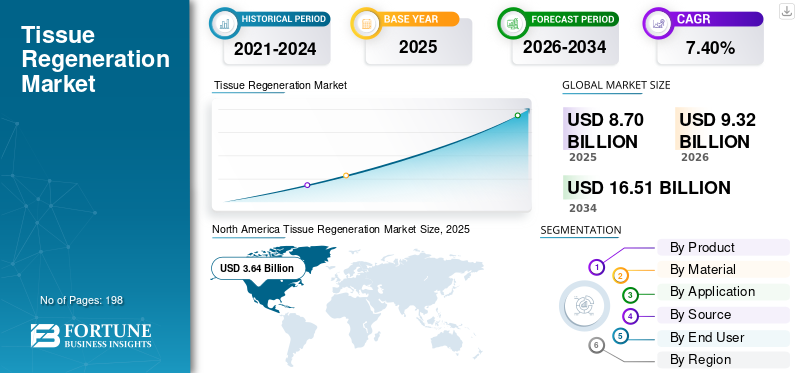
The global tissue regeneration market size was valued at USD 8.70 billion in 2025. The market is projected to grow from USD 9.32 billion in 2026 to USD 16.51 billion by 2034, exhibiting a CAGR of 7.40% during the forecast period. North America dominated the tissue regeneration market with a market share of 41.83% in 2025.
Tissue regeneration is the physiological and biological process of replacing, repairing, or regrowing damaged cells, tissues, or entire organs to restore normal function. The market is growing due to the rising burden of chronic wounds, diabetic foot ulcers, burns, orthopedic injuries, dental bone loss, cartilage defects, and soft tissue damage that require advanced tissue repair solutions. Market growth is further supported by the shift toward advanced wound healing, minimally invasive reconstruction, biologic surgical matrices, guided bone regeneration, and tissue-engineered products that help improve healing outcomes and reduce complications.
Key players operating in the global market include Integra LifeSciences Corporation, Vericel Corporation, Smith+Nephew, and MIMEDX Group, Inc. These firms are focusing on advanced products and regulatory approvals to maintain their market positions.
Download Free sample to learn more about this report.
Tissue Regeneration Market Key Takeways
 Global Market Size & Forecast
- 2025 Market Size: USD 8.70 billion
- 2026 Market Size: USD 9.32 billion
- 2034 Forecast Market Size: USD 16.51 billion
- CAGR: 7.40% from 2026–2034
 Market Share
- North America dominated the tissue regeneration market with a 41.83% share in 2025.
- The bone & dental regeneration segment is set to hold a 44.9% share in 2026.
- The allogeneic segment is set to hold a 39.9% share in 2026.
 Key Regional Highlights
North America
North America maintained its market leadership with a valuation of USD 3.64 billion in 2025.
Europe
Europe is projected to expand at a 6.07% CAGR during the forecast period, driven by strong demand for advanced tissue regeneration products.
Asia Pacific
Asia Pacific market is expected to reach a valuation of USD 2.13 billion in 2026.
U.S.
U.S. The market is projected to reach approximately USD 3.45 billion in 2026.
Japan
Japan The market is estimated to reach around USD 0.46 billion in 2026.
Read More

TISSUE REGENERATION MARKET TRENDS
Advancements of 3D Bioprinting Technologies is a Significant Trend Observed in the Global Market
The advancement of 3D bioprinting technologies is emerging as a significant trend in the worldwide market, as it allows the layer-by-layer construction of tissue-like structures utilizing cells, biomaterials, hydrogels, and bioinks. This technology aids in creating personalized scaffolds for skin, bone, cartilage, vascular, and soft tissue repair, enhancing the accuracy and biological significance of regenerative products. It is also assisting researchers in developing patient-specific tissue models for drug testing, wound healing, preclinical evaluation, and disease modeling, lessening reliance on conventional 2D cell culture and animal models. With advancements in print resolution, cell viability, vascularization support, and bioink compatibility in bioprinting platforms, companies and research institutions are progressively employing these technologies to create sophisticated tissue-engineered products. The increase is further backed by growing investments in biofabrication, regenerative medicine, and tailored healthcare. Nonetheless, widespread clinical application is still progressing, since printed tissues need to satisfy rigorous standards for reproducibility, sterility, mechanical strength, vascularization, and regulatory approval. Overall, 3D bioprinting is anticipated to support sustained market growth by broadening the range of future tissue regeneration products.
- For instance, in November 2025, the Indian Institute of Science and the Henry Royce Institute at the University of Manchester entered into a collaboration to advance 3D bioprinting, biofabrication, and materials science. The partnership aims to develop technologies such as in-vitro tissue models and medical implants, supporting innovation in healthcare, precision medicine, and regenerative applications.
MARKET DYNAMICS
MARKET DRIVERS
Download Free sample to learn more about this report.
Growing Investments in Regenerative Medicine Research is Driving Market Growth
Growing investments in regenerative medicine research are a key driver of the market as they help move new cell-based therapies, tissue-engineered products, biomaterial scaffolds, and regenerative matrices from early-stage research to clinical use. Higher funding supports studies in wound healing, cartilage repair, bone regeneration, stem cell biology, tissue engineering, and translational manufacturing, thereby expanding the future commercial pipeline. These investments also help academic institutes, biotech companies, and medtech players generate clinical evidence, improve product safety, and meet regulatory requirements. As more funding flows into regenerative medicine, companies are able to develop advanced products such as living skin substitutes, engineered cartilage, collagen/HA matrices, allogeneic grafts, and biofabricated tissue platforms. This improves innovation across wound care, dental regeneration, orthopedic repair, soft tissue reconstruction, and cell-based therapies. The driver is also important as tissue regeneration products often require long development cycles, specialized manufacturing, and strong clinical validation before broad adoption. Therefore, sustained public and private investment is directly supporting market expansion and long-term commercialization.
- For instance, the California Institute for Regenerative Medicine has stated that California’s Proposition 71 and Proposition 14 together allocated USD 8.5 billion in general obligation bonds to support regenerative medicine in the state. CIRM also funds projects across infrastructure, education, discovery research, translational research, and clinical research, supporting regenerative medicine development from early discovery to clinical trials.
MARKET RESTRAINTS
High Treatment and Development Costs to Limit Market Growth
High treatment and development costs are a major restraint on the global tissue regeneration market growth, as many products require expensive biomaterials, donor-tissue sourcing, cell processing, sterile manufacturing, quality testing, cold-chain handling, and clinical validation before commercialization. These factors increase the final treatment price of advanced skin substitutes, cell-based cartilage repair products, acellular dermal matrices, biologic meshes, and tissue-engineered products. As a result, hospitals and specialty clinics may limit the use of these therapies to complex wounds, failed standard care cases, high-risk surgeries, or patients with adequate reimbursement coverage. High costs also create reimbursement pressures, especially when clinical outcomes are not consistently proven across all patient groups. Smaller companies may face difficulty scaling their products as regenerative medicine development requires long timelines, specialized facilities, and regulatory documentation. This can slow adoption in emerging markets, where out-of-pocket spending is high and reimbursement coverage remains limited. Therefore, even though clinical demand is rising, affordability and payer scrutiny can restrict broader market penetration.
- For instance, in October 2025, CMS highlighted concerns around rapidly rising spending on costly skin substitutes used in wound care. According to the report, Medicare spending on these products increased from about USD 256 million in 2019 to USD 10 billion in 2024, prompting CMS moved to introduce new payment adjustments aimed at controlling escalating costs. This shows how high treatment costs and reimbursement pressure can directly restrain the adoption and commercialization of advanced tissue regeneration products.
MARKET OPPORTUNITIES
Expansion of Advanced Wound Care and Tissue Engineering Applications to Offer Market Growth Opportunities
The growth of advanced wound care and tissue engineering applications is generating significant opportunities for the global market, as chronic wounds, burns, diabetic foot ulcers, surgical wounds, and soft tissue defects often require solutions that surpass standard dressings. With the rise in wound complexity, healthcare professionals are implementing collagen matrices, placental/amniotic products, ECM scaffolds, dermal templates, fish-skin grafts, and tissue-engineered substitutes to enhance tissue healing and minimize complications. This chance is also broadening into surgical reconstruction, sports medicine, cartilage restoration, dental regeneration, and soft tissue enhancement, where biomaterials can aid in tissue integration and healing. Companies are thus expanding their portfolios from individual wound products to multi-use regenerative platforms. The potential is particularly significant in hospitals, ASCs, wound care centers, and specialty clinics that cater to high-risk patients requiring advanced treatment alternatives. Expansion is additionally facilitated by the transition to outpatient wound care and the need to minimize recurring visits, infections, amputations, and lengthy healing periods. In general, the broader clinical application of advanced wound care and tissue engineering products is anticipated to generate new revenue possibilities in both established and developing healthcare markets.
- For instance, in March 2024, TELA Bio sold the distribution rights for the NIVIS Fibrillar Collagen Pack to MIMEDX. NIVIS is an absorbent collagen matrix indicated for the management of moderately to heavily exudating wounds and the control of minor bleeding, showing how companies are expanding advanced collagen-based wound care portfolios to address tissue repair needs.
MARKET CHALLENGES
Limited Reimbursement Coverage in Some Regions to Pose a Prominent Challenge to Market Growth
Limited reimbursement availability in certain areas poses a significant obstacle for the global market, as numerous advanced products are costly and often lack consistent coverage from both public and private insurers. Items such as skin substitutes, placental/amniotic grafts, cell-based cartilage treatments, acellular dermal matrices, and biologic soft tissue matrices typically need robust clinical evidence before reimbursement can be granted. In regions with less robust reimbursement frameworks, hospitals and specialized clinics might limit their usage to serious wounds, unsuccessful standard treatments, or patients who can pay out-of-pocket. This restricts adoption in developing markets and creates uncertainty for producers preparing product releases. In developed markets, coverage can differ based on indication, care setting, payer, and regional medical-necessity standards. Consequently, healthcare providers might opt for cheaper conventional products when reimbursement is uncertain, slowing the wider adoption of advanced tissue regeneration technologies. Consequently, inconsistency in reimbursement continues to be a significant obstacle despite increasing clinical demand.
- For instance, in October 2025, according to data published by Medicare (CMS), Medicare administrators were considering changes to reimbursement for high-tech wound-care products, including skin substitutes used to treat conditions such as diabetic sores. The report noted a growing clash between manufacturers and hospitals/providers over potential payment reforms, showing how payer scrutiny and reimbursement uncertainty can affect access to advanced wound and tissue regeneration products.
Segmentation Analysis
By Product
Bone & Dental Tissue Regeneration Products Segment Dominated Due to High Use in Dental Bone Grafting and Orthopedic Bone Repair Treatments
In terms of product, the market is divided into skin & wound regeneration products, bone & dental tissue regeneration products, cartilage & joint regeneration products, soft tissue regeneration products, cell-based & tissue-engineered products, and others.
The bone & dental tissue regeneration products segment held the dominant global tissue regeneration market share in 2025. The dominance is attributed to the widespread use of these products in high-volume procedures such as dental implant-site preparation, ridge preservation, sinus augmentation, periodontal regeneration, spinal fusion, trauma repair, and bone defect reconstruction. Additionally, bone and dental regeneration products have broader procedural use, stronger clinical familiarity, and higher adoption across hospitals, dental clinics, orthopedic centers, and maxillofacial surgery settings. The segment is also supported by the rising burden of tooth loss, periodontal disease, aging-related bone defects, orthopedic injuries, and demand for dental implants.
- For instance, in February 2025, LifeNet Health launched OraGen, which it described as the first viable dental bone allograft for dental procedures. The product is intended for sinus and ridge augmentation and repair of large mandibular or maxillary defects. It combines cryopreserved corticocancellous bone with demineralized bone matrix to support osteogenicity, osteoconductivity, and osteoinduction, thereby promoting bone regeneration.
The cell-based & tissue-engineered products segment is anticipated to rise with a CAGR of 12.26% over the forecast period.
To know how our report can help streamline your business, Speak to Analyst
By Material
Wide Use of Collagen as a Core Biomaterial in Soft Tissue Repair Supported the Growth of Collagen-based Segment
Based on material, the market is segmented into collagen-based, hyaluronic acid-based, glycosaminoglycan/chondroitin sulfate-based, cell-based, and others.
The collagen-based segment captured the major share of the market in 2025. This is due to the fact that collagen is one of the most widely used biomaterials for wound matrices, dermal regeneration templates, dental membranes, bone graft carriers, cartilage scaffolds, and soft tissue repair products. Additionally, this material is preferred as it is clinically familiar, broadly available, and compatible with both standalone and composite biomaterial formats. Moreover, collagen-based products have wider commercial availability and easier adoption across developed and emerging markets. Furthermore, the segment is set to hold 41.8% share in 2026.
- For instance, in March 2024, TELA Bio sold the distribution rights for NIVIS Fibrillar Collagen Pack to MIMEDX. NIVIS is an absorbent collagen matrix indicated for managing moderately to heavily exudating wounds and controlling minor bleeding.
The hyaluronic acid-based segment is anticipated to rise with a CAGR of 8.52% over the forecast period.
By Application
High Procedure Volume of Regenerative Procedures Supported the Bone & Dental Regeneration Segment Growth
In terms of application, the market is segmented into wound healing & skin regeneration, bone & dental regeneration, cartilage & joint repair, tendon & ligament repair, soft tissue & surgical reconstruction, and others.
The bone & dental regeneration segment dominated the market in 2025, as it covers a broad range of high-volume procedures, including dental implant-site development, ridge preservation, sinus lift, guided bone regeneration, and others. The segment is also supported by rising tooth loss, periodontal disease, dental implant demand, aging-related bone loss, and orthopedic injury cases. Furthermore, the segment is set to hold 44.9% share in 2026.
- For instance, Geistlich Pharma has highlighted clinical evidence supporting the use of Geistlich Bio-Oss Collagen in ridge preservation and guided bone regeneration. The product is a ready-to-use bone substitute block made of 90% Geistlich Bio-Oss granules and 10% porcine collagen. It is used for ridge preservation following tooth extraction, guided bone regeneration around implants, and periodontal treatments.
The soft tissue & surgical reconstruction segment is anticipated to rise with a CAGR of 9.05% over the forecast period.
By Source
Allogeneic Segment Dominated Due to Broad Clinical Applicability
On the basis of source, the market is segmented into allogeneic, xenogeneic, synthetic, and others.
In 2025, the allogeneic segment led the market. This is owing to the fact that donor-derived human tissues are widely used in wound healing, bone grafting, soft tissue repair, nerve repair, placental/amniotic products, acellular dermal matrices, and tissue-engineered products. Moreover, these products offer an off-the-shelf treatment option without the need to harvest tissue from the same patient, which reduces procedure time and supports wider clinical use. Furthermore, the segment is set to hold 39.9% share in 2026.
- For instance, in December 2025, the U.S. FDA approved Axogen’s AVANCE Nerve Graft, an acellular nerve allograft used as a peripheral nerve scaffold for sensory, mixed, and motor nerve discontinuities.
The synthetic segment is anticipated to rise with a CAGR of 7.72% over the forecast period.
By End User
Hospitals & ASCs Segment Led Due to High Use of Advanced Regenerative Products
Based on end user, the market is segmented into hospitals & ASCs, specialty clinics, academic & research institutes, and others.
The hospitals & ASCs segment accounted for the dominant market share in 2025, as most advanced regenerative products are used during various procedures in the hospitals & ASCs. Compared with specialty clinics and research institutes, hospitals and ASCs handle larger volumes of complex and higher-value procedures, which supports their leading revenue share. Furthermore, the segment is set to hold 55.0% share in 2026.
- For instance, in August 2025, Waterbury Hospital’s Wound Center in Connecticut adopted a spray-on autologous cell therapy procedure for deep and chronic wounds. The treatment uses a small sample of the patient’s own skin, processes it into activated skin cells, and sprays it over the wound to help restore the epidermis and support healing.
The specialty clinics segment is projected to witness growth rate of 8.27% during the forecast period.
Tissue Regeneration Market Regional Outlook
By geography, the market is divided into Latin America, Asia Pacific, Europe, North America, and the Middle East & Africa.
North America
North America Tissue Regeneration Market Size, 2025 (USD Billion)
To get more information on the regional analysis of this market, Download Free sample
The North America accounted for the largest share of the market, reaching USD 3.40 billion in 2024. In 2025, the region maintained its dominance, with USD 3.64 billion. Growth in the region is supported by the strong adoption of advanced wound biologics, skin substitutes, acellular dermal matrices, bone graft substitutes, and cell-based tissue-engineered products. The region also benefits from high healthcare spending, established hospital and ASC infrastructure, strong reimbursement access for selected advanced products, and a large patient pool.
U.S. Tissue Regeneration Market
The U.S. market led the North American region and is projected to reach approximately USD 3.45 billion in 2026, representing about 37.0% of the global sales.
Europe
Europe market is growing at a CAGR of 6.07% during the forecast period, supported by strong demand for dental bone regeneration, collagen membranes, xenograft/allograft materials, orthopedic grafts, and advanced wound care products. The region also benefits from established dental implantology practices, public healthcare coverage, and regenerative medicine research activity.
U.K. Tissue Regeneration Market
The U.K. market is estimated at around USD 0.40 billion in 2026, representing roughly 4.2% of global revenues.
Germany Tissue Regeneration Market
Germany tissue regeneration market is projected to reach approximately USD 0.47 billion in 2026, equivalent to around 5.0% of global sales.
Asia Pacific
The Asia Pacific market size is expected to reach a valuation of USD 2.13 billion in 2026. Asia Pacific is expected to be the fastest-growing region due to rising healthcare infrastructure, increasing dental implant procedures, expanding orthopedic and trauma care, and growing demand for advanced wound healing products.
Japan Tissue Regeneration Market
The Japanese market is estimated to reach around USD 0.46 billion in 2026, accounting for roughly 5.0% of global revenues.
China Tissue Regeneration Market
China’s market is projected to reach around USD 0.65 billion in 2026, representing roughly 7.0% of global sales.
India Tissue Regeneration Market
The Indian market is estimated to reach around USD 0.25 billion in 2026, accounting for roughly 2.7% of global revenues.
Latin America and Middle East & Africa
Latin America and Middle East & Africa regions is anticipated to witness slower growth over the forecast period. The growth of the market is driven by increasing use of dental regeneration products, orthopedic bone graft substitutes, and advanced wound care solutions. The market in Latin America is estimated to touch around USD 0.46 billion in 2026.
In the Middle East and Africa region, the GCC market is projected to reach approximately USD 0.18 billion in 2026, representing about 1.9% of worldwide revenues.
COMPETITIVE LANDSCAPE
Key Industry Players
Key Market Players Strengthen Their Position Through Broad Regenerative Product Portfolios
The global tissue regeneration market is moderately fragmented, with major companies such as Integra LifeSciences Corporation, Vericel Corporation, Smith+Nephew, and MIMEDX Group, Inc. representing a significant portion of the global market. The competitive position of these players are supported by their strong presence across skin and wound regeneration, along with bone and dental regeneration products.
- For instance, in February 2025, Vericel reported 20% full-year revenue growth in 2024 to USD 237.2 million, with MACI revenue up 20% and burn care revenue up 22%. The company also highlighted strong indicators for the MACI Arthro launch, with around 250 surgeons trained by that time.
Other industry participants include Tissue Regenix Group, VIVEX Biologics, Inc., and Bioiberica S.A.U. These firms are anticipated to focus on product improvement, expansion of product offerings, and regulatory approvals to strengthen their market positions throughout the forecast period.
LIST OF KEY TISSUE REGENERATION COMPANIES PROFILED
- Integra LifeSciences Corporation (U.S.)
- Geistlich Pharma AG (Switzerland)
- Vericel Corporation (U.S.)
- Organogenesis Inc. (U.S.)
- Smith+Nephew (U.K.)
- MIMEDX Group, Inc. (U.S.)
- Tissue Regenix Group (U.K.)
- VIVEX Biologics, Inc. (U.S.)
- Bioiberica S.A.U. (Spain)
- LifeNet Health (U.S.)
KEY INDUSTRY DEVELOPMENTS
- December 2025: Researchers from CSIR-Central Leather Research Institute (CLRI), India, developed a cell-free bilayer scaffold for osteochondral defects, consisting of a collagen/fibrin cartilage layer and a hydroxyapatite/graphene oxide bone-supporting layer. Animal studies showed near-complete healing of rat knee joint defects within 12 weeks.
- April 2025: Vyjuvek received marketing authorization for medical use in the European Union for topical treatment of wounds in patients with dystrophic epidermolysis bullosa.
- April 2025: Zevaskyn was approved in the U.S. as an autologous cell-based gene therapy for the treatments of wounds in patients with recessive dystrophic epidermolysis bullosa.
- February 2025: LifeNet Health launched OraGen, described as the first viable dental bone allograft for dental procedures. The product is intended for sinus and ridge augmentation and the repair of large mandibular/maxillary defects.
- January 2024: Xenco Medical unveiled TrabeculeX Continuum, a technology-enabled platform that bridges orthobiologics and digital health by combining a regenerative biomaterial for 3D bone formation with a linked recovery app.
REPORT COVERAGE
The global tissue regeneration market analysis includes a thorough evaluation of the market size and forecasts for every segment highlighted in the report. It offers insights into the market dynamics and trends expected to drive the market throughout the forecast period. It provides understanding of essential factors, including technological progress, product innovations, the regulatory environment, pipeline analysis, and the launch of new products. Additionally, it details partnerships, mergers & acquisitions, and key developments in the industry within the market. The global market forecast report also provides an in-depth competitive landscape, including information on market share and profiles of key active players.
Request for Customization to gain extensive market insights.
Report Scope & Segmentation
| ATTRIBUTE | DETAILS |
| Study Period | 2021-2034 |
| Base Year | 2025 |
| Estimated Year | 2026 |
| Forecast Period | 2026-2034 |
| Historical Period | 2021-2024 |
| Growth Rate | CAGR of 7.40% from 2026 to 2034 |
| Unit | Value (USD Billion) |
| Segmentation | By Product, Material, Application, Source, End User, and Region |
| By Product |
|
| By Material |
|
| By Application |
|
| By Source |
|
| By End User |
|
| By Region |
|
Frequently Asked Questions
According to Fortune Business Insights, the global market value stood at USD 8.70 billion in 2025 and is projected to reach USD 16.51 billion by 2034.
In 2025, the market value stood at USD 3.64 billion.
The market is expected to exhibit a CAGR of 7.40% during the forecast period.
By product, the bone & dental tissue regeneration products segment led the market.
Shift toward advanced wound healing, minimally invasive reconstruction, biologic surgical matrices, guided bone regeneration, and tissue-engineered products that help improve healing outcomes and reduce complications are key factors driving the market.
Integra LifeSciences Corporation, Vericel Corporation, Smith+Nephew, and MIMEDX Group, Inc. are some of the top players in the global market.
North America dominated the market in 2025.



- 2021-2034
- 2025
- 2021-2024
- 198
Get 30-60 hrs Free Customization
Expand Regional and Country Coverage, Segments Analysis, Company Profiles, Competitive Benchmarking, and End-user Insights.













.webp)






Related Reports
-
US +1 833 909 2966 ( Toll Free )
-
Get In Touch With Us