Head-Up Display Market Size, Share & Industry Analysis, By Product Type (Windshield, Combiner, Augmented Reality, and Holographic HUD), By Display Generation (Conventional, Digital, AR-HUD, and 3D AR-HUD), By Component (Picture Generation Unit, Display Panel, Light Source, and Projection Lens), By Platform Type (Vehicle, Aircraft, and Defense), By Vehicle Platform (Passenger Cars, SUVs & Crossovers, and Electric Vehicles), By Installation Type (OEM Line-Fit, Factory-Fitted, and Aftermarket), By Sales Channel (Direct OEM Supply, and Tier-1 Integration), and Regional Forecast, 2026-2034
 Download Free Sample
Head-Up Display Market Size and Future Outlook
 Listen to Audio Version
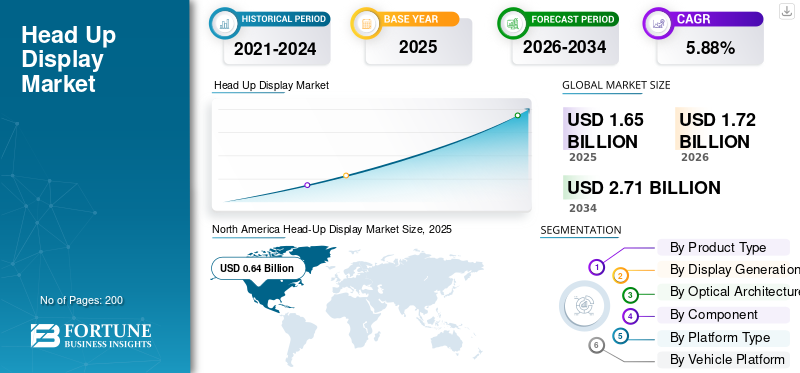
The global head-up display market size was valued at USD 1.65 billion in 2025 and is projected to grow from USD 1.72 billion in 2026 to USD 2.71 billion by 2034, exhibiting a CAGR of 5.88% during the forecast period. North America dominated the head up display market with a market share of 38.79% in 2025.
The global head-up display industry covers display systems that project critical information directly into the user’s forward field of view through vehicle windshields, combiner glass, aircraft cockpit HUDs, and helmet/head-worn displays. In the automotive sector, HUDs display speed, navigation, ADAS alerts, road-sign information, and EV status. In the aerospace and defense sectors, they support pilot situational awareness, targeting, low-visibility operations, and mission-critical flight guidance.
The global head-up display market is driven by rising adoption of ADAS, connected cockpits, electric vehicles, premium digital interiors, and pilot-safety systems. Automakers are moving from small windshield HUDs to AR-HUD and panoramic HUDs, while the aviation and defense sectors continue to drive demand for HUDs and head-worn displays that enable faster decision-making in complex operating environments.
Major players include AUMOVIO SE, Nippon Seiki Co., Ltd., DENSO Corporation, Panasonic Automotive Systems Co., Ltd., and other companies serving commercial applications. In the defense and aviation segment, key players include BAE Systems plc, Elbit Systems Ltd., Honeywell International Inc., and Thales S.A., which provide HUD solutions for military aircraft, armored vehicles, and soldier systems. Key players are focusing on augmented-reality overlays, wider field-of-view displays, compact projection units, eye-tracking, OEM partnerships, software-defined cockpit integration, and defense-grade helmet/display systems to expand adoption beyond luxury vehicles into mainstream vehicles, aircraft, and military platforms.
Download Free sample to learn more about this report.
HEAD-UP DISPLAY MARKET KEY TAKEAWAYS
 Global Market Size & Forecast
- 2025 Market Size: USD 1.65 billion
- 2026 Market Size: USD 1.72 billion
- 2034 Forecast Market Size: USD 2.71 billion
- CAGR: 5.88% from 2026–2034
 Market Share
- North America dominated the market with a 38.79% share in 2025.
- The Others product type segment held the largest market share 33.17% in 2025.
- The Digital HUD segment held the largest market share 26.42% in 2025.
 Key Regional Highlights
North America
North America reached USD 0.64 billion in 2025 and is projected to reach USD 0.66 billion in 2026, supported by increasing ADAS adoption, vehicle safety requirements, and defense modernization.
Europe
Europe reached USD 0.41 billion in 2025, growing at a 6.29% CAGR, driven by stricter vehicle safety requirements and premium OEM cockpit upgrades.
Asia Pacific
Asia Pacific reached USD 0.45 billion in 2025 and is projected to grow at the fastest 7.17% CAGR, driven by the integration of HUDs into smart cockpits, EV platforms, and advanced driver-assistance systems.
U.S.
The market reached USD 0.57 billion in 2025 and is projected to grow at a 4.93% CAGR, supported by ADAS adoption and defense cockpit modernization.
Japan
The market reached USD 0.08 billion in 2025 and is projected to grow at a 6.22% CAGR, supported by smart cockpit development and continued HUD technology investments by Japanese automotive suppliers.
Read More

Head-Up Display Market Trends
Rising Uptake of Immersive HUD Technologies and Growing Focus on Software-Defined HUDs to Boost Market Development
The strongest HUD technology trend is the shift from simple projected data to immersive cockpit visualization. AR-HUDs, 3D HUDs, panoramic windshield displays, eye-tracking, AI navigation, and cockpit-domain controllers are increasingly being integrated to display real-time driving experience or mission-critical data closer to the user’s natural field of view. BMW’s new Panoramic iDrive, for example, combines Panoramic Vision, an optional 3D head-up display (HUD), central display, steering-wheel controls, and BMW Operating System X into a unified software-defined interface.
Major suppliers are also moving toward platform-based strategies rather than vehicle-specific HUD programs. This approach enables OEMs to scale display technologies across entry, mid-range, and premium models while maintaining flexibility for brand-specific enhanced user experience.
For instance, in January 2026, Visteon announced its CES 2026 showcase, featuring next-generation head-up display and projection technologies developed in collaboration with FUTURUS, aimed at blending digital content into the driving environment.
Market Dynamics
MARKET DRIVER
Download Free sample to learn more about this report.
Increasing Integration with ADAS and Digital Cockpits to Drive Industry Growth
The key driver for the global head-up display market is the rising need to keep drivers’ and pilots’ eyes on the road or in the forward field of view while handling more volumes of digital information. In vehicles, HUDs are moving beyond speed and basic navigation to display ADAS warnings, lane guidance, EV range, sensor alerts, and software-defined cockpit functions. In aviation and defense sectors, HUDs and helmet-mounted displays are becoming more important as pilots need fused flight, targeting, night-vision, and mission data without looking down at cockpit screens.
OEMs are responding by developing AR-HUDs, wide field-of-view displays, digital night vision, full-color symbology, and retrofit-ready helmet displays for existing aircraft fleets. The industry’s strategy is focused on integrating HUDs with sensors, digital maps, cockpit controllers, and mission computers rather than offering them as standalone display hardware.
For instance, in November 2025, Thales Defense & Security received six orders under an existing NATO Support and Procurement Agency contract for Scorpion Helmet Mounted Display retrofit kits to support U.S. Air Force F-16 modernization. The upgrade replaces legacy JHMCS units with a digital full-color day/night display solution.
MARKET RESTRAINT
High Cost and Design Complexity to Limit Product Adoption
The primary restraint is that advanced HUDs, particularly AR-HUD and panoramic HUD systems, remain complex and costly to engineer. These systems require high-brightness projection, precision optics, thermal protection, distortion control, software calibration, and enough dashboard packaging space, which makes adoption challenging in entry-level and compact vehicles. AUMOVIO’s 2025 compact 3D HUD announcement shows this packaging challenge, as the company highlighted a design that cuts required installation space by up to 50% compared to conventional HUDs
MARKET OPPORTUNITIES
Rising Demand for Modular and Aftermarket HUD Solutions to Boost Industry Growth
A major market opportunity lies in expanding HUD adoption beyond premium cars and new aircraft platforms. Mid-range passenger vehicles, small cars, light commercial vehicles, motorcycles, aftermarket accessories, trainers, helicopters, and legacy fighter fleets all represent underpenetrated market segments. This opportunity is important as many users need basic eyes-forward information but cannot justify the cost of a factory-installed AR-HUD system.
To address this demand, key players are developing modular, compact, and retrofit-friendly products to widen product adoption. In the defense sector, upgrade kits reduce the need for complete cockpit redesigns, while in the automotive sector, aftermarket HUDs enable the technology to be added to vehicles that were never built with factory-installed HUD systems.
For instance, in February 2026, Nippon Seiki announced that a new Sakura Pink version of its LumieHUD aftermarket head-up display would go on sale in March 2026. The company positioned LumieHUD as a solution for vehicles without factory-installed HUD systems.
MARKET CHALLENGES
Ensuring Accurate AR and Display Alignment to Hinder Market Growth
The major challenge is making HUDs brighter and also ensuring they are accurate, safe, and easy to interpret under real-world operating conditions. AR overlays must stay precisely aligned with the road, surrounding objects, or flight environment, even as the driver or pilot moves their head. Panasonic’s AR HUD 2.0 development shows this technical challenge, as the company used eye tracking, parallax alignment, and dynamic autofocus to adjust projected imagery based on the driver’s changing line of sight.
SEGMENTATION ANALYSIS
By Product Type
Augmented Reality Head-Up Display Segment to Grow Fastest due to Rising Adoption of ADAS Features
The global market, by product type, is classified into windshield head-up display, combiner head-up display, augmented reality head-up display, holographic head-up display, panoramic/pillar-to-pillar HUD, waveguide HUD, light-field HUD, and others.
The augmented reality head-up display segment is estimated to be the fastest-growing, registering a CAGR of 10.04% during the forecast period (2026-2034). Growth is driven by automakers shifting from basic speed-projection HUDs to systems that overlay navigation, lane guidance, collision alerts, and ADAS warnings directly onto the driver’s field of view. This growth is mainly linked to rising demand for safer and more intuitive driver interfaces in premium and mid-range vehicles, EVs, and software-defined vehicles.
The others segment consists of head-worn display, portable/aftermarket HUD, multi-plane HUD, dual-plane HUD, and so on. It accounted for a 33.17% share in 2025 and is projected to grow at a CAGR of 2.83% during the forecast period.
By Display Generation
Sensor-Fusion HUD Segment to Grow Fastest, Fueled by Shift Toward Semi-Autonomous Driving
The global market, by display generation, is classified into conventional HUD, digital HUD, AR-HUD, 3D AR-HUD, holographic HUD, full-windshield HUD, AI-enabled HUD, and sensor-fusion HUD.
The sensor-fusion HUD segment is estimated to be the fastest-growing, registering a CAGR of 8.66% during the forecast period. The growth is driven by the increasing integration of camera, radar, LiDAR, GPS, ADAS, and cockpit-monitoring data into a unified forward-facing visual layer. This segment benefits from the industry shift toward semi-autonomous driving and advanced pilot/driver assistance, where raw data must be converted into simple visual cues.
The digital HUD segment held the largest market share of 26.42% in 2025 and is projected to grow at a CAGR of 4.11% during the forecast period.
By Optical Architecture
Holographic Optical Element Segment to Witness Fastest Growth, Driven by Growing Focus on Compact and Lightweight HUD Designs
The global market, by optical architecture, is classified into freeform mirror optics, folded mirror optics, curved combiner optics, flat combiner optics, aspheric lens optics, holographic optical element, diffractive optical element, and others.
The holographic optical element segment is estimated to be the fastest growing, registering the highest CAGR of 9.21% during the forecast period. The growth is driven by HUD manufacturers’ increasing focus on thinner, lighter, and more efficient optical designs. This technology helps reduce dashboard packaging challenges while improving image quality, virtual image distance, and field-of-view performance.
The others segment consists of waveguide optics, pupil expansion optics, retinal projection optics, and so on. The others segment accounted for a 19.80% share in 2025 and is projected to grow at a CAGR of 2.31% during the forecast period.
By Component
Picture Generation Unit Segment to Display Fastest Growth, Driven by Growing Need for Real-time Graphics Processing
The global market, by component, is classified into picture generation unit, display panel, light source, DLP/DMD Chipset, LCoS chipset, projection lens, freeform mirror, and others.
The picture generation unit segment is estimated to be the fastest-growing, registering the highest CAGR of 8.78% during the forecast period. Growth is driven by the increasing need for advanced imaging rendering, real-time graphics processing, and software calibration in HUD systems. As HUDs evolve from static data to AR overlays, sensor alerts, 3D visuals, and aircraft mission symbology, the picture generation unit becomes the core value driver of the system.
The others segment accounted for a share of 21.20% in 2025 and is projected to grow at a CAGR of 2.14% during the forecast period.
By Platform Type
Aircraft Platform Segment to Display the Fastest Growth due to Rising Demand for Advanced Cockpit Displays
The global market, by platform type, is classified into vehicle platform, aircraft platform, and defense platform.
The aircraft platform segment is estimated to be the fastest-growing, registering the highest CAGR of 6.66% during the forecast period. In addition, this segment accounted for the largest market share of 72.54% in 2025. The growth is supported by rising demand for advanced cockpit displays in commercial aircraft, business jets, and military aviation. Airlines and aircraft OEMs are focusing on pilot workload reduction, low-visibility operations, flight guidance, and situational awareness, which keeps HUD adoption relevant in both line-fit and retrofit programs.
The defense platform segment accounted for the second-largest market share in 2025 and is projected to grow at a CAGR of 4.00% during the forecast period.
By Vehicle Platform
Electric Vehicles Segment to Showcase Fastest Growth due to Increasing Adoption of Digital Cockpit Features
The global market, by vehicle platform, is classified into passenger cars, luxury cars, SUVs & crossovers, electric vehicles, plug-in hybrid vehicles, fuel cell vehicles, light commercial vehicles, and buses & coaches.
The electric vehicles segment is estimated to be the fastest-growing, registering the highest CAGR of 4.57% during the forecast period. Growth is driven by the increasing adoption of digital cockpit features, ADAS integration, range visualization, and connected navigation among EV buyers. EV platforms also provide OEMs more freedom to redesign interiors around large displays, driver-assistance systems, and software-led user experience.
The SUVs & crossovers segment accounted for the largest market share of 27.86% in 2025 and is projected to grow at a CAGR of 3.11% during the forecast period.
By Aircraft Platform
Narrow-Body Aircraft Segment to Display Fastest Growth due to Fleet Renewal and High Aircraft Deliveries
The global market, by aircraft platform, is classified into narrow-body aircraft, wide-body aircraft, regional aircraft, freighter aircraft, business jets, and general aviation aircraft.
The narrow-body aircraft segment is estimated to be the fastest-growing, registering the highest CAGR of 8.19% during the forecast period. In addition, this segment accounted for the largest market share of 33.21% in 2025, driven by commercial fleet expansion and replacement demand. Airlines rely heavily on narrow-body aircraft for domestic and regional routes, increasing the adoption of cockpit AR technologies that improve safety, operational efficiency, and support low-visibility operations.
The business jets segment accounted for the second-largest market share of 25.08% in 2025 and is projected to grow at a CAGR of 6.64% during the forecast period.
By Defense Platform
Drive Soldier-Worn Systems Segment to Grow Fastest, Driven by Increasing Adoption of Wearable Displays
The global market, by defense platform, is classified into combat helicopters, military transport aircraft, armored vehicles, naval bridge systems, soldier-worn systems, special mission platforms, and training & simulation systems.
The soldier-worn systems segment is estimated to be the fastest-growing, registering the highest CAGR of 5.03% during the forecast period. Growth is driven by the increasing adoption of wearable displays, helmet-mounted systems, and augmented situational awareness solutions by armed forces for dismounted troops. The segment is benefiting from the need for real-time navigation, targeting cues, blue-force tracking, night operations, and mission-critical data displayed directly within the soldier’s direct field of view.
The combat helicopters segment accounted for the largest market share of 18.99% in 2025 and is projected to grow at a CAGR of 4.42% during the forecast period.
By Installation Type
Defense Upgrade Program Segment to Display the Fastest Growth Owing to Increasing Number of Air Forces Upgrading Existing Fighter Jets
The global market, by installation type, is classified into OEM line-fit, factory-fitted optional package, dealer-fitted accessory, aftermarket portable device, retrofit kit, and defense upgrade program.
The defense upgrade program segment is estimated to be the fastest-growing, registering the highest CAGR of 6.76% during the forecast period. Growth is driven by the increasing number of air forces upgrading existing fighter jets, helicopters, and training aircraft instead of replacing full fleets immediately. HUDs and helmet-mounted displays are attractive retrofit items as they enhance combat effectiveness, targeting, navigation, and pilot situation awareness without requiring a complete platform redesign.
The OEM line-fit segment accounted for the largest market share of 44.80% in 2025 and is projected to grow at a CAGR of 6.59% during the forecast period.
By Sales Channel
To know how our report can help streamline your business, Speak to Analyst
Defense Prime Contractor Supply Segment to Grow Fastest, Fueled by Growing Preference for Platform-Integrated Solutions
The global market, by sales channel, is classified into direct OEM supply, Tier-1 integration, avionics OEM supply, defense prime contractor supply, distributor/aftermarket retail, and MRO retrofit channel.
The defense prime contractor supply segment is estimated to be the fastest-growing, registering the highest CAGR of 7.12% during the forecast period. Growth is driven by the fact that defense HUD and helmet-display systems usually require integration with mission computers, sensors, weapons, avionics, and secure communication systems. Defense prime contractors play a leading role as governments prefer validated, platform-integrated solutions rather than standalone display components.
The direct OEM supply segment accounted for the largest head-up display market share of 29.49% in 2025. In addition, the segment is projected to grow at a CAGR of 6.48% during the forecast period.
Head-Up Display Market Regional Outlook
By region, the market is categorized into Europe, North America, Asia Pacific, and Rest of the World.
North America
North America Head-Up Display Market Size, 2025 (USD Billion)
To get more information on the regional analysis of this market, Download Free sample
North America held the dominant market share in 2025, valued at USD 0.64 billion. The region is also expected to maintain its leading position in 2026, with USD 0.66 billion. Growth in the region is driven by the increasing adoption of HUDs as vehicle safety regulations push the integration of advanced driver assistance systems (ADAS) into mainstream vehicles. The U.S. NCAP roadmap includes features such as blind-spot warning, lane keeping assist, and pedestrian AEB (Autonomous Emergency Braking), which increases the need for clear driver-facing visual alerts. Defense modernization also supports head-up display market growth, with the U.S. Air Force upgrading F-16 pilot visualization through Scorpion helmet-mounted display retrofit kits.
U.S. Head-Up Display Market
Based on North America's strong contribution and the U.S. dominance within the region, the U.S. market reached USD 0.57 billion in 2025. It is estimated to register a CAGR of 4.93% during the forecast period.
Europe
Europe is projected to grow at the second-highest CAGR of 6.29% during the forecast period. In 2025, the market value stood at USD 0.41 billion. Growth is driven by stricter vehicle safety requirements and premium OEM cockpit upgrades. Euro NCAP’s assisted driving protocols assess features such as speed-limit information, lane support, collision warning, and driver monitoring, encouraging OEMs to adopt more advanced human-machine interfaces. BMW’s Panoramic iDrive and 3D Head-Up Display show how European automakers are turning HUDs into a core interface for navigation and automated-driving information.
U.K. Head-Up Display Market
The U.K. market was valued at USD 0.07 billion in 2025 and is estimated to grow at a CAGR of 4.09% during the forecast period.
Germany Head-Up Display Market
The Germany market was valued at USD 0.12 billion in 2025 and is estimated to grow at a CAGR of 7.52% during the forecast period.
Rest of Europe Head-Up Display Market
The Rest of Europe market was valued at USD 0.11 billion in 2025 and is estimated to grow at a CAGR of 6.21% during the forecast period.
Asia Pacific
Asia Pacific is estimated to be the fastest-growing region, registering the highest CAGR of 7.17% during the forecast period. In addition, the market in Asia Pacific was valued at 0.45 billion in 2025. Growth in the region is driven by China, Japan, and South Korea integrating HUDs into smart cockpits and EV platforms rather than positioning them as luxury features. China’s government-backed intelligent connected vehicle ecosystem covers smart cockpits, autonomous driving, and cloud connectivity, while Japanese suppliers such as Nippon Seiki and DENSO continue scaling HUD technologies focused on forward-view driver safety.
China Head-Up Display Market
The China market was valued at USD 0.20 billion in 2025 and is estimated to grow at a CAGR of 7.85% during the forecast period.
India Head-Up Display Market
The India market in 2025 was valued at USD 0.07 billion in 2025 and is estimated to grow at a CAGR of 8.80% during the forecast period.
Japan Head-Up Display Market
The Japan market was valued at USD 0.08 billion in 2025 and is estimated to grow at a CAGR of 6.22% during the forecast period.
Rest of the World (Latin America and Middle East & Africa)
The Latin America and Middle East & Africa regions are expected to witness moderate growth in this market during the forecast period. The Latin America market was valued at USD 0.06 billion in 2025. Growth in the region is driven more by defense modernization and vehicle safety upgrades than by mass-market automotive adoption. Brazil’s Gripen program, which includes locally supported wide-area displays, HUD, and helmet-mounted display systems, is helping establish a regional aerospace electronics ecosystem.
The Middle East & Africa market was valued at USD 0.08 billion in 2025. The region’s growth is mainly supported by smart mobility programs and defense cockpit modernization. The UAE is advancing regulations for autonomous premium and mid-range vehicles and building AI-based smart mobility systems, which creates demand for advanced display and driver-assistance interfaces.
COMPETITIVE LANDSCAPE
Key Industry Players
Innovation and Strategic Partnership by Key Players Shape Competitive Landscape
The competitive landscape of the global head-up display market is shifting from hardware-led display supply toward integrated cockpit experience platforms. Automotive OEMs and Tier-1 suppliers are investing in panoramic HUDs, 3D HUDs, eye-tracking, AR navigation, and software-based image correction so the same HUD architecture can be scaled across multiple vehicle models. BMW’s Panoramic iDrive strategy shows this direction by combining windshield-wide projection, optional 3D HUD, assisted-driving notifications, and Operating System X for all vehicle segments in 2025. AUMOVIO’s 2025 mirrorless 3D HUD also reflects the supplier-side focus on reducing packaging space, improving AR depth perception, and lowering model-specific optical customization costs.
Competition is also strengthening in the aerospace and defense sectors, where HUD and helmet-mounted display suppliers are focusing on retrofit kits, full-color symbology, night-vision integration, precision tracking, and mission-computer compatibility. The market is developing through long-cycle defense upgrade programs rather than only new aircraft production, as demonstrated by the U.S. Air Force F-16 modernization programs, which include Scorpion helmet-mounted displays under the NATO Support and Procurement Agency framework. Eurofighter partner nations are also funding advanced helmet display maturation for Striker II, showing that military users are prioritizing pilot visualization, sensor fusion, and reduced cockpit workload.
LIST OF KEY HEAD-UP DISPLAY COMPANIES PROFILED
- AUMOVIO SE (Germany)
- Nippon Seiki Co., Ltd. (Japan)
- DENSO Corporation (Japan)
- Panasonic Automotive Systems Co., Ltd. (Japan)
- Robert Bosch GmbH (Germany)
- Visteon Corporation (U.S.)
- Hyundai Mobis Co., Ltd. (South Korea)
- HARMAN International Industries, Incorporated (U.S.)
- Honeywell International Inc. (U.S.)
- Thales S.A. (France)
- BAE Systems plc (U.K.)
- Elbit Systems Ltd. (Israel)
- RTX Corporation — Collins Aerospace (U.S.)
- Shenzhen Raythink Technology Co., Ltd. (China)
- Huawei Technologies Co., Ltd. (China)
KEY INDUSTRY DEVELOPMENTS
- March 2026: Naval Air Systems Command awarded Collins Elbit Vision Systems LLC a USD 585.01 million contract for Lot 18 and Lot 19 F-35 helmet-mounted display hardware, including LCD and OLED helmet display units for U.S. military services, F-35 partner nations, and FMS customers.
- February 2026: A Tier-1 European defense contractor awarded Kopin Corporation a USD 3.6 million purchase order for an advanced avionic helmet-mounted display system to be integrated into a rotary-wing military aircraft platform.
- February 2026: A Tier-1 European defense contractor awarded Kopin Corporation a USD 2.0 million initial microdisplay production order for a new rotary-wing pilot helmet-mounted AR display system supporting tactical data overlay.
- December 2025: The U.S. Navy awarded Boeing a USD 104.43 million delivery order for the repair of large-area HUD displays and low-profile head-up displays used in F/A-18E/F Super Hornet and EA-18G Growler advanced cockpit systems.
- May 2025: The U.S. Navy awarded Thales Defense & Security Inc. a USD 31.10 million delivery order for the repair of H-1 aircraft helmet units and Head-Up display units, supporting the sustainment of rotary-wing pilot display systems.
REPORT COVERAGE
The global head-up display market report provides a comprehensive study of the market and forecasts across all segments included in the report. It contains detailed insights on the market dynamics and key trends expected to drive the market over the forecast period. It provides information on key aspects, including an overview of technological advancements, pipeline candidates, the regulatory environment, and product launches. Additionally, it details partnerships, mergers & acquisitions, and key defense industry developments. The global market research report also provides a detailed competitive landscape with information on the market share and profiles of key operating players.
Request for Customization to gain extensive market insights.
Report Scope & Segmentation
| ATTRIBUTE | DETAILS |
| Study Period | 2021-2034 |
| Base Year | 2025 |
| Estimated Year | 2026 |
| Forecast Period | 2026-2034 |
| Historical Period | 2021-2024 |
| Growth Rate | CAGR of 5.88% from 2026 to 2034 |
| Unit | USD Billion |
|
Segmentation |
By Product Type
By Display Generation
By Optical Architecture
By Component
By Platform Type
By Vehicle Platform
By Aircraft Platform
By Defense Platform
By Installation Type
By Sales Channel
By Region
|
Frequently Asked Questions
Fortune Business Insights says that the global market value stood at USD 1.65 billion in 2025 and is projected to reach USD 2.71 billion by 2034.
In 2025, the market in Europe stood at USD 0.41 billion.
The market is expected to exhibit a CAGR of 5.88% during the forecast period.
By sales channel, the defense prime contractor supply segment is expected to hold the highest CAGR over the forecast period.
Increasing integration with ADAS and digital cockpits is a key factor driving the market.
Nippon Seiki Co., Ltd., DENSO Corporation, BAE Systems plc, Elbit Systems Ltd., RTX and Corporation — Collins Aerospace are the top key players in the market.
North America dominated the market in 2025.



- 2021-2034
- 2025
- 2021-2024
- 200
Get 30-60 hrs Free Customization
Expand Regional and Country Coverage, Segments Analysis, Company Profiles, Competitive Benchmarking, and End-user Insights.




















Related Reports
-
US +1 833 909 2966 ( Toll Free )
-
Get In Touch With Us