Aerospace & Defense MRO Market Size, Share & Industry Analysis, By Market Domain (Commercial Aviation MRO, Defense Aviation MRO, Business & General Aviation MRO, and Others), By Aircraft Class, By MRO Service Type (Line Maintenance, Base Maintenance, Engine MRO, APU MRO, Component MRO, Digital MRO, and Others), By Maintenance Level, By Maintenance Event, By Defense Mission Systems (Radar Systems, Electronic Warfare, Weapons Interface, and Others), By Provider Type (OEM MRO, Airline-Affiliated MRO, Independent MRO, Authorized Service Center, and Others), and Regional Forecast 2026-2034
 Download Free Sample
Aerospace & Defense MRO Market Size and Future Outlook
 Listen to Audio Version
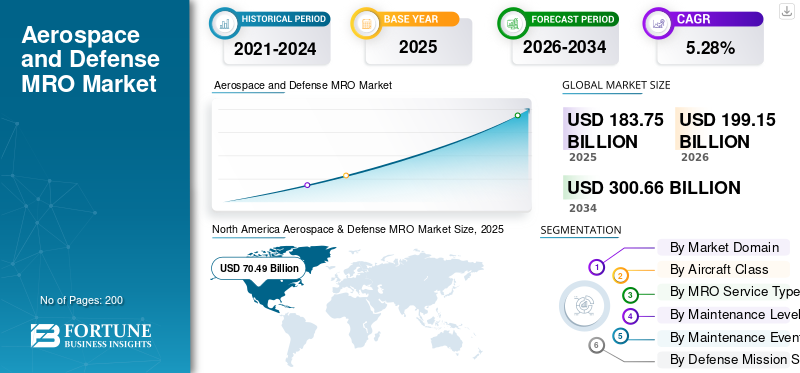
The global aerospace & defense MRO market size was valued at USD 183.75 billion in 2025. The market is projected to grow from USD 199.15 billion in 2026 to USD 300.66 billion by 2034, exhibiting a CAGR of 5.28% during the forecast period. North America dominated the aerospace and defense MRO market with a market share of 38.36% in 2025.
The aerospace & defense MRO sector covers maintenance, repair, overhaul, upgrades, spares, engineering support, logistics, and digital sustainment for commercial and military aircraft, engines, avionics, components, and mission systems. It is the market that ensures that the fleets are airworthy, mission-ready, and economically functional during their service life.
The global market growth is being propelled by higher flight activities, aging aircraft fleets, delayed new-aircraft deliveries, and immense pressure on airlines and militaries to extend asset life rather than to replace the platforms quickly. IATA reported a 5.3% growth in 2025 air travel demand, while SIPRI reported global military expenditure touched USD 2.887 trillion in 2025, both supporting a stronger civil and defense sustainment demand.
The major MRO companies include Boeing, Airbus Servies, Rolls-Royce plc, RTX/Pratt & Whitney–Collins Aerospace, and Lufthansa Technik.
Download Free sample to learn more about this report.
Aerospace and Defense MRO Market Key Takeaways
 Global Market Size & Forecast
- 2025 Market Size: USD 183.75 billion
- 2026 Market Size: USD 199.15 billion
- 2034 Forecast Market Size: USD 300.66 billion
- CAGR: 5.28% (2026–2034)
 Market Share
- North America dominated the market with a 38.36% share in 2025.
- The intermediate level segment accounted for the largest market share of 27.14% in 2025.
- The radar systems segment held the largest market share of 18.98% in 2025.
 Key Regional Highlights
Asia Pacific
Asia Pacific generated USD 41.07 billion in 2025.
North America
North America generated USD 70.49 billion in 2025 and is projected to reach USD 76.00 billion in 2026, maintaining its leading market position.
Europe
Europe accounted for USD 49.45 billion in 2025 and is projected to register the fastest growth at a 6.58% CAGR during the forecast period.
U.S.
U.S. market reached USD 64.72 billion in 2025 and is projected to grow at a 4.61% CAGR during the forecast period.
Japan
Japan market reached USD 5.87 billion in 2025 and is projected to grow at a 3.85% CAGR during the forecast period.
Read More

Aerospace & Defense MRO Market Trend
Shift of MRO from Reactive Repair to Predictive, Digital, Additive, and Lifecycle-Based Sustainment
The market is moving toward connected sustainment, where operators use aircraft health data, digital work instructions, AI-based parts sourcing, automated inspection, additive aircraft maintenance repair and overhaul MRO to reduce downtime. AI-driven procurement that connects buyers to suppliers, consolidates quotes, analyzes supplier performance, and supports faster purchasing decisions through AAR’s Airvoyant launch exemplifies the future direction market is taking. . This kind of software directly addresses one of MRO’s major pain points that is slow and fragmented parts sourcing.
For instance, in May 2026, the U.S. Army’s official Army Sustainment issue focused on maintenance modernization, including predictive maintenance, cold spray, tele-maintenance, low-cost sensors, and AI-ready reporting.
Market Dynamics
MARKET DRIVER
Download Free sample to learn more about this report.
Fleet Availability, Lifecycle Extension, and Defense Readiness Are Pushing The Demand for MRO
The aerospace & defense MRO market growth is being driven by fleets’ requirement to remain accessible even if the new aircraft deliveries, spare-parts flows, and defense fleet modernization are stretched. Boeing’s 2025–2044 services outlook reports that commercial aviation support and services amounted to USD 4.7 trillion, covering MRO, modifications, parts, supply chain, training, and digital solutions. Airbus reported that it also expects aviation services demand to grow strongly, reaching USD 311 billion by 2044. This shows that MRO is becoming a core fleet-availability and lifecycle-management business.
MARKET RESTRAINT
Shortages of Parts, Engine Material Constraints, and Cost Inflation Are Slowing Turnaround, Hampering the Service Demand
The market’s one of the biggest restraints is the ability to execute maintenance repairs and overhauls work on time and profitably. Engine MRO is especially affected as high-value parts, used serviceable materials, life-limited parts, castings, and repairable components remain in short supply across several programs. RTX’s Pratt & Whitney openly stated that material constraints are one of the main causes of delays in the MRO process, owing to this, the company is expanding used serviceable material stock and quick-turn capacity.
MARKET OPPORTUNITIES
Localized Sustainment, Regional MRO Hubs, and Digital Procurement to Unlock High-Value Growth
The strongest growth opportunity for the market is building MRO closer to the fleet operator, especially for defense customers that want sovereign or in-country sustainment. Local depots reduce dependency on overseas repair centers, shorten turnaround time, improve readiness, and support local industrial participation. This is particularly attractive in India, the Middle East, Southeast Asia, and Latin America, where defense modernization and commercial fleet growth are creating demand for local repair ecosystems.
For instance, in April 2026, GE Aerospace signed a contract with the Indian Air Force to help establish an in-country depot for F404-IN20 engines powering the Tejas LCA fleet.
MARKET CHALLENGES
Maintenance Challenges Associated With Older and Newer Aircraft is Hampering the Market Growth
The main challenge for the market growth is old and new aircraft becoming harder to sustain. Older aircraft require corrosion, fatigue, obsolete parts, and unplanned depot work and newer aircraft require software complexity, proprietary data, mission-system integration, and higher dependence on OEM technical support. GAO, on May 14th, 2026, reported that U.S. Air Force depot maintenance delays have increased considerably since FY2019, and by FY2024 as 73% of aircraft were delayed against their original target completion date.
SEGMENTATION ANALYSIS
By Market Domain
Rising Operational Costs of UAS/Drone Deployments in Various Applications Has Made UAS / Drone MRO the Fastest-Growing Segment
The market, by market domain, is classified into commercial aviation MRO, defense aviation MRO, business & general aviation MRO, rotorcraft MRO, UAS / drone MRO, space & launch sustainment, defense electronics sustainment, and ground support equipment MRO.
The UAS / drone MRO sub-segment is estimated to grow at a fastest CAGR of 8.56% during the forecast period. The growth is mainly driven by rising operational cost of drones in defense surveillance, border monitoring, battlefield reconnaissance, logistics support, and commercial inspection activities.
The commercial aviation MRO segment accounted for the largest market share of 39.77% in 2025. In addition, the segment is projected to grow at a CAGR of 4.27% during the forecast period.
By Aircraft Class
Higher Combat Readiness Needs and Defense Tensions Are Pushing Fighter Aircraft MRO Growth Ahead
The market, by aircraft class, is classified into narrowbody commercial, widebody commercial, regional aircraft, cargo aircraft, fighter aircraft, military transport, special mission aircraft, and others.
The fighter aircraft segment is estimated to grow at a fastest CAGR of 8.56% during the forecast period. This growth is linked to rising defense tensions, higher training intensity, modernization of legacy combat fleets, and the need to keep fighter aircraft mission-ready for air defense, deterrence, and rapid-response missions.
The narrowbody commercial segment accounted for the largest market share with 26.23% in 2025. In addition, the sub-segment is projected to grow at a CAGR of 4.46% during the forecast period.
By MRO Service Type
Shift Towards Connected Maintenance Workflows Is Making Digital MRO The Fastest-Growing Segment
The market, by MRO service type, is classified into line maintenance, base maintenance, engine MRO, APU MRO, component MRO, airframe MRO, engineering services, material services, digital MRO, and others.
The digital MRO segment is estimated to grow at a fastest CAGR of 7.97% during the forecast period. The growth is attributed to airlines, defense forces, and MRO providers getting shifted from paper-heavy, reactive maintenance towards predictive, data-driven, and connected maintenance models.
The engine MRO segment accounted for the largest market share with 30.89% in 2025. In addition, the sub-segment is projected to grow at a CAGR of 5.32% during the forecast period.
By Maintenance Level
Greater Control Offered to Operators by MRO Over Complex Systems Is Driving OEM-Level Sustainment Growth
The market, by maintenance level is classified into organizational / line level, intermediate level, depot level, field-level sustainment, and OEM-level sustainment.
The OEM-level sustainment sub-segment is estimated to grow at a fastest CAGR of 6.83% during the forecast period. The growth is driven by the increasing complexity of modern aircraft, engines, avionics, mission systems, and software-defined defense platforms. Operators are relying more on OEMs as many critical systems require proprietary technical data, certified repair methods, software access, original spare parts, and engineering support.
The intermediate level segment accounted for the largest market share with 27.14% in 2025. In addition, the sub-segment is projected to grow at a CAGR of 4.58% during the forecast period.
By Maintenance Event
Rising Demand for Defense Units to Remain Operational Has Made Military Readiness Events the Fastest Growing Segment
The global market, by maintenance event, is classified into scheduled maintenance, unscheduled maintenance, lifecycle maintenance, and military readiness events.
The military readiness events segment is estimated to grow at a fastest CAGR of 6.76% during the forecast period. This growth reflects the rising demand for air forces, naval aviation units, military aviation fleets, and unmanned systems to remain operationally available during exercises, deployments, border tensions, and conflict-preparedness cycles. Unlike routine scheduled maintenance, readiness-driven maintenance is directly tied to mission availability and require rapid repair, inspection, modification, and parts replacement.
The scheduled maintenance segment accounted for the largest market share with 36.00% in 2025. In addition, the segment is projected to grow at a CAGR of 3.88% during the forecast period.
By Defense Mission Systems
Expanding Electromagnetic Threats Are Accelerating Electronic Warfare Demand
The market, by defense mission systems, is classified into radar systems, electronic warfare, electro-optical / infrared, communications / CNI, weapons interface, ISR payloads, defensive aids, mission software, and others.
The electronic warfare segment is estimated to grow at a fastest growing CAGR of 6.90% during the forecast period. The growth is being driven by the rising importance of jamming, electronic attack, electronic protection, signal intelligence, radar warning, and countermeasure systems across modern air and defense platforms. As threats become more networked and sensor-driven, aircraft require frequent EW software updates, hardware refresh, calibration, testing, and integration with mission systems.
The radar systems segment accounted for the largest market share with 18.98% in 2025. In addition, the segment is projected to grow at a CAGR of 5.26% during the forecast period.
By Provider Type
To know how our report can help streamline your business, Speak to Analyst
Faster Adoption of Software-Led Tools Is Helping Digital MRO Providers to Fastest Growing Provider Type
The global market, by provider type, is classified into OEM MRO, airline-affiliated MRO, independent MRO, defense prime sustainment, military organic depot, authorized service center, and digital MRO provider.
The digital MRO provider segment is estimated to grow at a fastest CAGR of 7.36% during the forecast period. This growth is supported by the rising need for software-led maintenance planning, AI-enabled diagnostics, parts forecasting, digital records, connected technician workflows, and fleet-health platforms. Digital MRO providers are gaining traction as they help operators solve practical problems such as delayed parts, inefficient work packages, poor maintenance visibility, and avoidable downtime.
The OEM MRO segment accounted for the largest market share with 24.55% in 2025. In addition, the segment is projected to grow at a CAGR of 5.86% during the forecast period.
Aerospace & Defense MRO Market Regional Outlook
By region, the market is categorized into Europe, North America, Asia Pacific, the Middle East & Africa, and Latin America.
North America
North America Aerospace & Defense MRO Market Size, 2025 (USD Billion)
To get more information on the regional analysis of this market, Download Free sample
North America held the dominant aerospace & defense MRO market share in 2025, valued at USD 70.49 billion, and also expected to maintain the leading share in 2026, with USD 76.00 billion. The growth is being driven by high fleet utilization, aging commercial fleets, and sustained defense sustainment budgets. International Air Transport Association (IATA) reported North America held 22.9% of global passenger traffic in 2024, while U.S. military spending reached USD 997 billion, equal to 37% of global military expenditure, supporting both commercial and defense MRO demand.
U.S. Aerospace & Defense MRO Market
Based on North America's strong contribution and the U.S. dominance within the region, the U.S. market reached USD 64.72 billion in 2025 and is estimated to grow with a CAGR of 4.61% during the forecast period.
Europe
Europe is projected to grow at fastest growing rate of 6.58% during the forecast period. In 2025, the market value stood at USD 49.45 billion. Europe’s MRO demand is rising as airlines are operating at high load factors while governments are sharply increasing defense readiness and platform availability. The International Air Transport Association (IATA) recorded 8.7% RPK growth for Europe in 2024 and SIPRI reported European military spending rose by 17% to USD 693 billion in 2024.
U.K. Aerospace & Defense MRO Market
The U.K. market in 2025 was valued at USD 8.99 billion and is estimated to grow at a rate of 6.64% during the forecast period.
Germany Aerospace & Defense MRO Market
The Germany market in 2025 was valued at USD 9.37 billion and is estimated to grow at a rate of 7.39% during the forecast period.
Rest of Europe Aerospace & Defense MRO Market
The Rest of Europe market in 2025 was valued at USD 10.39 billion and is estimated to grow at a rate of 3.40% during the forecast period.
Asia Pacific
The Asia Pacific market was valued at USD 41.07 billion in 2025 and secured the position of the second-largest region in the market. Asia Pacific represents the strongest growth engine the market as traffic recovery, fleet expansion, and defense modernization are occurring simultaneously. The region accounted for 33.5% of global passenger traffic and posted 16.9% RPK growth in 2024, while Airbus expects Asia Pacific particularly, China and South Asia to represent around 45% of global aviation services demand by 2044.
China Aerospace & Defense MRO Market
The China market in 2025 was valued at USD 13.45 billion and is estimated to grow at a rate of 5.83% during the forecast period.
India Aerospace & Defense MRO Market
The India market in 2025 was valued at USD 6.92 billion and is estimated to grow at a rate of 7.26% during the forecast period.
Japan Aerospace & Defense MRO Market
The Japan market in 2025 was valued at USD 5.87 billion and is estimated to grow at a rate of 3.85% during the forecast period.
Middle East & Africa
Middle East & Africa region is expected to witness moderate growth during the forecast period. The Middle East & Africa market was valued at USD 16.68 billion in 2025 and is set to grow at a CAGR of 3.67% during the forecast period. Growth is supported by expanding hub operations, airline fleet additions, and higher regional security spending. The IATA has reported a 9.5% traffic growth in the Middle East and 13.2% in Africa in 2024, while SIPRI showed Middle East military spending increased by 15% to USD 243 billion and Africa reached USD 52.1 billion in 2024.
Gulf Countries Aerospace & Defense MRO Market
The Gulf Countries market in 2025 was valued at USD 6.28 billion and is estimated to grow at a rate of 4.21% during the forecast period.
Israel Aerospace & Defense MRO Market
Israel market in 2025 was valued at USD 2.47 billion and is estimated to grow at a rate of 3.31% during the forecast period.
Turkey Aerospace & Defense MRO Market
Turkey market in 2025 is valued at USD 2.97 billion and is estimated to grow at a rate of 5.29% during the forecast period.
Latin America
The Latin America region is projected to grow at a slow pace with a CAGR of 2.81% during the forecast period. Latin America’s MRO market is growing mainly due to stronger airline utilization, narrowbody fleet activity, and security-related defense spending. The IATA reported 7.8% RPK growth for the region in 2024, while Latin American international airline traffic rose by 14.4%, increasing maintenance demand across airframe, engine, and component services.
Brazil Aerospace & Defense MRO Market
The Brazil market in 2025 was valued at USD 2.60 billion and is estimated to grow at a rate of 3.73% during the forecast period.
COMPETITIVE LANDSCAPE
Key Industry Players
Digitalized MRO Capacity Expansion and Defense Sustainment By Prominent Market Players are Strengthening Their Marker Positions
The global aerospace & defense MRO market is becoming more capacity-driven, with OEMs, airline-backed MROs, engine specialists, defense primes, and independent service providers expanding hangars, engine shop slots, component pools, and regional support networks. As aircraft are flying more hours, supply chains remain tight and airlines want faster turnaround rather than only low-cost maintenance.
Technology adoption has become a main competitive differentiator, not just geographic presence. Key players are investing in predictive maintenance, digital twins, connected aircraft data, AI-based fault detection, paperless maintenance records, additive manufacturing for selected spare parts, robotics-assisted inspection, and advanced composite repair capabilities. Overall, the competition in market is shifting toward integrated lifecycle support, faster spare availability, digital maintenance planning, and long-term performance-based contracts rather than standalone repair work.
LIST OF KEY AEROSPACE & DEFENSE MRO COMPANIES PROFILED
- Lufthansa Technik AG (Germany)
- Pratt & Whitney (RTX Corporation) (U.S.)
- Rolls-Royce plc (U.K.)
- Safran Aircraft Engines SAS (France)
- MTU Aero Engines AG (Germany)
- The Boeing Company (U.S.)
- AAR CORP. (U.S.)
- Airbus SE (France)
- Hong Kong Aircraft Engineering Company Limited (Hong Kong)
- Delta TechOps (U.S.)
- Turkish Technic Inc. (Turkey)
- SR Technics Switzerland AG (Switzerland)
- Sanad Aerotech (UAE)
- Lockheed Martin Corporation (U.S.)
- BAE Systems plc (U.K.)
- Leonardo S.p.A. (Italy)
KEY INDUSTRY DEVELOPMENTS
- December 2025: Lockheed Martin received a USD 3.63 billion contract modification from the U.S. Navy / Naval Air Systems Command to continue F-35 logistics support, including ground maintenance, depot activities, supply-chain management, reliability support, and maintainer training for U.S., FMS, and partner aircraft fleets.
- December 2025: Boeing received a USD 2.73 billion contract from the U.S. Army Contracting Command for Apache post-production support services, covering long-term sustainment support for the AH-64 Apache helicopter fleet through 2030.
- December 2025: AGILE JV LLC received a USD 445.32 million contract from Commander, Fleet Readiness Centers to provide logistics and engineering support for naval aircraft MRO, MRO engineering, MRO logistics, and MRO production services across key U.S. Navy depot locations.
- November 2025: RTX’s Pratt & Whitney received a USD 1.61 billion contract from Naval Air Systems Command for F135 engine sustainment, including depot-level maintenance, repair, spare parts, engineering support, software sustainment, and global propulsion support for the F-35 fleet.
- March 2025: Accenture Federal Services received a USD 336.83 million contract from the U.S. Air Force Life Cycle Management Center to continue maintenance, repair, and overhaul activities and add MRO-Supply support, strengthening the Air Force’s digital and enterprise MRO backbone.
REPORT COVERAGE
The global aerospace & defense MRO market analysis includes a comprehensive study of the market size & forecast by all the market segments included in the report. It contains details on the market dynamics and market trends expected to drive the market over the forecast period. It provides information on key aspects, including an overview of technological advancements, pipeline candidates, the regulatory environment, and product launches. Additionally, it details partnerships, mergers & acquisitions, as well as key aerospace and defense industry developments and prevalence by key regions. The global market research report also provides a detailed competitive landscape with information on the market share and profiles of key operating players.
Request for Customization to gain extensive market insights.
Report Scope & Segmentation
| ATTRIBUTE | DETAILS |
| Study Period | 2021-2024 |
| Base Year | 2025 |
| Estimated Year | 2026 |
| Forecast Period | 2026-2034 |
| Historical Period | 2021-2024 |
| Growth Rate | CAGR of 5.28% from 2026 to 2034 |
| Unit | USD Billion |
|
Segmentation |
By Market Domain
By Aircraft Class
By MRO Service Type
By Maintenance Level
By Maintenance Event
By Defense Mission Systems
By Provider Type
By Region
|
Frequently Asked Questions
Fortune Business Insights says that the global market value stood at USD 183.75 billion in 2025 and is projected to reach USD 300.66 billion by 2034.
In 2025, the European market value stood at USD 49.45 billion.
The market is expected to exhibit a CAGR of 5.28% during the forecast period.
The digital MRO segment is expected to grow with the fastest CAGR over the forecast period.
Fleet availability, lifecycle extension, and defense readiness are pushing MRO demand upward.
The major key players include Boeing, Airbus Servies, Rolls-Royce plc, RTX/Pratt & Whitney–Collins Aerospace, and Lufthansa Technik.
North America dominated the market in 2025.



- 2021-2034
- 2025
- 2021-2024
- 200
Get 30-60 hrs Free Customization
Expand Regional and Country Coverage, Segments Analysis, Company Profiles, Competitive Benchmarking, and End-user Insights.




















Related Reports
-
US +1 833 909 2966 ( Toll Free )
-
Get In Touch With Us