Anti-Radiation Missiles Market Size, Share & Industry Analysis, By System Type (Conventional Air-Launched, High-Speed, Hypersonic/Near-Hypersonic), By Launch Platform (Fighter Aircraft, Maritime Patrol Aircraft, Ground-Based TEL), By Range Class (Below 25 km, 25–75 km, 75–150 km, 150–300 km, 300–500 km, Above 500 km), By Speed Class (Low-Subsonic, High-Subsonic, Transonic), By Propulsion Type (Single-Pulse Solid Rocket), By Guidance & Seeker Architecture (Passive RF Homing, Wideband Passive RF Seeker), By End User (Air Forces, Naval Aviation Forces), and Regional Forecast 2026-2034
 Download Free Sample
Anti-Radiation Missiles Market Size and Future Outlook
 Listen to Audio Version
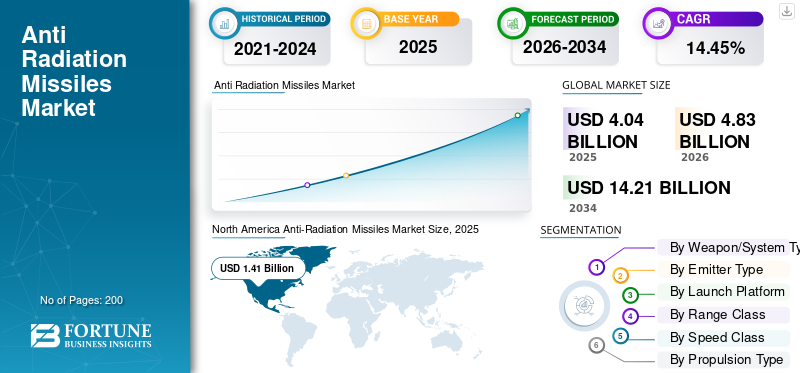
The global anti-radiation missiles market size was valued at USD 4.04 billion in 2025. The market is projected to grow from USD 4.83 billion in 2026 to USD 14.21 billion by 2034, exhibiting a CAGR of 14.45% during the forecast period. North America dominated the anti-radiation missiles market with a market share of 34.9% in 2025.
The global anti-radiation missiles market covers air-launched and, loitering anti-radar weapons used to suppress or destroy enemy air-defense radars, surveillance emitters, and radar-guided Surface-to-Air Missile (SAM) networks.
Demand is being driven by the return of high-intensity air warfare, dense integrated air defense systems, and the need for aircraft survivability against mobile radars that switch off or relocate to avoid detection. Modern systems are moving beyond classic passive radar homing toward multi-mode seekers, GPS/INS guidance, medium and long range anti-radiation capabilities, and better performance against emitter shutdown tactics.
Key players include Northrop Grumman Corporation, Raytheon/RTX, MBDA, Tactical Missiles Corporation/KTRV, and Israel Aerospace Industries (IAI). These players are focusing on range extension, multi-mode guidance, survivability against radar shutdown tactics, platform integration with fighters such as F-16/F/A-18/F-35-class aircraft, and export/local production partnerships.
Download Free sample to learn more about this report.
Anti Radiation Missiles Market Key Takeaways
 Global Market Size & Forecast
- 2025 Market Size: USD 4.04 billion
- 2026 Market Size: USD 4.83 billion
- 2034 Forecast Market Size: USD 14.21 billion
- CAGR: 14.45% from 2026–2034
 Market Share
- North America dominated the market with a 34.9% share, valued at USD 1.41 billion in 2025.
- Fighter Aircraft segment dominated the market with a 62.99% share in 2025.
- High-Speed/Supersonic segment held a 35.20% market share in 2025.
 Key Regional Highlights
North America
The market reached USD 1.41 billion in 2025, driven by U.S. SEAD/DEAD modernization programs.
Asia Pacific
The market reached USD 1.02 billion in 2025, driven by rising investments in anti-radar weapons.
Europe
The market reached USD 1.16 billion in 2025, supported by NATO air-defense modernization.
U.S.
The market reached USD 1.37 billion in 2025, driven by the AGM-88G AARGM-ER program.
Japan
The market is expected to benefit from regional investments in advanced air-defense suppression capabilities.
Read More

Anti-Radiation Missiles Market Trend
Convergence of Missiles and Electronic Warfare Capabilities Is a Key Market Trend
A major trend in the market is the convergence of anti-radiation missiles, stand-in attack weapons, electronic warfare effectors, and loitering munitions. Programs such as Northrop Grumman’s AARGM-ER and SiAW show this trend, as missile technologies are moving toward faster and more flexible weapons capable of engaging relocatable targets, jamming platforms, cruise/anti-ship missile launchers, and integrated air-defense assets. The U.S. Air Force awarded Northrop Grumman an approximately USD 705 million SiAW contract in September 2023, and the program later completed a milestone F-16 separation test in November 2024.
For instance, in May 2026, MBDA announced the first SPEAR flight on an F-35B and highlighted SPEAR-EW as a stand-in jammer designed to confuse enemy air defenses, showing the market’s shift toward integrated missile and electronic warfare effects rather than radar-homing alone.
Market Dynamics
MARKET DRIVER
Download Free sample to learn more about this report.
Rising Need to Defeat Mobile and Shutdown-Capable Air-Defense Radars Fuels Industry Expansion
The global anti-radiation missiles market growth is being driven by the rapid modernization of integrated air defense systems. Modern SAM batteries are more mobile, networked, and harder to kill as their radars can shut down, relocate, or use decoys after detecting a threat. As a result, buyers are moving from basic radar-homing missiles toward multi-mode weapons that can continue the attack even when the radar stops emitting. In 2025, NAVAIR stated that AARGM is built for SEAD/DEAD missions against relocatable integrated air-defense targets and radar shutdown tactics, while AARGM-ER adds extended range, survivability, and improved effectiveness against future threats.
For instance, in March 2026, the U.S. Department of Defense and Honeywell announced a framework agreement to surge production of navigation systems, actuators, and electronic warfare solutions, backed by a USD 500 million investment by Honeywell. This initiative strengthens the wider precision-munitions industrial base that supports advanced missile programs.
MARKET RESTRAINT
High Cost, Export Controls, And Integration Complexity to Slow Product Adoption
One of the biggest restraint is that anti-radiation missiles are not simple off-the-shelf weapons. Buyers need missile hardware, aircraft integration, mission-data support, software updates, training, spares, classified documentation, and national export approvals. For platforms such as F-35, F/A-18, Rafale, Eurofighter, Su-30, and future aircraft, integration can become as important as the missile itself. These weapons must connect seamlessly with aircraft mission systems, electronic-support sensors, and rules-of-engagement workflows. As a result, although the market remain attractive, procurement processes are often slow, expensive, and politically controlled.
MARKET OPPORTUNITY
Shift Toward Advanced Emission Suppression Weapons to Boost Industry Growth
One of the strongest opportunities in the market is the shift from classic anti-radar missiles to broader “emission suppression” weapons. The U.S. Navy’s Advanced Emission Suppression Missile requirement points to a future weapon with longer range than the current inventory, compatibility with F/A-18E/F, EA-18G, and F-35, broad-frequency seeker coverage, GPS/INS and alternate navigation, and the ability to engage both ground and airborne radar targets. This creates a new opportunity area beyond traditional SAM radar hunting, including airborne early-warning aircraft, jammers, and high-value electromagnetic nodes.
For instance, in February 2026, Defense News and Naval News reported that the U.S. Navy is seeking a new AESM anti-radar missile, with an expected requirement of up to 300 missiles per year and a desired fielding timeline of within two years of contract award.
MARKET CHALLENGES
Supply-Chain and Program Execution Risks to Hinder Industry Expansion
The key challenge is that advanced anti-radiation missiles are difficult to develop and produce at scale. They need high-speed airframes, advanced seekers, compact propulsion, precision navigation, classified software, aircraft certification, and reliable performance in heavily jammed environments. Any weakness in flight testing, qualification, or subsystem supply can delay fielding and reduce buyer confidence. This matters as air forces seek both high-end capability and large stockpiles, but the industrial base often struggles to deliver both at scale.
For instance, in April 2026, Naval News reported that the U.S. Navy’s FY2027 budget documentation placed the AARGM-ER on a “strategic pause,” with funding sharply reduced and procurement expected to restart at a lower level in FY2028. This does not eliminate the demand for the advanced anti-radiation weapons, but it shows the importance of OEMs managing development risk, export continuity, and production economics.
SEGMENTATION ANALYSIS
By Weapon/System Type
Anti-Radiation Loitering Munitions Segment to Grow Fastest Due to Persistent Demand for Radar-Hunting
By weapon/system type, the global market is classified into conventional air-launched, high-speed/supersonic, hypersonic/near-hypersonic, anti-radiation ballistic missiles, anti-radiation loitering munitions, anti-radiation unmanned attack systems, anti-radiation cruise missile, and others.
Anti-radiation loitering munitions are likely to be the fastest-growing segment, registering the highest CAGR of 17.28% during the forecast period. This growth is driven by the rising need for low-cost, persistent, and expendable radar-hunting weapons that can wait for emitters to activate instead of depending on a single high-speed anti-radiation missile.
The high-speed/supersonic segment accounted for the largest market share of 35.20% in 2025. The segment is projected to grow at a CAGR of 15.13% during the forecast period.
By Emitter Type
SAM Battery Radars Segment to Display Fastest Growth Due to Growing Threat from Advanced Air Defense Systems
The global market, by emitter type, is classified into early-warning radars, long-range surveillance radars, ground-control intercept radars, target acquisition radars, SAM battery radars, naval air-search radars, naval fire-control radars, airborne AEW&C radar emitters, and others.
The SAM battery radars segment is estimated to be the fastest-growing, registering the highest CAGR of 16.54% during the forecast period. Surface-to-air missile batteries remain the most direct threat to strike aircraft, drones, and stand-off weapon operations. As a result, militaries are prioritizing the suppression and destruction of these radars to open contested airspace and protect high-value assets.
The long-range surveillance radars segment accounted for the second-largest market share of 15.65% in 2025. In addition, the segment is projected to grow at a CAGR of 15.39% during the forecast period.
By Launch Platform
Ground-Based TEL Launchers Segment to Grow Fastest Due to Rising Need for Mobile and Survivable Launch Platforms
The global market, by launch platform, is classified into fighter aircraft, maritime patrol aircraft, ground-based TEL launchers, coastal defense launchers, surface combatants, patrol vessels, naval deck launchers, and helicopter-launched concepts.
The ground-based TEL launchers are estimated to be the fastest-growing segment, registering the highest CAGR of 16.99% during the forecast period. Growth is linked to the shift toward mobile, survivable, and dispersed launch systems that can operate without depending on airbase availability or manned aircraft sorties. TEL-based systems are useful for countries facing dense air-defense networks, island-chain defense needs, or high-risk airspace.
The fighter aircraft segment accounted for the largest market share of 62.99% in 2025. In addition, the segment is projected to grow at a CAGR of 14.04% during the forecast period.
By Range Class
Loitering Radius-Based Systems Segment to Showcase Fastest Growth Due to Its Ability to Persist Over Target Needs
The global market by range class is classified into very short range: below 25 km, short range: 25–75 km, medium range: 75–150 km, long range: 150–300 km, extended range: 300–500 km, deep-strike range: above 500 km, loitering radius-based systems, and endurance-based anti-radiation systems.
The loitering radius-based systems segment is estimated to be the fastest-growing segment, registering the highest CAGR of 17.04% during the forecast period. Their growth is driven by the need to remain within a target area, search for radar emissions, and attack when the emitter becomes active. Unlike traditional missiles, these systems are measured by straight-line range and their ability to patrol, wait, and engage at the right moment.
The long range: 150–300 km segment accounted for the largest market share of 29.57% in 2025. In addition, the segment is projected to grow at a CAGR of 14.29% during the forecast period.
By Speed Class
Hypersonic/Emerging Segment to Grow Fastest, Driven by Rising Need to Counter Advanced Integrated Air-Defense Systems
The global market, by speed class is classified into low-subsonic, high-subsonic, transonic, supersonic, high-supersonic, and hypersonic/emerging.
Hypersonic/emerging is estimated to be the fastest-growing segment, registering the highest CAGR of 16.40% during the forecast period. The main driver is the rising requirement to defeat advanced integrated air-defense systems before they can reposition, shut down, or intercept incoming weapons. High-speed anti-radiation concepts reduce reaction time for radar operators and increase survivability against modern air defenses.
The supersonic segment accounted for the largest market share of 46.34% in 2025. In addition, the segment is projected to grow at a CAGR of 13.51% during the forecast period.
By Propulsion Type
Turbojet Propulsion Segment to Grow Fastest Due to Rising Adoption of Loitering Anti-radiation Systems
The global market, by propulsion type, is classified into single-pulse solid rocket motor, dual-pulse solid rocket motor, turbojet propulsion, ramjet propulsion, scramjet/air-breathing concept, multi-stage ballistic propulsion, and advanced energetic solid propellants.
Turbojet propulsion is estimated to be the fastest-growing segment, registering the highest CAGR of 17.06% during the forecast period. Growth reflects the growing adoption of endurance-based and loitering anti-radiation systems, which complement short-burn rocket-powered missiles. Turbojet propulsion supports longer flight duration, better patrol time, and more flexible mission profiles, especially for systems designed to detect and engage radar emitters before attacking.
The single-pulse solid rocket motor segment accounted for the largest market share of 36.26% in 2025. In addition, the segment is projected to grow at a CAGR of 12.17% during the forecast period.
By Guidance & Seeker Architecture
Wideband Passive RF Seeker Segment to Grow Fastest, Driven by Rising Need to Detect Diverse Radar Frequencies
The global market, by guidance & seeker architecture, is classified into passive RF homing, wideband passive RF seeker, reprogrammable digital RF seeker, anti-radiation homing + INS, anti-radiation homing + GNSS, AI-assisted emitter classification, automatic target recognition, and others.
The wideband passive RF seeker segment is estimated to be the fastest-growing, registering the highest CAGR of 16.23% during the forecast period. The growth is driven by the need to detect, classify, and track a wider spectrum of radar frequencies across increasingly complex modern air-defense networks. As adversaries use multiple radar bands, mobile emitters, decoys, and intermittent transmission tactics, narrowband seeker coverage becomes less effective.
The passive RF homing segment accounted for the largest market share of 18.16% in 2025. In addition, the segment is projected to grow at a CAGR of 11.94% during the forecast period.
By Procurement Type
Export/FMS Package Segment to Grow Fastest Due to Rebuilding of SEAD/DEAD Capabilities by NATO and Allied Countries
The global market, by procurement type, is classified into new-build missile procurement, guidance-section retrofit, rocket-motor replacement, warhead/fuze upgrade, stockpile recertification, life-extension program, export/FMS package, co-development program, and indigenous development program.
The export/FMS package segment is estimated to be the fastest-growing, registering the highest CAGR of 16.91% during the forecast period. Growth is mainly driven by NATO and allied countries rebuilding their SEAD/DEAD capabilities after years of limited investment. Many countries prefer complete missile packages that include all-up rounds, spares, training rounds, software, support equipment, logistics, and platform integration rather than buying missiles alone.
The new-build missile procurement segment accounted for the largest anti-radiation missiles market share of 32.77% in 2025. In addition, the segment is projected to grow at a CAGR of 15.66% during the forecast period.
By End User
To know how our report can help streamline your business, Speak to Analyst
Air Forces Segment to Grow Fastest Due to Fighter-Led SEAD Modernization
The global market, by end user, is classified into air forces, naval aviation forces, carrier air wings, marine aviation forces, army missile forces, and strategic rocket forces.
The air forces segment is estimated to be the fastest-growing, registering the highest CAGR of 15.51% during the forecast period. The growth is driven by fighter-led SEAD modernization, especially as countries integrate anti-radiation missiles with F-35, F-16, Eurofighter, Rafale, Su-30-class aircraft, and other strike platforms.
The naval aviation forces segment accounted for the second-largest market share in 2025. In addition, the segment is projected to grow at a CAGR of 11.77% during the forecast period.
Anti-Radiation Missiles Market Regional Outlook
By region, the market is categorized into Europe, North America, Asia Pacific, and the Rest of the World.
North America
North America Anti-Radiation Missiles Market Size, 2025 (USD Billion)
To get more information on the regional analysis of this market, Download Free sample
North America held the dominant market share in 2025, valued at USD 1.41 billion, and is expected to maintain its leading share in 2026, with USD 1.66 billion. Growth is mainly driven by the U.S., which continues to sustain large-scale SEAD/DEAD modernization through the AGM-88G AARGM-ER program. The missile is designed to suppress or destroy RF-enabled surface-to-air missile systems and counter radar shutdown tactics.
U.S. Anti-Radiation Missiles Market
Based on North America's strong contribution and the U.S. dominance within the region, the U.S. market reached USD 1.37 billion in 2025 and is estimated to grow at a CAGR of 12.59% during the forecast period.
Europe
Europe is projected to be the fastest-growing region, registering the highest CAGR of 16.31% during the forecast period. In 2025, the market was valued at USD 1.16 billion. Growth is driven by the Russia-Ukraine war, which has made the suppression of enemy air defenses a front-line requirement for NATO air forces. This need has intensified as Russia continues to rely on layered radars, SAM systems, and electronic warfare assets.
U.K. Anti-Radiation Missiles Market
The U.K.’s market was valued at USD 0.11 billion in 2025 and is estimated to grow at a CAGR of 14.65% during the forecast period.
Germany Anti-Radiation Missiles Market
The German market was valued at USD 0.20 billion in 2025 and is estimated to grow at a CAGR of 17.26% during the forecast period.
Rest of Europe Anti-Radiation Missiles Market
The Rest of Europe was valued at USD 0.49 billion in 2025 and is estimated to grow at a CAGR of 16.17% during the forecast period.
Asia Pacific
The Asia Pacific market was valued at USD 1.02 billion in 2025 and secured the position of the second-largest region in the market. Demand across the region is rising as China, North Korea, Pakistan, and other countries are driving investments in weapons capable of disabling enemy radar systems before aircraft enter contested airspace.
China Anti-Radiation Missiles Market
The Chinese market was valued at USD 0.29 billion in 2025 and is estimated to grow at a CAGR of 10.62% during the forecast period.
India Anti-Radiation Missiles Market
The market in India was valued at USD 0.23 billion in 2025 and is estimated to grow at a CAGR of 15.39% during the forecast period.
Australia Anti-Radiation Missiles Market
The market in Australia was valued at USD 0.16 billion in 2025 and is estimated to grow at a CAGR of 16.37% during the forecast period.
Rest of the World
The Middle East & Africa market was valued at USD 0.38 billion in 2025. Growth is driven by Israel-Iran tensions, Gulf air-defense modernization, missile/drone threats, and dense radar networks, all of which make anti-radiation strike capability operationally important.
The Latin America region is expected to witness moderate growth in this market during the forecast period. The Latin American market was valued at USD 0.08 billion in 2025. Latin America is likely to show slower growth as the region has fewer high-end integrated air-defense networks and lower urgency for SEAD/DEAD weapons. However, opportunities remain in selected markets as military expenditure in parts of Latin America is increasing.
COMPETITIVE LANDSCAPE
Key Industry Players
Shift Toward Conventional Anti-Radar Missiles Toward Smarter Suppression And Destruction Systems Defines Competitive Landscape
The competitive landscape is moving from conventional anti-radar missiles toward smarter suppression and destruction systems that can attack mobile radars, shutdown emitters, and wider air-defense networks. Major OEMs are competing through extended range, multi-mode seekers, better propulsion, digital mission planning, and integration with advanced aircraft and carrier-based platforms.
Industry growth is also being shaped by adjacent technologies such as stand-in electronic warfare effectors, loitering anti-radiation munitions, and dual seeker systems. European and Israeli developments show that competition is expanding beyond classic missile suppliers to include EW payloads, autonomous loitering weapons, and modular precision-strike systems designed to suppress air defenses before manned aircraft enter contested airspace.
LIST OF KEY ANTI-RADIATION MISSILES COMPANIES PROFILED
- Northrop Grumman Corporation (U.S.)
- Lockheed Martin Corporation (U.S.)
- L3Harris Technologies, Inc. (U.S.)
- MBDA S.A.S. (France)
- BAE Systems plc (U.K.)
- Roketsan Roket Sanayii ve Ticaret A.Ş. (Turkey)
- Adani Defence and Aerospace (India)
- Bharat Electronics Limited (India)
- Israel Aerospace Industries Ltd. (Israel)
- Tactical Missiles Corporation JSC/KTRV (Russia)
- China Aerospace Science and Industry Corporation Limited (China)
- Defence Research and Development Organisation (India)
- Rafael Advanced Defense Systems Ltd. (Israel)
- Aerospace Industries Organization (Iran)
- Mectron Engenharia, Indústria e Comércio S.A. (Brazil)
KEY INDUSTRY DEVELOPMENTS
- December 2025: The U.S. Air Force Life Cycle Management Center awarded Northrop Grumman Systems Corporation a contract ceiling of up to USD 100 million for SiAW and AARGM-ER support activities, including hardware design, systems engineering, integration, modeling, testing, qualification, and repair capability for advanced anti-radiation and stand-in attack missile systems.
- January 2025: The Polish Ministry of National Defence, through the U.S. Government and with Northrop Grumman as the AARGM-ER OEM, signed a contract valued at around USD 745 million for the delivery of more than 200 AGM-88G AARGM-ER missiles. The procurement is intended to strengthen Poland’s tactical aviation SEAD capabilities during 2029-2035.
- January 2025: The Australian Government/Department of Defence approved an acquisition, through the U.S. Government and Northrop Grumman AARGM-ER supply chain, valued at up to USD 59 million for additional AARGM-ER missile stocks designed to detect, attack, and neutralize enemy radar systems.
- September 2024: The Naval Air Systems Command awarded Alliant Techsystems Operations LLC, a Northrop Grumman Defense Systems subsidiary, a USD 33.27 million firm-fixed-price contract for long-lead components, materials, parts, and production-support items associated with FY2025 low-rate initial production of AGM-88G AARGM-ER missiles.
- April 2024: The Government of the Netherlands received U.S. approval for a Foreign Military Sale valued at around USD 700 million. The package includes Grumman AARGM-ER production base, covering AGM-88G AARGM-ER missiles, spare guidance/control sections, and support for Dutch F-35 SEAD missions.
REPORT COVERAGE
The global anti-radiation missiles market analysis includes a comprehensive study of the market size & forecast by all the market segments included in the report. It contains details on the market dynamics and market trends expected to drive the market over the forecast period. It provides information on key aspects, including an overview of technological advancements, pipeline candidates, the regulatory environment, and product launches. Additionally, it details partnerships, mergers & acquisitions, and key defense industry developments and prevalence by key regions. The global market research report also provides a detailed competitive landscape with information on the market share and profiles of key operating players.
Request for Customization to gain extensive market insights.
Report Scope & Segmentation
| ATTRIBUTE | DETAILS |
| Study Period | 2021-2034 |
| Base Year | 2025 |
| Estimated Year | 2026 |
| Forecast Period | 2026-2034 |
| Historical Period | 2021-2024 |
| Growth Rate | CAGR of 14.45% from 2026 to 2034 |
| Unit | USD Billion |
|
Segmentation |
By Weapon/System Type
By Emitter Type
By Launch Platform
By Range Class
By Speed Class
By Propulsion Type
By Guidance & Seeker Architecture
By Procurement Type
By End User
By Geography
|
Frequently Asked Questions
Fortune Business Insights says that the global market value stood at USD 4.04 billion in 2025 and is projected to reach USD 14.21 billion by 2034.
In 2025, the European market value stood at USD 1.16 billion.
The market is expected to exhibit a CAGR of 14.45% during the forecast period.
By end user, the air forces segment is expected to hold the highest CAGR over the forecast period.
Rising need to defeat mobile and shutdown-capable air-defense radars is the key factor driving the market.
Northrop Grumman Corporation, Raytheon/RTX, MBDA, Tactical Missiles Corporation/KTRV, and Israel Aerospace Industries (IAI).
North America dominated the market in 2025.



- 2021-2034
- 2025
- 2021-2024
- 200
Get 30-60 hrs Free Customization
Expand Regional and Country Coverage, Segments Analysis, Company Profiles, Competitive Benchmarking, and End-user Insights.




















Related Reports
-
US +1 833 909 2966 ( Toll Free )
-
Get In Touch With Us