Methanol Engines Market Size, Share & Industry Analysis, By Vessel Type (Deep-Sea Commercial, Short-Sea & Coastal, Port & Harbor, Offshore & Energy, Inland Waterway, Passenger), By Engine Type (Low-Speed Two-Stroke, Medium-Speed Four-Stroke, High-Speed Four-Stroke, Dual-Fuel, & Dedicated Methanol), By Power Rating (Below 100 kW, 100–500 kW, 501 kW–1 MW, 1–5 MW, 5–20 MW, 20–50 MW, and Above 50 MW), By Engine Speed (Below 300 rpm, 301-1,000 rpm, 1001 rpm), By Procurement Type (New-Build Engine Sales, Retrofit / Conversion, and Integrated Propulsion Package), and Regional Forecast 2026-2034
 Download Free Sample
Methanol Engines Market Size and Future Outlook
 Listen to Audio Version
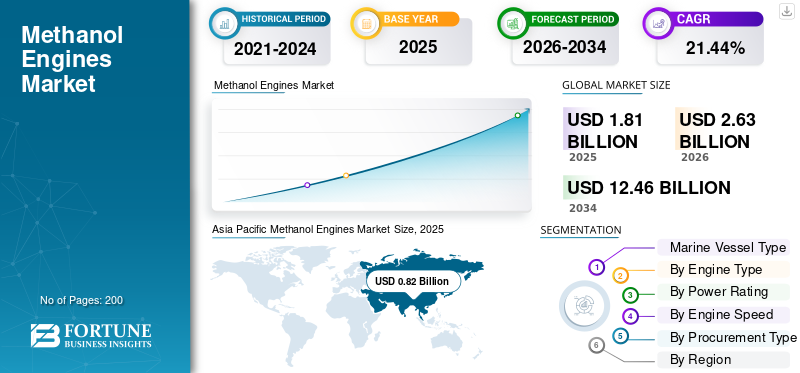
The global methanol engines market size was valued at USD 1.81 billion in 2025. The market is projected to grow from USD 2.63 billion in 2026 to USD 12.46 billion by 2034, exhibiting a CAGR of 21.44% during the forecast period. Asia Pacific dominated the methanol engines market with a market share of 45.30% in 2025.
The global methanol engines market covers methanol as a marine fuel or methanol-capable combustion engines, mainly dual-fuel marine propulsion engines, plus emerging land-based/heavy-duty, and genset applications. The market is being driven by shipping decarbonization rules, fleet demand for lower-carbon drop-in marine fuels, and methanol’s easier storage/handling compared with LNG, ammonia, or hydrogen. IMO’s 2030 target for zero/near-zero GHG fuels and DNV’s estimate of 450+ methanol-capable vessels in operation or on order show why adoption is accelerating.
Major players include Everllence SE, Wärtsilä Corporation, Caterpillar Inc., and Cummins Inc. are pursuing dual-fuel flexibility, retrofit kits, class approvals, shipyard/licensee partnerships, and portfolio expansion across vessel sizes.
Download Free sample to learn more about this report.
METHANOL ENGINES MARKET KEY TAKEAWAYS
 Global Market Size & Forecast
- 2025 Market Size: USD 1.81 Billion
- 2026 Market Size: USD 2.63 Billion
- 2034 Forecast Market Size: USD 12.46 Billion
- CAGR: 21.44% from 2026–2034
 Market Share
- Asia Pacific dominated the methanol engines market with a market share of 45.30% in 2025.
- The short-sea & coastal vessels sub-segment accounted for the second largest methanol engines market share at 14.17% in 2025.
- The low-speed two-stroke engines sub-segment accounted for the largest market share at 41.48% in 2025. In addition, the sub-segment is projected to grow at a CAGR of 21.71% during the forecast period.
 Key Regional Highlights
North America
North America recorded moderate growth, valued at USD 0.28 billion in 2025, and retained the leading market share in 2026 at USD 0.39 billion.
Europe
Europe is projected to grow at the second fastest growing rate, with a CAGR of 21.62% during the forecast period. In 2025, the market was valued at USD 0.61 billion.
Asia Pacific
The Asia Pacific region dominated the global methanol engines market, capturing a 45.17% share valued at USD 0.82 billion.
U.S.
Based on North America's strong contribution and the U.S. dominance within the region, the U.S. market reached USD 0.21 billion in 2025 and is estimated to have a CAGR of 18.78% during the forecast period.
Japan
The Japanese market was valued at USD 0.13 billion in 2025 and is estimated to grow at a rate of 20.55% during the forecast period.
Read More

Methanol Engines Market Trends
A Shift from “Methanol-Ready” Claims to Certified Engines, Retrofit Kits, and Integrated Fuel Systems to be a Significant Market Trend
A clear trend is the move from concept announcements to certified and type-approved platforms. WinGD’s methanol-fuelled X-DF-M engine passed factory and type-approval testing, with 56 X-DF-M engines on order across different bore sizes. Wärtsilä has expanded methanol capability across several engine families and fuel-supply packages, while Cummins received DNV Approval in Principle for its retrofittable QSK60 methanol dual-fuel marine solution. This indicates that OEMs are building modular platforms rather than one-off demonstration engines.
Technology direction is also becoming clearer as low-pressure fuel systems, automatic fuel switching, methanol-specific ECUs, double-walled rails, two-stage turbocharging, and integrated monitoring are becoming standard design themes.
For instance, in February 2025, WinGD announced the first methanol-fuelled 10-cylinder 92-bore X-DF-M engine passed factory and type-approval testing for a 16,000 TEU container ship, calling it the largest methanol-fuelled engine.
Market Dynamics
MARKET DRIVERS
Download Free sample to learn more about this report.
Decarbonization Rules and Fuel-Flexible Engines are Pushing Market Growth
The main driver for growth is the pressure on shipping companies to reduce lifecycle emissions without waiting for hydrogen or ammonia infrastructure to mature. FuelEU Maritime has applied from January 1, 2025, setting greenhouse-gas intensity limits for ships above 5,000 GT calling at European Union ports, while IMO’s Net-Zero Framework discussions are pushing owners toward lower-carbon emissions fuel pathways even though final adoption is still under negotiation. This regulatory pressure is creating demand for engines that can operate on methanol, conventional fuel, and eventually lower-carbon bio/e-methanol. DNV also notes that more than 450 methanol-capable vessels are already in operation or on order, which shows the market has moved beyond early trials.
For instance, in May 2026, Nanni announced successful testing of John Deere-based methanol dual-fuel genset engines using up to 70% methanol on an energy basis, with reported CO and HC reductions of 95–99% and NOx reduction of 65%.
MARKET RESTRAINTS
High Green Methanol Cost, Limited Supply, and Policy Delay are Slowing Conversion Speed
The biggest restraint for global methanol engines market growth is not engine readiness, it is fuel economics. DNV estimates bio-methanol at around USD 2,500 per ton of marine gas oil equivalent in 2025, roughly three times the price of marine gas oil, while current global low-GHG methanol produced is far below potential marine demand. This makes shipowners cautious since a methanol-capable engine only delivers meaningful decarbonization if green, bio, or e-methanol is available at a bankable price. For many bulkers, tankers, and smaller operators, conventional engines remain financially safer until carbon pricing, fuel availability, and customer demand become clearer.
For instance, in May 2026, DNV reported that MEPC 84 continued discussions on the International Maritime Organization IMO Net-Zero Framework but made no final decisions on key design features or a revised timeline, extending uncertainty for investment planning.
MARKET OPPORTUNITIES
Retrofit Programs, Bunkering Corridors, and Green-Methanol Supply Can Unlock Next Growth Opportunity
The largest opportunity is in converting existing vessels and building methanol-ready newbuilds for shipping corridors where fuel supply can be secured. Methanol engines have a practical advantage as bunkering can use infrastructure closer to conventional liquid marine fuels than cryogenic LNG or hydrogen systems. DNV states that dual-fuel methanol engine designs have accumulated more than 600,000 operating hours, while Lloyd’s Register has highlighted that the COSCO Shipping Libra methanol retrofit demonstrates that conversions are technically viable and moving toward repeatable solutions. This creates opportunities for engine OEMs, fuel-system suppliers, tank designers, shipyards, class societies, and port operators.
Port-side development is becoming a major growth lever. Hong Kong completed its first green methanol simultaneous bunkering operation in March 2026, and North Sea Port reported in February 2026 that risk analysis supports safe bunkering of methanol, ammonia, hydrogen, and LNG at key port locations.
For instance, in May 2026, Deendayal Port Authority issued a tender for a 50,000-square-meter green methanol and alternative fuels bunkering ecosystem, including green methanol bunker barge and related shipbuilding/repair infrastructure for a 30-year period.
MARKET CHALLENGES
Safety, Crew Readiness, Certification, and Commercial Confidence Remain Hard Execution Barriers
Methanol is commercially attractive since it is a liquid fuel, but it is not a low-risk fuel. NOAA’s September 2025 government brief notes that methanol is toxic, highly flammable, has a low flash point, and can produce nearly invisible flames; it also disperses in water, making spill recovery difficult. That means shipowners need stronger detection, ventilation, training, firefighting procedures, double-walled fuel systems, and port emergency-response readiness. These safety requirements add cost and slow adoption, especially for smaller operators and retrofit candidates.
SEGMENTATION ANALYSIS
By Marine Vessel Type
Deep-Sea Commercial Vessels Segment Leads Since Long-Haul Ships Create Strongest Methanol Engine Demand
By marine vessel type, the market is classified into deep-sea commercial vessels, short-sea & coastal vessels, port & harbor vessels, offshore & energy vessels, inland waterway vessels, passenger & specialty vessels, and government / defense vessels.
The deep-sea commercial vessels segment is estimated to grow at the highest CAGR of 22.23% during the forecast period and held the largest share of 52.90% in 2025. The segment’s dominance and growth is attributed to container ships, tankers, bulk carriers, and large cargo vessels, as they consume high fuel volumes and face the strongest pressure to reduce emissions. Ship-owners in this category are more willing to invest in methanol dual-fuel engines as fuel cost savings, charterer preference, and regulatory compliance have a bigger financial impact on large vessels.
The short-sea & coastal vessels sub-segment accounted for the second largest methanol engines market share at 14.17% in 2025. In addition, the sub-segment is projected to grow at a CAGR of 21.08% during the forecast period.
By Engine Type
High-Speed Four-Stroke Engines to Grow Fastest Due to Increasing Demand from Smaller Vessels
By engine type, the market is classified into low-speed two-stroke engines, medium-speed four-stroke engines, high-speed four-stroke engines, dual-fuel engines, and dedicated methanol engines.
The high-speed four-stroke engines sub-segment is estimated to grow with a highest CAGR of 21.78% during the forecast period. Their growth is driven by demand from smaller vessels, auxiliary engines, gensets, harbor craft, and distributed marine power applications. These engines are easier to test, modify, and deploy in lower-power applications, which helps OEMs commercialize methanol-ready technologies faster than in very large propulsion systems.
The low-speed two-stroke engines sub-segment accounted for the largest market share at 41.48% in 2025. In addition, the sub-segment is projected to grow at a CAGR of 21.71% during the forecast period.
By Power Rating
1–5 MW Segment to Grow Fastest Since it Serves a Wide Base of Short-Sea Vessels and Offshore Support Vessels
By power rating, the global market is classified into below 100 kW, 100–500 kW, 501 kW–1 MW, 1–5 MW, 5–20 MW, 20–50 MW, and above 50 MW.
The 1–5 MW sub-segment is estimated to grow with a highest CAGR of 22.44% during the forecast period. In addition, this sub-segment held the largest market share of 21.29% in 2025. This power band is attractive since it serves a wide base of short-sea vessels, offshore support vessels, ferries, harbor craft, auxiliary power units, and smaller commercial vessels. These applications need cleaner propulsion but cannot always justify very large, complex alternative-fuel systems.
The 5–20 MW sub-segment accounted for the second largest market share at 20.98% in 2025. In addition, the sub-segment is projected to grow at a CAGR of 21.84% during the forecast period.
By Engine Speed
Low-Speed Engines Segment will Grow at the Fastest Rate Since Deep-Sea Fleet Conversion Depends On Efficient Large-Bore Propulsion
By engine speed, the global market is classified into low-speed engines (below 300 rpm), medium-speed engines (301-1,000 rpm), and high-speed engines (Above 1,001 rpm).
The low-speed engines (below 300 rpm) sub-segment is estimated to grow with a highest CAGR of 21.50% during the forecast period. Their growth is directly linked to deep-sea commercial vessels, where slow-speed engines offer high fuel efficiency, long operating life, and strong suitability for large propellers. This makes them the natural choice for container ships, tankers, and bulk carriers.
The medium-speed engines (301-1,000 rpm) sub-segment accounted for the largest market share at 40.21% in 2025. In addition, the sub-segment is projected to grow at a CAGR of 21.38% during the forecast period.
By Procurement Type
To know how our report can help streamline your business, Speak to Analyst
Integrated Propulsion Packages Segment to Grow Fastest Due to Increasing Demand from Ship-Owners for Complete Solutions
By procurement type, the market is classified into new-build engine sales, retrofit / conversion, and integrated propulsion package.
The integrated propulsion package sub-segment is estimated to grow with a highest CAGR of 21.94% during the forecast period. Growth is being driven by ship owners’ preference for complete solutions that combine engines, fuel supply systems, controls, safety systems, and service support. This lowers integration risk and makes methanol adoption easier for shipyards and fleet operators.
The new-build engine sales sub-segment accounted for the largest market share at 41.17% in 2025. In addition, the sub-segment is projected to grow at a CAGR of 21.19% during the forecast period.
Methanol Engines Market Regional Outlook
By region, the market is categorized into Europe, North America, Asia Pacific, the Middle East & Africa, and Latin America.
Asia Pacific
Asia Pacific Methanol Engines Market Size, 2025 (USD Billion)
To get more information on the regional analysis of this market, Download Free sample
The Asia Pacific region dominated the global methanol engines market, capturing a 45.17% share valued at USD 0.82 billion. The region is also projected to be the fastest-growing, with the highest CAGR of 22.73% during the forecast period. This dominance is driven by China’s extensive use of regionally sourced coal and natural gas to produce cheap methanol. This methanol acts as a key feedstock for MTO plants, generating ethylene and propylene to support the region's massive plastics and packaging industries.
China Methanol Engines Market
China’s market was valued at USD 0.34 billion in 2025 and is estimated to grow at a rate of 23.82% during the forecast period.
South Korea Methanol Engines Market
South Korea’s market was valued at USD 0.18 billion in 2025 and is estimated to grow at a rate of 22.67% during the forecast period.
Japan Methanol Engines Market
The Japanese market was valued at USD 0.13 billion in 2025 and is estimated to grow at a rate of 20.55% during the forecast period.
North America
North America recorded moderate growth, valued at USD 0.28 billion in 2025, and retained the leading market share in 2026 at USD 0.39 billion. To meet carbon-neutral goals, the region is rapidly scaling renewable and green methanol production using biomass, industrial carbon capture, and green hydrogen. With over 27 operational renewable methanol projects in the U.S. alone, the region is aligning directly with long-term zero-emission targets.
U.S. Methanol Engines Market
Based on North America's strong contribution and the U.S. dominance within the region, the U.S. market reached USD 0.21 billion in 2025 and is estimated to have a CAGR of 18.78% during the forecast period.
Europe
Europe is projected to grow at the second fastest growing rate, with a CAGR of 21.62% during the forecast period. In 2025, the market was valued at USD 0.61 billion. This growth is driven by the European Union’s aggressive push for sustainability through the Fit for 55 package, the Renewable Energy Directive, and FuelEU Maritime. These frameworks impose heavy penalties on traditional fossil fuels.
Germany Methanol Engines Market
The German market was valued at USD 0.15 billion in 2025 and is estimated to grow at a CAGR of 22.57% during the forecast period.
Nordic Countries Methanol Engines Market
The Nordic Countries market was valued at USD 0.19 billion in 2025 and is estimated to grow at a rate of 23.13% during the forecast period.
Rest of Europe Methanol Engines Market
The market for the rest of Europe was valued at USD 0.12 billion in 2025 and is estimated to grow at a rate of 21.12% during the forecast period.
Rest of World
The rest of the world includes Latin America and the Middle East & Africa regions and are expected to witness moderate growth in this market during the forecast period. The Latin America market was valued at USD 0.04 billion in 2025. Brazil and Mexico are leading regional consumption by integrating methanol (M3 to M15 blends) into gasoline to reduce greenhouse gas emissions and lower reliance on traditional petroleum.
The Middle East & Africa market was valued at USD 0.07 billion in 2025. Regional investments in Methanol-to-Olefins (MTO) and formaldehyde production facilities are increasing. This shift decreases the region’s reliance on crude-oil-derived naphtha, encouraging local manufacturing of chemicals and plastics.
COMPETITIVE LANDSCAPE
Key Industry Players
Key Players are Focusing on Partnerships and Conversion Pathways to Strengthen Market Share
The global methanol engines market is developing around fuel-flexible marine propulsion, where competition is no longer limited to engine hardware but includes fuel systems, retrofit packages, shipyard integration, class approval, and lifecycle service support. Major OEMs are expanding dual-fuel portfolios across two-stroke and four-stroke platforms, while class societies and ports are helping standardize safety rules and bunkering practices. The market is also becoming more practical as DNV reports 450+ methanol-capable vessels in operation or on order, while technical solutions are now available for all major ship types.
Competitive growth is being led by larger engine ratings, type-approved methanol platforms, retrofit-ready solutions, and integrated methanol fuel-supply systems. However, competition is still uneven since methanol vessel orders fell in 2025 amid fuel-cost and policy uncertainty, so companies are focusing on readiness, partnerships, and conversion pathways until green methanol supply becomes commercially stronger.
LIST OF KEY METHANOL ENGINES COMPANIES PROFILED IN REPORT
- Everllence SE (Man Energy Solutions) (Germany)
- Wärtsilä Corporation (Finland)
- Winterthur Gas & Diesel Ltd. (Switzerland)
- HD Hyundai Heavy Industries Co., Ltd. (South Korea)
- Mitsui E&S Co., Ltd. (Japan)
- Hanwha Engine Co., Ltd. (South Korea)
- China State Shipbuilding Corporation Limited (China)
- CSSC-MES Diesel Co., Ltd. (China)
- Dalian Marine Diesel Co., Ltd. (China)
- Anglo Belgian Corporation nv (Belgium)
- Caterpillar Inc. (U.S.)
- Cummins Inc. (U.S.)
- Rolls-Royce Power Systems AG (Germany)
- Woodward L’Orange GmbH (Germany)
- Bergen Engines AS (Norway)
KEY INDUSTRY DEVELOPMENTS
- March 2026: Equinor secured a two-year contract as a supplier to Wallenius Wilhelmsen for mass-balanced bio-methanol. According to the agreement, Equinor will supply bio-methanol from Norway to Antwerp/Zeebrugge to fuel Wallenius Wilhelmsen’s methanol-capable fleet and support its decarbonization goals.
- December 2025: CIMC Raffles signed a contract worth over USD 500 million with Hapag-Lloyd to build eight 4,500 TEY dual-fuel methanol container ships. Deliveries are scheduled for 2028 and 2029, expanding Hapag-Lloyd’s green fleet capacity.
- September 2025: HJ Shipbuilding & Construction secured a contract with approximately USD 40 million with an Oceania-based shipowner for four 8,850 TEU methanol-ready, eco-friendly container ships. Deliveries are planned from 2027 onward, supporting the shift to low-carbon shipping.
- June 2025: WinGD was selected by a major Taiwanese container ship operator to design X-DF-M dual-fuel methanol and methanol-ready engines for more than 30 newbuild container vessels.
- April 2025: Nippon Shipyard and Japan Marine United won the contract to construct a methanol/heavy-oil dual-fuel VLCC for NYK. Idemitsu Tanker will serve as the long-term charterer. The vessel is scheduled for delivery in 2028.
REPORT COVERAGE
The global methanol engines market analysis includes a comprehensive study of the market size & forecast by all the market segments included in the report. It contains details on the market dynamics and global market trends expected to drive the market over the forecast period. It provides information on key aspects, including an overview of technological advancements, pipeline candidates, the regulatory environment, and product launches. Additionally, it details partnerships, mergers & acquisitions, as well as key marine industry developments. The global market research report also provides a detailed competitive landscape with information on the market share and profiles of key operating players.
Request for Customization to gain extensive market insights.
Report Scope & Segmentation
| ATTRIBUTE | DETAILS |
| Study Period | 2021-2024 |
| Base Year | 2025 |
| Estimated Year | 2026 |
| Forecast Period | 2026-2034 |
| Historical Period | 2021-2024 |
| Growth Rate | CAGR of 21.44% from 2026-2034 |
| Unit | USD Billion |
|
Segmentation |
By Marine Vessel Type
By Engine Type
By Power Rating
By Engine Speed
By Procurement Type
By Region
|
Frequently Asked Questions
Fortune Business Insights says that the global market value stood at USD 1.81 billion in 2025 and is projected to reach USD 12.46 billion by 2034.
The market is expected to exhibit a CAGR of 21.44% during the forecast period.
In 2025, the European market value stood at USD 0.61 billion.
The deep-sea commercial vessels sub-segment is expected to hold the highest CAGR over the forecast period.
Decarbonization rules and fuel-flexible engines are pushing market growth.
Everllence SE, Wärtsilä Corporation, Caterpillar Inc., and Cummins Inc. are top players in the market.
Asia Pacific held the largest market share in 2025.



- 2021-2034
- 2025
- 2021-2024
- 200
Get 30-60 hrs Free Customization
Expand Regional and Country Coverage, Segments Analysis, Company Profiles, Competitive Benchmarking, and End-user Insights.




















Related Reports
-
US +1 833 909 2966 ( Toll Free )
-
Get In Touch With Us