 Download Free Sample



Get a Quote
Receive a tailored pricing based on your needs.
- Choose license type
- Multiple user options
- Custom scope & coverage
- Fast turnaround
"Designing Growth Strategies is in our DNA"
 Listen to Audio Version
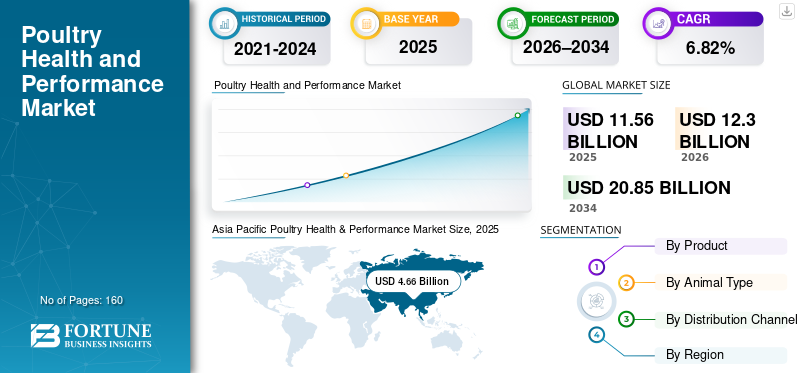
The global poultry health & performance market size was valued at USD 11.56 billion in 2025. The market is projected to grow from USD 12.30 billion in 2026 to USD 20.85 billion by 2034, exhibiting a CAGR of 6.82% during the forecast period. Asia Pacific dominated the poultry health & performance market with a market share of 40.31% in 2025.
The global poultry health & performance market includes products used to control and manage disease and improve the productivity of poultry animals. The global market is projected to grow at a steady rate due to increasing trade prospects owing to rising demand, which is further prone to disease outbreak risks, such as the highly pathogenic avian influenza (HPAI). Moreover, in the recent scenario, there has been an increasing awareness regarding various poultry-centric diseases and the need to prevent them, such as infectious bursal disease (IBD), Marek's disease, coccidiosis, Newcastle disease, and avian influenza. Furthermore, several market players have been engaged in innovative vaccine development, which is further supported by government-led initiatives to improve poultry health.
Also, numerous animal health companies such as Boehringer Ingelheim International GmbH, Merck & Co., Inc., Ceva, and others comprise the key players of the market. These companies are engaged in innovative product launches, coupled with strategic initiatives such as expansion of their manufacturing capacities to bolster their global market shares.
Download Free sample to learn more about this report.
 Global Market Size & Forecast
 Market Share
 Key Regional Highlights
Asia Pacific
Asia Pacific was the largest regional market, reaching a valuation of USD 4.66 billion in 2025.
North America
North America maintained a strong market position with a value of USD 2.01 billion in 2025.
Europe
Europe is projected to reach USD 2.61 billion by 2026, growing at a CAGR of 5.49%.
U.S.
The market is analytically approximated to reach around USD 1.78 billion in 2026.
Japan
The poultry health & performance market was estimated at around USD 0.24 billion in 2025.
Read More

Increasing Emphasis on Hatchery Delivered Vaccination is a Key Market Trend
Some of the emerging essential trends witnessed in the global market are the increasing trend of vaccination of poultry birds in settings such as hatcheries. Some of the types of vaccines that are administered in these settings include vector vaccines and combination products. This is a positive emerging trend as it reduces field labor, improves protection, and delivers critical protection at an earlier stage for the birds. This practice of providing expeditious vaccination is particularly valuable in broilers, which typically have short cycles. Furthermore, administration of combination vaccines is helpful as it allows for protection against multiple diseases and also involves lower handling stress.
Download Free sample to learn more about this report.
Strong Product Adoption Due to Risk of Disease Outbreaks to Drive Market Growth
Some of the driving factors that will contribute to the considerable market growth across the forecast period are the risk that HPAI will become endemic across the region. If the cases of HPAI outbreaks increase across the globe, poultry suppliers potentially face the dangers of pricing volatilities, egg/meat supply shocks, and increases in export restrictions. Hence, such risks lead to the considerable allocation of funding towards vaccines, surveillance, and biosecurity. Also, many poultry manufacturers are exploring other means of improving their productivity, such as gut-health/performance programs to eliminate stress susceptibility and secondary losses. Such factors together drive the poultry health & performance market growth across the forecast period.
Regulatory Complexities and Cost Sensitivities to Hinder Market Growth
The regulatory restraints associated with key product categories, such as vaccines, hinder the market growth rate. For example, in terms of animal vaccines, the regulations differ across several countries, leading to an uneven launch scenario, resulting in lower market adoption of key products. Another critical limiting parameter in this market includes the lack of ability to pay for the products with technological advancements which often carry premium costs attached to them. The large integrators may be able to afford them, but the smaller, fragmented farms usually are not. They prioritize immediate cash cost over longer-term performance return on investment ROI. This further restrains the greater market growth prospects for these offerings.
Development of Next Generation Vaccines Platforms to Provide Opportunities for the Market
As an efficient process of poultry manufacturing becomes critical for the global supply chain driven by consumer demand, and also the number of disease outbreaks increases, many vaccine manufacturers are focusing on the development of advanced vaccine platforms. Hence, there is a growing opportunity for manufacturers to scale new vaccine platforms such as vector animal vaccines, genetic vaccines, etc. This also allows various government and industry bodies to align on vaccination guidelines and surveillance frameworks, significantly increasing trade confidence. This substantially increases the addressable demand for vaccinations, programs, and monitoring services.
Outbreaks of Diseases and Biological Complexities in Poultry Animals to Disrupt Growth Prospects
Some of the significant challenges associated with the poultry health & performance market are the outbreaks of poultry diseases such as HPAI, leading to the disruption of production planning and causing trade bans. Such outbreaks divert the funds towards the mitigation of the financial impact of outbreaks, reducing the working capital of manufacturers to procure advanced vaccines and therapeutics. Also, the poultry birds are subject to biological complexities; hence, the results of performance additives are not similar across all birds or farms. Performance outcomes are often factor-based on parameters such as feed quality, mycotoxins, litter, genetics, and pathogen load. Hence, this makes the return on investment (ROI) variable across all farms and seasons, and companies often have to prove their products’ efficacy to gain suitable adoption for their products as they compete against cheaper alternatives.
Robust Adoption of Drugs & Vaccines for Management of Various Outbreaks to Boost Segmental Dominance
On the basis of the product, the market is segmented into drugs & vaccines, and performance additives. The performance additives segment is further sub-segmented into phytogenics, prebiotics & probiotics, and others.
As of product, the drugs & vaccines segment is projected to account for the dominant poultry health & performance market share. The segment’s dominating market share is owing to the fact that drugs and vaccines are considerably used, and are often not an optional expenditure for the animal farms. The process of vaccination is usually standardized and regulated at the level of hatcheries, and drugs remain critical when approved for coccidiosis/enteric control.
The performance additives segment is anticipated to rise with a CAGR of 7.29% over the forecast period.
To know how our report can help streamline your business, Speak to Analyst
Owing to Largest Production of Broilers Leads to Segmental Dominance
On the basis of animal type, the market is segmented into broilers, layers, and breeders.
In 2025, the broilers segment accounted for the largest revenue share of the global market. This segment’s dominance is primarily due to the reason that the broilers have the largest production throughput, and even a small impact on their productivity impacts massive volumes of birds. Hence, that alone drives the large scale of poultry vaccination and the high inclusion of performance additives.
The layers segment is projected to grow at a CAGR of 6.42% over the forecast period.
Integrators and Large Farms Control the Process and Protocols Leads to Animal Farms Segmental Growth
In terms of distribution channel, the market is segmented into animal farms, veterinary clinics & hospitals, retail channels, online channels, and others.
The segment of animal farms accounted for the largest global poultry health & performance market share. The animal farms held a significant proportion of the market value as integrators, and large farms control the procurement process and protocols. They also negotiate the direct contracts for vaccines and set standards for the performance additives. Moreover, the segment is set to hold a 36.03% share in 2026.
Moreover, the online channels segment is projected to grow at a CAGR of 12.50% across the forecast period.
In terms of region, the market is categorized into North America, Europe, Asia Pacific, South America, and the Middle East & Africa.
Asia Pacific Poultry Health & Performance Market Size, 2025 (USD Billion)
To get more information on the regional analysis of this market, Download Free sample
North America held a significant value in 2024, valued at USD 1.91 billion, and also maintained a considerable value in 2025, with USD 2.01 billion. The market in North America is projected to grow significantly across the forecast period, owing to North America being one of the largest consumers of poultry health & performance products across the globe. The recurrence of HPAI outbreaks, the need for control on egg pricing, and the demand for products that improve gut integrity and reduce pathogen load are expected to drive the region’s growth.
Based on North America’s regional dominance and the U.S.’ largest share within the region, the U.S. market can be analytically approximated at around USD 1.78 billion in 2026, accounting for roughly 14.4% of global sales.
Europe is on track to record a growth rate of 5.49% in the coming years and reach a valuation of USD 2.61 billion by 2026. Some of the parameters to the region’s strong market share include the firm adherence to regulatory norms, which classifies this region as a high-regulation, high-standard poultry market with strong retailer-driven requirements. Furthermore, the production in the region has been on an increasing trajectory in recent years.
The U.K. market in 2025 is estimated at around USD 0.21 billion, representing roughly 1.8% of global poultry health & performance revenues.
Germany’s market is projected to reach approximately USD 0.28 billion in 2025, equivalent to around 2.5% of global poultry health & performance sales.
The Asia Pacific is estimated to reach USD 4.66 billion in 2025 and secure the position of the largest region in the market. In the region, India and China are both estimated to reach USD 0.65 billion and USD 1.37 billion, respectively, in 2025.
The Japanese market in 2025 is estimated at around USD 0.24 billion, accounting for roughly 2.0% of the global revenues. Japan has a steady share in the global market owing to the repeated incidences of disease outbreaks, tight biosecurity, and strong official veterinary oversight.
China’s market is projected to be one of the largest worldwide, with 2025 revenues estimated at around USD 1.37 billion, representing roughly 11.9% of global poultry health & performance sales.
The Indian market in 2025 is estimated at around USD 0.65 billion, accounting for roughly 5.6% of global poultry health & performance revenues.
The South America, Middle East, and Africa regions are expected to witness considerable growth rates in this market space during the forecast period. The South America market is set to reach a valuation of USD 1.20 billion in 2025. Brazil is heavily influenced by export competitiveness, and disease events and trade import restrictions create strong incentives for vaccination, biosecurity, and performance consistency. In the Middle East, Saudi Arabia is set to reach USD 0.19 billion in 2025.
Diverse Product Portfolio Breadth Coupled with Wide Geographical Reach to Enable Dominance of Major Companies
The global poultry health & performance market comprises of a semi-fragmented competitive landscape, including key companies such as Boehringer Ingelheim International GmbH, Merck & Co., Inc., Ceva and others. The significant company revenue share possessed by these companies is attributable to their strong product portfolio, robust regulatory approvals, and focus on increasing market presence through capacity expansions. Furthermore, these players are also engaged in several research initiatives for the development of innovative products, including vaccines.
Other major companies present in the global market include Zoetis Services LLC, Elanco, Phibro Animal Health Corporation, Novozymes A/S, and others. These companies have several offerings in their product portfolio, including performance additives and a wide geographical presence, which support their strong market share across the forecast period.
Request for Customization to gain extensive market insights.
| ATTRIBUTE | DETAILS |
| Study Period | 2021-2034 |
| Base Year | 2025 |
| Estimated Year | 2026 |
| Forecast Period | 2026-2034 |
| Historical Period | 2019-2024 |
| Growth Rate | CAGR of 6.82% from 2026-2034 |
| Unit | Value (USD Billion) |
| Segmentation | By Product, Animal Type, Distribution Channel, and Region |
| By Product |
· Drugs & Vaccines · Performance Additives o Phytogenics o Prebiotics & Probiotics o Others |
| By Animal Type |
· Broilers · Layers · Breeders |
| By Distribution Channel |
· Animal Farms · Veterinary Clinics & Hospitals · Retail Channels · Online Channels · Others |
| By Region |
· North America (By Product, Animal Type, Distribution Channel, and Country) o U.S. o Canada o Mexico · Europe (By Product, Animal Type, Distribution Channel, and Country/Sub-Region) o U.K. o Germany o France o Italy o Spain o Poland o The Netherlands o Russia o Rest of Europe · Asia Pacific (By Product, Animal Type, Distribution Channel, and Country/Sub-Region) o China o India o Japan o Australia o Indonesia o Vietnam o Bangladesh o South Korea o Rest of Asia Pacific · South America (By Product, Animal Type, Distribution Channel, and Country/Sub-Region) o Brazil o Argentina o Chile o Peru o Rest of South America · Middle East (By Product, Animal Type, Distribution Channel, and Country/Sub-Region) o Saudi Arabia o UAE o Israel o Turkey o Egypt o Qatar o Kuwait o Rest of the Middle East
|
According to Fortune Business Insights, the global market value stood at USD 11.56 billion in 2025 and is projected to reach USD 20.85 billion by 2034.
In 2025, Asia Pacifics market value stood at USD 4.66 billion.
The market is expected to exhibit a CAGR of 6.82% during the forecast period of 2026-2034.
By product, the drugs & vaccines segment is expected to lead the market.
Risks of disease outbreaks, prompting product adoption, a strong poultry population, and innovative product launches are driving the market expansion.
Boehringer Ingelheim International GmbH, Merck & Co., Inc., and Ceva are the major players in the global market.
Asia Pacific dominated the market in 2025 by holding the largest share.

Get 30-60 hrs Free Customization
Expand Regional and Country Coverage, Segments Analysis, Company Profiles, Competitive Benchmarking, and End-user Insights.













.webp)






Related Reports
Get In Touch With Us
US +1 833 909 2966 ( Toll Free )
Receive a tailored pricing based on your needs.
Discuss your questions with our industry experts.
Have questions? Get quick answers before you purchase.

